Software
Houzz Logo Print
kwood2124

Need help! Trying to make organic more readily available!

10 years ago

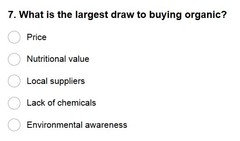
Can you please help by taking this 30 second survey! I'm trying to complete research in order to make organic more readily available near me! Thank you!!
https://www.surveymonkey.com/r/WHM6DL6

Comments (32)

  • 10 years ago

    My local grocer is reducing the "organic" selection because they were too high priced for the local market and were rotting on the shelves.

    We're a POOR, RURAL small town ... make the stuff cost competitive with the conventionally grown products, stop the stupid hype and wild claims, and see what happens to sales.

    If organic farming were as productive and fab as the proponents claim, it would have taken over by now. It hasn't.

  • 10 years ago

    I would say lazy gardens hit the nail on the head with the comments on removing the hype from organic. I witnessed the development of organic standards in a midwestern state in the 70s. There were lots of viewpoints how to make food safe, reduce certain usage of some chemicals, and encourage attention to soil development. Unfortunately, then as well as now, there are folks associated with the organic movement who are dogmatic about what is and is not acceptable, without necessarily reviewing facts and identifying acceptable alternatives. Certified organic food producers are saddled with a plethora of regulations, some of which really do not make for a safer food supply. Complying with these regulations does cost the producer significant time as well as money. Consequently organic foods tend to cost more in the grocery.

    One of the most insidious claims I hear is that organic foods can be produced at the same or lower cost as that of conventional agriculture. Not only is this claim completely unfounded by the vast body of readily available agricultural statistics, it is also rebutted readily by the costs of foods in the grocery. If, in fact, organic production was a lower cost, higher yield solution, commercial farmers with their keen attention to cost minimization would have adopted more organic methods years ago. The reality is that organic costs more; if you want to make organic food more readily available, lobby for the reduction of some of the senseless constraints on organic production.

  • 10 years ago

    If organically grown foods are so expensive and hard to find are so many of the chef's around the world buying and using organically grown foods in their restaurants? Could it be that organically grown foods taste better?

    Whether organically grown foods are more expensive, or not, depends on whether you factor in the real cost of production including the subsidies many of the large producers receive that the smaller scale organic growers do not.

    kimmq is kimmsr

  • 10 years ago

    kimmsr ... because it's a MARKETING gimmick.

    Could it be that organic food tastes better? Well, it hasn't passed the blind taste testing.


  • 10 years ago

    If, in fact, organic production was a lower cost, higher yield solution,
    commercial farmers with their keen attention to cost minimization would
    have adopted more organic methods years ago.

    Many conventional farmers are using no-till farming, which is a lot easier if you can use herbicides to knock out the weeds as you plant through the stubble, crop rotation, and pest-resistant crops so they can use less pesticides.


  • 10 years ago

    Only 3% of commercial agricultural land use is organic production. And most organic farms are small scale and offer a range of fruits and veg, rather than the larger, one or two crop agribusiness farms. Organic food production does not benefit from any economies of scale like larger conventional farming operations do and is far more hands-on and labor intensive. That's why organic produce is more expensive - it has nothing to do with 'marketing' or 'hype'. In its current state, organic food production is simply more expensive to bring to market than conventional farming methods.

    As to the availability of organic foods in the marketplace, obviously the demand has to support the supply. More metropolitan areas tend to support younger and more highly educated consumers than do rural areas and these consumers are far more likely to search out and demand organic products as well as also having income levels that can support higher food costs. And there is also an organic "cachet" that is more prevalent in specific areas of the country that also fuels the supply.

    In my area of the country, small organic farms are common, as are farmers markets and CSA's that offer 100% organic product. Every supermarket chain has a large organic foods department and I know of at least two local supermarkets (one of which is a national chain) that are very nearly completely organic in their product offerings.

  • 10 years ago

    It is a fallacy of equivocation to think the National Organic Program (NOP) promotes organic farming as we once knew it. Now, promoting the watered down definition of organic that s1100 mentions, that it will hype. Just like its new definition, having the word "Organic" in the name of a USDA department means little.

    tj

  • 10 years ago

    If you've done your homework and still think that going organic is hype, why would you hang out or post in an organic forum? Are you trying to gain converts? For many of us it's about limiting our exposure to harmful chemicals. If you are willing to vote with your dollars, you can force change or keep things the same. As a result, high-quality organic produce is easy to find and reasonably priced in my locale. Fast food and other restaurants are adapting or failing based on healthier consumer patterns.

  • 10 years ago
    last modified: 10 years ago

    MrClint, do you not find any value in exploring more than one point of view on a given topic? I like to look at the evidence and facts on all sides before choosing which one to support.

    Converting anyone is quite unlikely in any matter as most people tend to defend the position that they've already decided is 'right'.

  • 10 years ago

    If you've done your homework and still think that going organic is hype,
    why would you hang out or post in an organic forum?

    Mostly to annoy kimmsr, and to try to bring some balance to the discussion.

    For many of us it's about limiting our exposure to
    harmful chemicals.

    Here's the list of allowed chemicals for organic farming ... as well as manure. Note that organic vegetables are NOT tested for residue of these allowed chemicals - they are only tested for the presence of banned ones to make sure no one is "cheating".

    http://www.ams.usda.gov/rules-regulations/organic/national-list

  • 10 years ago

    For many of us it's about limiting our exposure to
    harmful chemicals.

    This seems to to be a big one for those who support organic agriculture, yet it seems to be quite misunderstood. Organic farming uses plenty of 'harmful chemicals' and, at times, these have a far greater negative environmental impact than would the lesser amount of conventional materials needed to achieve the same results.

    Too many people equate 'organic' with 'pesticide-free' or 'chemical-free', yet they fail to understand farming practices, or even what the word chemical means. Organic supporters do little to dispel this myth, including the survey in this thread.


  • 10 years ago
    last modified: 10 years ago

    "Organic farming uses plenty of 'harmful chemicals' "

    It might be a bit nit-picking, but I think it more proper to say that 'organic farming can also use plenty of chemicals.'

    While some growers who farm organically might use chems, others may use none. I think, as many here say, the term 'organic', as a controlled term - especially as it applies to commercial agriculture - might be used by some as hype. However, for other growers and sellers, it's very serious business. Kimmq and gardengal (among others) are also correct. There are extremely valid reasons why organic products are often more expensive, including the 'laws' of basic economics.

    As far as myths... I wouldn't say that what has been discussed are really 'myths'. At best they are overly-broad generalizations. Does that make a myth? Meh, maybe. Just, as sclerid pointed out... more of misunderstandings - as well as purposeful misleading by those who are less than honest. There are far too many ways to skin a cat than to say one method used by one, is executed in exactly the same way as by another grower using the same method.

  • 10 years ago
    last modified: 10 years ago

    There are extremely valid reasons why organic products are often more expensive, including the 'laws' of basic economics.


    Let's not ignore the AMS's own finding of:

    "...the USDA Organic Seal and marketing program [being] responsible for increased consumer trust in and willingness to pay more for organic products"

    From this Organic Marketing Report

  • 10 years ago

    @sclerid(6a/5b), this is a forum for people interested in organic gardening methods. You're interested in debunking them. These points have all been made a thousand times. Do you think you're blowing the lid off of something? Anyone growing organically knows how the detractors think and what they have to say. So yes, there isn't any value in arguing the simplest of points 1,001 times. Best of luck to you!

  • 10 years ago

    Maybe you missed the part where I said, "I like to look at the evidence and facts on all sides before choosing which one to support."

    Instead of hostility, defensiveness, and making (incorrect) assumptions as to why people are here, why not contribute something of value to the conversation?

  • 10 years ago

    If you did not watch Michael Pollans "In Defense Of Food" on PBS last night you may want to look for it or get his book of the same title. Some people may even learn something from watching, or reading, these.

    lazy_gardens wrote, "Mostly to annoy kimmsr, and to try to bring some balance to the discussion." and does neither.

    kimmq is kimmsr

  • 10 years ago

    I think that Pollan is an absolutely wonderful writer and has made some interesting documentaries.

    Keep in mind that he has an English degree (or two) and is not a scientist. He's made millions writing about food and has admitted to showing a heavy bias in favor of the organic industry.

  • 10 years ago

    My favorite quote from "In Defense of Food":

    "You don't have to be a scientist to know how to eat."

  • 10 years ago

    That's true. Even single-celled microbes know how to eat.


    Here's another quote from Pollan:

    "The media has really been on our side for the most part. I know this
    from writing for the New York Times where I’ve written about a lot of
    other topics. But when I wrote about food I never had to give equal time
    to the other side. I could say whatever I thought and offer my own
    conclusions.
    Say you should buy grass feed beef and organic is better,
    and these editors in New York didn’t realize there is anyone who
    disagrees with that point of view. So I felt like I got a free ride for a
    long time."


  • 10 years ago
    last modified: 10 years ago

    It's great that Mr. Pollan had the fortune to be working with such wise and educated editors for so long! It's also admirable that he had the good grace and humility to speak the truth, knowing that there may be some who would some day throw it in his face.

    It's too bad that Ms. Winfrey found herself facing a different attitude. Yep, Mr. Pollan's comment reflects an honest assessment of the politics surrounding food, and food producers.

  • 10 years ago

    That Pollans degrees are in English, and that he teaches Journalism, only means that he can take some difficult to understand information and put it into a form most people could understand. That is kind of like Eliot Coleman with his degree in Spanish literature writing about organic growing. If Coleman can make a very good amount of money every year growing crops on 1-1./2 acres, organically, anyone should be able to as well.

    http://www.theatlantic.com/health/archive/2010/12/a-visit-from-maines-organic-gardening-guru/68586/

    kimmq is kimmsr

  • 10 years ago

    Michael Pollan isn't winging it. He references plenty of scientific data in his books.

  • 10 years ago

    Citations are no indication of objectivity.

  • 10 years ago

    The above may be a good example of "Don't confuse me with facts, my mind is made up".

    kimmq is kimmsr

  • 10 years ago

    My guess is that the availability and success of organic food products depends on the area. Here in Vermont, and most of the northeast for that matter, the market for organics has exploded. New organic farms are on the rise here and all the local supermarkets have many aisles devoted to organics, as well as perhaps a third of the produce aisle. Demand drives supply, so I am guessing economics plays a large role.

  • 10 years ago

    kimmq is kimmsr said:

    "That Pollans degrees are in English, and that he teaches Journalism,
    only means that he can take some difficult to understand information and
    put it into a form most people could understand."


    That's the only thing it could possibly mean? Really?


  • 10 years ago

    @spedigrees z4VT, you are correct. In my locale the demand for organic produce/products has driven the price down and availability way up. The trend is sure to continue and spread. The big guys like Costco and Walmart have gotten the message as well.

  • 10 years ago

    "The big guys like Costco and Walmart have gotten the message as well."


    So, is that good ?

  • 10 years ago

    I just read somewhere that the 3 big food chains (only can remember Walmart!)...have gotten the message and are expanding their organic offerings.

    I live in a very rural area..I grow the majority of my vegetables organically myself, and buy my meat from an organic farm nearby. I have noticed in just the past 5 years how much more organic food is available, and coming down in price. More and more people are getting it..food can make you very healthy or very sick.

    As for the original post..."If organic farming were as productive and fab as the proponents claim, it would have taken over by now. It hasn't."

    I think there are a multitude of reasons that we got away from organic farming...more and more people moved into cities and there was a need for fast, easily shipped produce...what we gave up in the interim was flavor...compare any store bought tomato to a home grown one...and nutrition...a lot of the old varieties are just plain more nutritious than bland, generic store bought produce. Add to that the toxic chemical soup that they're grown in, and you have the 3 main reasons organic food is making a comeback.

    Organic food is not a "new" idea...it is the way that food was always grown, and the way it should be grown. Food laced with pesticides and herbicides is a 20'th century invention, and IMO , a bad one. I think more and more people are starting to accept this and as more do, the prices will continue to drop, until organic will be as common as "toxic"...then the pendulum will swing!

  • 10 years ago

    Food laced with pesticides and herbicides is a 20'th century invention, and IMO , a bad one.

    Humans have been using pesticides in agriculture and for food preservation for several thousand years. The idea of chemically controlling pests is not new.