Software
Houzz Logo Print
canadianplant

Need help for choosing some trees

10 years ago

Hey everyone, 2 questions

1 - Im looking for a conifer of some sort hardy to zone 3 that will have to be able to withstand some north winds, that isnt the typical Thuja occidentalis (white ceder), or Juniper (Juniperus virginiana). I am hoping that it (they) will shelter the yard from the cold winds in winter.

2 - I may possibly have to replace an old lilac and want to plant a tree that will have the same general growth (wide many branched). It is near a power like so something that gets too tall may not be best. Im thinking the growth form of amur maple. Also, that lilac is used a lot by birds, and would like the fasted growing tree I can find. It will also need to be for sure hardy to zone 3 (even though im technically a 4) due to northern exposure. I already have a russian olive somewhere else so I would prefer not to have another. I would also go for a larger tree if it can take the pruning to get around the wires.

Comments (34)

  • 10 years ago

    lilac is a shrub ... and brilliant for under power lines .... there is a shrub forum .... if you want more ideas than you get here ... but its mostly the same peeps ...


    as to the latter .... i wonder if canada... has soil conservation dist offices.. like we do in the states.... they would be a great resource for the types of trees/plants .. that will accomplish your goal ... try starting at this link:


    http://www.soilcc.ca/


    z3 is too far outside my experience.. to opine ...


    and of course.. there is the usual problem.. that you might not be able to get what you want in CA... if we go too far off the beaten path ...


    whatever you decide.. do not plant one type plant.. diversify ....


    ken


  • 10 years ago
    last modified: 10 years ago

    I, however, have no problem opening about things I know nothing about.


    Sun or Shade? Is the spot swampy? Are bark beetles, turpentine beetles, wooly adelgid, or spider mites issues in your area? Is road salt?

    I find a lot of the time choosing a conifer is about choosing one not plagued by pests in your area.

    1.) I like plain old white pine (pinus strobus). Balsam Fir?

    2.) Hawthorne (Downy Hawthorn)? American Mountain Ash (sorbus Americana)? Both are pretty and birds like them.

  • 10 years ago

    There is a 30 foot green ash about 15 feet away, it will get sun for at least 6 hours a day, if not more. Balsam fir is everywhere here, literally. I do liek white pine, and though of that as an option as well. Maybe a korean pine "pinus koriensis" if I an fine one big enough. The common species here are white/black spruce, balsam fir, jack white and red pine. I am looking for conifer to block the front yard from the winter winds.

  • 10 years ago

    Siberian pine, Korean pine, black spruce

  • 10 years ago

    Russian cedar too

  • 10 years ago

    Will Larix laricina or some of the other larches do?

  • 10 years ago

    Thanks for the suggestions!. Black spruce is literally everywhere here. Nothing special to me. The same would be the same with white spruce. Colorado blue (pseudotsuga menzeizii) is also over planted here, as well as norway spruce.

    I dont think there are any siberian pine/cedar here. They look really interesting. There are also tons of tamarak here (l. laricina) as well as european (l. ducilis(?)). I am looking for a conifer that keeps its needles for bird habitat in winter as well as a wind block for the yard.

  • 10 years ago

    Check out Tsuga canadensis. Not recommended in warmer areas due to wooly adelgid, but shouldn't be an issue for an area as cold as yours. Around here it gets used as a wind block. White pine drips a lot of sap onto what ever is below and loses branches as it ages, so IME isn't a great yard tree, though it's a great plant.

    I'm with Ken on replacing the lilac with a large shrub. Look at some of the larger viburnums such as V. cassinoides (witherod). You'd need two different selections for good berries (or wild types) but great flowers and fall color.

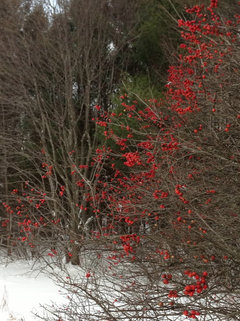
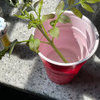
    Another possibility is Ilex verticillata, winterberry holly. It's deciduous, so the berries really shine on the bare stems in the fall. It would need a compatible male for berries, and IME suckers some and is much loved by pollinators when in bloom. Here's a wild one - the selected ones can have much larger and denser berries.

    Shrubby dogwoods, particularly those selected for their bright winter twig color, are nice.

  • 10 years ago

    I have thought of hemlock, but am not sure how hardy it is. It would be exposed to north winds. Some years the windchills get below -45C, and while plants dont "feel" windchill, that cold of wind would burn or fry a lot of conifers. I should also say that I would prefer something as fast growing as possible.

    As for the lilac replacement - I am not sure any holly would be hardy here. Vibernums would be a good idea, but they dont have the branching lilacs or some small trees/shrubs have. Again it will be exposed to the harsh winds, and the shrub needs to be hardy. I would prefer a fast growing one as well. Ill most likely be growing them from seed (unless I can find something locally available, which is hard to do).

  • 10 years ago

    On paper, winterberry holly and hemlock are both hardy to Zone 3. Remember, winterberry is much more cold hardy then the evergreen hollies.

    I'd listen to NHBabs, she knows her stuff and lives in a similar environment.


    I find hemlock and balsam fir gorgeous. I wish I could plant hemlock where I am, but hemlock is threatened by disease in my area.


    If balsam firm is everywhere around you, you know it does well in your area. Why not plant it? I find it attractive.


    If you want fast growing...I really don't think you are going to find any evergreen rated for Zone 3 that's faster growing then white pine (pinus strobus). Not good for right near the house or driveway, but I find it very attractive, and it is both fast growing and tough.

    Red pine and some of the asian pies are vulnerable to turpetine beetles in parts of the US...I'd check in your area to see if there are any mature healthy specimens of red pine. Inspect them for holes in the bark.

  • 10 years ago

    My favorite evergreen on the north side of my house is rhododendron. Certain cultivars will grow 10 feet high and the flowers in summer are beautiful. Your local nursery should have hardy cultivars.

  • 10 years ago

    That is good to know about the hemlock. Seems like it will do well here. Im on the NW shore of lake superior, so we tend to have a cooler climate than the surrounding area in the summer.


    I also didnt know about the holly. That would be an interesting idea. There is also a good amount of red pine around here. I plan on collecting some viburnum seeds or divisions this spring. Theres quite a bit of that around too.

  • 10 years ago

    What about Mountain Ash (Sorbus americana)? Hardy to Zone 2 or 3, no relation to true ash. Nice orange berries.

    What do you find attractive in a tree?

  • 10 years ago

    Yew - I can find no fault in yew. Abies.

  • 10 years ago

    Ed - I have thought of sorbus, but again they are native here, and over planted. I will definitely keep them in mind though. We have americana and S decora native here, not to mention all the russian sorbus planted and crossed seedlings that are poping up everywhere. The general form of sorbus is a good example of the form I am looking for.

    As for the yew. I cant think of any hardier yew than taxus canadensis (canada yew). Hicks yew doesnt survive above the snow line here, which also tells me both the types used to create hicks yes wont be hardy here either. Canada yew has an odd growth habit,and is slow growing. I am however looking for one to plant in another space as well.

  • 10 years ago

    Is Canada yew available as a landscape plant where you are? I've never seen such offered, and with deer at so high a population, what little remains in the wild is just bits and pieces on rock ledges and so on. A great plant, but one which is nearly extirpated in the wild.

    +oM

  • 10 years ago
    last modified: 10 years ago

    So you are actively trying to avoid native plants?

    What about weeping Alaskan Cedar? Only rated to Zone 4, but it is native to Alaska. Not that familiar with it, but it looks pretty.

    What about White fir? (Abies concolor) Kind of a cross between a tougher Blue Spruce and Norway Spruce. (metaphorically)

  • 10 years ago

    I wouldnt say im actively avoiding native plants, I just prefer plants that are rare or arent over planted.

    The C nootkatensis would be interesting, except my teacher has a small one that gets burned in the winter here, and its in a generally protected spot. If i had more room and a wall of conifers i would try. Its also a coastal rainforest species, and giving it proper conditions would be difficult in most areas.

    Are you familiar with Jackpine (Pinus banksiana)?

  • 10 years ago

    Canada yew should be available in a few places here, but it grows in many places here. If it is endangered further south, it is not the case up here, but the shrub is more prostrate. Very few in the wild get large.

  • 10 years ago

    Oh I've seen it. Just not very common these days. In fact, "threatened" across most any US state where it exists at all. Only in some of the heavy-snow areas of Michigan's Upper Penninsula-where snow gets too deep for much deer action-have I seen any appreciable numbers of this plant. And as a suppressed understory species in most such cases, I doubt we're looking at its true genetic potential. Still surprised-and I will admit, somewhat doubtful-that you're really seeing lots of Canada yew. Could be wrong of course, but this is kind of the poster plant species for what over-abundant deer are doing to our forests-eliminating it from the scene.

    +oM

  • 10 years ago

    You're in a part of the world where there are few choices, so what can grow, gets overplanted. Want inane lectures about the significant differences that exist between every variety of spirea known to man? Welcome to the difficulties of dealing with -40.

    You have few choices that won't suffer some kind of dieback. So those choices get used to point of being overplanted. Want plants truly tough as nails? Look at what comes out of the programs from North Dakota State and the Morden Research Station.

    You're looking for resistance to winterburn, and within that parameter, the arbs deserve a second look. Rushmore, Brandon, Warreana, I have a Yellow Ribbon growing the Detroit Lakes area of MN that hasn't burned yet. The Siberian arb (cultivar 'Warreana') is an arb, but has a look that isn't exactly commonplace. Norway spruce has a ton of cultivars that aren't exactly commonplace and provide some kind of unique look.

    Pinus cembra. Perhaps my favorite. If you ever see this growing next to white pine in late winter, you'll never plant white pine again.

    Want to know how to tell people who come from really cold places or not? If you talk about cold hardy and the suggestion is Ilex verticillata as opposed to Symphoricarpos, you've established a line of demarcation.

  • 10 years ago

    Dont get me wrong wisc., its not as abundant as black/white spruce, pin/choke cherry or alders, but it seems to common. There are a few sites where it dominates spots on the lake shore. We have an average of 3-4 feet of snow every winter, and the further from the lake you go the more snow you are likely to get.

    Common species are Populus tremuloides/balsimifera (with some spread out examples of grandidentata), Black/white spruce, Red/white pine, balsam fir, alder and pin/choke cherry. Some populations of red oak, bur oak, red/sugar maple, yellow birch, ironwood (ostrya virginiana), crataegus spp. and Prunus nigra very close by. Some planted examples of butternut (juglans cinerea) survive to production. An example of austrian pine (Pinus nigra) is growing well here. European larch is naturalized. Green ash (F. pencylvanica) grow well here (no EAB yet). I am experimenting with coffeetree (G. dioicus), hopefully beech (Fagus grandiflora).


    Thanks so far for the suggestions


  • 10 years ago

    Got it-thanks for getting me up to speed a little bit better. So on the butternut, I presume you're inferring that the canker disease would be a major concern? Makes sense-evidently there has been some breeding work in that direction as well, aimed at disease-resistance. Not sure where that's at but yeah, cool trees to have in the mix, and a bummer to have lost so many. It's present here in WI as well.

    Interesting about the larch. What type of habitat, or plant community is it colonizing? I'm waiting to see what, if anything comes of the hybrid larch I've planted so extensively up on my land, as far as naturalizing. I'd think it could happen. We'll just have to wait and see, but not for long. The oldest of them are starting to bear cones.

    +oM

  • 10 years ago

    I surprised butternut survives here. Ive found about 6 examples of various age. One is about 25 -30 feet tall. I dont see evidence of canker, but I mentioned butternut so there is something to compare whats growing here and help you make suggestions. I collected some nuts and planted them though!

    The larch is about 100 feet from the shore of lake superior. Someone planted one or two and they naturalized in the area (which is second growth forest). There is definitely some tamarack there.

  • 10 years ago

    Hey wayne, what do you mean by "arbs"?

  • 10 years ago
  • 10 years ago

    Here I was somehow picturing your location being quite far to the east. Evidently, you're in the Lake Superior area and as such, straight to my north. Know that area quite well. Yes, it is at least somewhat surprising to hear of butternut up that far north. And now, with a better understanding of your location, it does indeed make sense that at least some Canada yew would still be around. Those Upper Michigan stands I referenced are not at all far from where you speak of after all.

    OT Canadian Plant but I've got a question, or rather, a bemused comment directed your way: I've noticed that when Canadians speak of "northern Ontario", they mean any place within this huge province that's not in that area to the east of Detroit, MI basically, the Hamilton area. I found that amusing as I was corresponding with a Canadian researcher into the honeyberry shrub who said-in the same sentence-that he'd found wild plants just north of Lake Superior....in "northern Ontario", lol! Of course to this statesider, that looks curiously like southern Ontario, lol. Turns out any part of the province is "northern" so long as it's not that little area I mentioned above! Kind of funny, especially since I would expect that degree of geographic illiteracy to be more typical of my own countrymen and women than to the relatively astute Canadian!

    +oM

  • 10 years ago

    I'll second P. cembra. Great form and easy to grow. Very hardy!

    As for replacing the lilac, you mention "wide many branched." What immediately came to mind is Cockspur Hawthorn (Crataegus crus-galli). Low, wide spreading small tree with dense branching. Fall color can be quite good and it really shines in winter when its branching and flat top is shown to full effect.

  • 10 years ago

    Arbs, arborvitae, deer salad, northern white cedar, Thuja occidentalis. Common? Overwhelmingly, but there are varieties that aren't, as well as being worth sought out.

  • 10 years ago

    Wisc- IT happens all the time! Its my fault for using local names. Im inthe NW onthe shore of lake superior, very localized climate. An old survaying guide from the 1800s said the local flora and climate was similar to hastings ontario, or that of the st lawrence valley. On the canadian forest regions, I am literally at the boarder of the boreal (tiaga) forest and great lakes st lawrence (I think you call it the great lakes region).

    If you want to get technical, Northern ontario is berry to sault ste marie, and north west is sault ste marie west to kenora.

    Thanks wayne. Common names can be tricky at best. People plant cedar here quite often. Its native here, and they get quite a large size in the wild. One trunk was about 4 feet thick. The main problem with cedar is its advantageous root system. I wont deny that they are probably one of the best choices for a wind break. Unfortunately, thuja plicata (wester redcedar) wont grow here.

  • 10 years ago

    "Advantageous root system"...I don't grock? "Cedar", aka northern white cedar, aka Thuja occidentalis, is, like most conifers, and certainly when growing in a site with a high water table, very shallow-rooted. The trees help each other stand in such locations, and if the wind ever does get a foothold and blow a few down, the unfortunate result is often a slowly-expanding ring of downed timber. "Cedar swamps" as well as more upland groves of this tree are just plain high-quality wildlife habitat, as well as places of rare beauty. There's just nothing quite like a cedar stand, with its mossy downed logs, ferns, gurgling brook (I've got springs up where mine are growing) and the near-absence of wind. Great trees, great plant associates.

    +oM

  • 10 years ago

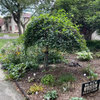
    In what I have seen they are generally described as being shallow rooted, not to mention the examples I see planted here. Mind you, generally the soils are fairly shallow in many places. Here is a pic of some of the native cedars:


    at least im pretty sure theyre cedars..... lol

    The main thing with choosing is availability here. There isnt much to choose from at nurseries here and the best choices are to ship them into town. That makes the list shorter because i need an online nursery that ships in/to canada.

  • 10 years ago

    We learned quite a bit about Thuja in class (im in college for forestry), but we use the common name eastern white-cedar or "western redcedar". The 'cedar" is never alone as a name, because as you say it is not a "real" cedar.

    I knew conifers in general can help "trap" heat but i forgot about certain ones being used as thermal cover by animals. The front (where this will be planted) is already fairly sheltered by tall caregana hedges, the porch, another lilac and the boulevard ash. It does not get sun all day, but at least 6 hours (good thing for the long summer days in the north!). The true purpose to have a tree that will block as much wind as possible is because I want to experiment with Magnolia acuminata, Kalopanax pictus (also has a new genus "septembolus"), Acer pseudoseiboldianum and some of the hardier hybrid hazelnuts. Trees that are known to create a literal thermal cover for plants would be a perfect way to do this.

    I usually have a fascination with the rare (in cultivation and my area) and rare native plants so that usually leads me to look around for other examples that can grow in my area.

    Do you have any native plum around there wisc?