Software
Houzz Logo Print
hairmetal4ever

Engineered vs. Solid Hardwood

10 years ago

In our newly purchased home, we would like to install hardwood in the MBR, hallway, and one other BR in a continuous "flow,", meaning, no transition pieces among the three areas, and going the same direction.

The subfloor is a rather typical wood subfloor (I'm guessing plywood?) from 1978, the same type of subfloor that was in the house I grew up in, which was built in 1978 as well.

I'm 99% sure the direction we intend to put the floors is perpendicular to the floor joists, which I will confirm tomorrow when I pull the carpet and locate the nails in the subfloor.

So the question: Engineered vs. Solid? I've installed engineered floors (both click-lock and glue-down) in the past on my own with good success. I have not done nail-down installations. However, I think I am capable.


Can engineered hardwood hold up to the rigors of normal use over time? It seems tha in my old house where I have red oak engineered, the floors dent much more easily than solid oak would.

My other concern is trim. I really dislike shoe mold, and find it "cleaner" to the eyes when the expansion gap is covered only by baseboard, but the existing baseboards are only 0.5" thick, which won't cover the recommended 0.75" gap for solid hardwood. I really don't want the added hassle of buying new baseboards, too.

Thoughts?

Comments (19)

  • 10 years ago

    Do most engineered products have at least some level of "sandability?"

  • PRO
    10 years ago

    First of all, you may use Eng. or solid wood floor if you have a plywood subfloor for nailing or stapling down. Eng. wood floor can be made very expensively or cheaply compared to solid wood floor. Some can be refinished as many times as a solid wood floor. Others no sandable wear layer at all. If you plan to live in the house long and may refinish the floor down the road, consider Eng. floor with 3 mm sandable wear layer or thicker. If you are in a more humid region, consider Eng. choice more. If you like really wide plank 5" or wider, your best choices are Eng. since the solid will not be stable.

    Don't get me wrong, the solid wood floors have served us for centuries. It is hard to go wrong with solid wood because it is not nearly as complex in production process as Eng. I would recommend nail or staple any day over floating if condition is allowed.

  • 10 years ago

    It also appears that few engineered products have a compatible stair nose transition piece. Am I missing something, or does this rendering pretty much impossible to use this product when you're transitioning to a staircase?

  • 10 years ago

    Most companies off a stairnose, reducers, different molding etc... to match their flooring products. Also most professional floor installers may offer to make their own.

  • PRO
    10 years ago

    You floor supplier should be able to provide stair noses for Eng. floor made by the floor manufacture or wood floor molding mills.

  • 10 years ago

    Are you considering prefinished or site finished? A lot more solid woods are currently available prefinished, but not nearly as many as prefinished. Your selection might be dictated by what's available in your desired look. Are you looking at wider or narrower flooring? If you're going wider, engineered has some advantages. How about humidity swings?

    As to expansion space, as long as you don't install solid flooring during the dry time of the year, the baseboard would probably provide sufficient expansion space. There's only a few items I've come across that don't offer a complete range of matching moldings.

  • 10 years ago
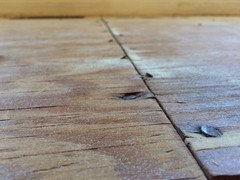
    Ok, so the floors are flat except at some seams. The bigger issue than the wood (which appears within sandable range) are the nails. The nails stick out diagonally.

    Can I countersink them.
  • 10 years ago

    You should be able to pound those down with no issues. If you're skeptical of the soundness of the subfloor you could add some nails or better yet, screws.

  • PRO
    10 years ago

    May want to run a sander along those plywood seams. The idea is to get the sub floor as flat as possible so there aren't any voids underneath. Can cause squeaky floors.

    The video near the bottom of the page below shows some tips.


    Floor Prep Wood Sub Floors

    Ken Fisher

  • 10 years ago

    I would spend the time now to screw the entire subfloor down, in theory you're not going to be tearing up the wood for many decades, the last thing you want to do is install the floor and find a squeek.

    When you have screwed off the subfloor then take a look at unlevel seems and sand as necessary, nail heads that are protruding a bit and can hammered down afterwords.

  • 10 years ago
    The subfloor itself squeaks. I put some screws in the squeaky areas. Some worked, some didn't.

    The nail heads pound down pretty easily.

    Some areas have an almost metallic, hollow sound. I assume where ductwork runs. Anything I can do about that?
  • PRO
    10 years ago
    last modified: 10 years ago

    "Some worked, some didn't."

    It happens. Unfortunately what happens in new construction is framers don't put enough pressure on where they're fastening, especially with the use of pneumatic nailers today. They may spread enough construction adhesive on the floor joists, but once the plywood is laid, they run like heck to nail it home. IE: the adhesive isn't squeezed down in any consistent matter, creating voids that cause squeaks.

    I learned this while working on a job ten years ago. It was actually a warranty claim. The builder was found at fault because the framers didn't install the ply the right way. Not many do really. To them it's about getting the job done. Most don't even think about problems it can cause. The customer naturally wanted it done right. Hence, all flooring and sub flooring was removed and re-installed.

    Ken Fisher

  • 10 years ago

    If you can get below the floor joists, and can locate the general area, you can take some shims and fill any gaps you may see. It will probably require a buddy or helper to apply pressure up above near the squeeky areas.

    Then look at the duct work, if they mounted the strapping directly to the subfloor remove that and try to mount the strapping to the joists instead. Thats kind of a general explanation which im sorry for but its one of those things that unless i can see it first hand its all the help i can give.


  • 10 years ago

    I can't really get below the joists. This install is on the second floor. So unless I rip out floorboards or the drywall on the first-floor ceiling...

  • 10 years ago

    gotcha, This is the point where you gotta ask yourself how much are the squeeks gonna bother you? If its going to drive you insane, tear up a sheet of plywood, that you think is the bad one, and reglue and screw it off.

    this next tip works sometimes, its not a garuntee but it has helped me in the past.

    Locate where the worst squeek is, then when you install in that area, make sure you use a board thats going to span that entire distance that squeeks. making sure theres no buttends really does help. is it going to solve it forever? probably not, but it should help in the short term.

  • 10 years ago

    Good stuff. Thanks!

    Last night, I did a bit of "overkill" with the screws, but I think I reduced the squeaks by about 70%.

  • 10 years ago

    Just recently installed a solid, unfinished, wood floor in 4 bedrooms and 2nd floor hallway all without any transitions. Took a lot of pre-planning and a table saw to modify 1 row of flooring to make it all line up but it was well worth it.

    To gain the extra expansion gap suggested you can easily use 1 of those new utility tools on a spare piece of flooring to cut the bottom of the sheetrock so the expansion gap becomes the molding and the space under the SR.

  • 10 years ago

    Actually, while removing the master bath vanity, it appears that there is about a 3/4" gap under the drywall. If the same is true under the baseboards, I should be set regardless.