Software
Houzz Logo Print
mfran12345

What plants needed to level a table top

10 years ago
last modified: 10 years ago

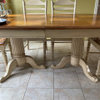
I'm building a kitchen table and need to level out the top. It's about 40" wide X 54" long made from boards placed edge to edge. I want to smooth out the table and have it level by using hand planes. My grandfather has a large shelf of planes and I was wondering what ones I would need to remove the high spots and ultimately level out the tabletop. I don't know what's there but was hoping someone would be able to tell me what to look for as far as labels or numbers or lengths on them. I know planes are named by numbers, but I s there an order that would be typical followed like with sandpaper to go from removing high spots roughly to eventually smoothing it out. If I get a chance I'll try to get a picture of them all. Thanks.

Comments (10)

  • 10 years ago

    Plants...darn auto correct on my phone. But I guess whatever gets people intrigued to read my post! Thanks for your input. Looks like I have a lot of research and learning to do before I do the work. Thanks for the help though. I don't think he ever really used them so they will most likely need to sharpened and set up. He just collected them for the most part, probably like 20 to 30 total. Maybe he used them before my time. Before I do anything with them I'll post pictures if I find a Stanley 7, 8 or 9. I don't know if they have any value but I'd hate to ruin a collectible learning how to use it.

  • 10 years ago

    Here's a site Stanley Planes that will tell you _everything_ that is known about Stanley planes. I'd pick one to start with (something like a Stanley #3, one of the most common planes there is) and make it work well before worrying about dealing with 20 to 30 of them. Beware, once you make that first perfect ribbon of gossamer thin wood float off your plane you can be addicted for life.

  • 10 years ago

    "once you make that first perfect ribbon of gossamer thin wood float off your plane you can be addicted for life."

    So true. It's easy to form the mindset power tools are required for quility work but it's just not true. Don't overlook card scrapers while doing this type work. With that said,I usually glue up large flat projects in pieces that will fit through a power planer or drum sander then glue pieces togeather.

  • PRO
    10 years ago

    I'd use nothing longer than a #4. For table-top planing, you need to shape the iron (plane blade) slightly convex so when it is set there is no exposed corner to leave a sharp gouged line. If you have ever seen old hand-planed wood you pick up on the idea of the slightly scallop-y blade shape. It is sometimes referred to as a cambered iron.

    Casey

  • 10 years ago

    A large aspidistra in the center, surrounded by african violets, should disguise the problem.

    First - how bad is it?

    Second - is there any chance the boards can shift after they are leveled? If they aren't edge glued or biscuited or pocket hole screwed, planing would be a waste of time.

    I've never had any luck with real planes, so I cheat with a rasp and sandpaper.

  • 10 years ago

    I don't think there's a good substitute for standing next to an experienced woodworker showing you how to sharpen, set up and use. The Internet is an amazing thing, but there's a lot of subtle art to this too. I'm more of a wood butcher than a wood worker and this is one of my problems - no experienced people around to watch.

  • PRO
    10 years ago

    There is a certain investment needed to gear up to have sharp planes and chisels. I now have a set of Shapton stones, but in the past I used wet/dry sandpaper held to a sheet of plate glass by water, and wet-sanded the blades. The first investment is the Veritas blade holder/jig, which works with any flat stone or abrasive. A hone (wheel with jeweler's rouge) for the final polish is an asset, but a leather strop works just fine. If it shaves the hairs off your arm it is pretty sharp. google "scary sharp" for a bunch of discussion/articles/tips.

    Casey

  • 10 years ago

    OK, this is a bit of a hijack into the arcana that I warned against. I just spent a couple hours reading up on water stones thinking it was time to give them a serious try.

    Casey-- Which Shapton stones did you get? The glass stones or the Professional? Are you using their $$$ lapping plate or something more reasonable like the Atoma? Did you go 1000-6000-10,000 or some other combination? Did you consider, or have you used Sigma stones? (Tools from Japan offers a nice package deal on them.) Thanks!

  • PRO
    10 years ago

    I have the yellow, wine red and green stones. The yellow is coarsest(1000). I have the cast iron lapping plate, and two different abrasive grits, the 5000 and 8000 stones need the fine grit/powder. The 8000 gives a mirror polished edge ready for the jeweler's rouge. I have used them for over 10 years, and have had to replace the 1000 grit stone because it wore down pretty thin, it didn't snap in two, but I retired it.