Software
Houzz Logo Print
parker25mv

Flowering Cherry Trees and Fruiting Cherry Trees Explained

10 years ago
last modified: 10 years ago

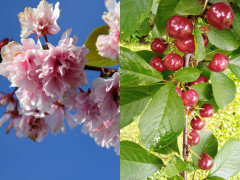
Many people may be wondering what the difference is between Flowering Cherry Trees and Fruiting Cherry Trees. One produces pretty ornamental blossoms and the other produces fruit for eating, obviously, but besides from that, what is the difference? The following post will explain.

Flowering cherry trees can produce tiny little drupelet fruits, but they are more
fit for the birds than for people to eat. However, with the ornamental varieties
of cherry blossom that are commonly planted, there are multiple good reasons why
most people will rarely or never see the fruit (but I will get back to this
subject later).

Are sweet cherries in the same species as flowering
cherries? I have actually done some research into this, and it turns out the
answer is very complicated, it's not an easy yes or no question, for a variety
of reasons. As it turns out, it IS possible to crossbreed sweet cherries with
flowering cherries, and importantly the second generation offspring will
be fertile (that's not the case when sweet cherries are crossed with sour
cherries). The reason generally has to do with chromosome count. Sweet cherries
have 16 chromosomes. Wild Japanese flowering cherry trees also have 16
chromosomes. However, there are many ornamental cultivars which resulted from
hybridization, which have 24 chromosomes. Black cherries and sour cherries, on
the other hand, have 32 chromosomes. If you crossbreed sweet cherries with sour
cherries, the resulting hybrid tree will have 24 chromosomes, and will still be
able to produce fruit, but the seeds will be sterile (like breeding a horse and
donkey together resulting in a mule, there will be no third
generation).

Back to flowering cherry trees...

The pink variety 'kanzan', being a double-flowered variety (2 rows of petals), is sterile, it does produce drupelets or seeds. Particular cultivars of cherry are
propagated by cuttings, so the fact that they cannot produce seed does not
matter. (I believe under certain conditions they might be able to induce these varieties to produce normal single flowers and then they could produce drupelets, but not sure about that)

By far the most common ornamental cherry variety is Yoshino. I
was watching a documentary and there was an elderly Japanese expert who lamented
that Yoshino is not really a natural variety.

Wild cherry blossom trees
in Japan do produce tiny drupelet fruits. They are not very edible (the birds
like eating them though).

The Yoshino cultivar, on the other hand, is a terrible pollinator,
it does not even attract bees. Those little fruits cannot form if there is no
pollination, so you are unlikely to see any drupelets form in a group of cherry trees that are all Yoshino.

What does it really mean for cherry varieties to be within a different "species" (and I use that term loosely), even though they may be capable of freely interbreeding? Well, Yoshino is an excellent example. The Yoshino variety is thought to have resulted from a single hybridization between Edohigan and Oshimazakura. When you crossbreed between different species, the offspring can often be less hardy and resilient, or not as well able to reproduce. The Yoshino variety will typically only live 30-40 years, whereas other cultivars with origins closer to the original wild cherries can live much longer than that. (By the way, sweet cherries can grow to be well over a hundred years old too if they are not grafted) Furthermore, when you have different species it results in some slight degree of incompatibility when they are grafted onto each other. For example, 'kanzan' flowering cherries sold in American nurseries will very often be grafted onto sweet cherry species (P. avium) rootstock to keep it from growing too big.

For anyone who may be interested, I came across a published
reference to Prunus campanulata being crossbred with sweet cherries. Here is the
excerpt:

"Since there is no low-chill germplasm avaialable for sweet
cherry, the only other alternative is to go to another species of cherry for
this trait. Several species have been used in crosses with sweet cherry with
occasional success with Prunus pleiocerasus and Prunus campanulata. In 1957,
W.E. Lammerts made a cross between P. pleiocerasus and P. avium 'Black
Tartarian'. This hybrid is very low-chilling (<200 CU ) but not self
fruitful. The hybrid was repeatedly crossed with sweet cherry and P.
campanulata. In the mid 1970s, the Florida program developed several seedlings
by using mixed pollen (P. campanulata and 'Stella'). All the hybrids had pink
blooms and thus were probably hybrids with P. campanulata. Several of these
seedlings were fruitful. Although the size is still small, this germplasm is
useful for the development of low-chill sweet cherries."
Temperate Fruit
Crops in Warm Climates, edited by Amnon Erez, p216

Prunus campanulata is
the Formosan cherry, called kanhizakura in Japanese. Several hybrids of
kanhizakura with other Japanese flowering cherries exist: kanzakura, okame, and
youkouzakura being the three most prominent. The Formasan cherry is remarkable
for being the only flowering cherry not originally native to Japan, and its
ability to thrive in the Southernmost part of Japan where there is very little
chill.

There are nine different varieties of cherry that grow in the wild
in Japan, from which all other cultivated flowering cherry varieties
originate:

Yamazakura (Prunus jamasakura)

Oyamazakura (Prunus
sargentii)

Kasumisakura (Prunus verecunda)

Oshimazakura (Prunus
speciosa)

Edohigan (Prunus Ascendens spachiana)

Mamesakura (Prunus
incise)

Choujizakura (Prunus apetala)

Minezakura (Prunus
nipponica)

Miyamazakura (Prunus maximowiczii)

Comments (21)

  • 10 years ago

    What does "low chill" mean? And if you just want a tough, long lived Zone 6 cherry, what would you go with?

  • 10 years ago

    'Low chill' is a term that is usually associated with fruit-bearing trees and indicates an ability to produce successful crops in relatively warm winter areas.

    A long-lived flowering cherry is a bit of an oxymoron......25-30 years is considered a decent lifespan for most types, although if given good care and free of disease or insect problems (not an easy accomplishment!), some may live quite a bit longer. With that caveat, Prunus x yedoensis or the Yoshino cherry is probably the quintessential flowering cherry. These are the cherry trees that grace the mall and tidal basin in Washington D.C. and various college campuses and boulevard plantings across the country.

  • 10 years ago

    Another example of species ambiguity... Taxonomists have never made a clear determination whether Capulin cherries fall under Prunus Serotina or should be classified as their own species, Prunus salicifolia. Capulin is extremely closely related to Wild Black Cherry, but has a different range, geographically much farther South in the mountains of Mexico and Guatemala, where it is well adapted to the low chill conditions there.

    (personally, I would tend to view Capulin as a subspecies, and there are many different varieties of Capulin cherries)

  • 10 years ago
    last modified: 10 years ago

    I was confused by "low"...when I see "low" close to "chill" I think "low" temperatures. I'm used to the opposite problem from what you describe.

    The typical "ornamental" cherry is a delicate "foo foo" cultivar. I see them as traps for amateur gardeners...they look amazing when you see them in botanical gardens, universities with professional landscapers, or in the yards of serious hobbyists, but tend to die or generate work in your typical homeowner's yard.

    Your post raises an interesting possibility...if I were willing to compromise blooms a little, could I go to one of the wild ancestors of ornamental cherries and get something tougher? Have there been any attempts to cross the tough black cherry or choke cherry with...not an ornamental cherry I guess, but one of the prettier sweet cherries?

  • 10 years ago

    Although just an anecdote, I was surprised one day last summer, when literally picking a bit of low-hanging fruit on one of my old, nearly decrepit "Canada red cherries", which are maroon-leaved cultivar of chokecherry, said fruit was sweet. Sure wasn't expecting that, and I'm also not sure it wasn't an anomaly. But sweet and good it was. Nevertheless, I will continue to let the birds do most of the eating off those two trees, for whatever time they (the trees) have left.

    Generally speaking, trees from genera that produce known food-grade fruits have been manipulated by man for millennia. I'd suspect it is that, more than any other factor, which has led to the current taxonomic confusion.

  • 10 years ago
    last modified: 10 years ago

    The cultivar 'Mesabi' is a cross between Bing and Montmorency. It produces fruits that are somewhere in between that of a sweet cherry and a sour cherry, and takes after its parent Montmorency in the fact that it is "self-fertile" (does not need to be pollinated by a different variety to produce fruit). The seeds inside the fruit are sterile of course since the hybrid is triploid (3n=24 chromosomes).

    To my knowledge, there has never been any commercial application for crossing ornamental flowering cherries with sweet cherry varieties, and the available information about such hybrids is very sparse, but the seeds from such a hybrid tree would be able to grow (since both the first generation parent species had 16 chromosomes). I would imagine though that the resulting hybrid might not grow as vigorously, you might read up more on Outbreeding Depression.

    "Outbreeding depression refers to cases where offspring from crosses between two different different populations have a lower level of fitness than offspring from crosses between individuals from the same population.

    One of the ways that outbreeding depression can occur is by the breakdown of biochemical or physiological compatibilities between genes in the different breeding populations. Within local, isolated breeding populations, alleles are selected for their positive, overall effects in complementary combination with other specific alleles. Due to nonadditive gene action, the same genes may have rather different effects in different genetic backgrounds--hence, the potential evolution of locally coadapted gene complexes.

    Herbert Spencer and the Harvard geneticist Edward East, a pioneer in hybrid corn research, observed that genetic crossing would disrupt the smooth operation of growth habits and physical qualities which had been established in different strains of maize over hundreds of generations by natural selection."

  • 10 years ago

    Oh, thanks for that, Parker. What is a chokecherry? I grow cultivated p.avium and several gean cherries. or the wild form of p.avium (and also p.cerasifera and spinosa for hedging)...and the cherries are small but sweet enough on the geans. There are a couple of venerable trees of enormous size in my local cemetery, which are enthusiastically raided by humans, birds and squirrels. Sour cherries, I have always known as morellos or the mysterious 'Duke' which I have heard of but never, to my knowledge, seen or ate.

  • 10 years ago
    last modified: 10 years ago

    The name chokecherry is usually used for Prunus virginiana. It is a Sec. Padus cherry, the North American analog to P. padus.

  • 10 years ago

    Hey Camp. That would be Prunus virginiana, an extremely common and widely dispersed native cherry. The kind I have in my yard are the so-called "Canada red cherry", a variant that has foliage that turns deep red/purple in summer. I'm not sure if it's in the trade as much these days but used to be a common item.

    This state grows a great many cherries, in orchards especially in Door County.

  • 10 years ago
    last modified: 10 years ago

    Yup. Chokecherry is a North American shrub known for toughness and salt tolerance. Planted for erosion control and wildlife. The fruit are usable for jam. I mentioned it as the exact opposite of the "fu fu" Japanese cherries.

    Has anyone developed any cultivars or hybrids of prunus serotina (black cherry)? I admire it's toughness. Does anything have the same number of chromosomes?

  • 10 years ago
    last modified: 10 years ago

    The hybrid is likely to be as short as its hardy parent, so you might end up getting more of a bush than a tree.

  • 10 years ago

    Sorry, I moved on from chokecherry. Prunus Serotina (Black cherry) is a respectable sized tree. I'd just want either something to dial up the flowers a notch so I could use it in the spots that show or make the wood a shade tougher so I could take advantage of it's salt tolerance and use it in windy spots. There are so many untapped species of cherry out there.

  • 10 years ago

    'Canada Red' is a Bailey nursery introduction derived from 'Schubert'. It is supposed to offer improved growth and color. Other purple leaved P. virginiana cultivars include 'Mini-Schubert', 'Robert' and 'Sharon'.

    said fruit was sweet. Sure wasn't expecting that, and I'm also not sure it wasn't an anomaly

    'Schubert Copper' is known for being non astringent.

  • 10 years ago
    last modified: 10 years ago

    A huge favourite in the UK is the beautiful glossy barked p.serrula and the less common but equally lovely Manchurian cherry, p.maackii. Have promised myself a Tibetan cherry just for stroking and admiring. I agree, Edincoln - the genus holds so much more promise than the (thankfully vanishing) Kanzan (but I will always have a love for TaiHaku, the great white cherry).

  • 10 years ago
    last modified: 10 years ago

    "subgenus" may be more appropriate (or maybe not, taxonomists have put both sweet and sour cherries into the subgenus Cerasus). All these different cherry species are very closely related, if one wants to consider them different species. This is one example where the line separating different species is not a clear one. It could even be possible to consider the different cherry families as subspecies. After all, if they can freely interbreed and hybridize with each other, can they not be considered members within the same species? (by this definition we could divide all cherries into only 2 groups: those with 16 chromosomes and those with 32)

    Or one could attempt to divide cherries into different families: Sweet cherries (P. avium), sour cherries, Black cherries plus Capulin native to the American continent (put into same group), and Asian flowering cherries.

    Perhaps better classification could be provided if taxonomists utilized multiple degrees of species relatedness/separation, because it is ambiguous whether some of the different cherries should be classified as entirely separate species or subspecies within a singular species, neither of which would be wholly accurate.

  • 10 years ago

    "After all, if they can freely interbreed and hybridize with each other,
    can they not be considered members within the same species?"

    The ability to reproduce with another type of plant is generally not a defining or limiting characteristic of a species. There are many species that commonly and freely reproduce with other species (look at most quercus species, for instance).

  • 10 years ago

    By this reckoning, plums, apricots, etc. would have to be fit in somewhere. Quite an unwieldly tribe, and human interference (plant breeding) has done nothing but further confuse the issue. That looks to me like somebody's life work-untangling Prunus!

  • 10 years ago

    wisconsitom, it gets even more complicated. I have come across sources claiming that it is possible for quince and pear to be crossbred and freely hybridized (and they are not even in the same genus!), although there are a whole bunch of issues with that because reduced vigor or sterility usually results, it depends on which cultivars of pear were used, and there is a very low success rate.

    related threads:

    Any Pear or Apple varieties with an aroma like Quince?

    Will these fruits cross-polinate - same gensus/different continen

  • 10 years ago

    Quince and pear are close enough to be graft compatible - quince has been used as a root stock for orchard pears in commercial practice. A synonym of Cydonia oblonga is Pyrus cydonia.

  • 5 years ago

    Cherry Blossom vs Cherry Tree: Flowers Or Fruits? This article explains all differences between these trees.