Software
Houzz Logo Print
dbarronoss

Choosing between Philadelphus and Callicarpa

10 years ago

Ok, I have small Callicarpa americana that I rooted last year in a pot and I am about to order a Philadelphus x Belle Etoile. I'll find a place for both, but I want to query for thoughts of which for the street corner of my driveway. The area will be full sun, soil is brown clay (typical of Arkansas bottom lands), zone is 7a, area is generally moist/wet, though I do expect to have to hit it with the hose several times in summer during dry spells.

Bearing in mind, both are going to be small plants (however both grow very fast), what is the consensus for the best plant for that area ? (I'm replacing a privet, in my war against privet...which apparently the previous owners adored). Other suggested shrubs (before I order) are welcome, they have to be able to take wet winter soils.

Comments (48)

  • 10 years ago

    Just because it's a personal favorite of mine, I'd reach for the Callicarpa. Oh, and yes, either one is infinitely preferable to privet, lol!

    dbarron thanked wisconsitom
  • 10 years ago
    last modified: 10 years ago

    dont know the calli ...

    and i dont have a dwarf mock orange ... nor BE ... but of the 3 or 4 versions i have ... frankly .... they are rather ugly plants.. lol ... and they need to be renovated often to look nice ... [now mind you.. for that fragrance .... its a must have plant ... dont get me wrong ... thats why i have 4 .. lol]

    so the question would be ... what ... would you want out in that prime space ...

    ken

    ps: also look at link .... perhaps it might have more vigor than the marketing peeps want you to think ... which just means more frequent renovation

    https://www.google.com/search?q=Philadelphus+x+Belle+Etoile.&source=lnms&tbm=isch&sa=X&ved=0ahUKEwinsOG0xtnKAhWivIMKHZygASMQ_AUIBygB&biw=923&bih=745&dpr=0.9

    dbarron thanked ken_adrian Adrian MI cold Z5
  • 10 years ago
    last modified: 10 years ago

    Ken, my friend, what do dormant buds on oak have to do with philadelphus ? :)
    Vigor is good, unless it's eat my car and my garage type vigor.

  • 10 years ago

    I would plant something evergreen in a corner.

    'Belle Etoile' is not dwarf.

    dbarron thanked Embothrium
  • 10 years ago

    Part of the appeal of the Philadelphus is its scent, so site it where the scent will reach you. The callicarpa should be close enough so that you get good views of its gorgeous berries.

    dbarron thanked NHBabs z4b-5a NH
  • 10 years ago

    on my screen .... the link reads mock orange ...


    my MO are surround my deck ... or upwind of summer winds ...


    lets see if this link is better .... ken

    https://www.google.com/search?q=Philadelphus+x+Belle+Etoile&source=lnms&tbm=isch&sa=X&ved=0ahUKEwjssaLT-tvKAhUrtYMKHZnXCtIQ_AUIBygB&biw=923&bih=745&dpr=0.9

  • 10 years ago
    last modified: 10 years ago

    Much better Ken (the link)...and point taken...I think the MO looks lovely. I think it's top in my mind for that spot right now. I also loved the suggested idea (found in one of the google links) of planting a non-woody clematis to run along the mock orange...and I think C. pitcheri (purple) or maybe 'Rooguchii' fits the bill.

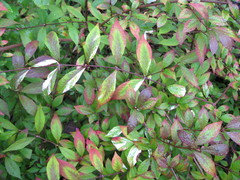
    Frankly the callicarpa (I love those berries) looks like a big weed till the berries set. And then they're glorious till frost (and the birds pick them off).

  • 10 years ago
    last modified: 10 years ago

    In climates where evergreen shrubs (broad-leaved in particular) are grown with reasonable ease these should be used to give borders structure, with the comparatively lightweight deciduous shrubs placed where they are surrounded by them, form visual transitions between the mass of evergreen shrubs and the lightness of herbaceous plants. In a rectangular mixed border backed by a fence for instance, deciduous shrubs might be put near the center, at the rear, against the fence, with flowers in front of these and evergreen shrubs at each end, to bookend the arrangement.

    Climbers could drape the fence behind the deciduous shrubs or the shrubs themselves, if the vigor of the climber and size of the shrub are well matched.

    Placing deciduous shrubs where they will end up functioning as structural elements should be limited to those very cold climates where (broad-leaved in particular) evergreen shrubs just aren't possible, at least as regular landscape elements. In such cases using deciduous shrubs for this is a half measure forced on the gardener by local conditions, and not producing the fully realized effect gotten from evergreen shrubs.

    dbarron thanked Embothrium
  • 10 years ago

    Other than conifers, and a very very few other things (that I do not prefer), there are no suitable evergreens. I don't want a magnolia grandiflora there...a bit large :)

    If I could grow Ceanothus or something like that, I would certainly use it or if the exposure suggested an Aucuba would work (too sunny and too windy).

    Thanks for the advise Embothrium, but I will fail to heed it.

  • 10 years ago

    And why can't you grow Ceanothus? I'm sure they're hardy to zone 7.

    dbarron thanked laceyvail 6A, WV
  • 10 years ago

    Anything planted on the street corner of your driveway should be small enough so you can see to pull out on the street. The plants mentioned are all too large. Something small and evergreen would be more appropriate.

    Most deciduous shrubs make poor specimen plants in prime viewing spots.

    Mike

    dbarron thanked Mike McGarvey
  • 10 years ago

    Heh, that was my first thought upon opening this thread-visibility when backing out of the driveway. I figured though that dbarron had that covered,or he wouldn't be posing this line of questioning to us.

    dbarron thanked wisconsitom
  • 10 years ago
    last modified: 10 years ago

    I will position the shrub far enough from the corner that visibility shouldn't be an issue. I hate not being able to see (lol). And for the record, drainage is a consideration...the yard frequently stands in water during winter/spring and stays saturated for long periods of time, thus many interesting things can't even be considered. And for Ceanothus, this climate in general is too wet (let alone the flooding issue..which would be instant death).

    I have things like sweet bay magnolia, fringe tree, and two listed here that can tolerate wet feet to some degree.

  • 10 years ago
    last modified: 10 years ago

    Well, Belle Etoile is a large unwieldy thing in my climate and I would have to float a suggestion for the smaller Manteau d'Hermione...but if size was not such an issue, then why not go for p.coronarius aureum - the lovely spring foliage (it does get a bit greener as the season wears on) is an excellent addition to the fleeting blooms (and is not so attractive to aphids either)...or, my favourites, the deutzias?

    The clematis idea can be a little problematical with the highly foliaged philadeplhus (although, for sure, an integrifolia would be my choice or c.pitcheri or even texensis) - works much better with chaenomeles which has smaller leaves and a rather good architecture for a climber..or the classic combo of roses.

    Forgive enthusiasm, I rarely chime in with suggestions, gardening being so subjective...but philadelphus (and deutzias and quince) are definitely some of my favourite shrubs.

    Escallonia? Sorbus reducta?

    dbarron thanked User
  • 10 years ago
    last modified: 10 years ago

    Well, I'm too cold for Escallonia to be reliable (plus drainage issue) and I'm too hot (summer) for Mountain Ash. Isn't gardening fun ?

  • 10 years ago

    "Placing deciduous shrubs where they will end up functioning as
    structural elements should be limited to those very cold climates where
    (broad-leaved in particular) evergreen shrubs just aren't possible, at
    least as regular landscape elements."

    This seems limiting to me, and a little bit too normative -- like something from a Sunset or Southern Living gardening book written in the 1950s.

    Dbarron, your description of the Callicarpa (weedy before fruiting) confirms my suspicions. I saw a bunch of these last year at the Gorman Discovery Center here in KC when they were fruiting. Loved the berries and the foliage color, but thought the structure might be too loose for the spot I wanted to put them in. Seems like something you might want to mingle with ferns, etc. at the edge of a wood.

  • 10 years ago

    Hee, I live in town..there are no woods and that restrictive wetness limiting what I can plant. I used to live in the country and have acreage, but not since my mother was terminal and I moved back to Arkansas.

    And that privet, must go!

  • 10 years ago
    last modified: 10 years ago

    This seems limiting to me, and a little bit too normative

    What's limiting and normative is the common habit of scattering plants around without any regard to their naturalistic character and how this determines what visual impact they have as landscape elements. If recognizing that a deciduous shrub does not "read" in the same way as an evergreen one seems identified with a certain time period, so be it.

    And so what.

  • 10 years ago
    last modified: 10 years ago

    I agree with WoodsTea; deciduous stems can still provide a sense of "structure", if that's why you are planting something. There are plenty of gardens even in the UK where BLEs are plant and forget-easy, with a beech hedge. Or a Carpinus hedge.

    Alas, I would also have to point out...if you look at the overall history of western garden design, indeed 6a is at least a cold climate. It's not really being harsh to say BLEs not growing somewhere is a sign of a very cold climate. Relative to what's been available for most of the history of the development of art, so to speak. If you read a history of western garden design you're going to start in, well, Sumeria or whatnot, advance to the Mediterranean world, thence to western Europe. (and some would say, next to California) All places with their respective evergreen plants. I consider my climate a cold one - in winter! When you have winter days with highs well below freezing for days on end during winter, that's cold. Even if a correctly sited and grown BLE like C. X williamsii 'Aida' survives it w/o a scratch. Though it may not be very cold by US standards. The Germans built their temporarily camellia coverings...starting before the 20th century I believe...as a concession to the fact that they have a cold winter climate, etc.

    dbarron thanked UpperBayGardener (zone 7)
  • 10 years ago

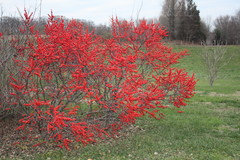
    The area will be in full sun... Sounds like a perfect spot for winterberry, it would be an easy decision for me.

    Callicarpa sp. not my favorite.

    dbarron thanked sam_md
  • 10 years ago

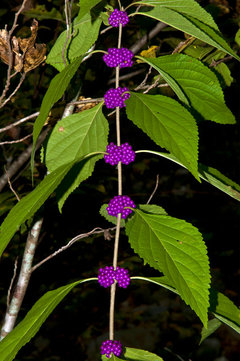
    Now be fair sam, lol...that's an abnormally shoddy look at Callicarpa! In fact, that washed-out pink is not even the correct color for most specimens that are out there. Just saying.........a reasonably close-up view of the intensely purple wintertime fruits of Callicarpa would blow that photo away....easily.

    And yes, the winterberrys are nice too.

    dbarron thanked wisconsitom
  • 10 years ago

    Yep, I thought of a winterberry, they grow in fencerows here, and they DO seem to like their water, so the moisture wouldn't be an issue. However, I don't like them during the growing season (reverse prejudice I guess).

  • 10 years ago

    Davidrt28 -- I think it's that western (and especially UK) gardening tradition that
    I hear in the rules given above about the appropriate use of broadleaf
    vs. deciduous shrubs.

    A couple of miles to the northwest of
    me are the old money neighborhoods of Kansas City. You'll find a lot of
    BLEs there, rhododendrons in particular, which I expect have required
    considerable expense to maintain -- deep soil amendment, supplemental
    water, mulch, shelter in various forms.

    In many of these homes you will
    also find at least one painting of a fox hunt.


    dbarron thanked WoodsTea 6a MO
  • 10 years ago

    I think it's that western (and especially UK) gardening tradition that I hear in the rules .... Hey, don't blame us ;-) I've never heard of these 'rules'. Our gardens are full of evergreen and deciduous shrubs and I'm pretty sure no one bothers with any rules about where they have to be put. Campanula - have you ever heard of these rules?

  • 10 years ago

    Lol, I think WoodsTea is referring to the English Gardening Architecture rules. Perhaps they're just a myth :)

  • 10 years ago

    Certainly not a comment on contemporary English gardening or gardeners -- about which I am largely ignorant aside from you and Camp and Derek Jarman, and none of you come across as formalists.

    I really didn't mean to be so combative in the first place, but that thing about "half measure forced on the gardener by local conditions" rubbed me the wrong way.

    Down at the end of my driveway it's pretty much short grasses like prairie dropseed and perennials that have melted or blown away by this point. It looks a little disheveled out there, but I feel just fine about it. I don't think there's a great need to be too concerned about structure at this time of year. Maybe I'll put a big chunk of limestone out there some day. Or a wagon wheel. ;-)

    I have thought quite a bit about something with red berries like that Ilex verticillata, though it couldn't go near the driveway due to visibility issues. I hear that the local birds aren't too crazy about those berries, so they stick around through most of the winter looking pretty until all the other food is gone...or the cedar waxwings arrive, I'm not sure. Anyway the bigger problem for me is that you need a male and a female and I don't like them enough to devote that much of my small yard.

    dbarron thanked WoodsTea 6a MO
  • 10 years ago
    last modified: 10 years ago

    Well, here, the local environment is almost certain to provide adequate maleness if you buy a female (berrying) plant. And yes, they seem to be the last desperate measure for the birds to eat...some years the berries are still on when new leaves start.

    I like them in winter, but not too keen about the winterberries any other time (I've had them at my previous house...sown by nature/birds). I think I'd relegate them to a mass display at the edge of the lawn somewhere. They are fairly impressive.

  • 10 years ago

    I'm always wishing there were a vacant lot somewhere nearby where I could plant a bunch of auxiliaries -- either males (for spicebush, etc.) or else cross-pollinators for things like Viburnum.

  • 10 years ago
    last modified: 10 years ago

    I've frequently found that I live within a mile of viburnum rufidulum, hollies, spicebush, etc (for many of the natives)...suppose that's one of the perks of being native. I like the way a nursery friend put it, plant a female, if it doesn't make berries, I'll sell you a male.

  • 10 years ago

    Looks like I will have to find a male Callicarpa. I only get around 10 berries a year on mine. I don't live in a city.

    I did get a little color on it last Fall though.

    Mike


    dbarron thanked Mike McGarvey
  • 10 years ago

    I would put both of them in, fairly close together so they combine and give longer interest. I have my mock-orange planted with several other deciduous shrubs and roses all around a very large loropetulum which anchors the corner. I realize you probably can't do the loropetulum, but a "mixed" area is very effective in my opinion.

    dbarron thanked junco East Georgia zone 8a
  • 10 years ago
    last modified: 10 years ago

    Mike, I *think* Callicarpa are perfect flowering, however, you may need another variety (or the species) for cross-pollination, so that you get a better fruit set.

    You should be getting fruit set like this:


  • 10 years ago

    I want someone to send a current pic of a beautyberry shrub, what do they look like now?

  • 10 years ago

    Do you mean a whole profile shot in season or what do they look like in February ?

  • 10 years ago

    Can someone post pic that is current, leafless. mid-February does it still have berries, what color are they, are they bleached out, are they shriveled?

  • 10 years ago

    Plant (Callicarpa) grows from S. Florida to at least Maryland, so there's going to be a range of conditions depending on where pic taken. I've never seen the plant here in Wisconsin, first becoming aware of it in far S.W. Florida, so my view is colored by the fact that those I've seen might have been especially fruitful at the time of observation. This would have been December of several years.

    Incidentally, breeders have worked with not only C. americana but also C. dichotoma, C. bodinieri, and perhaps still others, so for anyone looking for more winter hardiness out of this type of shrub than that provided by the American version, it is available. Aesthetic characteristics are largely similar.

  • 10 years ago

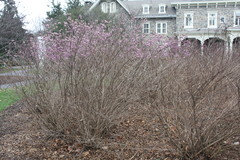
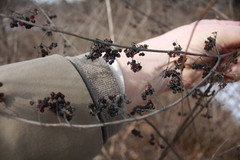
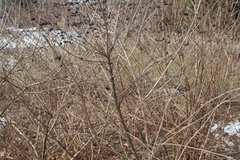
    I froze my you know what off taking this current, leafless, mid-February pic:


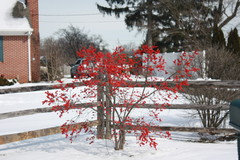
    and here's the winterberry, I didn't get out of the truck for this one:

  • 10 years ago

    Was about what I imagined, though the winterberry is a bit scraggly..must be under some shade.

  • 10 years ago

    I think Russell Page used to spout on quite a bit about 'rules' Flora but as I find him to be such an irredeemable snob, they are to be disregarded. I planted a couple of callicarpas myself a couple of years ago, along with my current new craze - viburnum nudum (chancing my arm though in my alkaline soil). I used to consider viburnums to be a bit of a dull joke (how wrong I was) but yep, I like to see blossom, berries and good autumn colour (hence sorbus) and have been enjoying a euonymous bungeana lately...along with aronias. I rarely get a massive tizz about planting this and that - being able to change our minds at a whim is one of the reasons we have compost heaps and relatives with empty gardens.

  • 10 years ago

    I planted a V nudum myself last year, Campanula, I look forward to it being a large shrub...but truth be told, I like V rufidulum better (of our natives).

  • 10 years ago

    I lived next door to the most appalling leatherleaf viburnum which I hated, HATED with a consuming passion...and it sort of poisoned my mind (that and the ubiquitous v.tinus everywhere) until seeing common old guelder rose (V.opulus) growing en-masse in a natural habitat - that and v.lantana - and what a wonderful spring sight, especially when twinned with euonymous europaeus, a profusion of jewel-like berries - I had an overnight epiphany. Still learning about US natives so will check out the rufidulum - cheers.

  • 8 years ago
    last modified: 8 years ago

    Good marks to the local bog box for planting of Fothergilla gardenii.

    Upon closer inspection one plant seems markedly larger than the others.
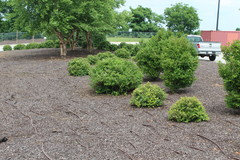
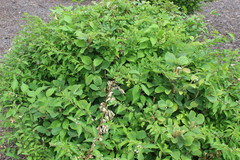
    You guessed right, a weedy specimen of Callicarpa, likely one of the Asian ones. The Fothergilla was probably infected before it left the grower and the current mow, blow & go crew can't tell the difference.

  • 8 years ago
    last modified: 8 years ago

    Lol, I had absolutely forgotten about this thread.

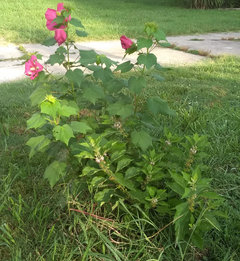
    What actually got planted in the spot vacated by the privet was Callicarpa americana, hibiscus mutabilis, and muhlenbergia riverchonii. The hibiscus carrying the color for high summer to fall, callicarpa fall into winter, and the grass a fall accent (mainly because I didn't know where to plant it).

    With callicarpa americana being a loose shrub, I actually expect them all to co-exist. The callicarpa was a cutting from a plant I had at my parent's house, it's just going full berry production finally this year. The grass is beginning to open it's plumes too (earlier than I had expected). The hibiscus is colorful. Maybe I'll take a shot and edit this post later with what it looks like now.

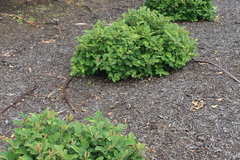
    Ok, callicarpa is in front...loaded with berries which are just now setting, hibiscus in back, and grass kinda out of view hidden by the shrubs.

  • 7 years ago

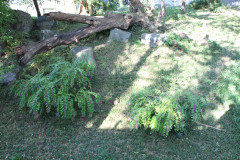
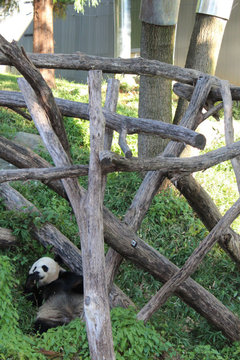
    This pic taken at the Nat'l Zoo. Notice the beautyberry? The last time I was at this zoo many of the displays were empty. Sadly much of the zoo is unkept, beautyberry is a weed we see everywhere in the capital area. Entrance here is free but I would rather pay a fee and see a well run zoo. This is one of the Asian beautyberry species in the panda pen. The pandas ignore it.


  • 7 years ago

    aww

    What pleasant surprise the photo is.

  • 7 years ago

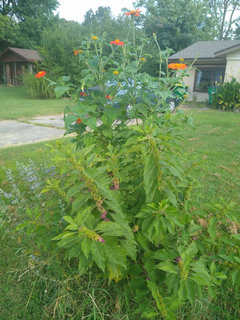
    The hibiscus faded out with the winter (though it had been there for several years)...hibiscus don't seem to like it here (the normal hardy herbaceous does the same thing). Here's what I have now (beauty berry still with us, tithonia, and caryopteris).


  • 6 years ago

    Successful British herbaceous and mixed borders have often used hedges and walls to provide structure. Otherwise such schemes will tend to look like so many sticks and chaff in winter, not have much meat to them even in summer - deciduous and herbaceous plants simply do not "read' like evergreen ones.

    If that is a rule it is a rule of perception, same as red being the color of alarm (or warning) and green assurance, hence their respective uses in traffic lights.