Software
Houzz Logo Print
mesembs

Palm soil?

10 years ago
last modified: 10 years ago

I have long had an interest in growing palms in containers (it is too cold for outdoor palms), and I have recently decided to exercise this interest (lol).

So what I really was wondering about: I currently do not know a good soil mixes to use with my palms, and I certainly do not want to have to repot because of a mistake I could have prevented.

So, i am wondering, does anyone have any good mixes that they use?

I also know about Al's gritty mix, but that all seemed a bit vague to me, so please either suggest a new mix, or clarify Al's gritty mix for me. I will be very grateful either way.

Thank you!!

~palmsandsnow

Comments (44)

  • 10 years ago

    Hi

    I grow a lot of palms from seed so have many in pots in various stages .

    What type of palm ??

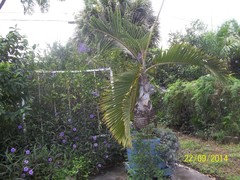
    Here is a pic of a bottle palm grown continuously in a pot . This is a 3x3 foot pot using a mix of top soil,pine bark fines and some leca. This was grown from seed from 1986 . Have used a similar mix except when a seedling using about 50 percent black cow until the trunk started to swell. For understory palms I use a much richer mix . gary

    mesembs thanked garyfla_gw
  • 10 years ago

    I would be disinclined to use any topsoil in a container planting medium regardless of plant type. Or Black Cow, which is a compost. Neither will offer the fast drainage required unless used in minimal quantities and both will breakdown and/or compact with long term usage.

    What is it about the gritty mix that you find vague? Seems very straight forward to me:

    1 part screened Turface
    1 part screened pine or fir bark
    1 part crushed granite (granite poultry grit in grower size)

    mesembs thanked gardengal48 (PNW Z8/9)
  • 10 years ago

    Thank you both for replying!

    garyfla_gw,

    My current interests are in windmill palm (Trachycarpus Fortunei), and also pindo palm (Butia Capitata).

    Thank you!

    gardengal48,

    Thanks for the mix 'recipe' It is much more straight forward recipe than what I found by searching this forum. Then again, It might have been a different mix that I saw! I think it was something like 5:1:1 mix... Anyway, it was very vague.

    Thank you!

    ~palmsandsnow

  • 10 years ago

    LOL!! Even the 5-1-1 is pretty straight forward (at least IMO):

    5 parts pine bark fines, dust - 3/8" (size is important)

    1 part sphagnum peat (not reed or sedge peat please)

    1-2 parts perlite (coarse, if you can get it)

    garden lime (or gypsum in some cases)

    controlled release fertilizer, CRF (if preferred)

    btw, both mixes can be amended for more specific requirements if necessary. For long term growth in a container (longer than a single growing season), I'd highly recommend the gritty mix, as it holds up better and longer without need for replacement.

    mesembs thanked gardengal48 (PNW Z8/9)
  • 10 years ago
    last modified: 10 years ago

    Take a look at this:

    http://forums2.gardenweb.com/discussions/1422673/als-gritty-mix-recipe?n=8

    I took a look at that thread, and for some reason it did not compute with me. The further I looked through the thread, the more confused I got. So there you go! That is ultimately why I asked!

    And yes, I would like a mix that will hold up for a good while, because I always think repotting is a hassle.

    Thanks!

    ~palmsandsnow

  • 10 years ago

    Here is a link to the thread that started it all (or at the least the most current successor to the original thread, since we are on repost #22). It's long and fairly detailed but it outlines the whys and wherefores of container soil mixes and why the bagged stuff really doesn't work well. It is certainly worth bookmarking and reading for future reference.

    mesembs thanked gardengal48 (PNW Z8/9)
  • 10 years ago

    Alright, I'll take a look at it!

    ~palmsandsnow

  • 10 years ago

    Hi

    The so called hardy palms. Are you growing from seed to eventually plant out ?? Both species get very large for a house plant They also require very high levels of light though Butia is the most tolerant .

    There are many other species of palms that would be better as "permanent" house plants Do they grow" brace" roots and are you starting from seed?? If so you'll need to adjust the pot to allow for that habit

    I have never grown them because they are much more suited to cooler climates I understand they are quite hardy though so good luck with them!!! gary.

    mesembs thanked garyfla_gw
  • 10 years ago

    garyfla_gw,

    Yes, I am growing the palms from seed, but I don't know yet if I will plant out, if I did, it would be the windmills that I plant. I tend to disagree with you on this next part though, windmill palms are slow growing, and I have heard many growers on this forum say that these palms are good container plants.

    By brace roots do you mean roots that grow out of the side of the trunk as the tree grows taller? If not, I really don't know what you mean. And again yes, I am growing from seed.

    Thanks for the info!

    gardengal48,

    Hey, I just have a question. I do not have any Turface, pine/fir bark, or crushed granite. Might I be able to find these materials at a place like Home Depot, or what?

    P.S. (This is really a question for everyone)

    Thanks both of you for the nice information!!

    ~palmsandsnow

  • 10 years ago

    I would also like to know if there are any substitutions for Turface; I am not sure Home Depot would have it.

    ~palmsandsnow

  • 10 years ago

    Most anywhere in the west you can find a Horizon store with Turface, I get my granite fines from a landscape supply, I use my chipper/shredder to make fir bark the right size.

    mesembs thanked calistoga_al ca 15 usda 9
  • 10 years ago

    Turface is typically found at a landscape supply company that services baseball fields.
    A replacement is optisorb from oreilly autoparts which is diatomaceous earth.


    mesembs thanked Nil13 usda:10a sunset:21 LA,CA (Mount Wash.)
  • 10 years ago

    Pretty much any auto parts store will sell a product very similar to Turface (calcined clay) as an absorbent. Appropriately sized bark is sometimes found labeled as soil conditioner, orchid bark or reptile bedding (pet supply stores). Granite grit can often be found at landscape supply yards or feed stores (sold as poultry grit) or you can substitute with something like pumice.

    With gritty mix, it is less about sourcing the precise ingredients as it is the particle size and durability. Sometimes you need to get a little creative :-)

    mesembs thanked gardengal48 (PNW Z8/9)
  • 10 years ago

    I think I will just try at an auto parts place. I am confident that Home Depot would have something like pine bark and crushed/decomposed granite.

    Thanks for the suggestions!

    ~palmsandsnow

  • 10 years ago

    Be sure to ask how big the particles are at the auto parts store. One store in my area only carries the really fine sandy stuff and the other carries the coarse gravelly stuff. You want the coarse stuff. I'd just call around first.

    mesembs thanked Nil13 usda:10a sunset:21 LA,CA (Mount Wash.)
  • 10 years ago

    Thank you everyone for your advice and suggestions!

    Jane,

    Nice! Unfortunately, cat palms were never on my favorite list for some odd reason, but I am glad your plants are doing so well! I have never been able to grow a palm from seed past three leaves :( . wrong potting soil and general lack of palm knowledge I expect... Buuuuuuuut!!! That was a while ago. Maybe this time around I will haves some luck!

    ~palmsandsnow


  • 10 years ago

    Where do you live?

    Al

  • 10 years ago

    No offense, but would not like to reveal my place of dwelling.

    I know you are trying to help.

    Thanks anyways!!

    ~palmsandsnow

  • 10 years ago

    He wasn't asking for your home address just a general location like central Georgia or Los Angeles.

  • 10 years ago
    last modified: 10 years ago

    Lol - alrighty then .....

    I'll just wish you well on your peregrination.

    Thanks, Nil.

    Al

    mesembs thanked tapla (mid-Michigan, USDA z5b-6a)
  • 10 years ago

    Nil13,

    I know, but you don't have to know some one's address to be able to nuke them.

    Just saying (lol funny right).

    ~palmsandsnow

  • 10 years ago

    No one can help you without an idea what your growing conditions are. You could add your zone to your user name so we have some idea what climate you are growing. Otherwise, any advice will not be useful.

    Jane

  • 10 years ago

    Jane,

    Yes, I realize this. It is not as essential for me, I think, because I grow 95% of my plants indoors, and my outdoors plants have not had problems in years.

    Thank you for your consideration, I understand you are trying to help.

    ~palmsandsnow

  • 10 years ago

    In terms of a mix for my palms, if I am not able to find the materials needed for the mixes, I might just make up my own mix which could get interesting! I'll just try and see what works.

    ~palmsandsnow

  • 10 years ago

    Where (s)he lives has no bearing on whether or not (s)he can be helped. There is a ton of reliable general help available that climate has no or very little bearing on. Plants of a particular species prefer exactly the same kind of conditions in the rhizosphere whether home is at the equator or in Alaska. I asked where she lived because over the years I've become quite handy at locating those soil components growers often initially have difficulty locating, and I needed that info to get to work on behalf of the OP. I have no problem with the privacy concerns, but I can't help unless I had something to go on.

    There ARE several threads on the container forum dedicated to sharing sources for ingredients used in making soils widely discussed across the forums, in case the OP wanted to do a search and peruse those threads.

    Al

  • 10 years ago

    Light, temps, humidity all factor in. Palms can be tricky growing indoors as they like humidity or are prone to mites. Some Palms like high light, some lower light. Lower light Palms are great as houseplants but can be prone to problems when humidity is too low.

    If the palms can be summered outdoors, that would be helpful info.

    Jane

  • 10 years ago

    Jane,

    I'm a zone 7a, pretty/really hot summers; outdoors in the summer is a possibility.

    Al,

    I have, in fact, been searching this forum quite a lot, but if you want something specific, I have found it is best to just ask the question; rarely does a post go unanswered.

    Thank you both for your help!

    ~palmsandsnow

  • 10 years ago
    last modified: 10 years ago

    Alright!

    I have gathered some ingredients, and I am pleased to announce that I am just about ready to assemble my first 1-1-1 mix!

    This mix is composed of:

    Self-screened Earthgro brown mulch (substitute for screened pine bark)

    Self-screened paver base (substitute for crushed granite)

    Oil absorbent/floor-dry (substitute for turface)

    This is an experiment!

    But all are welcome to criticize/reprimand.

    I'll be sure to tell y'all what comes of it.

    ~palmsandsnow

  • 10 years ago

    Give the bark a good overnight soak before using.

    mesembs thanked Nil13 usda:10a sunset:21 LA,CA (Mount Wash.)
  • 10 years ago

    Thank you, I will try to remember to do that :)

  • 10 years ago

    Good luck. Keep us updated!

    Jane

  • 10 years ago

    I will try to remember to do that too :)

  • 10 years ago

    P&S - what is the paver base made of? Where I live, it's crushed limestone, and that would be inappropriate as a significant fraction of a container soil.


    Al

  • 10 years ago

    I actually don't know, but I will check on it. It is definitely not limestone, though.

  • 10 years ago

    OK - you want something pretty inert - that isn't soluble and won't affect pH or the plants ability to absorb all the nutrients it needs to grow normally.


    Al

    mesembs thanked tapla (mid-Michigan, USDA z5b-6a)
  • 10 years ago

    Yea, I get that. It looks like a conglomeration of some sort, kind of like hardened sidewalk cement, but in different colors. It also says on the bag that it can be used for landscaping.

  • 10 years ago

    Ok, one last question. I have mixed together a soil mix, but I noticed the pieces of Turface and the smaller pieces of paver base had gravitated toward the bottom of the pot, while the mulch stayed near the top. I wonder, is this normal? Will this make a big difference?

    Thank you!

    ~palmsandsnow

  • 10 years ago

    Whenever you have a significantly disparate differentiation in the size of particles that make up the medium, there will be a greater tendency for stratification. Essentially, the physical properties of the medium will be primarily determined by the more homogeneous mix of particles in the lower strata, and the mulch will serve pretty much as mulch, rather than as a integral part of the mix.


    Al

    mesembs thanked tapla (mid-Michigan, USDA z5b-6a)
  • 10 years ago

    I see, and that is as I figured, but my main point is: will this greatly affect the properties of my mix?

  • 10 years ago

    Were the Turface & paver base screened? Did you determine what material the paver base is made of?


    If the finer ingredients aren't screened, you're not going to like what you end up with. There will be a particularly big difference in performance between a mix where all ingredients were of an appropriate size and the mix homogeneous compared to one where the bark is so large it 'floats' on top of the other 2 ingredients if the other 2 ingredients include inappropriately small particles. The difference would not be as significant if the particle size of the Turface and paver base combination is too small to significantly limit the ht of the PWT or eliminate it entirely. In the later case, you'll experience the same limitations associated with other soils/media that support PWTs of similar heights.


    Al

    mesembs thanked tapla (mid-Michigan, USDA z5b-6a)
  • 10 years ago

    Thank you! Yes, I did screen out the smaller particles, especially the sand-like particles in the paver base. But so far I have not figured out what is in the paver base, as the bag does not have a list of ingredients, unlike a box of crackers.

    I will keep trying to figure it out though.

    Could I bother you to ask what PWT means? Thanks.

    ~palmsandsnow

  • 10 years ago

    PWT = perched water table. For more on that, follow the link Pam left above on Feb 10 @ 1:14.


    Al

    mesembs thanked tapla (mid-Michigan, USDA z5b-6a)
  • 10 years ago

    Aaaah, yes I see. I think I might just check that link again!