

The "GMO Feed in Goats" study was falsified
End of investigation, and accusations confirmed. All papers' authors will have to work, and submit publications, strictly supervised from now on.
But they will keep their positions because it's impossible for get rid of a tenured professor.
http://m.repubblica.it/mobile/r/locali/napoli/cronaca/2016/02/09/news/universita_-133079638/
Comments (48)
 10 years agolast modified: 10 years ago
Lol... I gotta wonder what motivates a person to extemporaneously post articles such as this one. Because no research with which the poster may agree has ever contained falsified data.
 10 years ago
Since the link is entirely in Italian (and I am in no way fluent with that language), it's a bit hard to tell what the discussion is about.
btw, that's one of the many features of life online..........one can always find an argument/publication to support ANY view point. Just a matter of picking and choosing and overlooking the validity of sources and junk science. We seem to see plenty of that on these forums :-)
Related Professionals
Daytona Beach Landscape Architects & Landscape Designers · Savannah Landscape Architects & Landscape Designers · Ithaca Landscape Architects & Landscape Designers · Chico Landscape Architects & Landscape Designers · Yuba City Landscape Architects & Landscape Designers · Cowansville Landscape Architects & Landscape Designers · Baltimore Landscape Contractors · Boise Landscape Contractors · Fort Myers Architects & Building Designers · Quincy Architects & Building Designers · Portland Architects & Building Designers · Napa Architects & Building Designers · Yuba City Architects & Building Designers · Kennewick Architects & Building Designers · Toronto Architects & Building Designers- 10 years agolast modified: 10 years ago
Interesting note at http://www.sciencedaily.com/releases/2014/09/140926101023.htm detailing 30 years of studies on over 100 billion animals which showed no signs of health or nutrition problems associated with GMOs. There is also a link at this page to a full journal paper: A. L. Van Eenennaam and A. E. Young. Prevalence and Impacts of Genetically Engineered Feedstuffs on Livestock Populations. Journal of Animal Science, 2014
Renais
- 10 years ago
"I'm glad to see that with such diligent cataloging of what is considered by many as 'safe' GMO's that undoubtedly the people welcoming such info would have no compunctions against mandatory labeling." I would be very concerned about mandatory labeling. There actually is labeling in place already to identify non-GMO foods for those who wish to limit their choices to such foods. Some foods are labeled non-GMO certified, and some are labeled organic. In the US, at the moment, certified organic foods do not contain GMOs. The huge issue with mandatory labeling is the cost to implement such labeling. Testing and supply chain monitoring of all food inputs would add significant costs not requested by those who do not care if their food contains GMO ingredients. Right now, that cost is only borne by those who wish this added feature for their food.
Renais
- 10 years agolast modified: 10 years ago
The cost to implement such labeling? lol... Seriously? Who are you trying to fool? Yourself? If it is so much safer, and 'better', it should be a selling point! Like...
"New and Improved!"
It must cost companies a ton to print that out! Lol. And you wonder, when using red herring arguments like that, why people aren't believing that GMO's aren't safe.
Let's see... 'New and Improved!' has 15 characters. 'Contains GMO's' has 13. Look at that... and since GMO's are so fantastic, it should be a selling point. Therefore, the exclamation point should boost sales. 14 characters!
If that was the "huge issue with mandatory labeling" then there would obviously be no issue at all.  10 years ago
I though Renais clarified the point about increased cost with:
Testing and supply chain monitoring of all food inputs would add
significant costs not requested by those who do not care if their food
contains GMO ingredients. Right now, that cost is only borne by those
who wish this added feature for their food.It's not about the ink on the package. It's the cost to producers to track materials. The onus shouldn't fall on those who are using GM materials, but rather on producers and consumers who choose to avoid them.
With the unfortunate general lack of science literacy in this country, along with the propaganda from Big Organic, I'd venture a guess that packages marked "Contains GMO" would suffer fewer sales. The same would likely happen with bottled water that was labeled "Contains Dihydrogen Monoxide".
A question for those who favor mandatory GMO labeling:Would granulated sugar made from genetically engineered sugar beets be labeled as a GM food?
- 10 years ago
For what it's worth, there has already been quite a bit of discussion of costs in some of the states which are considering laws related to GMO labeling. The actual cost for all the printed label changes has been estimated to be about $.029/person. This would relate to any design changes, etc.. Since labels change frequently anyway, and they are continuously being produced, the cost is very small. However, the cost of the labeling process (certifying and monitoring) of GMO products is conservatively estimated to be very much more. Much of the cost uncertainty relates to what certification would involve. For instance, would drinks, breads, candy, and other foods made with high fructose corn syrup need to be labeled if that corn syrup came from GMO corn (as much of it does). This would require some strict supply train monitoring since there are essentially no proteins left in the processed product, so it would be a difficult test to confirm the absence of GMO corn as a source.
GMO labeling would require another bureaucracy like that required for organic certification. Who is willing to pay this cost, and what benefits would be achieved?
A producer who wishes to sell a non-GMO certified product is not restricted in doing so. Why force producers who do not wish to sell such products to add a feature? The consumer can select what he wishes to spend money on.
There is a good explanation of the supply chain economics and issues at https://gmoanswers.com/studies/costs-gmo-labeling.
Renais
- 10 years ago
Again, if GMO's are better than non-GMO's then labeling should increase demand. The higher demand would easily cover any costs. Besides, if the onus is on the producers, there is no effort needed to keep track. It would be easy to simply make the disclosure begin with the producer To cover any of the companies that package products to simply print... "This product may contain GMO ingredients."
These are excuses. We all know that companies are very concerned that if the consumer is made aware that products contain GMO ingredients, sales may suffer. This has been widely known for some time. All arguments against mandatory labeling are red herrings and you know it's true.
It's a simple economic competition issue of consumer demand. If the consumer is informed about whether the product contains, or may contain GMO ingredients, suppliers who can sell equivalent food stuffs using non-organic, yet non-GMO ingredients - at a similar price point - will sell more product.
Talk about rhetoric... red herring excuses are a form of rhetoric. An informed consumer is the enemy of those with a GMO agenda. Why else come to an organic forum and post such arbitrary content? It's to try to win a battle of competition and demand. - 10 years ago
"Why else come to an organic forum and post such arbitrary content?"
hmmmmm.....because maybe it just might be true??
" We all know that companies are very concerned that if the consumer is
made aware that products contain GMO ingredients, sales may suffer."Oh c'mon......really?? Any adult with half a brain in their head and the slightest bit of awareness/concern of how their food is sourced is already fully aware that products containing GMO's permeate their supermarket shelves - breakfast cereals, cookies, crackers, snack bars, anything with corn syrup or corn products in the prepared food, soy milk, tofu, ice cream, yogurt, anything with a 'Little Debbie' label, diet sodas, canola oil, baby formula, etc., etc., etc. It hasn't seemed to have much of an impact on sales.
Personally, I have no issues with GMO labeling - bring it on!! It really makes no difference to me one way or another as everything I've researched/read from reputable scientific sources (not the fear-mongering press, those with a political agenda or organo-nazis) confirms there is no negative impact on human health and safety.
- 10 years agolast modified: 10 years ago
An informed consumer is the enemy of those with a GMO agenda.
Sadly, this is true; however, one must consider the source and quality of that information. There is far too much misinformation and propaganda being spread by for-profit corporations and snake oil salesmen for the general public to make a truly informed decision.
It's far better to be educated, at least enough so as to be able to separate the good information from the bad.
- 10 years ago
"It's a simple economic competition issue of consumer demand. If the consumer is informed about whether the product contains, or may contain GMO ingredients, suppliers who can sell equivalent food stuffs using non-organic, yet non-GMO ingredients - at a similar price point - will sell more product."
This is already the case. Consumers who wish to purchase non-GMO foods simply have to look for labels stating that the food is non-GMO. They do not need to worry about other foods not so labeled, which may contain GMOs or not. There is no need for a law to tell such consumers that there might be GMOs in the unlabeled foods. Why force those who do not worry about GMO content to pay the cost of an unnecessary label?
"Again, if GMO's are better than non-GMO's then labeling should increase demand. "
I don't see people saying GMOs are better than non-GMOs as foods, just that they are equivalent. If people wish to not eat GMOs, as noted above, there are already alternatives. No new law is needed to help them. GMO corn, canola and soy occupy a very significant portion of US consumption, and are ubiquitous in the American diet today.
Renais
- 10 years agolast modified: 10 years ago
But Renais, educated consumers are not just interested in the scientific study of GMO nutrition and whether it is safe, they are also interested in what GMO's may do to the environment. There is no study that can prove or disprove the long term environmental effects of GMO crops. There are far too many examples of genes escaping into the wild. Look at how many farmers have been sued simply because pollen from their neighbor's GMO crop spread into their seed corn.
People who are interested in organic foods are simply NOT as interested just in whether GMO crops are safe to eat. It seems that yourself, the OP, as well as a few others who have been posting to the Organic Gardening thread are trying to prove food safety. This is a gardening forum. Sure, many are also interested in the produce from those gardens, and that they are indeed organically produced, but organic gardening is a holistic approach to life. Most organic gardeners are often more concerned about the process of growing than they are about the safety of foods grown by big agro. We already know we can't trust the profit motive.
The reason many of us grow organically is to control the process and, through our holistic efforts, to enhance the natural state of the environment as a whole. Growing GMO crops is a dangerous experiment. There is no way to duplicate nature in an experiment. Remember the BioDome experiment? Fail!
Do you understand now? It's not just that they are equivalents for nutrition, the promise of GMO's is that they are BETTER for the farmer, and society as a whole. If they are truly better, then the label would increase sales. And that non-GMO labels exist on every product is a falsehood. How can you say that with a straight face?
Two products side by side. Same price point, one may have GMO's, the other not. Neither one is labeled. Since the GMO product is the 'experiment' it is the one that needs the label. The non-laboratory ingredient does not.
So, when people come to a forum like this, and expect to convince people that they are wrong about the safety of GMO's, the insidious motivations are obvious. Organic gardening is about more than food safety. It is about seeing the world as an interconnected organism that has evolved in harmony for billions of years. To introduce, through way of proliferation, altered experimental organisms in just a few generations is the height of hubris.
Have you not learned from the past? Over and over, humans with financial agendas have promised fantastic results from their laboratories that will benefit humanity and the environment - and every time they are wrong!
Give it up.
- 10 years ago
"Over and over, humans with financial agendas have promised fantastic
results from their laboratories that will benefit humanity and the
environment - and every time they are wrong!"Really - every time???? Guess we all then need to dismiss any modern pharmaceuticals - countless laboratory-spawned antibiotics, anti-virals, pain meds and cancer targeting medicines, not to mention any other creations that originate in labs such as medical implant technology, fertilizers that help feed the world, biocontrols from insects and plant extracts, etc.
Making such egregious statements as the above does nothing to further your cause and only makes your position look silly.
btw, still waiting to hear about those poor unfortunate insect species that are being decimated by GMO food crops. What were they again??
- 10 years agolast modified: 10 years ago
Modern pharmaceuticals kill and injure a percentage of the people taking those medications. These are considered by some as acceptable. However, the person taking it can NOT know ahead of time that they might be negatively affected. It might be perfectly safe for one, and it might be a death sentence for another. The next time you want to use that example, just remember my friend John and the stubs he has as arms because his mom was told thalidomide would be a good thing. The percentages of potential damage are only numbers to the ignorant. To my friend, and everyone who knows him, they are real!
There was no way to positively know the long term effect of the laboratory experiment on my friend nor his mother. But they were told it was safe. Then, when the damage was done, it was too late. Long term damage can NEVER be known. Hubris.
"Laboratory-spawned antibiotics" are the cause behind the most deadly organisms on the planet. Super bugs! The long term effects of use and misuse was not known. It is now. Hubris.
Anti-virals... fairly new science, we are yet to see what fresh hell they might bring. Hubris.
Pain meds... should we even discuss the real-world effects upon millions of addicts? Hubris.
Cancer-targeting medicines... can we even describe these as anything more than poking around? Sure, why not use them though... at least these are known, and sold as imperfect experiments - that there is no way to know whether they will be effective. And sine the cancer will definitely kill, why not? Other than the percentage of people these drugs have killed and injured slightly faster than death by cancer, the irony is that of all the 'scientific advances' these medicines are known to be imperfect, yet are the most efficacious in the long term. They are only helpful, or harmful to the organism taking the dose, not to the environment at large. Besides, the host would die anyway. The only cancer on the Earth itself are the arrogant humans which inhabit it. The ironic aspect? It is human action which causes many cancers.
And here's the thing... I haven't said that efforts to better humans and society through science is wrong. What I said is that the promises backed by financial agendas are NEVER backed up by real world employment. There is no way to duplicate the harmonic balance of nature in a laboratory. What is done to one aspect of nature, affects the rest. It may be immediate, or it may take centuries. There is no way to know.
Mandatory labeling allows the consumer the opportunity to choose how their actions affect the world - and which course to take. It does not guarantee that everyone will make the same choice, it simply offers information of what is part of the natural cycle, and what is man-made.
That said, there are even practices within the natural world that may, or may not be beneficial. Before contour plowing, a lot of good land was ruined. It wasn't until after the damage was done that humans learned from that mistake.
In ancient times, numerous civilizations fell from ignorant agricultural practices. In every case all that was known was the short term benefit. "Oooh, look how much better my crops are doing." Then everybody did it, then their civilization fell.
Hubris is the idea that we as humans can experiment on a grand scale and pretend that what we are doing is 'better' than what we have. We forget that we ourselves are an integrated aspect of nature, not separate from it. What we do to ourselves we do to the world, and what we do to the world we do to ourselves.
The best 'advances' are those where we learn about the world we live in and conform ourselves appropriately. You don't want your house to flood? Then simply realize that houses near waterways flood from time to time. Anything more is hubris.
- 10 years ago
I think, rgreen48 that you and I have some very similar views. I will often tell people that I'm more focused on the process of growing, than on the final products I might eat or use. For me, it is important to improve the land and the environment as I can, and to not cause problems. I will leave my land much better than I found it, and whoever is here in the future will benefit from my stewardship of this property. I many ways I am much more fanatical about what processes and procedures I might use than I'd need to be to be certified organic. There are some areas where, as I've looked at my particular situation, I do not do things the certified way. Certification is not something I'm interested in, so I don't care.
As a professional scientist I was very concerned about the potential negative impacts of GMOs in the growing environment, and I've monitored this situation pretty closely since the first GMO tomato years ago. One of my purposes of posting on this site is to provide a science basis for understanding what is going on in this field. People with a sound scientifically based understanding can then make reasoned decisions. There will still be differences of opinions, but at least they will be based on the facts.
There are issues with GMOs which I see being addressed. Are they being addressed quickly enough? That is another matter of opinion.
- 10 years ago
Proof by verbosity or The Gish Gallop: a debating technique of drowning an opponent in such a
torrent of small arguments that the opponent cannot possibly answer or
address each one in real time.It's a rather poor strategy and most often relied on when one's position is weak and not supported by facts.
User
Original Author10 years agorgreen " Because no research with which the poster may agree has ever contained falsified data."
If it did, I would expect a retraction of the study and some disciplinary action ... because if you have to lie about it, it's not science.
there have been some studies that were truly awesome, but didn't hold up to scrutiny.- 10 years agolast modified: 10 years ago
Renais, agreed. I personally don't buy organic at the supermarket unless it is as low a price as the non-organic. When the price is the same, I will always choose the organic. I doubt that I'm alone. The reason is simple... financial ability. However, my efforts to make a difference within my financial ability comes from my garden.
Btw... when I have the opportunity to garner non-organic fertilizers for free, I take the opportunity and I use them in my garden. Why? Because chemically speaking, for the most part, plants can just as easily take up synthetics as they do 'natural' fertilizers. However, I choose to not give my money in support of the production of synthetic chemicals. I can make such choices because of labels.
I do not, however, use what I refer to as 'cides. Pesticides, herbicides, fungicides... I don't even use 'natural' 'cides such as Bt. This is my choice. Again, I can make such choices because of awareness. I am aware because of labels. I can know what is in a product and make choices. I cannot make anyone's choices for them, and just like Bt might be perfectly safe for any organism except worms, caterpillars etc... it is my choice to use what I want - aside from 'safety'. And again, labels are what inform my choices. For anyone to say that GMO's are 'nutritionally equivalent' and therefore do not require labels, takes away my ability to make choices based upon other factors... especially those related to environmentally holistic approaches to nature. Organic 'certifications' have little effect on my choices except to provide a production-based standard. The certifications do not help those whose idea of 'organic' do not fit into such simplistic definitions.
Sclerid, I'm not sure to whom you are referring, but my verbosity was in answer to the comments of others. If you weren't speaking to me, then I shall sit down. However, to respond to every aspect of every question requires nuance. Besides, I've already ignored some details brought up in comments.
For example... I ignored the tangent of sugar beets above because it would be an entirely separate discussion from the simple idea behind all of my comments...
GMO's are synthetic. Man's ability to see how their efforts today affect the future are limited. To promise a benefit based especially upon financial incentives, while ignoring the potential consequences, is hubris. It ignores the nuance of individual life-choices by assumption of simplistic assertions of supposed* 'safety.'
* Why supposed? Because it is impossible to test for real world applications, and experiments (actions) have both intended, and unintended consequences.
 10 years ago
This issue is very simple for me. I want product labels to disclose if it contains GMO products. If it does, simply state it and if it doesn't, simply state it. Everyone will have to spend the same amount of money for the ink that is used.
- 10 years ago
The following was stated: "detailing 30 years of studies on over 100 billion animals which showed no signs of health or nutrition problems associated with GMOs."
---------------------------------------------------------------------
" Methods:A meta-analysis approach was employed using electronic databases, current and past journals, and bibliographies of relevant articles. Twenty-seven sources were identified from 2003-2015. Keywords used were GMO testing/methods, GMO health risks, and GMO allergy effects.
Results: GMOs have been found to cause adverse health problems (e.g., precancerous cells, bleeding stomachs, hepatomegaly, abnormal renal and blood cells, and premature death) in animals fed exclusive GMO diets......."
See:
https://apha.confex.com/apha/143am/webprogram/Paper323931.html
--------------------------------------------------------------------------------
See also:
http://www.tufts.edu/~skrimsky/PDF/Illusory%20Consensus%20GMOs.PDF
User
Original Author10 years agoDirtGuy - "Everyone will have to spend the same amount
of money for the ink that is used."It's NOT just the labels, it's the extra storage to keep
varieties apart, lab testing to ensure no contamination at every step in
transport, extra cleaning of storage, harvesting and transportation
... way more than a label change.Here's a grain producer's take on it ...
http://thefoodiefarmer.blogspot.com/2014/04/the-costs-of-gmo-labeling.html
And who would pay for the field to market segregation of the supply chains to ensure the labels are not false?- 10 years agolast modified: 10 years ago
"Since Cattaneo sent her findings to the journals concerned, one of the three papers under investigation has been retracted. The paper2, published in Food and Nutrition Sciences, was withdrawn with a citation of "self-plagiarism". The journal noted that the results were still valid and that the issues were down to "honest error".
- 10 years ago
The saddest part of this entire fraud situation in my view is that now a number of students (including a Ph.D. student) are involved in the papers under review. The blemishes on these students' careers will be hard to erase. As the article Henry posted noted, there are now a number of other papers that have come under critical scrutiny since Cattaneo first pointed out the issues. These papers point to corruption in the entire lab.
The European press, which finds this a much more important issue than does the US press, has calls for Infascelli (the lead researcher) to be removed from the University --a most unusually severe punishment.. It will be difficult for scientists to now trust anything he has done, or will do in the future. His dishonesty will haunt him, and his reputation will not recover.
- 10 years agolast modified: 10 years ago
Those who would like more info on Infascelli and his lab can start by reading the Nature article from Jan. 21 of this year. The Nature article points out the involvement of the Ph.D thesis, and other papers from the lab in the fraud investigation. For more info on the "research" and quality of the results, there is an extensive critique at http://www.biofortified.org/2016/01/retracted-infascelli-quality/. This link has links to much more information.
Note that much of such "research" is published in vanity journals which will publish essentially anything if a page fee is paid. The biofortified link calls these predatory journals, but I use the more conventional term. Peer review and quality are not hallmarks of these journals. ars Technica has a good piece on the fraud issues at http://arstechnica.com/science/2016/01/anti-gmo-research-may-be-based-on-manipulated-data/.
There is a short piece at http://barfblog.com/categories/genetic-engineering/ about more of the papers involved, including notes that Infascelli happens to be on the board of a journal that published some of his work. There are also details here about how the exact same photos were used in different publications to illustrate different things: in one publication, it was supposed to show data on a liver, in another, data on milk. The fraud could not have been much more blatant.
- 10 years ago
renais1, I asked for documentation of your statements. The Nature article that you refer to is the one that I introduced. It tells of an investigation - it is not a report of conclusions except for the journal report that I pointed out. "The paper2, published in Food and Nutrition Sciences, was withdrawn with a citation of "self-plagiarism". The journal noted that the results were still valid and that the issues were down to "honest error". The 2 other journals apparently have not yet replied to the accusations.
You then provide a link to a Biofortified article. Biofortified is not a reviewed scientific journal. What is Biofortified? http://www.sourcewatch.org/index.php/Biology_Fortified,_Inc.
You may find this article of interest: http://www.gmwatch.org/news/archive/2014/15630-biofortified-continues-to-misrepresent-gmo-facts I personally check that site (biofortified) daily, but I consider it as one view of gmo facts. I suggest that the reader do a Google search using the search terms biofortified and kuska for specific examples.
The Technica link that you cite also gives the journal response. As indicated in the title "Anti-GMO research may be based on manipulated data" he uses the concept of "may be based" to the rest of the article.
The final link that you gave appears to repeat the information given in the earlier links. Yes there are investigations and there are apparent problems/errors. But is the journal response accurate? The journal noted that the results were still valid and that the issues were down to "honest error". The scientific way to test this statement is to try to repeat the experiment (unless there is an admission of guilt).
In summary. The title of this thread is: "The "GMO Feed in Goats" study was falsified". I suggest that the information presented in this thread indicates that an "accurate" title would be something along the line of: ""The "GMO Feed in Goats" study may have been falsified".
- 10 years ago
lazy-gardens, you totally missed my point, I am not concerned in the least about what one farmers is crying about the cost or what every they are think it represents to only their singular farm. I want to have full disclosure if the product offered to the public today is GMO laced or not. Don't patronize me or anyone else by dodging the question. Disclosure of the products offered to they public should be disclosed. I cannot believe why anyone would object to disclosing to the public such a controversial issue. Why are you afraid of simply disclosing that a product contains GMO products.
 10 years ago
"Just exactly what insect species are being decimated?"
Monarch butterflies for one, just off the top of my head. Glyphosate has killed off significant amounts of milkweed which the butterflies require for breeding. Other butterfly species have suffered, and firefly populations have fallen off in recent years. An entomologist could doubtless supply lists of insect species suffering from GM farming methods.
- 10 years ago
It is a pretty generous leap to assign glyphosate the responsibility of loss of monarch butterfly habitat.......while I do not doubt it has some influence, the loss of habitat due to continued development/urban sprawl in the areas where milkweed grew naturally has a larger role, to the tune of 2.2 million acres per year. Also, the loss of overwintering habitat in Mexico due to logging and forestry is also significantly to blame.
To assign responsibility of insect declines solely to the development of GMO crops is extremely simplistic in approach and ignores so many other, equally or exceedingly damaging factors, primarily that the human population keeps expanding and as it does it claims more and more land that was once naturalized wildlife habitat. Not only do you see this in this country but you see it all over the world and with much larger and more significant species than just insects. It is just not possible to directly assign responsibility to a single factor and certainly not to one as specious as GMO's.
- 10 years ago
gardengal48 (PNW Z8/9) Of course there are often a number of contributions to a given problem, but that does not mean that each contribution should be ignored.
Nature is complex. If one reads the actual research papers (instead of just the abstracts) one normally finds that the publishing scientists, reviewers, and the editor are aware of this complexity. The following link leads to a recent full paper that reports the results of a study of:
"Effects of sublethal doses of glyphosate on honeybee navigation"
- 10 years ago
spedigrees the study you cite gmo's hurting Monarch butterflies was debunked several years ago.
- 10 years ago
The following was stated: "the study you cite gmo's hurting Monarch butterflies was debunked several years ago."
H.Kuska comment: Oh?
See:
https://aesa.oxfordjournals.org/content/early/2016/02/04/aesa.sav115.full
- 10 years ago
"...evidence that the key driver of population decline is the massive loss
of milkweeds, the larval host plant, in agricultural fields due to the
use of glyphosate..."It seems the key driver in butterfly population decline is a loss of milkweed and not the glyphosate itself. The plants could have been removed with shovels, but that would not have made shovels responsible for hurting butterflies.
- 10 years ago
There are lots of comments in the media about how Roundup ready crops are responsible for the decline of the Monarch. In fact, it is NOT the crops, but, as noted above, the fact that farmers are more efficient at eliminating milkweed in their fields that is the issue. See http://www.mlmp.org/Results/Findings/Pleasants_and_Oberhauser_2012_milkweed_loss_in_ag_fields.pdf for a wealth of information on how milkweed has been reduced in agricultural fields, and the effects on the Monarchs. As noted above, it is not Roundup that is causing the problem; if farmers had developed a great mulch that suppressed weeds, the same weed reduction could have occurred, and there would be articles about how the mulch reduced the monarch population.
There are some very significant efforts to increase the planting and development of more land that has milkweed. One of the effects of the current government program to use alcohol fuel in cars has been a reduction in the area set aside for such plantings.
Note that there has never been a study which linked Roundup monarch mortality directly. It has always been the case that the efficient weeding which Roundup ready crops allows means that there is less milkweed in agricultural fields. It might be of interest to also note that milkweed is a plant which is often associated with disturbed ground. When the great plains were first farmed there was a significant increase in milkweed due to the increased disturbed ground.. Those farmers brought monarch populations up above pre-Columbian levels by sod busting.
Renais
- 10 years agolast modified: 10 years ago
The following was stated by Renais1: "As noted above, it is not Roundup that is causing the problem; if farmers had developed a great mulch that suppressed weeds, the same weed reduction could have occurred, and there would be articles about how the mulch reduced the monarch population."
H.Kuska comment: please put in quotes the statement(s) in the link that you provide in your last post that you feel supports your conclusion: "it is not Roundup that is causing the problem;"
The reference that Renais1 gave states in the discussion the following:
"We have not yet seen the full impact that the use of glyphosate
herbicides and the consequent reduction in milkweed resources
will have on the monarch population. At present, some milkweeds
still remain in agricultural fields. Given the established dominance of glyphosate-tolerant crop plants and widespread use of glyphosate herbicide, the virtual disappearance of milkweeds from agricultural fields is inevitable."H. Kuska comment: In the above quote I have used bold print to emphasize what the authors have to say about the contribution of Roundup. And of course the wording had to be approved by the reviewers and the editor.
 10 years ago
Farmers don't want weeds, let alone perennial milkweed in their fields. So....other sources need to be provided. I let a few grow around here.
- 10 years agolast modified: 10 years ago
I suggest that the information presented in this thread indicates that
an "accurate" title would be something along the line of: ""The "GMO Feed in Goats" study may have been falsified".Make any suggestion you like, but "may have been" is looking more and more like "was deliberately". A second Infascelli paper was retracted last week.
Link:
- 10 years ago
sclerid, thank you for pointing out the more recent findings on an earlier research paper from the same group. An important question that remains (at least for me) - was the digital manipulation due to the lack of scientific ethics by an individual in the group (and not known by the other authors) or was it known by the other authors.
It is easy to say that all of the authors on the paper should have checked all of the data, but in practice this is probably very seldom done. I taught and supervised research at a much smaller university. I did have 2 thesis that I rejected, but I still had one published paper that I had to publish an "errata" on as the data on which part of it was based were incorrect. I never thought to check that data.
 PRO10 years ago
I watched the youtube video at the end of this article 2 years ago. I wonder if anyone has heard about French Prof. Gilles-Eric Séralini.
He did a research study about organ damage when using Roundup ready seeds and GMOs (genetically modified organisms). Prof. Séralini is the leader of the research team from the Committee of Independent Research and Information on Genetic Engineering (CRIIGEN), and the Universities of Caen and Rouen. His conclusion appear in the International Journal of Biological Sciences. Prof.Séralini and his team conducted separate tests 7 years after Monsanto released GMOs into the world, which means Monsanto never did any long term research of the effects of GMOs and Roundup on mammals, and particularly in humans. “The GMOs were released without any toxicological tests on Mammals”, Prof. Séralini explained. He said the GMO companies test their products for safety, and then they will share their findings with the general public. The problem is that there is no independent studies of those findings after a product has been released. He studied, and analyzed the results given by Monsanto, and came to the conclusion, that rats that were fed with GMO during a 3 month period, developed serious damage to its kidneys and livers. He affirms that GMOs are unsafely tested, and that GMOs presents levels of toxicity within the very short time they are tested (3 months).
He concluded a 2 year test on rats, that ate GMOs, and GMOs with Roundup, and released the results.
https://www.youtube.com/watch?v=pwBSjLkNe94
This is another reason GMO foods should be labeled, and toxic pesticides are not needed if you follow an organic approach to lawn, and garden care.
- PRO9 years ago
It looks like Profesor Séralini's research Still stands.
For every article on the internet, there will be another article that will say the opposite. I guess nobody wins....
JGilOrganic
Marc Fellous, former President of the Biomolecular Engineering Commission (CGB), has been found guilty of forgery and use of forgery to defame Prof Gilles-Eric Séralini.
On 22 September a judge in the Criminal Court of Paris found Fellous guilty of forgery and the use of forgery in order to defame Prof Gilles-Eric mobile gamblingSéralini and CRIIGEN, a research association which focuses on the risks of genetic engineering and pesticides and the development of alternatives.
Marc Fellous is a GMO proponent who was formerly President of the Biomolecular Engineering Commission (CGB), which assessed the safety of GMOs in France for the ministries of agriculture and environment from 1998 to 2007. In 2016 he became president of the French Association for Plant Biotechnology, a lobby group that was set up to promote GM crops.
Last November Fellous lost a libel case to Séralini. The court ruled that Fellous had defamed Séralini.
During that court case, Fellous used or copied the signature of a scientist without his agreement (“forgery” and “use of forgery”) to argue that Séralini and his co-researchers were wrong in their reassessment of Monsanto studies. The Séralini team’s re-assessment reported finding signs of toxicity in the raw data from Monsanto’s own rat feeding studies with GM maize.
The new court ruling means that Fellous will be sentenced in a few months’ time – probably in early 2017 – at a public correctional hearing. The use of forgery in a court case is a serious offence and may result in a jail sentence.
The ruling marks a second court victory this year for Prof Séralini, his research team, and CRIIGEN. On September 7 they won a libel suit in the Appeals Court against Marianne magazine and its journalist Jean-Claude Jaillette, who repeated the defamatory words of the American pro-tobacco and -GMO lobbyist Henry I. Miller.
- 9 years agolast modified: 9 years ago
Still stand as retracted? Yes. Yes, his GMO and Goats paper is still retracted.
You can find all kinds of stuff on the internet but, I have to warn you, it's not all true. It's more a matter of knowing how to evaluate reliable sources of information as opposed to "guess[ing] nobody wins".
Seralini may have been successful in libel case, but that says nothing for the quality and content of the earlier, reacted paper. The glyphosate/rat paper was retracted because of poor design and shoddy procedural practices, the GMO/goat paper retracted for deliberately falsifying data.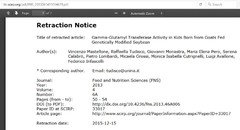
- 9 years ago
sclerid(6a/5b), stated: "The glyphosate/rat paper was retracted because of poor design and shoddy procedural practices,"
H.Kuska comment: no documentation given for the above.
The links below are to what Retraction Watch stated.
http://retractionwatch.com/2014/06/24/retracted-seralini-gmo-rat-study-republished/
- 9 years ago
The glyphosate/rat paper was retracted because of poor design and shoddy procedural practices.
The link below is what the publisher stated.
- 9 years ago
sclerid, how does your quote support your statement:
" shoddy procedural practices." ?
The link you gave states: "Ultimately, the results presented (while not incorrect) are inconclusive, and therefore do not reach the threshold of publication for Food and Chemical Toxicology"
And then in the same link:
"The retraction is only on the inconclusiveness of this one paper. "
--------------------------------------------------------------------------------
The readers may find this more recent scientific paper of interest (published in a Springer Journal):
http://enveurope.springeropen.com/articles/10.1186/s12302-015-0049-2
The following background material concerning this journal is at:
http://enveurope.springeropen.com/articles/10.1186/s12302-015-0049-2
- 9 years ago
sclerid, how does your quote support your statement:
" shoddy procedural practices." ?
Moving the Goalposts:
Demanding from an opponent
that he or she address more and more points after the initial
counter-argument has been satisfied refusing to conceded or accept the
opponent’s argument.



rgreen48