Software
Houzz Logo Print
zmb01b

Stone pine needs help

10 years ago
last modified: 10 years ago
Trees · More Info

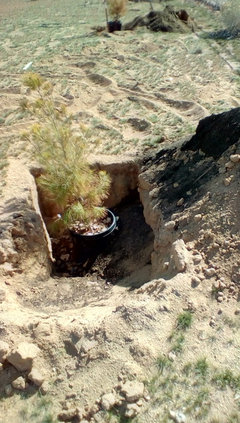
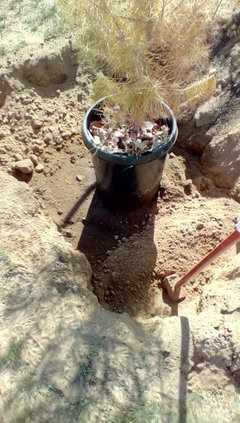
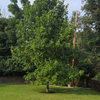
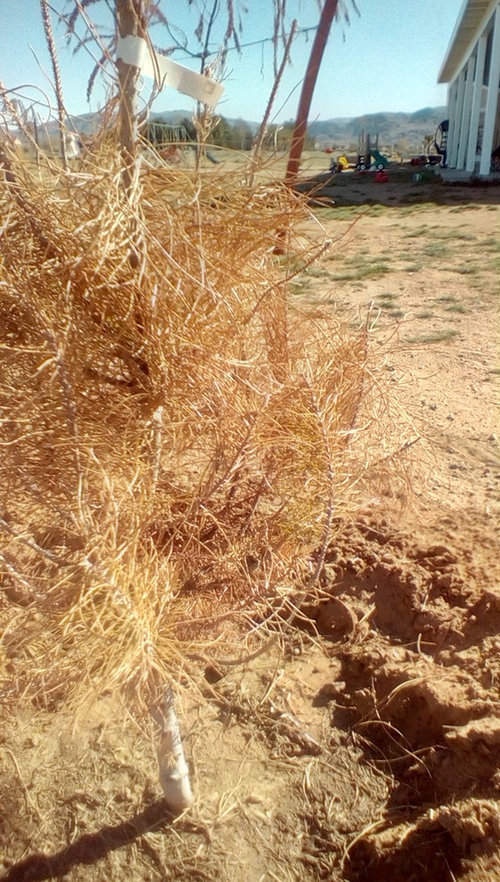
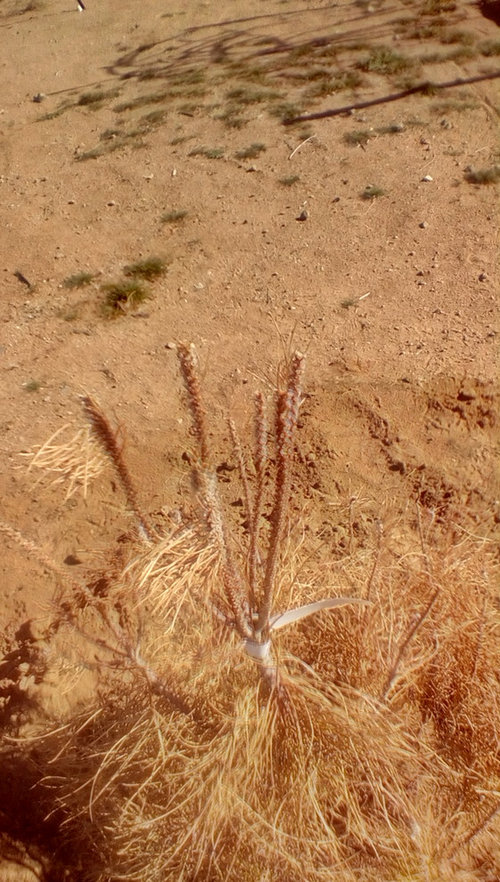
Unfortunately I did not get all our new trees (15gal) planted by winter. This one stone pine started turning brown so I make an emergency hole and sank it, in the bucket and covered it with a little mulch. Hoping this would help protect the roots from any freezes. We had a couple weeks in the teens over night. I finally decided to transplant as soon as it started warming up, about a month ago. It still has not shown any recovery, maybe too early to start new growth. The tips dried and broke, much of the rest of tree is still supple and bends ok though still all brown needles. The other stone pine that we got planted early looks fantastically green. I really don't think it was over watered, perhaps under. The tips that do break when bent are still green inside.

Trees · More Info

Comments (23)

  • 10 years ago

    Sorry, your conifer is dead.

  • 10 years ago

    Ah, yep, must concur.

  • 10 years ago

    i agree with the others.

  • 10 years ago

    Native soil is very sandy so drainage is not an issue. I waited to plant as I had ran out of amendment. The tree started turning brown before it got in the ground. We are in the high desert, CA, zone 8. It still has green needles and is bendable so hoping it might come back.

  • 10 years ago

    Looks so deep in the hole. What do you mean 'ran out of amendment'? What amendment and for what purpose?

  • 10 years ago

    "I waited to plant as I had ran out of amendment."

    It sounds like you may not be familiar with the science of planting trees. I would recommend reviewing the following link: Planting a Tree or Shrub (be sure to see section 7)

    "It still has green needles and is bendable so hoping it might come back."

    I'm still hoping to see Ed McMahon at my front door with a giant check.

  • 10 years ago

    Matthew, there are still signs of green because it takes awhile for everything on a conifer to turn brown. That doesn't mean that it's not dead.

  • 10 years ago

    Anyone remember Monty Python's "late parrot"? That is a late pine tree. Sorry to have to reiterate.

  • 10 years ago

    why such the harsh comments, geeze. like I said initially, the tree was turning brown before it got into the ground. I've done a fair bit of landscaping in CA and rarely never planted anything without amending the soil. I live in the desert and my soils are mostly loamy sands with basically 0% organic matter, so it makes sense to me, a professional soil scientist BTW, to add some OM, one of soils most important ingredients. Tree only been planted for a month or so, I doubt the root flare is an issue. Something happened this winter, while it was above ground. too much and not enough water look the same?

  • 10 years ago

    "why such the harsh comments(?)"

    I don't think anyone was trying to be harsh. It's just that we're trying not to give you false hope!

    "...it makes sense to me, a professional soil scientist BTW, to add some OM, one of soils most important ingredients."

    I am a little confused by this. I don't understand how a professional soil scientist would not know about the problems associated with adding amendment when planting trees...unless maybe your area of expertise is more civil engineering and not horticulture. This issue is pretty well understood and settled science.

    In some special cases, amending large areas, with the right amendment, can be beneficial, but, in general, it's best to avoid amending the soil when planting a woody plant. It's practically never, in the long run, beneficial to amend a small area (adding amendment to the backfill) when planting woody plants.

  • 10 years ago

    I have never had negative effects by adding amendment to the native soil backfill. I am not a hort specialist and have not planted a lot of trees either though. But what is the problem with amendment, short or long term, esp. with very sandy soils that have TOO much drainage.

  • 10 years ago

    Organized studies using controls were seeing decreased growth from amending of planting holes starting in the 1960s.

  • 10 years ago
    last modified: 10 years ago
    The problem with amending soil for trees is that you usually only amend a small selection. Water often has trouble crossing the interface where the two different soils (native and amended) meet. (For reasons I don't understand) This can mess with drainage or create some kind of wicking action where moisture is wicked away. Also, if the amendment works and improves the soil, the roots are sometimes "reluctant" to cross into the inferior native soil.

    Regardless, amendment isn't your problem. Even if you think amendments help in your situation, a pine would probably have a better chance in sandy soil then surviving the winter in a pot.

    The problem with burying in a bucket is the bucket may fill with water if there aren't holes in it. Don't know if there were holes in your bucket.

    If it died before being put in the ground...it could be the cold, or have been too dry, or have been too wet.

    Matthew 8b-Mojave Desert thanked edlincoln
  • 10 years ago
    last modified: 10 years ago

    Amending planting hole back-fill usually gives it a different texture from the soil around the hole. Water moving through a soil profile halts and accumulates when encountering a different soil texture. So amended planting holes dug out of damp, heavy soils may act as sumps, collect water.

    And since amending of planting holes often makes them coarser in texture than the unmodified soil around the planting hole water may be attracted away from the amended vicinity of the transplant, resulting in a chronic drought condition. This happens because finer textured soils have a greater attraction for water than coarser textured soils.

    I have dug plants installed with intact potting soil root-balls to find them as dry as dust, in the midst of moist soil. The amending of planting hole back-fill merely extents the zone of difficulty out a little farther.

    Roots in amended holes are not routinely reluctant to enter unmodified soils around the holes, although stated repeatedly this is false. An exception is when planting hole walls have been severely compressed by tree spades. In those instances the tiny new roots growing from the cut ends of the sometimes quite large and old roots of spade-dug trees may grow into the soil around the holes less readily than if it were loose and well aerated.

    The solution in this instance is to use back hoes to dig the planting holes for spade-dug trees. I have even seen trees inserted into spade-dug holes left sitting perhaps nearly 1 ft. above grade as a result of the obviously ludicrous and cheapskate practice of planting spade-dug trees in spade-dug holes.

    This was at a university where the contractor was probably getting top dollar for the job. Multiple different trees were left perched in the lawn in front of a building, looking as though they had dropped from the sky and pierced the ground.

  • 10 years ago

    "Roots in amended holes are not routinely reluctant to enter unmodified
    soils around the holes, although stated repeatedly this is false."

    Stated in that way, I can see how the statement could be considered misleading. However, in cases where small areas (like the planting hole) are amended and the surrounding soil is well-draining (so that the planting hole stays moist while the surrounding soil dries out), root systems are likely to develop improperly and roots may be encouraged to develop preferentially in the amended area. Drainage doesn't really "block" root growth but encourages root growth in certain ways and in certain areas. The results can be that amended planting holes frequently result in more poorly formed root systems.

    As explained above, this isn't the only problem caused by amended soils (and often may not even be the primary problem) but can still be problematic. Amending soils when planting woody plants is rarely (only in what I would consider special cases) beneficial.

    Matthew 8b-Mojave Desert thanked brandon7 TN_zone7
  • 10 years ago

    ....but regardless, given that to survive and thrive, a tree must extend its roots well beyond that small backfill area, what is done there, even if to the
    "good", is of little to no ultimate consequence to the plant. Personally, I believe this to be the single greatest reason not to amend backfill. It's insignificant in the ultimate performance of that plant.

    Matthew 8b-Mojave Desert thanked wisconsitom
  • 10 years ago

    I certainly understand the pore space issue and how it could be a concern, however I think primarily with finer textured soils. This problem could also be a function of the type of amendment, how fine the OM particles are. Careful backfiring with a "gradient" of amendment, less amendment on the boundary of the native soil, more towards the potting soils mix of the container would decrease the abrupt textural change. I also understand the roots will eventually grow beyond the backfill hole and have to adapt to that soil. With the sandy soil we have here my thinking was to provide an initial sink of OM to provide nutrients and moisture, I'm in the desert with summer temps in the high 90s-100s with strong winds for a good 8-12 weeks. Keeping them hydrated can be tough, OM will help that by increasing water holding capacity. Furthermore, the long-term benefit of OM decomposing and leaching nutrients into the rootzone should work if the planting hole is sufficiently sized. I dug almost all mine, about 35, with a backhoe. They all measure at least 3x4x4', some as deep as 5', a shovel length. I'll post some pics. I do think the cold here got the stone pine. A couple other trees in ground got zapped good by temps in the teens.

  • 10 years ago

    It makes sense to me. It works if the interface is gradual and convoluted. I've done it for years. Planting in a smooth sided hole in clay is not the way to go. It's all about drainage and no sudden interface.

    Mike

    Matthew 8b-Mojave Desert thanked Mike McGarvey
  • 10 years ago

    Lots of studies have been done regarding amending soil when planting woody plants. Some of these studies have focused on plantings in courser grained (sandy) soils, such as yours. None have shown a long-term benefit to amending backfill soils. I don't think you are likely to cause problems with just a little amendment (heavily amending would be much more likely to be problematic), but I also think it's important for people to realize that amendment is, at least, not a necessity.

    I can't understand why you'd dig a planting hole 5' deep! It is virtually universally recommended not to dig the planting hole deeper than the rootball being planted (except in very rare cases where one can dig down to reach a better-draining level of soil AND still keep the backfill and plant from sinking). I'd recommend that you don't do it. There's no advantage, and there is the disadvantage that you could get a sinking plant. Also, there's the extra work.

  • 10 years ago

    Yeah it is alot of work mixing and back filling. I use a 45 lb tamping rod to get good compaction too. Each tree has taken me a good 4 -6 hrs to get planted, that's not the digging just back fill. Finished one today. This is an Aleppo.


    Last April I got 35 trees. I had access to a backhoe and it made sense to just get all the holes dug with that. Amending the soil here with some OM and compacting the back fill to eliminate subsidizing was intuitive. I just don't see how adding OM to sandy soils will be a detriment. If you can site the research I'd like to read it. I have 5 or so trees that did not get holes dug with the backhoe, so I may try them into holes considerably smaller. The previous owners put a few eucalyptus out front with apparently no major amendment or even decent well ring and they have gotten going pretty well.


  • 10 years ago

    I just don't see how adding OM to sandy soils will be a detriment. I agree with that and so does Cornell Factsheet

    The reality is that the planting site is necessarily modified with OM because the potting mix (at least in my part of the country) is easily 85% bark. Sounds like you are already on the right track with the backhoe, follow-up and let us know how the trees grow.

    PS by now you know that the pine in your OP died having nothing to do with amended soils.

    Gotta go, late for church.

  • 10 years ago
    last modified: 10 years ago

    I just reread that Cornell factsheet and it is not addressing what we are talking about. It's not about amending backfill soils when planting woody plants. Cornell (yep, same people) have a number of publications that advise against amending backfill when planting trees. So...apples and oranges.

    Sam, you might want to reread Mathew's second post (6th post down, I think). The plant was NOT planted BECAUSE of a lack of amendment on-hand. So, I think you could definitely say that the pine likely died because of amendments, just not the way you might have been thinking.