Software
Houzz Logo Print
edlincoln

Most Reliable Conifers for Massachusetts?

10 years ago

What spruce, fir, juniper, and cypress are most reliable in Massachusetts?

Comments (10)

  • 10 years ago
    last modified: 10 years ago

    Interesting. Not many people grow firs around here. Lots of people seem to have trouble with Blue Spruce. My parents have a rather good looking abies concolor.

    Diseases seem to be the problem. Pine bark beetles threaten most pines, spider mites threaten spruce.


    What is the most bullet-proof "blue" form.

  • 10 years ago

    Are pine bark beetles an issue for white pine, which is native? I don't see that at all here. There are some smaller versions of white pine, mostly weepers or derived from witches brooms.

    As far as junipers, avoid Juniperus scopulorum, the Rocky Mountain juniper which tends to get diseases in our eastern more humid climate. It has some handsome cultivars, but they tend to live a short time and look bad after the first year or two.

    I would second the suggestion to visit Arnold Arboretum, and the Polly Hill Arboretum, though probably warmer than your folks' house, would be helpful for salt-tolerance since it is on an island.

  • 10 years ago
    last modified: 10 years ago

    White pine is the only local pine that seems immune to bark beetles. That's not purely because it's native...my understanding is that native pitch pine and red pine are somewhat affected. White pine is my favorite pine in terms of looks...I prefer it to a lot of the exotics folks on the conifer forum rave about. The problem is it is notorious for being vulnerable to salt and dropping branches in ice storms, making it problematic as a coastal wind break or street tree. Thus I tend to have the dilemma of going with white pine (beautiful, disease resistant, cheap, easy to find, but extra vulnerable to salt spray and prone to dropping branches) or pitch pine (super salt tolerant, wind resistant, but still somewhat prone to bark beetles and less attractive)

    Also wondering if some nice blue juniper might be a good choice for the area.

    I've been to the Arnold Arboretum a few times. Awesome place to see real world examples of trees you are considering.

  • 10 years ago

    Yep, Blue spruce are very susceptible to pests & diseases when they are outside their native range. It seems the number of issues with this species has only increased in the past few decades.

    For blue form, I would go with any of the cultivars of concolor or koreana. There are several cultivars to choose from, depending on the dimensions you are looking for. 'Blue Cloak', 'Archer's Dwarf', and 'Kings Gap' are 3 really nice cultivars of concolor. Koreana is most well known for it's "white curled" needled cultivars such as 'Silberlocke', 'Silver Show', and 'Ice Breaker' (maybe the most sought after dwarf conifer), but there are also some nice blue forms as well. Wittboldt-Muller nursery has been somewhat obsessed with creating the greatest blue form of koreana for sale as christmas trees. They have crossed it with lasiocarpa (Sub-alpine fir) and even applied radioactive cobalt treatment to form some of the best cultivars including 'Blauer pfiff', 'Blue Emperor', and 'Blue Magic' just to name a few.

    Beyond the firs, Picea engelmannii 'Blue Angel' and 'Bush's Lace' have both done well for me so far, but I have concerns about recommending them due to their very close relationship with the blue spruce. Any of the hardy cedrus do well here, such as Cedrus deodara `Feelin Blue' or Cedrus atlantica 'Glauca'.

    In addition to those, The owner of Katsura gardens in plymouth, ma (best conifer nursery around), has a ~15yr old Abies numidica 'Glauca', that has become my new favorite conifer. I have no evidence of long term success of this species, but it seems to do quite well.

    Another one that has caught my attention lately is Cunninghamia lanceolata 'Glauca'. It might be marginally hardy, but the really interesting thing about this one is that it is regenerative, which is quite rare, and as far as I known, unheard of for any other blue variety of conifer. So, like yew, this species can be cut right down to a stump, and it will regrow. Making this a nice blue alternative to green yew foundation plants seen in front of everyone's home, will still allowing for annual sheering to keep it's size in check, and is said to have very good shade tolerance.

    edlincoln thanked sc77 (6b MA)
  • 10 years ago
    last modified: 10 years ago

    So, concolor fir may be the way to go. I should look into blue forms.

    How do the native Firs do in Massachusetts?

    I've wondered about Blue Atlas Cedar and Alaskan Cedar. The native Eastern Red Cedar do great. (Someone should come up with a blue cultivar of that...it would be really useful...)

    Cunninghamia lanceolata might not be cold-hardy enough, but is intriguing. While it is not the main place I'm interested in putting conifers, there is a spot that might be interesting. The neighbors put in a row of white pine as a privacy screen separating our yards. White pine lose their lower branches of course, and I question their longevity in that spot. (It's the spot that gets the most heavy winds and is most likely to get salt spray in a hurricane) My parents put in a mixed border of dwarf alberta spruce as "backup" there and I've added holly...this might be an interesting thing to add. If it tolerates shade it can survive in the shade of the white pine, and I can hack off branches that get damaged by wind or frost or salt spray. Can block the bottom as the white pine lose branches, and then hopefully they will get reasonably tall before the white pine get taken out by a hurricane or someone decides they are too big.

  • 10 years ago
    last modified: 10 years ago

    I guess the only true Native fir is Abies balsamea which doesn't do well, at least in eastern MA. The mountains of western MA, NH and north is where it really thrives. However, I have seen some sites list concolor as native (not by definition as originating here), but has actually been able grow in the wild here and can now be found in pockets throughout Mass, Maine, & Vermont. I found one growing randomly in the woods near my house. It was that finding, that got me to start researching the species. I figured, if they could grow in the wild here, they had to be pretty well suited.

    It is true that firs are not planted as frequently, but if you keep your eyes peeled, you will see them. And, they almost always look way better than a blue spruce of the same age, full to the ground, and healthy. But, you never see them for sale at the big box store, it always Blue spruce, so that's what the vast majority of people plant.

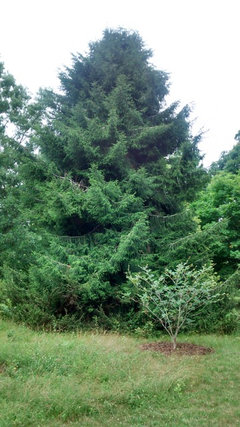
    I have seen several old Blue Atlas cedars that look excellent. They seem to do quite well here also. I've posted this before, but here is a picture of two side by side concolors near my house that are at least 30ft tall and very wide. Ultra healthy looking with branching all the way to the ground. I know of another one that is about 60ft tall and looks pretty decent (planted way to close to the house).

    I wouldn't have considered Cunninghamia, but since It will be sheltered by my foundation on the N. West side of my house, and also that it can be sheered if there is winter damage in really cold winters, it seems like a good one to try.

  • 10 years ago

    Picea Orientalis @ Polly Hill looking healthy & full

  • 10 years ago

    I have a serbian spruce which is has been in at least 8 years and is beautiful.

    Spruce Fat Albert has done very well, but it hasnt been tested yet, it has been in about 4 years.

    At Mason Hollow I purachased blue atlas cedars ¨yankee blue¨ They are alive, but were small and planted 2 years ago.

    My mongomery spruces varied too much in form and look rather silly now. No diseases and color has held.

    White pine: many get white pine weevil that result in double headers- ok if seen from a distance, not so attractive up close. One could, I suppose , train a new leader but

    who has time to do that and once they are tall, forget it.

    Funny how the mind works: I have two that have limped along for several years and I

    cannot recall the names.

    For my money, the chamycypress (sp) are green enough, varied in needle form, height, density, and character to fulfill many evergreen garden requirements. If one is a collector that won´t work. But for the everyday gardener wanting ¨evergreen" beauty, I would turn to these early on.

    My 10 cents worth.


    edlincoln thanked Marie Tulin Boston burbs z 6a
  • 10 years ago

    Sorry, I don't have a lot of experience with conifers that are positive, but thought it might be helpful to also know what didn't work well.

    I had a Juniper 'Witchita Blue' and that was a big mistake. It did not do well for me at all and I moved it to two different locations in the yard. Finally we ripped it out as it was covered with rust.

    For evergreen, I ended up with Arborvitae 'Emerald Green' and another variety. They do pretty well and my conditions are challenging, so I'm happy with them. The one I am most happy with is the variety I don't remember the name of and I just went looking for it and can't find it. I could come up with it if anyone is interested. I thought it might be a Western Arborvitae, but I'm not sure. I bought it at NE Nurseries in Bedford and it was their recommendation.

    I don't have enough sun for a lot of conifers or I would have more. So I have gone for Taxus, which I'm very happy with. It created a good screen where I needed it with very little sun.

    Boxwoods are the other evergreen I use and that's about it. Sorry it's not more help.