Software
Houzz Logo Print
dgeist

Perforated vs. Solid PVC in landscape drains: when and where?

9 years ago

I'm trying to formulate a plan for dealing with excess water in two spots in my home. Both at the base of downspouts and both which tend to collect and pool based on the slope and the downspout itself. The grade SHOULD be easy to handle with some good fill dirt and patience.
I want to either tie the drain line directly into or put a catch basin at the bottom of the downspouts. I'm leaning towards catch basins with silt socks for "clean-out" ability. Thoughts?. I'd also like to be able to deal with any remaining surface pooling, but I may be over-thinking that if the gutter and grading remove most of it.
Can I use a combination of solid and perforated 4" PVC to accomplish both? Would I connect the solid core nearest the structure and then only pass through the perforated (with sock and gravel) a little farther out? I know the perforations work both ways, so avoiding reintroducing excess water near the basement is important. The overall run is about 25-30' and will empty into a larger established drain system. The path is slightly downhill and mostly parallel with and roughly 8-10' out from foundation. Any thoughts and general guidance here?

Comments (15)

  • PRO
    9 years ago

    If the grade is sloped so as to run water away from the foundation, why do you want to place water in the ground instead of just dispersing it on top of the ground (a simpler solution)? Is water that's coming into the house coming from the ground, or on top of the ground?

    dgeist thanked Yardvaark
  • PRO
    9 years ago
    last modified: 9 years ago

    Every one of the downspouts I have terminates within 12" of the foundation wall. Everyone one of them also has a splash block below it that directs the water, and carries it in the correct direction away from the building. Then, the positive downhill slope of the grade, going away from the building, carries the water farther away from the house. It's not possible to keep the ground around the house dry during a rain. It doesn't matter though, if the water is running away from the foundation wall. You've mentioned a sidewalk that acts as a retaining wall. You should show us all the conditions that affect the situation in a picture. (It should be a comprehensive look, not a close-up of anything.)

  • 9 years ago

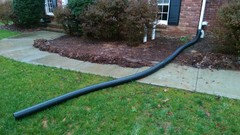
    Attached image below. The downspout is taking ~1/4 of the main roof elevation (about 250 sq. feet, left side of frame) plus probably 1/3 of the 2-car garage "lower elevation". The snake of drain pipe relocates the vast majority of the water, but as you can see, there's still some pooling behind the sidewalk (pine straw removed for visibility). Even with the correct grade (it used to be correct before some plumbing work in the area) the affected ground area is a veritable swamp with anything more than a light rain. I've checked and this was true with the extended flex drain pictured and it was leaking out very little to the surrounding area.

  • PRO
    9 years ago

    You've alluded to water infiltrating the house but have not shared the specific details. Fixing grade and drainage at the yard surface cannot cure everything. If the problem has to do with lack of waterproofing at the exterior of basement wall, or a cracked foundation wall, you would need to do work that is separate from landscape grading and drainage. But for the latter, I think you are leaning toward complicating the situation which could cause other problems (clogged or faulty drains and pipes) in the future.

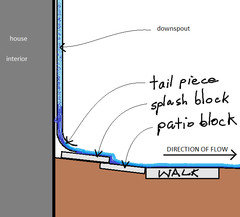
    The simple fix begins with establishing proper grade next to the house. It can't be too high or you risk moisture infiltrating into the first floor wall space. From it's proper elevation it should slope downhill toward the walk. You would need a tailpiece on the downspout to direct water away from the house, and a splash block to extend the distance for which the water direction is controlled. This would guide the water probably about half the total distance between house and walk. In the typical case, the splash block is terminating at the lawn so that established grass maintains the soil from washing. Here you have no plantings capable of preventing soil from eroding. Either you will establish groundcover (if it's desired) or you can extend the splash block effect all the way to the walk by placing a hard surface (such as concrete patio blocks or a custom concrete structure) between the walk and the splash block, per illustration.

    It will cause you far less problems if you keep the water flow above ground and properly direct it away from the house.

  • 9 years ago

    The source of water infiltration in the basement is via hairline cracks in the slab after multiple days of heavy rain (doesn't happen often, maybe a few times a year). I have an interior perimeter drain that's nearly dry even when the slab is seeping. I suspect it is not nearly deep enough (i.e. not down by the foundation footer to relieve much if any of the hydrostatic pressure that's building up. There's a sump pit near the rear of the house, but the basement slab doesn't have gravel under it to allow for any decent permeation to that side (the back doesn't ever weep even though it has some cracks as well). I never have ANY weeping though the walls and only very minor at the corner of the slab and walls (usually right near my hairline cracks).

    I get what you're saying about proper grade and/or plantings taking care of surface water and the gutter output being carried to the walkway to drain safely. Unfortunately, that leaves the area in FRONT of the walkway as a swamp as it is also only marginally well drained. I can live with that area being a little wet but don't want to make it worse. Long story short, I think there's a large volume of rain (either directly or from the roof) that's never able to go anywhere other than straight down all across the house and that's giving me an artificially high hydrostatic pressure on the front side of the house. Removing the water seems like the logical way to solve the problem. I'm sorry that seems contrary to your guidance.

    All I was originally asking was if I should use solid PVC or perforated in my drain to allow SOME of the excess standing water to be carried away...

    Dan

  • 9 years ago

    Dan, any gravel embedded perforated pipe in the ground will cause the soil above the pipe to be dryer and the soil below the pipe to be wetter. That's why any such pipe near a foundation wall of a basement should have the pipe elevation below the footer. It's OK to use a solid pipe to take water from a surface inlet and carry it to a lower exit point above ground.


    The advice you got from Yardvaark was excellent even if it wasn't what you wanted to hear.

    dgeist thanked pls8xx
  • 9 years ago

    That makes a lot of sense and thanks for rephrasing it. Basically, if I'm looking to remove a volume of water from an area and don't want to redistribute it in the soil beneath, then don't use perforated. If my goal is to drain the surface moisture and I don't mind (or want) the water a few inches underground, then perforated is good. Right?


    Dan

  • 9 years ago

    No. Use perforated pipe near a house basement ONLY if the pipe will be lower than the basement floor. And don't use any surface material such as gravel or mulch near the house where it can hold water over the soil until it soaks into the soil. What you want is low permeable soil with a positive slope away from the house.

  • PRO
    9 years ago
    last modified: 9 years ago

    " ... that leaves the area in FRONT of the walkway as a swamp ..." (I presume you're talking about the grass side of the walk. Then, shouldn't you deal with surface drainage of that area as well?

    While fixing the lawn surface for proper drainage is "a given" regardless of other things, I'm thinking it may not be the solution for your particular problem as it sounds like it has another cause. It may be that you need to create another "lowest place" in another part of the basement to collect seepage water and pump it out.

  • 9 years ago

    Very true. It's a system of conditions that all need to be addressed, but I'm triaging it based on things like "impact to my family's enjoyment of the house" and "cost to repair if it goes Tango Uniform, etc. The good thing is that the basement doesn't have "visible" water (i.e. up through the slab) except for in extreme weather cases. Obviously there's no effective vapor barrier beneath it so I'll have to deal with the vapor that is naturally present in concrete when I make flooring choices. I may eventually notch a portion of the slab between the front and rear and gravel down to the footer level to facilitate easier drainage for groundwater which is naturally a bit heavier in the front (due to overall property slope). I'm leaving a large portion of the basement unfinished, so this shouldn't be too hard, just messy.

    As for the grassy area, yes, there's a spot that could use a little more backfill to help with drainage, but I don't want to bring it up TOO much for fear that it might compound the problem near the structure. I'd rather have swampy grass than a swampy basement. One idea that relates to the original topic is using an idea stolen from DWV plumbing vents. If I had a hard PVC drain from my gutter to daylight, I could potentially add a few wyes at strategic spots and up-turn the joint 22 degrees from level, then feed them from perforated PVC in "trouble spots". That way the normal rain load from the gutter would (probably)never back up into the perforated sections. If the ground became so waterlogged in those areas as to fill the gravel trench, the perfed PVC drain would allow excess to flow away with the gutter output. This hybrid might prevent me from having to create two different drainage solutions.

  • PRO
    9 years ago

    Dgeist, not sure I understand the "hybrid" proposal so can't comment.

    Pls8xx, nice to "see" you again. Always appreciate your water management advice!

  • 9 years ago
    hybrid meaning a main trunk of solid pipe to remove water from the area and perforated solid slightly uphill and connected by wyes to evacuate surface pooling in places I can't solve with grading.
  • PRO
    9 years ago

    I don't think that the "hybrid" drain solution will be as effective as proper grading. PROPER grading will not "compound the problem near the structure."

  • 5 years ago

    Dgeist, I had the exact same thought as you. Sorry you never got a clear answer to your question. What did you end up doing for your issue and did it work??

Sponsored
COLAO & PETER Luxury Outdoor Living
Average rating: 5 out of 5 stars21 Reviews
VA, MD, and DC's Award-Winning Custom Pool Builders | Best of Houzz