Software
Houzz Logo Print
dvargo71

row covers for bug etc.

I had a BAD problem with bugs - cucumber beetles, Japanese beetles and cabbage loopers. I used neem, organic stuff, yellow glue strips and hand picked 2-3 times a day 7 days a week. It was pretty much a waste.


It was suggested I use row covers to keep the bugs out from the start. I am considering it. I woul like to cover squash, cucumbers, melons etc.


How do I use row covers? How do I water with them on? I would suspect you want to leave them on 99% of the time right? Do I need to support them off of the plants?

Comments (14)

  • 10 years ago

    Lots of discussions here about how to use row covers you can read through. The forum search will pull them up and they should answer all your questions.

    But basically the "how-to" depends on which type/weight you use. Since insects is your main goal then the ultra-light insect barrier row covers are the best bet and they are so light weight most plants support them all on their own - they just float on top the plants as they grow.

    Watering is only an issue if you use overhead watering - which is never recommended anyway - but water does get through the fabric. Watering at ground level is no problem.

    Using them with plants that require insect pollination like squash, some cukes and melons will mean you have to hand pollinate or you would have to remove them to allow the insects access - which defeats the point of using them. So if you don't want to take the time to hand pollinate then they won't work for those particular crops.

    Dave

  • 10 years ago

    As for cukes, grow either of the two varieties that resist the bacterial wilt carried by the cuke beetle --County Fair or Little leaf.

  • PRO
    10 years ago

    as DIgdirt2 said, you are going to have to remove them to pollenate, which becomes a deterrent in using them in the first place.

    Think about using silver mulch, as it is another way of decreasing the battle with bugs, and increasing harvest.....and there are no chemicals involved. :)


    Silver Mulch


  • 10 years ago

    After striped cucumber beetles decimated my zucchini patch, I put Agribon over the winter squash row. It stayed on until mid-July (I'm in NH) so the plants were pretty safe after that and the blossoms hadn't started yet. I think timing is important. A particular insect population comes and then disappears, I think. I use a simple sprinkler so I'm watering overhead. It gets through the fabric fine.

    I also hope that birds are helping keep the insect population down. Calendula and borage self seed in the garden but I plant other flowers and herbs here and there in the vegetable garden. I have a strip of tall grass/weeds next to the vegetable garden which I hope helps attract beneficial insects. We have bird feeders up all winter and I don't cut down the dead flower stalks in the perennial beds until spring.

    I hand pick potato beetles and their larvae, actually, it's quicker to knock them off into a container of water.

    This year I plan to cover the cukes and summer squash as soon as the seedlings get a little growth. There is an insect netting available from Johnny's but the Agribon I already have seems to work fine and gets the plants some cold protection early in the season.

  • 10 years ago

    Those are all great ideas too.....the silver mulch confuses the bugs that want to lay eggs on the underside of the leaves. Flowering plants like borage and calendula are good for attracting the beneficials. Blue, purple and yellow will attract bees. Also, flat or shallow blossoms like daisies, zinnias asters and Queens Lace will attract the largest variety of bees.

    I enjoy the collective wisdom here. :-))

  • 10 years ago

    I like the silver mulch idea BUT it it cools soil - which is the opposite of what I want for plants I am having trouble with (zuc/squask, cucs)?


  • 10 years ago

    I used black plastic to kill weeds in my squash patch then mulched with grass clippings after removing plastic. Opened up the mulch to add composted manure and plant squash hills. Squash were up a bit before I covered with Agribon. It worked fine here in NH. Best crop ever. I think once we get to a certain point in the season, the ground doesn't cool off too much at night.

  • 10 years ago

    I cannot imagine a row cover letting in water properly and not getting affected by wind - even if that means netting stays but destroys plants when windy. Also if there a lot of cuc beetles around opening at all will let them in - they will find a way, not they are trapped inside with food......


    i like the idea I jsut think with a ton of cuc beetles and a large garden it is not that simple.

  • 10 years ago

    Hand pollinating is easy and fast to do unless you have hundreds of plants. It means the covers never have to be removed or they can be removed once the cuke beetle life cycle is passed in the area. Plus hand pollination insures more crops. As for water, if it is done at ground level as recommended then whether the row cover lets it is or not is no issue. Wind? Sure it isn't going to stand up to 50 mph wind but then neither would the plants whether they were covered or not. Works just fine for many of us.

    Dave


  • 10 years ago

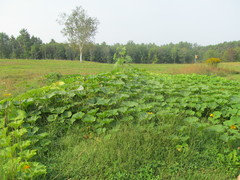
    I think the Agribon garden fabric I have is 83" wide. I bought a roll off Craigslist but last fall got a wider piece from Johnny's. Row is 36-48" wide. The fabric is laid out so it's very loose in the middle which will be on top of the plants. Yes, I have to put a brick down about every 5 feet to hold it down with several on the short west end of the row since the wind usually comes in from the west. I don't use hoops for this. The squash plants were strong enough to push the fabric up. I have a photo that shows just a tiny bit of one end of the fabric covered row that was taken the weekend after 4th of July last summer. I don't recall how soon after that that I removed the fabric. The plants were getting big but not putting out runners yet. I did get some squash bugs after the fabric was taken off but not many. The photo shows how big my squash patch was after it started running. I grew Confection kabocha type, Long Island Cheese Pumpkin and Delicata. You can see some yellowing leaves at about the 9 o'clock position in the photo but whatever was causing the problem seemed restricted to that particular vine. I have an oscillating sprinkler. The water gets through the fabric just fine. I'd have to check my records but I don't think I planted until mid-June so the plants were only a month old in the smokey photo #1.


  • 10 years ago

    I use Agribon 19 and leave it on for months (for winter crops) -- the rain and melting snow gets in just fine. The Agribon 15, best for insect barrier, lets in even more rain. It is very light and won't hurt plants if blown with/against them.


  • 10 years ago

    Here's the Agribon-15 covering zucchini and banana squash. It was 100% effective at defeating all bugs, especially the dreaded squash vine borer (a particularly devastating pest in my area.) Lasted all summer through the worst of storms, and I'll still be able to use it again this year. This was the 118" width.


    I was still going through a learning curve on how to hold it down when this pic was taken. I settled on bricks (without the trays) for the weight, and the wood chip mulch to keep the bugs from crawling under the edges. I hand pollinated everyday and got a great harvest from these 2 relatively small beds.


  • 10 years ago
    last modified: 10 years ago

    I use gallon milk jugs filled with water to weigh down my row covers, tied onto the jug handle at the bed corners and placed every few feet along the sides. Black plastic pipe like this is what I use for my hoops. I think my hoops must be something like 25 years old now, so a great value. I think mine are 1" but I am not sure.

Sponsored
High Point Cabinets
Average rating: 5 out of 5 stars21 Reviews
Columbus' Experienced Custom Cabinet Builder | 4x Best of Houzz Winner