Software
Houzz Logo Print
johniferous

Reforesting a small area - your thoughts

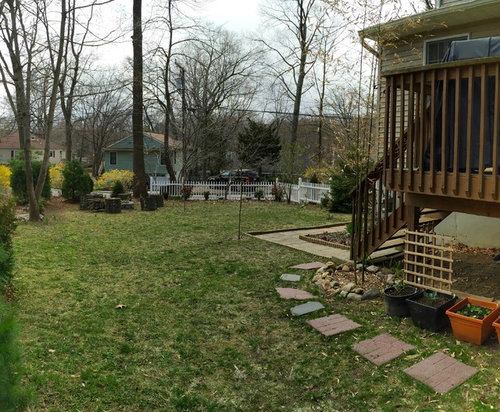
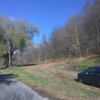
The space in the picture is an area of my property that I would like to reforest. I want to bring the woodland look back because I love my natural surroundings and want more privacy (as you can see there is little privacy from those houses across the street). You can see in the pic that I put two young trees in the middle of the lawn so far (one red maple and one red oak thats hard to see). The one in the center is the closest I would ever plant a native shade tree to the house...12 feet.

I would like to finish the process this year by planting native deciduous trees (cheapo whips or seedlings...5 ft max) randomly within the grassy space. There is a good amount of dappled shade as the neighbors to the left of the picture have several large old oaks on their property. The pic is facing west and is a downhill slope. The area at the bottom left is a firepit with some oak stumps to sit on which will stay where it is.

I'm imagining that they would come up naturally and their branches would compete, creating an unintentional, natural wooded look. I would only take off the lowest branches after some time so that I could walk around my property freely. The ground is already covered in moss which I love.

I realize this goes against lots of planting advice...like don't plant too close to each other, don't plant too close to the house...but isn't that what the forest is like? I don't want specimens...I want woods!

The only obstacles are the power lines on the right and below them is the buried gasline...I will clearly avoid that area by at least a few feet.


Any guidance/tips/experience doing this?


Comments (25)

  • 10 years ago

    Insufficient data. What is your USDA Zone?

    What do you want out of a tree? Does the area flood? There are literally millions of options. Most people stick to a handful they have heard of. Do you want fall color, edible food, pollinator value, evergreen for privacy screens?

    I'm not sure the area depicted in the pic is sufficient for true "reforesting". I understand you want a wooded "look"...and for all I know, there may be much more land not shown in that picture.

    Visit an arboretum and make a note of the names of trees you like. See if your state has a State Nursery or if the County Soil Conservation Office has seedling Sales...they are often in early Spring.

  • 10 years ago

    1. I am in zone 6 - north western NJ....appalachian type forest setting at around 1k ft elevation.

    2. The area does not flood and there is a stream area that runs during spring months only, just left of the edge of the picture.

    3. There are evergreens (white pine and douglas/balsam fir mostly) around the permeter so I would only like to plant deciduous trees that grow a single, strong central leader.

    4. There is not more land - what you're looking at is all I want to do. The area you're looking at is the only area of my property I can reforest. The lawn area has a septic and drain field and thats on the other two sides of the house.

  • 10 years ago

    A maple an oak and a sycamore would fill the space and then some, just three trees. If it was me I would plant a couple of eastern redbuds and maybe a paw-paw or two.

  • 10 years ago
    last modified: 10 years ago

    You could literally grow almost anything. I'm used to gardening with more constraints.

    My general suburban reforesting advice is:

    1.) See if your state has a State Nursery and what the order deadline is. Also check out the state nurseries of neighboring state...I've used the New York State Nursery.

    2.) See if your County Conservation District has a sale and mark it on your calendar.

    3.) Plant trees with different growth rates and life expectancy. Faster growing trees are often shorter lived, and people often end up taking them down when they outgrow their spot. Plant some long lived shade tolerant understory/secondary succession trees. You don't want all your trees to die or outgrow their spot at once. (What happened to my parents)

    4.) When you have a list of tree suggestions...

    a.) run them by the regional forum for your area to see if they grow well there, and if anyone has volunteers they are trying to get rid of
    b.) visit a local arboretum to see what they look like in person.

    Not sure I buy the conventional wisdom that you can't plant trees on your leech field. I've never lived in a place that didn't have trees in the leech field. Just don't plant anything expensive above the septic tank....they might have to rip it out to work on the tank.

    Slightly shady and moist...what about American Basswood (Tilia americana) or Tupelo (Nyssa sylvatica)?

  • 10 years ago

    (cheapo whips or seedlings...5 ft max)


    ==>> been a while john... how ya been ...


    i see you still dont understand going small ... sheesh ... 5 foot whips.... lol ..


    see you your COUNTY extension office has a spring plant sale.. for one to two foot plants ... their list.. will also give ou good general info on what you might plant ...


    ken

  • 10 years ago
    last modified: 10 years ago

    How closely the trees should be planted, there is a trade-off. In old well-established woods, the distance between trees is much farther apart because each tree is much bigger. This is really healthier for the forest in the long-term, and will help each tree grow to its maximum potential. But in the rush to try to create a "wooded" feel, many people want to plant the trees closer together. This is ok, but then these trees really should be cleared out 25 years down the line, otherwise you are going to have a tightly packed wood of many skinny trees, none of which will ever grow to become great trees. Have you ever gotten the chance to observe the difference between virgin primeval forest and second-growth forest that got logged out 60 years ago?

  • 10 years ago
    last modified: 10 years ago

    Can I make a suggestion? Somewhere in your forest plant a fruiting pear tree or a sweet cherry tree growing on its own roots. Both of these are fast-growing and make truly impressive trees when growing on their own roots, not grafted like they always are in orchards. In 60 years there will be people marveling at your fruit tree.

    This is not really "unnatural" either. Many wild forests in the world are interspaced with some type of fast growing tree species whose seeds are distributed by animals eating its fruit. It could really add some character to your forest, in my opinion. Just something unusual for you to consider.

  • 10 years ago

    For more privacy you'd need some understorey species as well as actual trees. Redbud, Amelancier, Hamamelis or whatever else might be in woodland in your area. They'd block the fence and give a lovely look in spring time.

  • 10 years ago

    If this were actually a patch of regenerating forest, as in following a timber sale or wind storm, what would be seen is a thick, let's make that very thick population of new tree "recruits" coming in. There would be no need for understory plants as the young trees themselves would be those understory plants. Later, much later, you can worry about that stuff, but for now, you want to plant small trees, and depending on your personal tolerance for the woodsy effect, possibly quite a few of them. This for if your really do want a young forest effect.

    I'd steer clear of planting big transplants but that's just me. I have filled many acres with seedlings, and the growth rate of these baby trees is nothing short of explosive. I've got stuff in the ground since 2008 that is 25 ft. tall, and this isn't in Florida or Georgia, places with long growing seasons, but up in cold, dreary northeastern Wisconsin. Plant small and learn to enjoy this early stage. There's nothing else quite like it.

  • 10 years ago
    last modified: 10 years ago

    By small do you mean 1-2ft bare foot seedlings? I don't like planting large, but these 4ft $10 maples and oaks I find at Walmart are cheap, native and already in the dirt...which I find gets a tree settled in better than planting bare root (as long as I open up the rootball after taking the pot away). It also gets some of the branches trunk height taken care of. Remember, I want to be able to walk around the yard freely between the trees, so ground level spreading branches are not ideal. At the same time, I would never plant a huge potted or burlaped tree....I learned that lesson two years ago with some white pines...thanks to KEN. Lol.
    Thoughts?

  • 10 years ago

    I don't like planting large, but these 4ft $10 maples and oaks I find at Walmart are cheap


    ==>>> i was just just yanking your chain ... remembering all your old struggles ... lol


    but i am not sure ... what you are talking about are actually WHIPS ... but it doesnt matter ...


    what you are seeing at bigboxstore ..... were probably bare root stock last fall .. and they just potted them up for sale ... i wouldnt mind buying them, at that price ... but i would slide one out of the pot at the store.. and make sure the roots are not swirling around and around.. meaning.. they have been in the pot too long ..


    as you know.. bare root is something for the dormant season .... we dont want to do that when the tree is leafed out ... or in summer ...


    so even if you buy in late spring.. it might be better to leave it in the pot.. until fall planting season ... just because you buy it.. doesnt mean it has to be planted ...


    right now.. i am sure its early enough to plant... i like to think of doing it.. 6 to 8 weeks before the heat of summer ... as being the deadline... for me in MI.. thats the end of april ... and if i want to stretch it a bit.. into mid may ...


    those peeps who end up having trouble.. are the ones.. who declare winter over and go into the yard the first of june .... and then wonder why trees planted a few weeks before the heat of summer.. fail ...


    IMHO ... ten bucks or so.. is worth a go ... you have enough experience ... to understand your odds and what not to do


    ken

  • 10 years ago

    Yes Johniferous, if you're able to source some native plant outlets (I sure don't know about Walmart meeting that description!), it is common for the offerings to be in the two to four foot range-ideal for wildland planting and so-called native restoration. These often appear as sticks and that's a good thing. Many garden centers hideously try to make their baby trees look just like miniature versions of the mature plant, via horrible practices like inidiscriminantly cutting the tops off. This is so not how trees grow! Look at a young woods sometime (hey, I sense a theme developing!) and note the profusion of saplings coming up. In many cases, there will be perhaps one hundred times more stems per unit area than will be there in thirty years. Mother nature always produces far more offspring-think fish eggs, seeds on plants, root suckers coming up from a rhizomatous species like aspen...then the stand will ultimately support. So, as the more vigorous individuals get taller, they begin to shade out and inhibit the slowpokes. This is the natural way.

  • 10 years ago
    last modified: 10 years ago

    "...if you're able to source some native plant outlets (I sure don't know about Walmart meeting that description!)"

    Believe it or not, walmart has red maple, sugar maple, red oak, pin oak and a few others that are native to my local forests. In general I hate buying plants at big box stores...but the combo of small size and price, along with being a little taller than the seedlings i get in the mail, makes them attractive to me.

    With regard to the natural process...I totally get forest regeneration, and I appreciate your guidance. But I am trying to skip the first decade or so by planting some small guys and leaving the rest of my yard as moss for now. And it may stay that way forever...we'll see how entertaining guests around that firepit changes this summer after I fill the yard with trees....lol....

  • 10 years ago

    'If this were actually a patch of regenerating forest..' Agreed, but it isn't. It's a smallish corner of someone's back yard and one of the stated objectives was to increase privacy. Of course some trees need to be planted but to block the view of the neighbours sooner rather than later some shrubs seem to me to be a perfectly practical and attractive suggestion.

  • 10 years ago
    last modified: 10 years ago

    Most people who say they want a forest in their yard want the "look" of an old growth forest...they typically want to skip the early, scrubby stages of succession. This isn't quite the same as real conservation forestry or standard ornamental gardening. When you said "plant a forest" you pushed people's "Conservation Forestry" buttons. This is why I like to use the phrase "faux forest".

  • 10 years ago

    One word of caution then, Johniferous, about purchasing common species at Walmart. I'll use red maple as my example: This species is found naturally from S. Florida to Quebec and Ontario, Canada. A very well-adapted species indeed. But this should not be taken to indicate that the red maples I saw in the woods down near Fort Myers would do well in your neck of the woods. They have been adapting to local conditions for centuries, maybe millenia. I don't know where you're operating but neither does the person who buys nursery stock for Walmart. Maybe they take great care to source only "local" genotypes...I have no idea. But that's a fairly advanced concept in marketing of plants. And I'm not sure Walmart is where I'd go for fairly advanced plant marketing skills.

    Maybe it's just because whenever I've been to Walmart-all three times-I wanted to shoot myself afterward, lol...but I remain highly skeptical that they are focused on such matters. If I'm wrong, so be it.

  • 10 years ago

    Plant a Bald Cypress or Dawn Redwood depending on your native now vs native 100 million years ago desires. In average to above average moisture areas especially the Dawn Redwood grows as fast as anything and both are long lived.

    Toss in a white oak and a black gum for the board leafed (nyssa sylvatica) and you'll have long lived trees everyone doesn't own 4 of.

  • 10 years ago
    last modified: 10 years ago

    Dawn Redwood? Plant a Seqouia!

    they are slower growing but posterity will thank you

    Imagine a megalithic towering tree on your property a hundred years from now...

  • 10 years ago
    last modified: 10 years ago

    wisconsitom(Zone 4/5), That's why I use local wildflower societies and state nurseries...only way I know the seed source. However, thats mostly an issue when you are planting things at the edge of their range. I think OP is in zone 6 and planting pretty conventional temperate forest stuff smack dab in the middle of its range.

    I find big box stores work better as sources for trees that can sucker...they can usually recover from root damage better. I've had less luck with conifers...they dont recover as well from mangled roots or being planted too deep. Potted gives you more planting time flexibility...

    Baldycypress would love the spot by the stream and look amazing...but if you want the "tree cathedra" look maybe you don't want trees with pyramidal forms. Not sure you have space for that or a redwood.

  • 10 years ago

    I remember when I was a kid, a rather well-to-do family built a new house near us. The guy, actually I knew this family well-wanted an "instant forest". Now granted this was a long time ago, and things would probably go differently today, but what they did was transplanted some enormous trees onto the property. Actually, I just had a memory flash of this because so many aspects were done strangely. For instance, for whatever reason, they waited until late fall, and the ground was frozen, so they had a full-size high-hoe with a soil prong to dig with. Presumably, these trees would have been freeze-balled, a term so archaic I'm not at all sure it even has any meaning today. Suffice to say, these big silver maples (I think-I was just a kid) came in with their balls frozen, so to speak.

    In any case, the upshot was that none-not one tree from this undoubtedly expensive operation, survived the ordeal. Not that it matters, but had they instead planted a bunch of my two-footers, I am as sure as can be that a good many of these trees would still be standing.

    Not at all saying you're heading down this path, iferous. Just thought of it is all.

  • 10 years ago
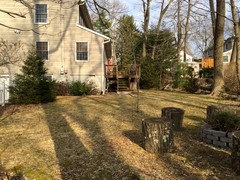
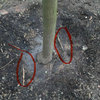
    Here's a pic with some twigs in the ground where I want to add 3 of them. You might have to zoom to see the one to the right depending on the device you're using. View is uphill/east, facing where the other pic was taken.
  • 10 years ago
    Sorry here it is
  • 10 years ago

    in your situation i would plant a small grove of honeylocust.....then you dont have to deal with leaves blowing in your neighbors yard...something like 3-5 trees. Then underneath plant some redbuds, dogwood, spicebush, and other woodland understory trees/shrubs. Lastly get some woodland plants for the herbaceous layer once the canopy has formed...things like trilliums, cohosh, wild ginger, baneberry, ferns, etc. if you truly want a forest setting you need to layer it.

  • 10 years ago
    last modified: 10 years ago

    Cool, thanks! I'd like to get some dogwood/redbud in there after the first set goes up a bit.

    Leaves are not an issue in the sense that there are already a ton and they're everywhere. The picture doesn't show it well but we are surrounded by 80-100ft old growth oaks, maple and ash. Most of the community will be treating the larger high value ash next year as EAB had arrived in NJ