Software
Houzz Logo Print
andrewhenrichs

How much to charge for custom cabinets?

10 years ago
Hi all,

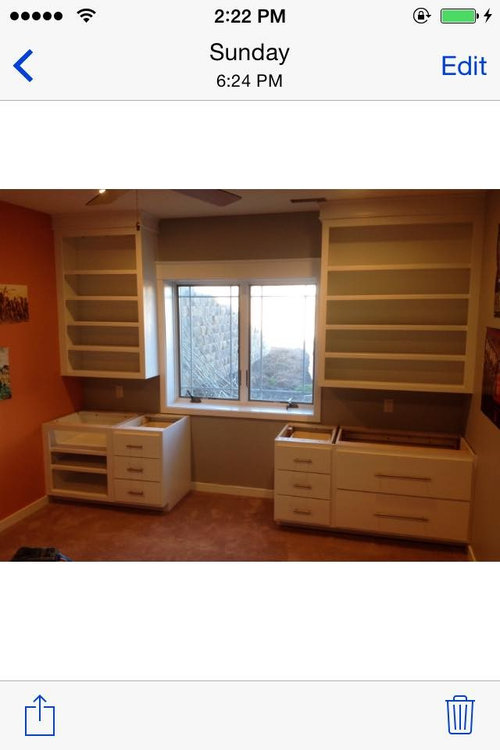
I am a full time college student who has started to do custom cabinet jobs on the side. (I made a set of custom kitchen cabinets for my parents and really enjoyed doing it) I just wrapped up my first "official" job, and I am a little lost on how much to charge for the "profit" portion. I am about $1300 deep in materials alone and have quite a bit of time put into it. The project took me about two months mainly working on the weekends.

It was hard to keep track of exact time as the work on it was when I really had time aside from doing homework and working. I also don't want to use time as a calculator of it because a portion of it that took me 5 hours, may have only took an experienced cabinet maker 2.5 hours.

I was thinking that charging $2000 would give me about $600 in profit and able to pay the person who helped me out a few times around $100.

Is this too little? Too much? This is something I plan on persuing more after college, so I want to show customers that I'm competitive compared to others but at the same time be able to make enough to justify doing it.

The cabinets are hard maple painted white. There are six total cabinets. The two upper cabinets are 54" in height and the four lowers are 28" in height. I would say they are a more high end cabinet based on the ProClassic Enamel paint used, custom crown molding, and soft-close, full extension drawer glides.

I'm fairly new to all of this within the last year, so hopefully I'm making sense.

Any input is greatly appreciated. Thanks!

Drew

Comments (11)

  • 10 years ago

    $600 is way too little. Many craftspeople charge 2 to 3 times their material costs.

    You may get some good advice here, and there is a website of nothing but woodworkers called WoodNet (www.woodnet.net) that has several professional cabinet makers and craftspeople who would be glad to give you pointers. WoodNet is free to join and belong, no fees or dues.

  • 10 years ago

    True, true: "... if you don't treat this as a BUSINESS you will end up losing money."


    If you are thinking a real business there are lot of other expenses that you need to figure in -- taxes, insurance, tools, waste, utilities, vehicles, non-paying customers, maybe eventually dedicated shop / showroom space.


    My grandfather, who was a truck farmer well into his 80s once told me a story about another vendor at the market where he had a booth. The other guy was selling produce at low prices. My grandfather approached and asked how he could do that. He asked about the cost of plants, fertilizer, baskets, transportation, land, equipment, booth rental, etc. The other guy looked stunned and said, "No, look at all this cash I have in my till. I have to be making money."

    I've been leery about rules of thumb like 2x or 3x cost of materials. It depends a lot of what you are making. If you are making Chippendale chairs or inlay veneer jewelry boxes, you have a lot more in labor than materials versus someone who makes utility shelves from sheets of plywood.

  • 10 years ago

    Some good advice here and I am no expert so I'll just post one idea: How much would it cost to buy something of comparable quality at retail? i.e. a base cabinet made of whatever and painted in such a way. You should probably be charging more than that in total (materials + labor) since they are custom made to size on top of that. Just one more way to measure it, that also does not take hours into account (an advantage since you said you don't work as efficiently as an experienced pro).

  • PRO
    10 years ago

    There is no way to tell from the pic what the quality is. the material may be fine, but it may be executed in a way that many maiden voyages are, which is very prone to mis-steps. IDK why someone would ask for all the shelf spaces to be so short, and fixed in place.

  • 10 years ago

    Do you have a business license? Why not?

    Insurance? What if you damage someone's house?

    Are you doing the install? That is additional labor, and an entire subset of skills that you need to provide

    What type of finish did you put on the cabinets? Surely not just some generic "paint"?

    If you want this to be a business, you have to treat it as a REAL business, not a hobby. For a business, your are already paying tuition in the s hook of experience. Because you've already lost money and you don't know it.

  • 10 years ago

    It is a common error. Charging a price based off on anything and everything EXCEPT for what your actual costs are and what type of wage you expect to earn.

    If you'll be doing this part time, say 500 hours a year?

    In the most simplistic of terms, you'll have some fixed costs. Figure your overhead. Insurance, licensing, facility costs, utilities, marketing, transportation, etc, etc. Let's pick a nice easy round number like $5000 a year. Some of these numbers are fixed whether you work one hour a year or 2000 hours a year. Some will be variable. To pay that portion of your overhead with 500 hours you need to have a $10/hour component built in to your pricing. If you expand and eventually work 2000 hours a year, some of those costs may decrease on a per hour basis. Some won't.

    Somewhere along the line you'll get a feel for other overhead items, consumables like sandpaper, saw blades, sharpening, broken drill bits, paint brushes, etc. Tools and tool replacement, etc. Until you're charging the customer for things like that, you're paying for it out of your own wages. You just don't know it. Remember, your wages should go into your pocket. Not into the business. These consumable numbers will fluctuate based on the volume of your work. But as you gain experience, you'll develop a basic correlation between variable costs and the number of hours it takes to complete a project.

    Again, in a most simplistic way...let's say $2000 for the year spent on consumables. That's another $4/hour you need built in to your pricing. As you expand and work more hours, you'll spend more on consumables. So again, in SIMPLISTIC terms, your consumables cost may stay around $4/hour no matter how many hours a year you work.

    Think of glue. Are you gong to charge a customer a line item charge for glue? You could, but are you going to waste a minute calculating and writing
    that line item charge up? It's much easier to wrap common incidentals or consumables
    like that into overhead. If you spend $100 a year on glue and you work
    500 hours a year on projects, you're spending on average 20 cents an
    hour on glue when you are working. The cost of the glue at 20 cents an hour can be a component in that $4/hr charge for consumable in the previous paragraph.

    Your wages. How much does it cost you to live? Figure a living wage and price it in. $15 an hour? $20 an hour? $50/hour?

    For your part-time simplistic argument, let's say $15/hour.

    Add all that up and right there you're at almost $30 an hour. You yourself are making a wage of $15/hour. But your business isn't making any money at all. Your business is simply covering its costs.

    Profit. A component that allows your business to actually make money. To expand your business, to invest in a new shop tool that may make your business more efficient. A rainy day contingency that will allow your business to survive a project that somehow got buggered up with inefficiencies. Instead of having that bugger-up ruining your business, it'll simply eat into your profit. This can vary, but again, for simplicity, figure 15% profit margin.

    The 15% profit component bumps your $30/hour to $34.50 an hour.

    On some jobs you'll work efficiently and your profit may come in above the 15% margin. On other jobs you'll bugger something up and when you're done with the accounting you may find that your profit vaporized. It's a balance.

    What does overhead mean?

    When you hire a helper and pay him $15/hr? You need to actually bill the
    customer $34.50/hr to pay that worker $15 an hour without your business
    "losing money" on your own worker. Again, this is a simplistic statement.

    So when you bill a project? Overhead costs? Figure your man-hours spent on a project, for the example above you'd multiply that times the $34.50 hourly cost. It's not uncommon to have to charge 2.5X what a laborer is paid to cover that laborer's wage and the business cost of carrying that laborer on the business' books.

    Again, the above is all very simplistic. Overhead components can be accounted for differently in terms of how they are tallied in your books and under which heading they are tallied in your books. Things can vary by trade and by region. But it has to be accounted for and if you're not charging it to your customers, you're paying for it our of your own pocket and you don't even know it.

    You may not know all of your numbers today. But I highly recommend you do accurate accounting. Tally everything. Reconcile hours. Incidentals. The quick run you made to the hardware store for the pack of sandpaper. The gallon of titebond.

    Your numbers will morph over time but as your business matures you'll eventually understand how your business runs, and how much it costs you to run your business. The better you know your business, the more efficient you can become.

    Most people in business haven't a clue.


  • 10 years ago

    Minimum of $170 - $250 per linear foot for the lower cabinets (depends upon wood cost by wood species). The uppers, slightly less as they do not have doors. Probably, $135 - $175 per linear foot, again depending upon the type of wood.

    Something like knotty alder or birch would be lower cost while maple or hickory would be higher cost. Exotic woods are priced on time and materials.

    If you're going to do this regularly, you need to get better documentation of your time and other costs. Keep a time sheet and make yourself fill out the amount of time spent. You'll be surprised as to how much "overhead" time you end up spending going to get materials, cleaning the shop, etc. That can't be free time - it has to be figured into your shop rate.

  • 6 years ago

    You’re way under on your pricing. Your materials should typically be about 20-25% of your total price, so if you’re in $1300 on materials alone (also figure fuel, tools and wear and tear, as well as insurance, and other overhead) and I’d say you’re really selling yourself short....big time. Also keep in mind that you never do the trade a favor when you undercharge for your services. I don’t like giving my pricing process out, but you are way low. None of us in the trades get anywhere by selling ourselves short. Also looks like you’re doing good work. Take pride in that and charge accordingly.

  • PRO
    6 years ago

    OLD TOPIC!

  • 6 years ago

    Haha, yes, old topic. He’s either a cabinet maker with fifteen Yelp reviews or graduating from his graduate program by now...