Software
Houzz Logo Print
mitchnc

All about hydroponic nutrients

10 years ago

Okay, Hydro, here goes.

Start with the easiest.

People say they start with one ratio, then switch over to another.
Where is that switch-over point? Blossoms, fruit, or just moving from seedlings into foliage?

And I assume lettuce and greens can just maintain one nute solution all the way through?

Comments (29)

  • 10 years ago

    Your assumption is correct about leafy greens. There is no need to switch over to more of a bloom mix for anything like that. You can use a grow mix throughout on those which will typically be heavier on N.

    For fruiting plants I switch over to a mix that's higher in P and K and less on N than I was using prior. The timing on that is when I start to see buds, not blossoms. I like to start it before I start seeing any full blossoms.

    Just don't fall into the trap of grow mixes that are super high on N on fruiting plants. Sure, you'll get tons of really green leaves and stems but it will hurt fruiting down the road.

  • 10 years ago

    Cal and mag....are those added only to the beginning of the grow cycle, or are they added to every water change?

  • 10 years ago

    Ramble? Are you kidding? I got excited when I had to scroll the mouse wheel a few times to see all you wrote. Thanks for this!

  • 10 years ago

    No problem. I have a habit of veering off topic but I eventually get to the point.

  • 10 years ago

    Good stuff. Love it.

  • 10 years ago

    It seems like calcium and magnesium are the nutes that pose problems or have issues in terms of lockout, assuming the nutrients being used are reputable. Is that correct more or less?

  • 10 years ago

    Not really. I guess it's somewhat semantics though. You're correct that Ca and Mg are common problems but most calcium issues are either a concentration issue or transpiration issue. There are other reasons but I think those two are the most common. And that's is not true lockout. Ca is not getting locked out from uptake by too much of an antagonistic element but since when plants uptake Ca is passive, it goes with water, if the concentration isn't high enough than not enough can be taken up with water uptake. Say you have 1 gallon of water with 100 ions of Ca distributed evenly and the plant drinks 1/4 gallon of it taking up 25 ions. This is a very simplistic example BTW. Versus that same gallon with 1000 ions of Ca and it drinks 1/4. Since Ca uptake is directly related to water uptake the concentration is key since it's not like other elements that the plant actively takes up when needed or take up just because it's there. And with that example you can see why transpiration is so important in regards to Ca. Even with lower levels of Ca if you can get the plant to drink more water it gets more Ca. So it's not really a lockout issue in the true sense.

    Mg is not passive like Ca but it can be locked out or usually just has inhibited uptake due to other elements or pH. So I guess you're on the more correct side of it with Mg ; ). There are several other elements that can inhibit Mg uptake. I used to have Mg issue frequently until I upped my concentration levels to at least 80% of K. You'll read a lot about the importance of the Ca:Mg ratio being so important for uptake but from what I have found that's basically been debunked. It's interesting that when I read research about this type stuff I frequently see cited references to research done 50 years ago when I can find newer university research from a couple years ago that contradicts it. Anyway, from an anecdotal standpoint once I upped my Mg to the "correct" levels I haven't had a single issue with Mg deficiency. What happens a lot with Mg though is when people start adding bloom boosters and jacking up P and K with no regard to Mg and they start seeing issues not only with Mg but high P can lockout some of the metals.

    This is why I feel like it's very important to start with a good mix especially with hydroponics since everything is so readily available and the plant doesn't have to go looking for it like soil. There is no real buffer. It's easier for plants to overindulge on a single element and cause issues with others. I see people say how they have had good results with this mix or that mix and show pictures and I'll see all kind of issues but they got a few tomatoes so it's a success! I guess it's all relative to their expectations. Not bad-mouthing them, to each their own. But if you're going to put a lot of work and time and money into something I personally want results that reflect that effort. I don't want a few tomatoes, I want a friggin' bushel! ; )

    I mostly stayed on topic. Progress!

  • 10 years ago

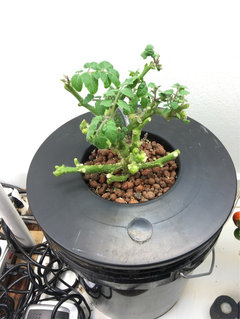
    So how about some practical application? I started this bean from seed on 3/11/16.
    Right now it's 500 ppm and 6.0 pH. I have a chart that says beans should be 1000 ppm.

    I have GH Flora series: Micro 5-0-1, Gro 2-1-6, and Bloom 0-5-4. I also have some dry 4-18-38 that I'm planning to use on my next grows.

    So what should I do for this bean plant and why?

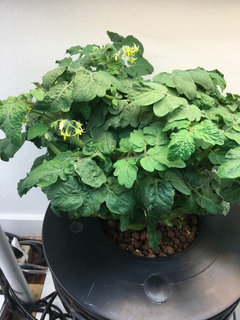
    Side note: That tomato plant to the right is the one that broke off. It really perked up overnight. It's sitting in 1000 ppm, equal parts Micro/Gro/Bloom. Also Ca and Mag, 1 tsp each.

  • 10 years ago

    The leaf in the middle that's covering the net cup is showing signs of Ca deficiency or you have a dog that chewed on it. The big leaf to the right of that is showing the beginning of some Mg issues and the one to the far right that looks puckered could be Ca related or high salts since they are all showing some signs of puckering to varying degrees although 500ppm really shouldn't be too high.

    I have had issues with beans before as well. The grow really fast and I think it's because of that they have trouble with Ca and translocating some other elements. I grew some Blue Lake pole beans a while back and the vines would grow literally up to 4 inches overnight and when the vines got long they started showing iron (immobile element) deficiencies on almost all the new growth. I also had 6 plants in one buckets which was not a good idea. They would compete for nutes and start showing signs of deficiencies in a matter of days even after a fresh mix - I actually did water changes back then ; ). Did bush style after that with no real issues. I actually have some Blue Lake beans germinating right now and will go into the bucket in about a week. Bush style again.

    On a bright note, your roots look good. What I need from you is what your mix is for those beans. Where you using the Flora Series 3-part and if so how much of each? I have some so I can see what's in each. And did you add anything else like Calcium Nitrate or Epsom or anything. What I will do is figure out the actual PPMs of what you're using to see where it sits now and how I think you need to adjust the mix based on what you're using. And are you using tap water? If so, what's the ppms on that? Tap water always throws a wrench into the works since you don't really know what's in it without a water analysis.

    We'll get it figured out. Or your plants will die. One or the other probably ; p


  • 10 years ago
    last modified: 10 years ago

    Yes to the tap water...70 ppm. When I set up the bucket, I did 1 tsp Epsom, 1 tsp Calcium nitrate, 1.25 TBS each of Micro, Gro, Bloom, per the label.

    That crinkled up leaf in the middle...isn't that a seed leaf? Does it matter?

  • 10 years ago
    last modified: 10 years ago

    just had a thought, your calcium nitrate doesn't contain ammonium nitrate does it? What's the N and Ca percentages on it?

  • 10 years ago

    Here's what's on the label:

    Calcium Nitrate 15.5-0-0
    Total Nitrogen 15.5%: 1.0% Ammoniacal Nitrogen, 14.5% Nitrate Nitrogen

    Calcium 19.0%

  • 10 years ago

    Ok. That's fine. Just wanted to make sure you were not using something high in ammonium nitrate as its not good with hydro.

  • 10 years ago
    last modified: 10 years ago

    The nitrogen is key for vegetative growth but too much of a good thing can turn bad especially for fruiting plants. Too much N throughout a grow and you affect fruiting since most of the energy will be directed at vegetative growth and maintaining the massive amount already there. Come to think of it that may be why your tomato is simply growing like crazy but no blossoms.

    Back to the beans. You're running it way too strong. I know you're just following what's on the GH bottles but the general rule is run half of what any manufacturer suggests. They usually run things too hot. If you're a conspiracy theorist then it's because they want you to use more nutes faster so you have to buy more ; )

    It's tough to tell from the photo but it looks like you can drop your water level some. You have roots hanging down so maintain it about an inch below the bottom of the net cup. That will help draw more roots down.

    I'd like to see you drop your mix down to 10ml of gro, bloom, and micro, 1/4 tsp of calcium nitrate, and 2 tsp of epsom. What this does is get rid of the massive amounts of N and Ca you were giving and raises up the Mg to better levels as well as overall lowering concentration. It puts your ratios better in line with what I like to use. I'd run that for a bit and see what happens.

    It may seem a little counter intuitive to lower the Ca when I stated that it looks like you have a Ca issue but if your overall concentration was way too high as I suspect it is then that will decrease water uptake, essentially dehydrating the plant, which in turn lowers how much Ca it uptakes. And Ca has to come down along with N since you're using calcium nitrate as your Ca source.

    I just want to get it in line with what I know works based on my experience. More than one way to skin a cat but you tried GH's way and it's not working ; )

  • 10 years ago
    last modified: 10 years ago

    Thanks so much for this. I just took samples. My ppm's are all around 500, but my pH has shot up to 10.0 in all the buckets! I measured the pH of my tapwater to make sure my meter wasn't malfunctioning, and it's reading 7.6, which is correct.

    Right before I read your post, I was about to raise my ppm to 1000 based on a chart I have. So I guess I can leave them at 500 and just lower the water level, and of course bring the pH down?

    Edit: I was about to dose with pH Down but re-measured first. Everything is 6.3.

  • 10 years ago

    Good. I was about to post that I have no idea how the hell you could have 10 pH. When things go wrong, roots issue whatnot, pH will generally drop fast but I have never seen it go up that fast. Anyway, I guess all is good in pH land.

    Beans are not very salt tolerant plants. If anything you should be lowering your concentration. Tomatoes are very salt tolerant and I run mine at about 600-700 ppm for a comparsion. You'll hurt your plants more by running it too high than too low. Most people run stuff too high IMHO. The plant may grow okay but past a certain point the benefit ceases to exist at the cost of nutes.

    The mix I posted a few back may even be a little too hot. I based that off of what looked like about 4 gal in that bucket and if you lower the level the concentration will go up. If you're gonna lower that water level half that mix except the calcium nitrate. Safer to start off weak. You can do more damage by running it too high than too low in my experience. If your bucket is going to have about 3.5 gal in it try 5ml of gro, bloom, and micro each, 1/4 tsp calcium nitrate, and 1 tsp epsom. Humor me ; )

  • 10 years ago

    I'm surprised 10ph didn't instakill everything, if in fact the meter was correct

  • 10 years ago

    Ok, Hydro... I mixed up a bucket of your solution. 3 1/2 gallons resulted in 378 ppm and 6.2 pH. Sound about right? I'm going to transfer my bean plant to it, and I was also thinking about the same solution for that tomato that won't flower.

  • 10 years ago

    Yeah, that sounds about right.

    You mentioned stressing that tomato to get it to flower in another thread. While that will generally work it's not solving the problem. The plant isn't flowering because it needs stress. It needs enough light, the right temperature and humidity and nutes. There has to be another factor that is keeping it from doing it's thing. You said it's way beyond maturity? Not even buds?

    If you give it that same mix as far as concentration level a healthy plant that size will suck all that down in a week as that's a low concentration for tomatoes. But...you could do it but let it run for two weeks with no changes or addition of nutes. Force that plant to use it stored elements. If you were giving it that previous mix you mentioned it was way high on N and it could have N stored up affecting it flowering. If you do use that mix use 15ml of the bloom instead of 5. P and K are very important in flowering and fruiting.

    On another note, I am about to put my beans in a bucket. And some sugar snap peas : )

  • 10 years ago

    Nope, not even buds.

    I'm jealous. But I'll stay patient, I have high hopes for this grow.

  • 10 years ago

    Not to rub it in, well, maybe a little ; ), this was my tomato plant mid march after I gave it haircut after two harvests since it was getting out of control. I like to cut them back after they produce to keep them more manageable to go into fruiting again, at least for determinate. Although red robin should be considered semi-determinate.

    And here is it today flowering like crazy

  • 10 years ago

    Would it be too hard to manage an indeterminate?

  • 10 years ago

    Not really. As long as you have 20 foot ceilings. Ha!

    They don't stop growing in my experience. I had a supersweet vf 100 out in the garden a couple years ago that was at least 12 feet. All the producing growth would eventually stop once ripened since new growth would take over so all the lower stuff would be pruned as it died off. That keeps going and going. I had about 10 feet of coiled up vine and the rest filled out with tomatoes hanging from my fence. Eventually winter came and it died. I don't know if there is a way to top them and keep them smaller since the lower growth always wants to die off in lieu of new growth. Someone more experienced with tomatoes may be able to answer that.

    Another weird thing is that I have gotten multiple harvests out of determinate which by definition are supposed to produce and die. Not hydro but out in the garden. But with hydro those red robin are listed as determinate and I am going on my third production. I guess they didn't get the memo : ). That's why I consider them semi. I have grown roma inside which were determinate but it got too big so I removed it after a bunch of tomatoes so I never saw if I could get that to produce more as a determinate variety.

    Hopefully someone with more tomato experience can chime in.

  • 10 years ago

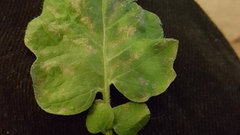
    So...before we had this conversation I had prepped a bucket for 1000 ppm based on info I had. Then I switched out my bean and my tomato for the new mix. But I forgot about my tomato cutting. It sprouted lots of roots, but the leaves look burned. Is this what nutrient burn looks like?

  • 10 years ago

    My tomato and bean plants are about 10" tall, and the cuke leaves are bigger than my hand.

    Solution is 500 ppm. Water level is still at the bottom of the net cups, so no topping off needed.

    Should I let things ride for now, or make any adjustments?

  • 10 years ago

    2 posts back - yeah, that could be nute burn. It manifests itself differently depending on the plant and other factors like that it could be a single element that is too high causing the issue or simply overall the salts (concentration) are just too high which will reduce water uptake as it dehydrates the plant causing deficiencies and loss of turgor pressure. Some elements plants will just uptake regardless of if it needs them or not and it's the build up that can cause issues or even interfere with the uptake of other elements.

    But generally your plant will just look like crap. Browning edges and/or tips, curling, new growth dying off quickly, puckering leaves and your leaves can get brittle or crispy.

    Most recent post - I thought you dropped the ppm on the beans and they were at 378?

  • 10 years ago

    Yes, you're right. The bean was our experiment with your recipe. It looks like it wants to flower, btw.

    Everything else is still its original solution. Since I want my mantra to be "I don't do water changes" I'm leaning towards leaving it alone, since you said that my ppm should be about half of what I originally thought.

    My chart (posted by Chuckwagon) says:

    Beans 1000-2000
    Tomato 1000-2500
    Peppers 900-1100
    Cucumber 850-1250

  • 10 years ago

    I found this helpful site for those interested in the science:
    http://www.cropnutrition.com/nutrient-knowledge


Sponsored
AIS Renovations
Average rating: 4.5 out of 5 stars15 Reviews
Custom Craftsmanship & Construction Solutions in Franklin County, Ohio