

nematode questions. Freaking out...
I have 2 questions about foliar nematodes on hosta that I will list here, and then describe my situation. I tend to get a little wordy so if anyone can answer my questions but doesn't need the whole rundown, the rest doesn't need to be read thru.
1) Once infected plants are removed, is that garden bed doomed for life or is there just a grace period that needs to be adhered to? Or some way to treat the soil before replanting? I've read that the nematodes remain in the soil, "dormant", which leads me to think I'm basically just screwed forever.
2) Can anyone recommend plants that are simply not affected by nematodes? If I have to just switch to altogether different plants I will be extremely sad but at least I will have SOMEthing there. Right now it appears not just my hosta have been affected but also my Jack Frost brunnera and perhaps my heuchera. So obviously those 2 are out.
Ok so here's the deal: about mid to late summer last year, I noticed several of my hosta, as well as my brunnera and possibly one heuchera, were getting brown spots on the leaves. At first I thought slugs bc I battle them too but there weren't holes in the spots. By fall, I was having to cut off several fully brown leaves from each plant, every few weeks and finally got the bright idea to google. It sounded like nematodes, which I'd never even heard of. It was near the end of the season anyway so like a big idiot I decided to table it til this spring. I must not have read up on it enough bc I now clearly see the recommendation is to get the entire plant in the garbage ASAP.
Fast forward to spring. Somehow I completely forgot about the whole issue. Everything is starting to come up beautifully and I was feeling that joy that comes along with that. Bought 2 new heuchera and went out there to plant, then first decided to divide a bunch of other stuff first that had gotten too big for the space. At the tail end of several hours working on all that, something finally hit me and I remembered the issue. Came in to google again and found myself incredibly depressed. Like, tears. Turns out that not only should I have thrown out those particular plants immediately, but now that I'd divided and moved a bunch of them all over, I've likely spread the infection to every single section of that planting area. Of course I didn't even clean the shovel between, bc I'd completely forgotten about the issue. And the plants won't show signs til many weeks from now so I have no idea who was infected last year. I know my blue mouse ears and stilettos weren't, and I don't THINK my new striptease was, but that doesn't mean they aren't now.
So what now?? If they remain dormant in the soil like I read, then won't anything I ever plant there just be doomed for destruction? Certainly any hosta, heuchera or brunnera, right? I also have a japanese maple out there and had planned to put another-- are they affected by these little creatures from hell as well?
And why on earth does every site I read say there's nothing you can do about this?? That is mind boggling to me. If all this is true, how had I never heard of these things before now? How did I live with hostas for the last 10 years, completely unscathed?
Some people use diluted bleach, some other chemicals they buy, some "good" nematodes... but it seems that each of these methods have more people saying they do not work, than people who do. And given that this little area is literally the only decent looking (semi-"done") area that we have here in this space we've owned for the past 3 years, it's not as if I have a ton of time to devote to it. There is work needed EVERYWHERE. Maybe this is the universe telling me to make better use of my time in the front of the house. Or on one of the sides. Or inside, ha.
Well if nothing else, I'll feel a little better sharing my pain with people I know will empathize. Sigh.
Nicole
Comments (26)
 10 years agolast modified: 10 years ago
Hi, Nicole!
Are you sure you have nematodes? They show up later in the season/summer/fall. I noticed mine two years ago in September.
Answer to question: if you can plant another hosta in its place? NO - if indeed there are nematodes present.
Did you take pictures? If not, do nothing until it can be confirmed - suggest you take pics should it occur again. Leaves can dry up and turn brown from lack of water as well. Difficult for anyone to help without photos.
This is Nematode presence

nnmjdklil
Original Author10 years agoWell I didn't do the chopping-up-leaf-and-soaking-in-water/microscope thing but yes I'm as sure as I can be without that. I've seen the pictures and it looked exactly like what I see in them, plus it fit the timing-- first noticing mid/late summer, getting noticeably worse by autumn's end. I will wait anyway... sounds like there's no point in rushing to get rid of them now since they're all already having a secret field day... and I'll post pics when it happens in a few months.
Hopefully someone can give me a list of plants that will not be affected by them and I can just start over next spring (or this fall). Hopefully, hopefully, hopefully.
Related Professionals
Lexington Landscape Architects & Landscape Designers · Kansas City Landscape Architects & Landscape Designers · Saint Marys Landscape Architects & Landscape Designers · Scranton Landscape Architects & Landscape Designers · Sacramento Landscape Architects & Landscape Designers · Sarasota Landscape Contractors · West Plains Landscape Contractors · Toms River Landscape Contractors · Oklahoma City Landscape Contractors · Jamestown Landscape Contractors · Plattsburgh Landscape Contractors · Paducah Home Additions · Tyler Home Additions · San Bernardino Home Additions · San Diego Home Additionsnnmjdklil
Original Author10 years agoHi Ken. I didn't take any pictures specifically for the purpose of ID-ing the issue, and am kicking myself for that. But I just went through some general photos I took and found some that I was able to crop to enlarge specific hosta-- excuse the blurriness, these obv weren't meant to be so extremely cropped. These were taken at the very end of October though so I don't know how much is from the neamtodes and how much is from "they were on their way out anyway". You'll have to just take my word for it though that the problem started much earlier. And after looking at these pictures, I have to say I'm even more devastated now bc I have another area on the other side of my house that has it too, see last pic... I now remember going thru the same thing with my one lone hosta out on that side (and the other Jack Frost brunnera). It may have also infected the hydrangeas, I guess I will know come summer. I definitely made it worse bc I water regularly with a hose from above, splashing all over the place.
I am beyond depressed right now.
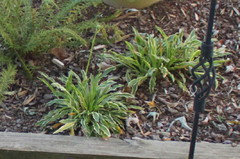
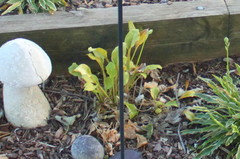
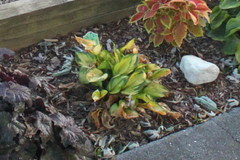
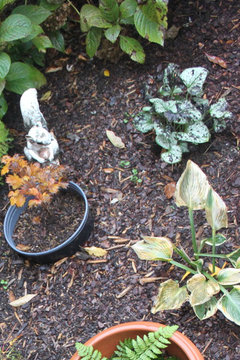
I have 5 little japanese maples in pots there too, on the other side-- one is pictured in that last pic there, above left of that horrible hosta. I didn't notice any issues with their leaves... does that mean they're safe or just that it hasn't shown signs yet? I've read that by the time you're losing entire leaves (and I was removing plenty of leaves), your infestation is moderately high.
I suppose maybe I was the one who spread it from one area of the yard to the next, by using the same tools. Oh and another hideous twist to this story, I gave my SIL one of my blue mouse ears last summer and she told me yesterday that she had the same issues. I only found out today it was the blue mouse ears, I'd forgotten what I gave her. So... I gave this horrible issue away to someone else to deal with too. Also now with that bit of info plus my stilettos above looking bad, I guess none of my hosta were really healthy and safe after all...
nnmjdklil
Original Author10 years agoFurthermore, can anyone recommend the best solution for cleaning all my tools? Most of them either won't fit in the oven (HA!) or have plastic parts that make that impossible.
Bleach solution? what ratio? Hot water? Lysol??
- 10 years ago
It's my understanding that foliar nematodes do not live in the soil for long. They just stay in the soil long enough to find a new host. If no host comes along, they die. Root knot nematodes can go dormant and remain in the soil for long periods. So, just make sure the information you are reading is about foliar nematodes.
10% bleach solution on your tools. They say boiling water dumped on the bed will kill the darn things. There are other things that will kill them in the soil, just not in the plant. The hosta society has sponsored research on them. I'll see if I still have the information. If so, I'll post it.
Just an fyi, I got foliar nematodes once from hanging fern baskets. I did not realize they were a host. Fortunately, my hosta were in pots, so I just dumped them, pot and all.I'm sorry about your mess. Take a deep breath and realize it's not going to be solved immediately. It will take a while to sort out what you want to do. It's not going to get that much worse in the next month or so. So, figure out a plan and do what you can.
bk
nnmjdklil
Original Author10 years agoThanks bk, it helps a lot to have compassionate ears out there ; )
I've read that the foliar nematodes can live in the soil IF there's old leaf tissue there...? Not sure how much needs to be there or for how long but I sure as heck have plenty of old leaf tissue in my soil! I didn't even used to remove the old leaves once they died from regular seasonal temp changes. This has at least, been a huge learning experience for me.
If I'm correct in all my assumptions, the evidence will be here in a couple of months and none of my plants out there will be salvageable anyway -- I can post pictures then. Right now I have emails out to a couple different people who might be able to help... They're long shots but if I get any worthwhile advice I will try it out and post all results here. I will say that since I'm not expecting to salvage any of them, I'm game to try just about anything, as long as it doesn't require ridiculous amounts of time. Experiments all around! Let's just hope I haven't already spread the darn things to ALL my plants, like in regular gardening last year with unsanitized tools. Grrrrrrrrr....
How about trees? Anyone know if my trees are safe? Surely at least the conifers are, right???
 10 years ago
I recognize you didn't take these shots specifically to show the nematode issue, but there is little evidence to me in these pictures that would indicate the presence of foliar nematodes. Plants going into senescence yes, nematodes no, they look like fairly typical end-of-season pictures with the possible exception of the "Stiletto' one and that picture really doesn't have enough sharp detail to be able to pass valid comment. To be sure, there's plenty of necrotic tissue to be seen, but late in the season you'd expect that.
Take a deep breath and relax but be observant and take close-ups of anything you think looks suspicious and post them here.
Below is from the PennState Extension and it's a far from complete list, witness the lack of Hosta and Heuchera as susceptible genera, but at least it conveys that the problem is widespread:
Many different plants are susceptible to Aphelenchoides
including African violet, Anthurium, Boston fern
(Nephrolepis), bird's-nest fern (Asplenium), columbine,
begonia, Crossandra, Cyclamen, gloxinia, Dahlia, Gerbera,
Hibiscus, Lantana, Mimulus, geranium, cineraria, Primula,
Ranunculus, Thanksgiving cactus, India rubber tree ( Ficus
elastica ) and iris.
The nematodes can remain on the outside of the plant or can
force its way into leaf and stem tissue. Wetness on the stems
and leaves provides an excellent environment for their movement. Splashing water during irrigation readily moves
the nematodes from leaf to leaf and plant to plant. In some
cases such as certain types begonias (Elatior), it can move into
the water conducting tissue and develop large populations
without causing any symptoms. Optimum temperatures for
foliar nematode development are between 21 and 24C
(70-75F). The nematode reproduces by laying eggs which
hatch to release a larva. The larva molts as it enlarges and
develops into a mature worm.
Pieternnmjdklil
Original Author9 years ago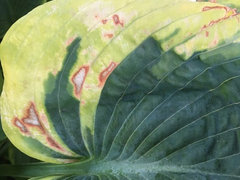 Does anyone know which of these plants are NOT susceptible to foliar nematodes? Coming back to this-- confirmed with microscope last week, after cutting off a brown piece and soaking a few hours in water. Little clear wormy thing just like in foliar nematode microscope video I found online.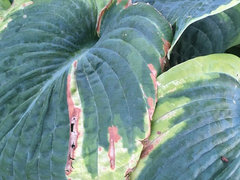
So snyway, I won't be buying more hosta and I'll dig this one up and dispose of it, then others as I see signs I guess. Some things I'm considering planting in place of this large hosta are a red japanese maple, a shade resilient conifer or maybe a black lace elderberry shrub. I understand the elderberry should do better in full sun but we may actually have that in this space someday soon anyway, as the large silver maple that provides the shade to that area will need to be cut down in a couple years.
Will the foliar nematodes hurt these plants too? Any other suggestions?
Thanks,
Nicole
- 9 years ago
It is my understanding that Nematodes usually don't cross veins but occupy the space in between - I agree with Jim in that the above photos look to me like typical FW necrosis. I zoomed in on your pics and I see sunscorch - my OBL and one FW show a wee bit of it already.
My experience with this is limited to one episode of nematodes in Summer Breeze back in 2014. I removed the affected leaves and disposed of them. A year later I moved the plant due to space issues. It is fine to this day. I guess I was lucky. (I also remove unsightly leaves on any of my hostas as soon as possible. Looks like Rainbow's End will end up a skeleton, lol - ugly frostbite.)
nnmjdklil thanked josephines167 z5 ON Canada nnmjdklil
Original Author9 years agoThis is the only one with this level of damage, yes. I'll take some pictures of some of the others tomorrow at some point. But what else could the clear wormy thing under the microscope have been? We only found it at 40x and it looked exactly like the pics google shows for foliar nematodes under a microscope. It was past the edge of the leaf, everything that fits the descriptions online. I really don't see how it could be anything else, though I'd be thrilled to be wrong in this case.
- 9 years agolast modified: 9 years ago
I'm with Jim and Josephine, the damage I see in the pictures you just posted do NOT scream "foliar nematodes" to me, nematode damage typically manifests itself much later in the year and will go between the veins from vein to vein. I'm at a loss to figure out what it was that you saw under the microscope and from what I've read you should be able to see them at 10x magnification, if you didn't see them until you hit 40x who knows what you saw....
The damage you see in those 2 pictures is typical of 'Frances Williams' in the spring. Here's some more info on the subject:
"Spring desiccation burn" refers to the brown areas that develop on
gold leaf sections of some H. sieboldiana cultivars, as commonly seen on
'Frances Williams'.
The non-yellow portions of the leaf are not affected. This is a
genetic problem in which excess water collects in the leaf tissue during
cold, rainy days in early spring.
The plant cells die and turn white, and then eventually rusty brown.Bill Meyer wrote,"I don't know how the word 'burn' came to be associated
with this, but it is caused by edema - too much water in the leaves on
cold rainy days. On the rainy
days it looks like it is water-soaked as cells are bursting in the
leaves. The next day the water is gone, and a week or so later the dead
cells start turning whitish, then
tan, then brown. If you go out on a cold rainy day you'll see it in
the leaves. It only happens in spring when the leaves are still soft.
Ones that do better in a lot of
shade may be getting less water from the rain being blocked."Unfortunately, there's not much that can be done to prevent the
browning caused by "spring desiccation burn". Some years will be better
than others depending on the
weather. The best alternative is to plant "non-burning" cultivars.Pieter
nnmjdklil
Original Author9 years agoOk!! So I went out there today to get pics of some of the others with damage and couldn't find anything worth photographing, save my Rainbows End which is only a month old and the damage on it looks nothing like this- just a few leaves are browning and curling on the edges. There were only 8-10 leaves to begin with so that's disappointing but as to the bigger picture, it sure sounds like I don't have foliar nematodes!!! I seriously feel a little high right now; thank you guys so much for all your help. I sure don't know what was in the microscope either but it took FOREVER to find it (seriously I think we were at it for at least 10 minutes... that's a long time to look around a 1cm square piece of dead leaf!) and it wasn't moving- I forgot to mention that. Everything I found online said it would be wiggling, and it wasn't.
Still this is the 3rd year this particular hosta has looked so bad, so I'm probably going to get rid of it anyway. Shame because it's beautiful for the first couple weeks but it goes downhill pretty quickly and there are far too many damaged leaves to make it worth picking them all.
Again though, bigger picture!! Overall I am truly thrilled. Thank you, all.
Nicole
- 9 years ago
I just went a class and the teacher said Nemakill was 100% effective if used early in the year, and almost that good any time. Of course, it's also super expensive. I think he said $100.00 for a pint. He used it and it was completely effective in his garden. You must really dilute it, because he's got a big garden and still has half a pint left.
He also told us a bleach solution (pretty sure it was 10%, but can't find my notes) was 97% effective. If you ever do get nematodes I'd try treating before you get rid of everything.
That said, your damage must be caused by something. Blue Mouse Ears doesn't suffer from spring dessication. Good luck, hope you find a solution!
- 9 years ago
Ok, I dug out my hosta field book, and found two possibilities. Your pictures look a lot like foliar fungus disease, which can be treated with fungicide. There's a three in one Bayer makes for roses that also kills Southern Blight. The other possibility is you have one of number of viruses. In that case, you're out of luck. Will your local extension office test your plants?
nnmjdklil
Original Author9 years agoI'm going to dig this one up, keep an eye on everything else, and report back if things get weird again mid-summer. Because last year things didn't get bad like they did in 2015, which was the time period that I initially posted about... though after posting this last year, I tried treating everything out there with a not-recommended-for-this-type-use (approved as a crack and crevice treatment though) active ingredient that was mentioned for commercial growers in an article I read on foliar nematodes from the BASF BetterPlants website from 2014- chlorfenapyr... and I mixed it in my pump sprayer. Last year the situation didn't get nearly as bad as the previous year... and def my blue mouse ears were all fine at least, as were the ones I gave my SIL. But she didn't treat hers at all.
So I don't know. But I will continue to monitor and post if anything new arises. I'm comforted by the fact that this spring desiccation only happens on the lighter areas of FW because my green areas are indeed fine.
As of the time of my initial post/freak out, my local extension office was not getting back to me about this (though they've always gotten back to me about other stuff promptly) so I gave up. If anything changes for the worse I will try again, or call another place.
- 9 years ago
I sure don't know what was in the microscope either but it took FOREVER to find it (seriously I think we were at it for at least 10 minutes... that's a long time to look around a 1cm square piece of dead leaf!) and it wasn't moving- I forgot to mention that. Everything I found online said it would be wiggling, and it wasn't.
The 'wiggling worms' should be visible in plain water when you drop in some leaf fragments after about 10 minutes, hold the vessel up to the light and use a 10x magnifier, no need for a microscope. Your comment above confirms to me you did NOT see foliar nematodes.
save my Rainbows End which is only a month old and the damage on it looks nothing like this- just a few leaves are browning and curling on the edges.
That sounds to me like a transplanting issue, the roots are either having trouble pulling up enough moisture because the roots have to adapt to their new environment or there's too much water and the roots are rotting, either way the leaves are not getting their requisite dose of moisture... and that's why you see the desiccation.
Pieter
nnmjdklil thanked Pieter zone 7/8 B.C.  9 years ago
I think the microscope is needed to confirm that the worms observed in the water are indeed of the pathogenic kind, not just any kind of small wiggly worm (which could have been hanging out on the outside of the leaf, not the inside). They need to be ones with a stylet, and you can't see the stylet without a microscope. Otherwise, you could probably take some grass leaves, soak them in water, and use a magnifier to observe wiggly worms in the water, but that would not tell you that they're the worms that infect hosta.
- 9 years ago
Stylet is the pointed straw they use for poking into the plant. Think of a retractable mosquito beak. There is a product called ProMax that can help. Its a contact killer, and will sterilize the soil, at which point you can begin to restart the biota with your own or their product called Zap. Its same day safe, which is nice and makes it my favorite roundworm destroyer.
 9 years ago
So where are we with the control of nematodes. Because of the wet season they are showing up in many places in my garden. There must be some kind of product that will control these worms? Is nemakill out ? If so what ? Boiling water is not an option. Come on experts, help!
- 9 years ago
I just took a look at the website referenced in the message 2 above and it looks interesting and might well be what we're looking for to deal with foliar nematodes. It is clear from the website they cater to large scale operations, as in farmers, and I doubt they'd have product available in a small enough quantity to make it a viable product for home use, but I'll be the first to admit I didn't dig through the site for further info. Having said all that, the only thing listed on the site are customer testimonials, no reference to any scientific control study. Why not contact them and see if there's a distributor in your area....
Pieter
- 9 years ago
Rob Canning of Lakeside hostas posted on his page that he uses Azamax and Biosafe with good success. Peracetic acid seems to be effective and this is what Biosafe has as an ingredient. https://www.ncbi.nlm.nih.gov/pubmed/11997971











jimr66