Software
Houzz Logo Print
alee2592

I need the most fool proof Finish for Expensive Dinning Table

10 years ago

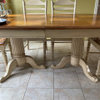
Please help me! I have light scratches, not into wood on the top of my very expensive dinning table. My Goal is to put "something" on the Top that will hide the fine scratches! I am trying to determine the original finish...using this method:
Test - OIL Finish...rub drops of boiled linseed oil into the wood, if it absorbs, the wood has an oil finish, if it beads up, the wood has a hard finish.
I have determined it has a Hard Finish... however, I do not have Acetone. I have Paint Thinner, Mineral Spirits, Lacquer Thinner & Denatured Alcohol.
(To identify the Hard Finish, rub Acetone over a spot in a gentle, circular motion.…
Lacquer will dissolve in 30 seconds under gentle, circular rubbing.
Varnishes and Shellacs will turn to a sticky, gel-like in 2-min.
The difference: Shellac will dissolve quickly in denatured alcohol... Varnish will react more slowly.
Polyurethane/polyester finishes will shed acetone like water)

Comments (19)

  • 10 years ago

    I am so at a loss! I have bags of stuff from every hardware store, wood shop in town ( with opinions galore from those places and some internet resources as well... all of which are different) and have spent $$'s and weeks on what I thought would be a simple project. I am usually good at FIXING things...but this one has me Stalled/Frozen.

  • 10 years ago

    Hard furniture wax close to same color as table is a simple and safe way to hide scratches while giveing it some protection.

  • 10 years ago

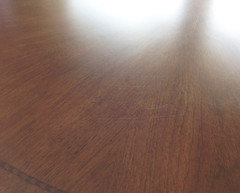
    Did you notice in the picture I sent that it also has an inlay and the Grainsare going in multiple directions. This is what was so perplexing for me..

  • 10 years ago

    Hi klem1, will hard wax work if the finish is Poly, Lacquer or Shelac?

  • 10 years ago

    I didn't see a pic. The only suprise can think of dependant on existing finish is level of sheen. The colored wax will result in a medium sheen that can be increased applying regular wax over the colored. Not so simple to reduce sheen. I've used a similar method to conceal scratches on cars and been very pleased with results. I don't claim this to be the best but it's certainly easy,reversiable and improve's appearance. This buy's time in case you want to continue trying figure out what's on the table. As with any surface work on furniture,if it's ever had silicon polish applied,all bets are off until that's been taken care of.

  • PRO
    10 years ago

    Is the scratch in the finish or into the wood? If it's into the wood you no longer have a very expensive dining table.

    If the scratch is in the finish it might be fillable or if a light kind of hologram scratches, just polished out w/rubbing compound, like a body shop does on a three year old car that's been through the carwash 150 times.

    To fill the scratch, you need to know what the finish is. If this is an antique, it is probably french polish (shellac applied with special techniques) if it's from between 1940 and 1970, it could be lacquer, but lacquer that old would probably look very poor by now. If it's a recent table, it is probably a catalyzed varnish or lacquer, if it came from a factory. if it was from a custom furniture builder it could literally be anything.

    Casey

  • 10 years ago

    I agree with what Casey said,esp "it could literally be anything.". That's why it's so very important knowing before starting a repair and op is takeing the wise approach. Since we are just "kicking it around",here's a tip to file away in the skill tool box. If and when you have a piece with old laquer,shelllac or french polish on it that look's hopeless,rejoice because it might be easier than you first think. Don't sand, scrap or stip until trying this. Make certain surface is free of contaminates then apply a diluted coat of same material. Lacquer thinner and denatured alcohol will normally desolve old finish,regardless how old. When that happens new and old finish amalgamate,level out and dry almost equiveilant of new finish. If it still doesn't suit you,90% of the old and new finish can be wiped off with proper solvent. The cherry on top is that by one in a million the piece is later discovered to once occupied Abraham Lincoln's bedroom,you did little harm compared to if stripped and refinished. None of my creations will become collectiable but to make it easier for future owners I attach a technicial sheet underneath. More info than op is after but some might find interesting.

  • 10 years ago

    Thank you Handymac, klem1 and Sombreuil, I am still overwhelmed by the diverse ideas and the opportunity to have a disaster on my hands.

    Reply to Sombreuli: The Scratches are in the finish, not down into the wood.

    Reply to Handymac: No I do not know the Mfg. of the table.... but I know it takes 4 grown, muscular men to move the Top alone, through the door. P.S. Loved the article on Rubbing out finishes! Going to put it in my "How-To" Library.

    I am enclosing another photo, in hopes that you can see the different directions of the Grains in the "wood veneer" with a "decorative inlay" which is about 2inches in from the edge of the Oval Table.

    If I don't hear a "DON'T DO THAT"..... (from you) after viewing the photo, I think I am going to use the "colored wax".... on Monday.

    Thank you so much for your responses,

    Aley

  • 10 years ago

    Aley, colored wax should be your first option. If you are unhappy with it, you can always remove it .

  • 10 years ago

    You can hide those scratches fairly effectively with colored wax, although they won't be totally invisible, especially if you keep looking for them :-)

    There is a high likelihood that you will really mess up the finish and regret you ever tried to fix this relatively minor defect if you start in with more serious approaches, like sanding, buffing, or applying permanent finishing materials.

  • 10 years ago

    If I do the colored Wax, how do I remove it if I am not happy with the results

  • 10 years ago

    Thank You, for your comments, I truly appreciate your time and advice. I will put The Colored Hard Wax on this weekend, I purchased BRIWAX, Dark Brown. If by chance, I need to remove it, how do I do that?

  • 10 years ago

    Good grief alle,you ask a question,get a simple answer then ask another question about covering all the bases,hedgeing your bets,bail out plans and havn't even tried the advise given to your first questions. You are a prime prospect for hireing a professional because you don't come accross as doing well in the world of diy. The answer to your question "how do I remove it if I am not happy with the results",is, exactly the same way you remove all the chit that;s on it right now. Do you seriously believe we can convey decades of experince and knowledge to you in 25 words or less? Put the wax on,see if you are satisfied and if not,take it to a pro or buckle down and be serious.

  • 10 years ago

    klem1.... :-) I am surprised you are sensitive enough to respond like this...

    If you only knew.... I was DIY before they even had a Term for the Talent!

    Thanks to all for your input!

  • PRO
    10 years ago

    Briwax will come off with solvents like naphtha or mineral spirits, also strong detergents and ammonia cleaners.

    That looks like a satin finish; wax is going to make it shinier, and will not actually fix the scratches. A finish specialist could buff out the scratches and then return a satin finish to the whole piece, but it will still not be exactly the same as a sprayed-on new satin finish.

    Casey

  • 10 years ago

    I have almost the same question and situation...except that I am perplexed by light brown scratches that don't appear to be in the top of the finish.

    I bought a used round mahogany pedestal table with leaf made by a to-the-trade company called Ebanista. The top has pie-crust veneer of what looks like quarter-sawn (ribbon) mahogany, separated by straight sections. It is relatively recently made; the company is only 15 years or so old, I think. So, no worries about ruining any value of an antique. The finish is lacquer. I saw the scratches, and although I didn't want to take on a strip-and-refinish project, I bought it hoping I could buff the scratches out of the finish, wax it with brown wax, and call it a day.

    Of course in the light of day and with plenty of time to inspect closely, it was worse than I hoped. I cleaned it with Natural Orange surfactant cleaner, then mineral spirits, and buffed it with Zaino auto compound for light scratches (water based). Didn't help at all.

    It has some very large gouges that are completely in the finish, but there are also these light-brown colored scratches with areas that don't seem to be in the top surface at all, when I look across at eye level. How can that be?

  • 10 years ago

    The dark colored scratches below the surface may have been the result of minor defects or even traces of sanding burn marks left on top of the wood, or were contaminants in an intermediate coat that were sealed in by the final coat(s). I admit it is unusual, but I have had situations where I thought certain types of defects would vanish with a coat or two of clear finish, and they didn't. It would be interesting to see some pictures of just what you are dealing with.

  • 10 years ago

    I'll get pics as soon as I can. Of course, my battery died just as I was trying to take them for my previous post. I think the scratches are from a little dog jumping on and running on the table top. I don't understand why I can't see all of the scratches across the surface...