

Help with gritty mix soil
I have purchased the Napa oildry, chicken grit, and reptibark. I understand the oildry should be sifted and not to use the tiny particles...the oildry itself is pretty small in comparison to the Repibark.. I put it in the blender..and sifted it...the sifted part is nice small pieces...I assume I should use it all..even the pieces that were too large to go through the sifter? I have not opened the chicken girt..so don't know the size of the particles ...but assume they are compatible with the above.
Now, I have cuttings with stems...these should be okay to put in this mix? Wait 2-3 days before giving water..and then should it be a small amount of water? Since the weather is nice now...I was going to put them outside..If I do.,.they will dry out pretty quick..so approx how often would you water them?
I have read to put them in the shade in the beginning and slowly out into the sun for 2-3 hours daily?
It rained all day today..if they had been outside they would have been flooded...how do you handle the rainey weather..since you don't always know when it's going to rain...and even if you do...do you have go move them?
I am new a this..these will be my first attempt at trying to get them off to a good start.
Would appreciate your help, Bev
Comments (21)
 10 years ago
So many questions! I think you can find additional answers if you do a bit of thread digging and reading up. =)
When dealing with new cuttings, I put them in places with less light and cooler temperatures so they don't dry up before growing enough roots.
Water proportionally to the amount of roots. No roots, no water.
How often you water is highly dependent on your growing conditions. Watch when your plants show signs they need water then 'water the day before'. You can use a skewer, moisture meter (Use the trend), weight, or just your eyes. =)
If your locale experiences torrential rains, consider covering your succulents. In case of heavy rain, I cover the sides of my growing shelves (they are covered from above). In case of big storms everything comes back inside.

blevine2
Original Author10 years agoSorry I put so many questions in that one post..but you answered most of them and I really appreciate it.
When you suggested new cuttings should have less light ...is it okay in the shade OUTSIDE? How will I know if there are roots with out digging them up?
About the gritty soil....I did read the Napa oildry needs to be sifted....and although the Repitbark pieces should be smaller..using blender doesn't change much...would take forever to put small enough batches in there..and even saw sparks at one point..so...should I use as is or leave them out? I am using pretty small plastic containers until I transplant after I see roots .
Related Professionals
California Landscape Architects & Landscape Designers · Knoxville Landscape Architects & Landscape Designers · Huntington Landscape Architects & Landscape Designers · Salem Landscape Architects & Landscape Designers · Willmar Landscape Contractors · Plattsburgh Landscape Contractors · Albuquerque Landscape Contractors · Salem Landscape Contractors · Lawton General Contractors · Miami General Contractors · Rockford General Contractors · Oshkosh General Contractors · Lancaster General Contractors · Bozeman General Contractors · Ogden General Contractors- 10 years ago
Shade outside is fine. I have no idea where you live (consider adding zone to your profile).
If your cutting leaves start changing colour or wilting quickly, then it's too bright or too hot where you put them.
When the cuttings start growing and respond well (overnight) to small amounts of watering, then roots are there. If the roots are not there, the cuttings will not change or absorb water after watering.
It's up to you what you want to do with your bark. I blended mine and sifted out the dust. It worked to reduce the size but was a big job.
Since reptibark is very expensive and too much work, I probably wouldn't buy it again.
blevine2
Original Author10 years agoSince I already have invested in the repitbark...might as well try to blend it some more. I was thinking of trying to cut it with my dog toe nail clippers..I will let you know if it works.
I did find pine park soil conditioner at a nursery who makes their own mulches.
It reads..75% pine park,25%compost plus trace minerals. Would that work? It's a huge bag for the money..
If you leave yours out...what would be missing that the bark supplied? Would you add anything else instead?
I just ordered some Foliage pro from Home depot. they only have it online..they shipped it to my house...no shipping cost..only tax..it was a large amount...but can be used for everything..and thought I'd also share it with others.. Do you use that? I think I read ...you can put in the water and use it every time you water. Not sure hope much to put in...the water.
I live in Kansas..I think that is zone 5.
Thank you
- 10 years ago
The bark really doesn't add anything very special to the mix. The concept of bark in gritty mix is that it's cheap filler. And Reptibark isn't cheap!
When blending, I filled the container about 2/3 full. Then I would tip the blender maybe 45 degrees and then swirl it around a bit. That would help propel the vortex of bark and swirl it around (and hit the sides of the glass where it would be broken up). If you just run your the blender standing up, the bottom bark will just turn to dust. My blender was $25 from Walmart, so higher quality ones may require less user-activity to get a good result.
This month I will begin experimenting with pumice and see how that goes. Might also be trying some other pumice, lava rock, and akadama too. All depends if I'm able to buy a small quantities to test.
I don't use Foliage pro, but many here do. Read the label carefully for usage instructions. I've heard of using 1/2 or 1/4 the recommended dosage?
For fertilizing my own succulents, I am using an EC meter to measure the amount and tweaking that with my soil mix and how much nutrients it holds.
blevine2
Original Author10 years agoThanks for the blender instructions...I was doing it all wrong. I can't get pumice here...however I did call a rock place..and they have all kinds of stuff that might work including lava rock, gravel, etc. Would you add one of those to the oildry and chicken grit I already have? I didn't know all that ingredient for the gritty was because it was cheap...so it won't matter what you use...as long as the water goes out fast? Even if you use just one of the items? So none of the ingredients add anything to the nurishment of the plant? Only the fertilizer does that? I didn't understand your method of fertilizing? What is EC meter? how do you tweak?
 10 years ago
I used to cut up the repti-bark with pet nail clippers & though it worked well, it was a lot of work. To make it more useless, I never could get the pieces small enough.
I don't use the bark anymore, and I don't use napa oil dry either.
The oil dry just gummed up the bottom of my pots, so I decided it wasn't worth it. Besides, all the sifting and prepping was starting to get to me.
If your collection is only a dozen or so pots, I could see doing it. However, mine is rather large and getting bigger by the year.
I use straight up pumice and chicken grit. I got the pumice online from here:
I bought a bag of the 3/16, it was 25$ but I don't recall what (if anything) I paid for shipping. I remember thinking that this was not only cheaper, but easier.
The bark is meant to hold on to some water, so is the oil dry. Not sure what your zone is, but here in 7, my succulent cuttings never struck roots faster now that I'm using just the pumice & grit =)
blevine2
Original Author10 years agoI am so grateful that your willing to share all that info with me. I am 82 and
just recently discovered succulents. I have gathered some cuttings from
friends and neighbors..but they don't even know what the names are..I guess it doesn't matter....except I would like to be able to have some in front of my south window this winter..but still think, the low light ones would be best....I do have a shop light in the basement with grow bulbs from years ago...but it would be nice to have some on the floor I could see them daily. Do you ever share cuttings of yours?
There are so many posts on this site, raving about the gritty mix ....I figured I should try to locate the ingredients..it was difficult...to say the least...but I do recall the raves about Pumice....when I asked for it here..the nurseries have never heard of it...except one..and she said ....it didn't sell and they ended giving it away. I have spoken with the owner of General Pumice...she told me she has sold it to some Succulent Societies and they they devy it up among the members. I went to one Society meeting locally and when I asked different ones if they propagated or made their own soil...most didn't. I have tried to learn all I can from the net and library..but it sure helps to know the details ...I have spoken to so many people who killed theirs and gave up..but they never tried to find out why. I can't understand how the nurseries can sell the bagged cacti and succulent soil and expect their plants to thrive...I bought some and realized right away , that the water didn't go through like I read it should...that's when I began my search for NOW WHAT:??? I did complain to the nursery about it and they tried to sell me Perlite..I had already learned that most didn't care for it. I assume most who buy from the nurseries...never repot them....who would have ,known to remove them from the soil they come in?
I also have learned it's best to keep them in their own pots...when I saw the many different kinds of containers filled with succulents at the nurseries and grocery stores for Mother's Day...that were selling from $25-$50...I thought most of these will not make it...I don't understand why they have become so popular recently. They do require a good bit of care info....almost to the point of being difficult, when it comes to having to figure out which plants need more or less water or light...soil...and fertilizer. I don't know how you all with many plants do it? I am aware how easy it would be to get addicted.
I was amused you had thought of cutting up the bark too? Guess there's no point in doing that. Others must use it as is...but I imagine their pots are larger than mine, starting out with the cuttings.
I think the most fun will be propagating ..watching their progress ..but then if you don't know how to care for them as they develop into a plant....and you lose them..how sad! They are almost like your babies! That's why I am trying to learn all I can..yes.there is tons of info on this site..I have spent hours and days already...and still you have shared so much valuable info.
I just can't thank you all enough!
- 10 years ago
Oh dear =)
Ok, here's the fun part...now that you've read all that you have, throw it all away & start experimenting what works for you.
I absolutely share of my collection, for at about 5 yrs old, it is large and unwieldy.
The increase in my collection is directly related to this forum & my use of gritty mix.
Once you know the principals of the interplay of light, water & potting medium, you can play fast & loose, haha. You must begin experimenting.
The general idea is to have similarly sized particles that hold very little water.
So with the classic gritty mix as written here on this website involves sifting each ingredient to keep & use only those that are just the right size.
Particles that are too small (fines) are just dusty & tend to compact, though nowhere near as much as organic soil mix. Particles that are too large, allows too much air between & though it's still a forgiving mix either way, is not optimal.
Did you check out the link above for Pumice?....you can also get a small amount of gritty mix already sifted to the right size and ready to go on Ebay, same thing with pumice if you can't use 15#'s of pumice.
I also have a few shop lights that I use in Winter but have yet to figure out how to display my succulents so that I can see them all the time too =/
I have curious pets who are occasionally very naughty to my plants, but who has eyes to be everywhere?! Also, much of these if not ALL of them are poisonous if ingested, so I just all treat them as toxic & keep them out of reach.
Now that you know about gritty mix, here's my Rx for success:
If you've got a big box store near you, buy a couple of succulents & either use your own gritty mix (which I have used with just grit & turface and it was just fine) or purchased ready made gritty.
Then, bare root & rinse away the soil from your starter plants, allow to dry for a few days, then pot back up either in their original pots or in terracotta pots of the same size which can be had for cheap at your local craft store.
Just make sure there's a drainage hole at the bottom 8)
The more sun your plants get, the more water they can use.
As mentioned above, no roots?...no water.
How do you know it's making roots?....you'll see growth, as in baby leaves.
If you can manage to put pictures up on your posts, you can get ID's for your succulents for more specific care.
However, I have several dozen pots & treat them *all* the same. All are thriving.
I protect only from critters, intense sun & frost. They grow like mad & I've more than I can give away.
PM me if you'd like some to add to your collection =D
Antoinette
- 10 years ago
Bev - I think Rina has already answered your questions very nicely!
One thing I've learned is that succulents are very trendy and popular plants to grow, but most sellers don't know much about them. Most staff are clueless, although some have small personal collections. Those ones are the most helpful. Honestly, even those who are growing them for commercial sale are still learning!
I do share cuttings, offsets, and full plants. This months I've given/traded away over 60 plants to others! Most were fairly local, but I have mailed succulents before.
If you're in the USA, it may be easier for those within the USA to send plants. Over the border is a bit of a risk.
Even though many species can be quite difficult, it makes me happy that garden centers and greenhouses are selling them. Succulents are just so interesting and strange, very addictive. I used to worry about buying the pickier ones, but as you get more it becomes much easier.
We all lose plants, it's hard to not get attached to them. Last year I lost four and this year I've lost one so far. I'm not counting the seedlings I've lost because that would be too depressing! Anyway, I don't worry about it.
Reading a lot has helped me greatly. Understanding research papers and the more complicated scientific information isn't too bad since I have some background in biology/chemistry.
Most of all though, experimentation has brought me a long way. Taking notes, taking the time to understand what I've done wrong, and keeping an open mind has been beneficial. Pretty much everything I "knew" about growing was wrong.
Rina - Well said! One thing is for sure, with a little practice or time everything gets easier. =)
blevine2
Original Author10 years agoYou guys are the BEST!!! thank you so much!
I am getting ready to pot some cuttings into gitty mix of reptibark, terface and girt. I have read they all need to be sifted first? Is that right? Also..I also read they need to be washed also. If that is the case...it will all be wet when I plant and I thought you were not suppose to water newly planted cuttings, until you saw roots. So I do need your advise before I kill them right off the bat.
- 10 years agolast modified: 10 years ago
It is better to sift to get rid of smallest particulates.
Rinsing will get rid of more dust.
Both are recommended, but not absolute must - sometimes one just doesan't have time or space or willingness to do it. I do both most of the times (if you shake the bag with let's say turface, most of the smaller particulates will settle on bottom; start scooping from the top and for a while you'll get the bigger only. As more is used, it would be better to sift).
I also rinse stuff in large colander, let it drip dry and then just mix all together - it will be just slightly damp, all mixes better and I usually do not water for couple of days.
For cuttings with no roots at all, I would let it dry more thoroughly - if in a hurry, I will spread rinsed product on a window screnn so it dries up faster.
Over all, do not obsess too much! When sifting, it may be wise to use a mask, some stuff is quite dusty and if doing larger amount you don't want to breath it in (I use it mostly when sifting perlite).
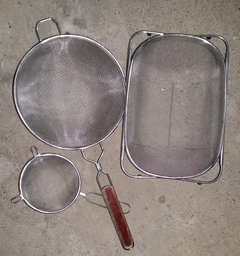
Adding photo of my 'succulent mixes dedicated' colanders/sieves; 2 parge ones I got for a $1/each in restore, small is regular kitchen sieve I bought at dollar store.
blevine2
Original Author10 years agoThat's what I needed to know.Really appreciated all the info and pic of strainers.
I spent part of the afternoon using my blender to make the Reptibark smaller pieces...It worked...but did end up with a lot of powdery stuff. I was afraid it would ruin my blender..but it didn't...however..I have seen them at the thrift store...just in case.
If I recall, reading about cuttings on this site...that after they are potted...not to water until there are roots. Just wanted to make sure that is what is best.
I now have small hairy like roots from leaves I have been waiting for..and there are also small beginnings of plants. At one point do I pot them in their own pot? I intend to pot them in gritty...and cover the roots as best I can ...don't water for a couple of days..and then give small amounts of water until they get larger and then they can have a full dunking of water,like the purchased plants? They are still attached to their mama, some are still fat with water.
These can be outside indirect light and gradually they can be in the sun for short periods of time?
.- 10 years agolast modified: 10 years ago
Bev
You are correct, cuttings do not have roots and can't take in any water. You could start spraying the surface of the mix they are in after a while - depends on temps, maybe after 1-2 weeks. I prefer not to spray plants, some do.
I usually leave leaves with fine roots where they are until they grow a little plant, leaving the old leave in place until it dries up and shrivels (it usually just falls off at that time). I will sprinkle some gritty mix over the roots sometimes. Moving/repoting them often just disturbs the fine roots, there is plenty of growing they need to do.
blevine2
Original Author10 years agoOkay Rina, I just needed your support on these matters.
After all the blending of the Reti-bark...I didn't end up with all that much out of the orginial bag. You all are right...it is expensive! What is it's purpose that leaving it out of the gritty mix won't matter? What about putting only 25% or so in the mix instead of 50%... would that be better than leaving it out completely?
- 10 years ago
Bev - Bark is just there as 'cheap' filler. It's easily replaced by other things like grit and Turface (and many others).
You can use it in different portions, just increase the Turface ratio to compensate.
blevine2
Original Author10 years agoWow! then Reptibark is an expensive filler!....obviously Al and maybe others are able to purchase it at far more reasonable priced than Reptibark.
So, are you saying that you could make gritty by using the Napa oildry instead of pine bark to Turface and Grit...still making it 1.1.1? or maybe gravel, lava rock or what ever else can be found? Or just use the Turface and grit making it 50 50? Would that still work for cuttings as well as rooted plants? I have read that others add perlite to potting soil and they say it works fine...but Al's gritty contains no soil....If I am understanding this issue of soil for succulents ...it's what ever one can find, afford, or can accommodate large bags...that works?
- 10 years agolast modified: 10 years ago
Bev - Based on my testing, Perlite and Bark have similar water retention. Just bark can hold on to nutrients better. You could do something like 50% grit / 25% turface / 25% perlite.
1:1:1 is a recipe suited for houseplants and succulents in much hotter climates than ours. So 50% Turface may hold too much water. Maybe 60% grit / 40% turface? I haven't gotten a chance to play much with that combination yet.
It's a bit of an experimental journey! Our growing conditions are different, so it's nice to try a couple different things and see how it goes. If something isn't going very smoothly, don't be afraid to change the mix ratio accordingly.
I find customizing soil is just like making dinner - cooking steak just how you like it, cheddar or mozzarella, red peppers or green ones. What exactly someone else uses or likes may not fit exactly to your own needs or desires.
blevine2
Original Author10 years agoI understand what your saying....but when you so new at this..and have started with propagating leaves and cuttings...it's hard to know what is actually working. My concern right now, is to pot my cuttings in whatever will result in roots and my leaves that have started sprouting roots and baby plants will continue to enlarge and grow into full size plants. Pumice is not available but have considered ordering some from the place mentioned on this site. Would that be a worthwhile investment? Someone ordered 1/8 but then 3/16 was considered better..is that your understanding.. Have you used it? Somewhere I read that pumice and grit produced the best and quickest roots one cuttings they have witnessed.
- 10 years agolast modified: 10 years ago
Bev
If one understand what is the reason to use type of gritty mix, it could be made of almost anything. Did you have chance to read at least some of the posts about the soils? Here is the long read, but could be worth reading: -click here to read about soils-
Well drained and aerated pottingmixesare good for all plants.
I use grit, perlite and turface. Turface does hold more water, so I am using less of it than 1/3rd for succulents. I used reptiBark only once since I could not find proper bark, now I don't use it at all. I believe I described how I make mix for succulents.
I don't order stuff that is too expensive (and some isn't even shipped to Canada & I didn't find another source). On top of it, postage is usually very high and that makes it even worse.
Many ppl use cacti & succulent soil and mix it with lots of perlite to make it more drainable - I don't use that soil, so can't really recommend or not. But it seems to work for many.












rina_Ontario,Canada 5a