Software
Houzz Logo Print
saturn333

Planted

10 years ago
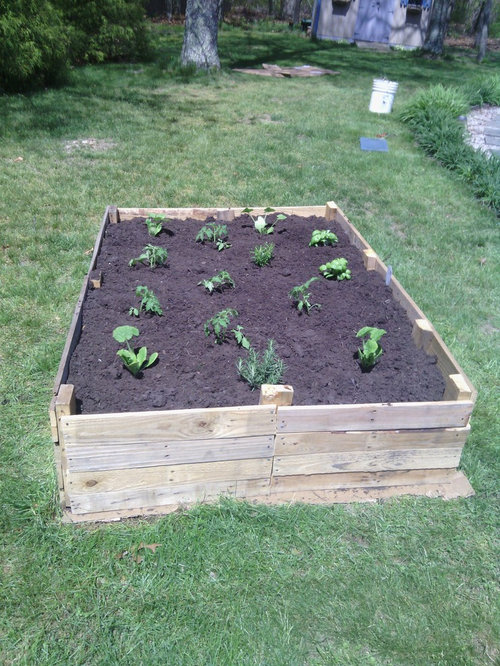
Planted our veggies cherry tomatoes zucchini Basil and rosemary


Comments (41)

  • 10 years ago

    six feet by four feet 19" deep I thought it might be a little tight it is the first time for raised bed for me seeing how it goes.

  • 10 years ago

    Cherry tomatoes will be huge once established. I will put max 2 plants and leave the rest to max 2 zucchini. They are both huge plants and very productive.

  • 10 years ago

    Is that a Rosemary at the end? It won't enjoy the water going on the other veggies.

    saturn333 thanked floral_uk z.8/9 SW UK
  • 10 years ago

    Yeah, Rosemary is a pretty resilient plant. You could lift it out and put in a sunny part of the yard somewhere, or in a container to bring it indoors over the winter. You'll have a little extra space in your bed.

    saturn333 thanked rgreen48
  • 10 years ago

    could I put two Rosemary plants in one container outside?? I am thinking they do not need much watering

  • 10 years ago

    Rosemary does fine in a container. Needs no fertilizer and rather little water. The number of plants doesn't matter. They'll fill the available space.

  • 10 years ago

    So I did move my Rosemary out of the bed into two containers. The raised bed has Natures Care organic soil for my vegetables. Will I still need to fertilize the vegetables in the raised bed?

  • 10 years ago

    That soil mix has minimal fertilizers. Basically lightly fertilized potting soil. Until you get some in situ composting going on in it, you'd be wise to add some fertilizer. But still, your cherry tomatoes are going to try to carpet that whole area. You'd be wise to set up a trellis, especially if the tomatoes are on the north side. Since the sides are wood, it would be easy to affix a trellis to the side of the bed. Basil wants sun, and those tomatoes will otherwise bury them.

  • 10 years ago

    I do have tomato cages to trellis them

  • 10 years ago

    Well, cherry tomatoes are really vines, and they will shoot out of a regular cage in no time. Mine are already towering over my 7-foot trellis. But maybe you could do some creative wrapping and threading in the cage to keep them under control. The important thing is to keep them off the basil and squash.

    saturn333 thanked daninthedirt (USDA 9a, HZ9, CentTX, Sunset z30, Cfa)
  • 10 years ago

    How often do you fertilize ???

  • 10 years ago

    "The raised bed has Natures Care organic soil for my vegetables."

    Could you clarify this?

    Natures Care Organic Garden Soil is a soil amendment, a soil additive that is supposed to be added to your native soil at a ratio of 1 part NC to 2 parts native soil. It is not intended to be used as a growing medium all on its own. This is explained in detail on the bag label.

    So if that is the product you used and you filled the bed with it and nothing else, then you have more serious problems than the over-crowded plants and whether or not to fertilize.

    If you used Natures Care Raised Bed Soil Mix that comes with soil already added that's fine. Then the problem becomes the over-crowding, over-planting. How bad a problem that will be for you all depends on the variety of cherry tomato plants you used. Many of the cherry varieties are the biggest tomato plants that exist, easily 8-10 feet tall and easily 4 feet wide.

    Either way, as Dan said they come with minimal nutrients that are available for the plants to use. So yes you will have to feed the plants regularly throughout the season. Any well balanced fertilizer that also contains micro-nutrients will work when applied per its label frequency directions.

    Dave

  • 10 years ago

    Why in the world do they call stuff "garden soil" that fundamentally isn't? You plant stuff in "garden soil". Everyone knows that. Of course they include instructions telling you not to plant stuff directly in their "garden soil", so maybe that's supposed to fix it? It would be more honest to call the stuff "soil improver", or something like that.

    In fact, I believe that while Natures Care Garden Soil is primarily an amendment, it does have added fertilizers, but the usable nitrogen is about 0.1%, which is a factor of two or three lower than what you'd really like your bed to have. It seems to have some P and K too, but probably has no minerals at all. Same problems as planting in pure compost.

  • 10 years ago

    Excellent question Dan. Likely the same reason Miracle Grow calls their similar product MG Garden Soil in big print on the front and then in small print on the back tell you it must be mixed with native soil at a 1:2 ratio and cannot be used in containers - to mislead new gardeners and the buyers who don't know better and so sell more product and increase their market share.

    No minerals and minimal primary nutrients in an undigested form and so unusable by plants until it first gets digested by the soil micro-herd (which don't exist in a new bed), drains poorly, compacts quickly, suffocates plant roots, etc.

    The information against these products and the poor reviews from real users (not company employees) are out there on the net but when some new gardener is standing in a big box store nursery trying to decide which of the 50 different products available to buy who is going to steer them in the right direction?

    Dave

  • 10 years ago

    Now, this is interesting. The link Frank sent, to "Natures Care Organic Raised Bed Soil", is different from one you can find online to "Natures Care Organic Garden Soil". Those are being sold as different products. The instructions for the latter specifies a dilution strategy of 2:1, but the former doesn't. In fact, for the former, one is instructed to use the stuff by itself in a raised bed. The composition of both seems to be mainly organic stuff and compost, and appears to differ substantially in detailed content depending on where you are.

    But the NPK of the two are similar, and it sure sounds as if neither has any real mineral composition. Certainly neither has any soil micro-herd and both can be predicted to drain poorly.

    So this seems to be more than not following instructions. It seems to be just that the material that is sold is in many respects not optimal.

    But Dave, you're certainly right about the "Garden Soil". They downplay the fact that you need to use a 2:1 dilution, because then you're going to buy a lot more of it.

    So Frank, if you used the Raised Bed Soil, we still think that you'd be a lot better off if you mixed it with some real soil AND added fertilizer, at least until the soil bacteria starts to work. Maybe for one season?

  • 10 years ago
    last modified: 10 years ago

    I already know the difference between the two products Frank which is why I asked which you used? You originally called it "Nature's Care organic soil" which means it could have been either. So I asked for clarification.

    I assume the link you posted is meant to indicate that you used the product labeled specifically for raised beds? Not sure what the link to the fertilizer is for but if you are asking if that fertilizer is good to use then the answer is no. It has the same limitations as the stuff added to the mix already in your box. It is not pre-digested, it is not in a form usable by the plants and your new bed contains no soil residents (what is called a soil microherd) since it contains little soil that can digest it so the plants can use it, and it contains no minerals and no micronutrients. Mixing in some good soil will help them develop over time as Dan said.

    The simplest solution is Miracle Grow All Purpose Water Soluble Fertilizer but if you wish to use only organic fertilizers then you will need to use pre-digested liquid forms like fish emulsion for NPK and one of the many mineral supplements such as greensand, kelp meal tea, etc.

    For example:

    Dr.-Earth-Liquid-Solution

    Fox Farm Grow Big

    Liquid Kelp

    Dave

  • 10 years ago

    Sorry for the confusion it is Nature care organic for raised beds is what I used. So now my mission is to get Miracle Grow All Purpose Water Soluble Fertilizer for my vegetables and follow instructions on frequency. Being my first raised bed and so many options at the store to by who knows what is better than the other. #hoping for the best

  • 10 years ago

    Can't tell from the picture; is the raised bed is sitting on something other than soil?

  • 10 years ago

    It's a little late, but you might dig in some scoops of real soil in the areas between the plants. At the least, that will help kick off the bacterial action that you'd really like get started in your bed and would add to the mineral content. Otherwise, it's just a matter of what manages to float down onto the surface of what is largely carbon.

  • 10 years ago

    That just pisses me off. How many bags of freaking garden soil have I bought this year? This is my first year gardening and I've spent way more money on bags of dirt than on everything else. And it will all probably die. Grrr.

  • 10 years ago

    Well, lol, don't give up on the eggs before they hatch... you never know what a season can bring.


    That said... while I completely understand that there are very valid and informed choices for building a raised bed, I do lament the 'walled-raised bed-trend' in general.


    Native soils are often as good, or far better - or can be made far better - than any soil you can buy. This is not always the case, but what's often misunderstood is that soils are just a 'medium'. Unless a soil; nay dirt; is contaminated, even what is considered a 'poor' soil can be made into something to envy. Unlike buying supplies though, it just can't usually be done in a weekend. However, even if your native soil is just 'fair', in some cases it can be done in a day.


    So, while we watch the continued consumerization (is that a word?) of gardening, let those who wish to learn continue to educate themselves. "Every time that wheel goes round, bound to cover just a little more ground."

  • 10 years ago

    How to grow a $20 tomato! I keep hearing the term 1st year gardener that has spent tons of money to try it out. Raised beds are fine but learn how to do this before spending tons of money. Container gardening is a great way to learn. or just raise something in the lawn. when I was renting a place I just dug a post hole, partially filled with compost and dropped in a tomato plant. put a black garbage bag around it for weed control. It worked great for very little money.

  • 10 years ago

    I have to agree. Raised beds are nice, but pricey. Unless your native soil is really detestable, perhaps seriously polluted, there isn't any reason why it can't be brought up to snuff. True, it can take a few years to really get it completely in shape, but it's an investment that pays off grandly, and it is naturally expandable. It builds on what you have, rather than building over what you have. I like the post hole-and-compost idea.

  • 10 years ago
    last modified: 10 years ago

    "That said... while I completely understand that there are very valid and informed choices for building a raised bed, I do lament the 'walled-raised bed-trend' in general."

    Strongly agree. While raised beds have their place in certain circumstances they have many negative variables. Upfront costs and needed research are only two of those negatives. So they sure aren't the perfect or even ideal gardening method many make them out to be.

    I wouldn't go so far as to include digging a hole and dropping in a plant as a better method in any way but since most raised beds are actually little more than big containers, container gardening first is a good way to learn the basics. As someone has does all 3 and has for years I can attest to the fact that neither will compare with an in ground garden when it comes to low cost, ease-of-use, consistent success, or production.

    Dave

  • 10 years ago

    That's how I've planted my green beans. I hope that they will live, but worry they will die once their roots get to the heavy clay. Most of my plants are in containers (5 gallon buckets and 2 kiddie pools) and I tried to use mostly potting mix for the buckets.

    Maybe next year I will wind up amending the soil and tilling and all that good stuff. Honestly this year just started with me wanting to plants a couple of self watering planters for myself and a few bean plants to show my toddler how things grow. It has snowballed.

    I do realize I am trying to buy my way out of work. I work full time and have an almost 1 year old and just turned 3 year old so I'm basically spending every free minute outside working on this. I just don't have many free minutes.

  • 10 years ago

    I've done both in ground and raised beds and both do have their advantages over the other but I give the overall advantage to properly constructed raised beds. Better drainage, easier and less weeding, easier harvesting, easier access during very wet periods when muck boots are often required to access in ground gardens, and for some reason I get far less 4 legged pest pressure than I do with in-ground beds.

  • 10 years ago

    Bingo, Dave.

    Not everyone can go to big open beds though.

  • 10 years ago

    "Not everyone can go to big open beds though."

    Oh I know but so many of these raised bed pics and discussions we see posted here are done because the new gardener believes that is their only and best option. They read all the glowing reports about how wonderful they are, how easy they are, with no mention ever made of the many drawbacks they have much less the costs involved. Every now and then we need to remind the readers that raised beds are a relatively new, but not necessarily better, method of gardening and that it is expensive.

    And no offense Jack but all those advantages you list are just as readily available in a properly constructed and maintained in-ground bed. ;-)

    Dave

  • 10 years ago
    last modified: 10 years ago

    It's interesting, I am driving through Italy enjoying all the farms, gardens, plants cultivated everywhere, and I don't think I have seen a single raised bed, even amongst all the personal vegetable gardens that are all over the place.

    Nature's Promise Raised Bed Soil worked well for me, for a small raised bed with no separation to the ground below.

  • 10 years ago
    last modified: 10 years ago

    I think Dave hit the nail on the head when he called raised bed gardening a form of container gardening. At least for the smaller raised beds, that's precisely what it is. One additional handicap of raised beds, at least in my locale, like container gardening, is that the soil temp is much closer to the air temp, and where summer daytime temps get well over 100F for a month at a time, that's really not optimal for roots. Also, freeze protection is harder, because you have to protect the walls of the bed, and not just the plants in it. The advantage of a raised bed is that with effort and expense, you can potentially get performance fast (if you really do it right). But your efforts have walls around them, and expansion is a matter of doing it all over again.

  • 10 years ago

    " I am driving through Italy enjoying all the farms, gardens, plants cultivated everywhere, and I don't think I have seen a single raised bed, even amongst all the personal vegetable gardens that are all over the place."

    Excellent point Peter but you don't have to go to Italy to see that. Even in most of the US you just have to get out of the city suburbs to see the same thing - lots of gardens but very few raised bed gardens. :-)

    Dave

  • 10 years ago

    One of the proud few here :)

  • 10 years ago

    When I first got my allotment about 25 years ago there were no raised beds at all on the site. Everybody grew in-ground using the perfectly adequate local soil with compost or manure, and fertilisers if they were that way inclined. In the last few years more and more new allotmenteers have installed raised beds and I have no idea why. The soil is good already. It was formerly rich pasture. I have tried adding a few boards on the down hill side of some of my in ground beds as a kind of rudimentary terracing and all it does is make a great place for slugs and snails to hide out in the day time and complicate the mowing of the paths.

    This year I have seen the first raised bed with entirely imported contents. I have no idea why these people spend their time and money money in this way. It appears to be almost entirely a question of fashion and marketing.

  • 10 years ago
    last modified: 10 years ago

    Just a bit of history for anyone 'new' to gardening...

    The evolution of the 'raised' bed had its 'roots' beginning with beds like these...

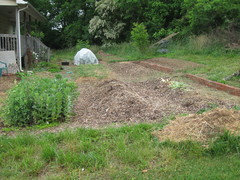
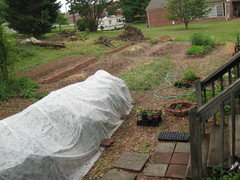
    You can see in the pics that when worked, soil (especially clay) naturally expands. Then, as you add organic matter, they can get quite high. The oldest of these are 2 years old. And except for last year's summer mulch - and the layer of winter leaf mulch - they haven't had much added to them. The worms and flora/fauna of the soil expand the clay soil to get at the organic matter. Before they were fork-turned earlier this spring, even the highest one now was then flat with the ground. You can see the fava and pea bed in the foreground of the 1st pic, they were sown no-till and are flat with the paths. And right now, 3 of the beds you see only have about an inch or 2 of mulch (just enough to protect them until they are planted.

    Then, I'm sure someone whose soil mounded as high as a couple of mine, said to themselves... "Hey, I should put something around the edges of my beds to keep the top of the soil flat across." See, when the soil expands, and they mound up, you no longer have 4' across the top, you lose almost a foot (6" on both sides) with sloped sides. The choices are to remove some soil, or build walls. I'll be removing some soil in a year or two.

  • 10 years ago

    Yes, we should refer to "walled beds" instead of just "raised beds". The former are a construction project. Nails and screws and the like. I've got unwalled beds that are a few inches higher than the soil level also, but it's just heavily amended soil. Really deeply amended. Well, I have a bed next to a sidewalk that I laid a fence board along, to keep the raised soil from spilling out onto the sidewalk. But yes, eventually the solution there will be to move some of the soil to a flatter bed.

    I don't want this to turn into wholesale criticism of walled beds. They're pretty cool. But I'd regret it if new gardeners got the idea that that's the only, or even the best way to do gardening. It does seem like loads of people are doing them, and it isn't entirely clear why. I guess if you like building wooden structures more than you like digging with a shovel, it might be more appealing than an in-ground bed. You have to haul bags in both cases. That being said, there are soils that are so miserable that you can't even dig them with a shovel. For those, an elevated walled bed seems a must.

  • 10 years ago

    As someone who has a yard full of caliche, I can tell you that a raised bed is basically a necessity. I think the traditional agriculture in the area were sunken beds next to washes, which also makes sense. Trying to just grow anything in the ordinary soil without decades of amendments or excavating & placement of good soil backfill is a fool's errand.


    As long as OP keeps an eye on the beds and fertilizes weekly, weakly everything should be fine. This first season, treat it like a big container garden and in the fall, dump in more stuff better suited. All isn't lost, it will be a learning experience (isn't all gardening?) and I'm sure it will produce stuff.

  • 10 years ago

    Part of gardening is getting the experience on trying out different things. We can read a lot about it but what would we remember when it comes time to actually plant? Terms like "garden soil" and "potting soil" are two important distinctions in the gardening business, but a lot of people use "garden soil" by itself for their plants, without understanding what they had to do with it.


    As for planting too many plants in a space, one of the easiest things to do with plants that grow for a season is to yank it out, if it turns out to be in the wrong place. You may lose it but you might also be able to grow it in a new spot.


  • 10 years ago

    "I don't want this to turn into wholesale criticism of walled beds."

    I agree and I surely didn't intend to imply that raised beds, walled in or not, don't have a place in gardening. They do, in some situations. However they are not the perfect gardening method that many claim them to be. They have limitations and their limitations need to be given consideration.

    Just as tilling up a patch of dirt doesn't make a garden, neither does constructing a box, setting it on the ground, and filling it with something make a garden.

    Dave

Sponsored
Landscape Management Group
Average rating: 4.9 out of 5 stars33 Reviews
High Quality Landscaping Services in Columbus