Software
Houzz Logo Print
latini

Yellowing tomato leaves!

10 years ago
last modified: 10 years ago

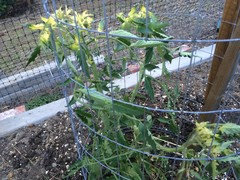
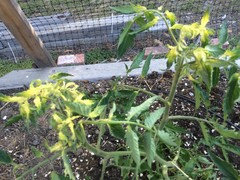
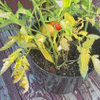
My tomatos were planted about 3 weeks ago with supplements of a handful each of compost, veg fertilizer, marine cuisine & 3 aspirin as per local experts' recommendations (I am in zone 9--marine influence but gets 90s reliably). Then a couple days ago I noticed the leaves turning yellow as in photo! What? Yes I am watering via drip when soil dries out a couple inches below surface! Only 2 out of 7 plants exhibit this. Your thoughts?

Comments (22)

  • 10 years ago

  • 10 years ago

    Someone used glyphosate, the active ingredient in Roundup, Kleenup, and several other herbicides (weedkillers).

    Tomatoes are especially sensitive to herbicides and will show damage when other plants don't. Glyphosate, applied during the growing season, causes the newest growth to blanch, just as on your plant..

    Likely it got a dose of the stuff on the breeze or simply due to spray turbulence.

    MK thanked Jean
  • 10 years ago

    Wow! Well, come to think of it my husband used roundup on the weeded hillside about a week ago--but that is quite a distance. Do I nip off the affected area or are the two plants goners?

  • 10 years ago

    Yellow leaves on the bottom is fungus. But bright yellow leaves way up on top is very different. Glyphosate makes the base of the youngest seedlings bright yellow. Indeed, it looks like that's exactly what's going on here. I believe that, if you're lucky, the yellow regions will eventually die and fall off, preserving the plant. But if the plant got a lethal dose, it'll start at the top and work its way all the way down.

    MK thanked daninthedirt (USDA 9a, HZ9, CentTX, Sunset z30, Cfa)
  • 10 years ago

    If you browse through all the other herbicide damage discussions here you'll find that tomato plants are especially sensitive to herbicides and seldom recover fully or even survive such exposure. Replace the plants for best results. You'll also learn that herbicides such as you used can drift for over a mile and still do damage.

    So you have now learned a very valuable lesson for the future. Sadly many seem to have to learn it the hard way. Even the label recommends you use it in the area no closer than 2 weeks prior to planting tomato plants.

    Dave

    MK thanked digdirt2
  • 10 years ago

    that does not look at all like Glyphosate. I would probably put a good chunk of money on it.That looks like a virus to me and there are so many kinds of viruses and many times you get a combination of them at once so impossible to I.D unless it was lab checked. The plant is for sure shot though. I would make sure you put out sticky traps and keep the weeds a big distance away. The virus is caused by insects eating on the host weed or flower and passing it on to the tomato plant via chewing, sucking, or injecting feeding tubes into it. Usually caused by whitefly, aphids, and thrips to a limited extent. I have not discussed this in awhile so my brain is a little slow on this topic. I have many tomato plants out now and all have viruses as of now, but my season is almost up and they always seem to get them by the end.

  • 10 years ago

    It actually looks identical to glyphosate damage.

    MK thanked CorgiKarma
  • 10 years ago

    If the spray was far away, I would hardly think it would be the problem considering only two were affected. I am a pest control tech, and UF graduate in Pest control. Of course without a lab test, we are all just voicing are thoughts. I will say, I have had viruses which are identical to that pic and I do not spray weed killers or any insecticides on my lawn or near my fruit trees. Nothing is out of the question however, never say never! lol

    MK thanked chuckurso1
  • 10 years ago

    if it is glyphosate yellowing, the leaf will very soon shrivel up and dry up. Viruses will continue to show other distortions and raised leaves, smaller leaves, and so forth depending on the virus.

    MK thanked chuckurso1
  • 10 years ago

    yes, it does show glyphosate similarity, that is for sure.

    MK thanked chuckurso1
  • 10 years ago
    last modified: 10 years ago

    There are literally thousands of glyphosate damaged tomato plants available via Google Images and they are identical to these plants.

    There is only one of the tomato virus diseases with a similar, but less pronounced, appearance and that is TMV (tobacco mosaic virus) and it has been essentially non-existent in the US for over 20+ years. Then there is CMV (cucumber mosaic virus) much more common however the discoloring of the leaves is reversed from that in glyphosate damage.

    So the odds are 9:1 that this is glyphosate damage.

    Dave

    MK thanked digdirt2
  • 10 years ago

    not correct! many viruses almost identical to these pics are thriving here in Florida and all deep South locations. As known, if Glyphosate damaged, the leaves or parts of leaf will shrivel up, if a virus, they will not, end of story!

    MK thanked chuckurso1
  • 10 years ago

    "not correct! many viruses almost identical to these pics are thriving here in Florida "

    Could you provide us with the names of and/or links to some of these viruses? The virus diseases that affect tomato plants are all pretty well defined and researched. As are the bacterial and fungal diseases that affect tomato plants. Florida State's ag extension services discusses them all in pretty good detail.

    Dave

    MK thanked digdirt2
  • 10 years ago

    I've never seen a disease that produces BRIGHT YELLOW young leaves. Glyphosate does that on tomatoes. That's pretty much a giveaway. But that's a good point that if it was airborne glyphosate spray, everyone should be affected. Was hubby perhaps helping you out by killing weeds under a few tomatoes?

    MK thanked daninthedirt (USDA 9a, HZ9, CentTX, Sunset z30, Cfa)
  • 10 years ago

    My vote is for glyphosate although I have never seen it that severe. It is posibble for it to affect some plants and not others. The fact that it looks like it and it was used right before symptoms developed makes it pretty much a closed case.

    MK thanked hoosier40 6a Southern IN
  • 10 years ago

    Thank you all! I have been gardening in this area for 20 years---still haven't " seen it all"! I'm glad for all your input and will let you know what happens next!

  • 10 years ago

    I have seen glyphosate damage this severe more than once.

    I have also seen one, two, three or more, or less plants affected and the plants right beside the affected ones not.

    I do not remember the affected leaves drying up and falling off of my damaged plants.

  • 10 years ago

    To me that is one of the common forms of herbicide damage. I have seen this on this forum many many times in the past. There is another kind with curling new growth . I have not experienced either kind myself but my eyes can detect them.

    Gardeneer

  • 10 years ago

    Cornell University and the University of Minn plant disease clinic are just a sample. Digdirt are you a little confused with diseases to even make such a broad based statement as you have ? Your statement that TMV has been virtually gone for the last 20 years is a very close minded assumption with nothing to back it up but ignorance of what your trying to talk about. You must not research anything because you can find it with a quick search. TMV can be either or both Tomato mosaic virus or Tobacco Mosaic virus or a combo of the two. Go to Cornell University plant disease website to verify some of this. You also have Tomato Mottle Mosaic virus which is a new one starting to show up more here. I have grown over 450 OP varieties here in the last 26 years and I can spot trouble on my plants very early on. Viruses are an every year occurrence we deal with here! In AG classes which I took at UF until last year, you never rule out anything. I was not there to see the spraying going on with Glyphosate, I can only assume the situation. I also have had almost the identical coloring as the tomato plant pics in this thread, and it turned out to be a virus more than a few times. It will go from that same coloration, to the later stages of the more fern like foliage. You do not know the exact virus it is, Cornell will explain that it is not possible without sample culture, just like I said previously with the original I.D remark in first post.

  • 10 years ago

    MK are those leaves that are yellow at the top getting smaller with a slight curl or mottled and raised appearance? To me when I look close, that looks like the case. If they are getting narrower and smaller, that is a virus. Let those plants stay in and observe them, you will know soon enough! great learning experience at the very least!

  • 10 years ago

    sometimes they curl and sometimes not, depends on the type of virus.


Sponsored
Peabody Landscape Group
Average rating: 3.5 out of 5 stars8 Reviews
Columbus' Reliable Landscape Design & Contracting