Software
Houzz Logo Print
leafxeater

What do you wish you knew when you first started gardening?

I'm just getting started with gardening, and would love to know some of the most valuable things you've learned! Obviously there is no substitute for experience: I've now learned not to water my drought tolerant natives in the summer.

A little about my garden & plans for it (in case anyone has specific tips!):

Currently I have two raised beds for vegetable gardening, which I recently refreshed and replanted with summer veggies and herbs. Here's whats in there right now: tomatoes, basil, hot and sweet peppers, chives, beets (from seed), carrots (from seed), sunflowers, chamomile, stevia, oregano, lettuce, honeydew, watermelon, spaghetti squash, marigolds, & summer squash (from seed).

I also have 3 citrus trees: a Paige Mandarin (about 3-4 years old), a lemon tree, and a grapefruit tree (can't remember their varieties right now, and they are about 1.5-2 years old)

And one pomegranate tree (1.5-2 years old)

My property is on a hill that goes in to a canyon; I currently have some natives on the hill and plan to plant many more! My favorite right now are my three matilija poppies that I'm hoping will survive their current fungal infection likely caused by my over-watering :(

I have a small container garden on my covered balcony where I'm currently growing mint, lemon balm, and catnip (each in their own respective container.)

I'm hoping to also find some room to grow blackberries and/or raspberries somewhere, and possibly a low-chill variety of an apple or peach tree! I definitely need to learn more about fruit tree care (specifically pruning) before I want to attempt that though.

I'm interested in what may be different regarding seasonal changes that are specific to California. A lot of the advice and info I read seems more geared to people growing their plants in areas that have very different weather conditions than we do here!

Comments (32)

  • 10 years ago
    last modified: 10 years ago

    Stuff that needs winter chill dies after the first season in sunset 23.

    That's what I wished I knew when I started out with 3 pine trees and a weedy Bermuda grass lawn on clay soil. You think I would have given up.

    You need to know what soil you have and how to improve it. I'd suggest a sunset western garden book and read the whole thing. It's hard to get plants right until you get the soil right if your soil is rock hard compacted from a builder or has a serious weed or something. Container gardening can be fun and creative.


    Carly S. San Diego, CA - 24 / 10b thanked kittymoonbeam
  • 10 years ago

    Get a copy of "52 Weeks In The Southern California Garden" by Robert Smaus and "Southern California Gardening a Month By Month Guide" by Pat Welsh. Extremely helpful for gardeners starting out in California. Pat Welsh is in San Diego so particularly applicable for your property.

    Carly S. San Diego, CA - 24 / 10b thanked hoovb zone 9 sunset 23
  • 10 years ago

    Sunset Western Garden Book never steered me wrong. I like the older editions (used book stores).

    I wish I had known how valuable old brown leaves are as compost.

    I wish I had realized the lovely sized plants in small pots at the nursery look that way because they're in special soil with time release fertilizer. My petunia needs a gallon of soil, not 4 inches.

    I'm glad I trusted gardeners rather that the professionals.


    Carly S. San Diego, CA - 24 / 10b thanked User
  • 10 years ago

    If I had to pick one thing it would be that double digging is bad for soil. I would have saved many years of hard labor.

    Carly S. San Diego, CA - 24 / 10b thanked Nil13 usda:10a sunset:21 LA,CA (Mount Wash.)
  • 10 years ago
    last modified: 10 years ago

    To avoid junk plants and put in low water/high exotic trees like Chorisia or one of the flowering Cassia's or even a common but elegant Jacaranda. Not all of them..but one or two. I also learned tree's really eat up space and light.

    One more..no spiny plants. In the long run bad if you are always in the garden.

    Carly S. San Diego, CA - 24 / 10b thanked stanofh 10a Hayward,Ca S.F. bay area
  • 10 years ago
    last modified: 10 years ago

    I'm going to second looking for "Southern California Gardening a Month By Month Guide" by Pat Welsh, especially since you are gardening in southern California. It really helps you to know when to plant what as far as edibles go, and also has a lot of good information on when and how to care for trees, lawns, pretty much anything you can grow. Invaluable for new gardeners, or old gardeners new to the area.

    My personal "wish I'd known" would have been to know how destructive gophers are around here. Would have saved me the effort of having to empty raised beds to put hardware cloth on the bottom retroactively so they weren't destroying everything. Also learning to use gopher baskets when planting anything in the ground was a huge time/money/plant saver.

    Carly S. San Diego, CA - 24 / 10b thanked Humsi
  • 10 years ago

    Again....really, go get Pat Welsh's book...she does have more than one and you don't have to buy it / them...San Diego libraries will have her books.....and yes, Robert Smaus' 52 weeks book.....Sunset, of course....

  • 10 years ago

    Thanks everyone! I now have Pat Welsh's book, as well as the Sunset guide. What I've read so far in both of those has been really helpful!

    Also, Humsi, thanks for for the gopher reminder. I had some a few years ago and it was awful. Need to keep that in mind for my future plans!

  • 10 years ago
    last modified: 10 years ago

    I started taking ornamental horticulture classes before I had access to land for a garden, so that helped!

    My biggest mistake was underestimating the tenacity of invasive plant(s). No, that 4' wide concrete sidewalk did not contain the Mexican evening primrose. And then there was no way to remove it from under the walk. Now I check the invasive/reseeding potential of a plant before sticking it in the garden.

    Carly S. San Diego, CA - 24 / 10b thanked gyr_falcon
  • 10 years ago

    What do I wish I had known? I started gardening at 20, I'm now 69...I wish I had known that it would become the main focus of mylife.....

    Carly S. San Diego, CA - 24 / 10b thanked wcgypsy
  • 10 years ago

    It all started with Lemon Grass for tea....LOL...

  • 10 years ago

    1. Buying the small 1 gallon instead of the 5 or 15 gallon always saves money, gives a plant with a healthier root system and requires only a few seasons of patience before their sizes are equal.

    2. There is no such thing as a no-kink hose.

    Carly S. San Diego, CA - 24 / 10b thanked kentc
  • 10 years ago

    Sometimes you get a dud plant. Don't blame yourself if it goes south. A plant in the right spot will thrive.

    -Babka

    Carly S. San Diego, CA - 24 / 10b thanked Babka NorCal 9b
  • 10 years ago

    wcgypsy, tea has been part of my inspiration as well! I've got mint, lemon balm, and chamomile that I'm hoping will take off so I can harvest for tea.

  • 10 years ago

    I can hear all of the voices chiming in right now, telling you that yes, the lemon balm and mint will certainly take off, dunno about the chamomile. The lemon balm / Melissa will reseed, the mint will spread. Growing all of the various mints is an addicting idea, but it's for sure a good idea to grow your mint / mints in large tubs or half barrels to control it / them.

  • 10 years ago

    I was liiving in Hawaii at one time and we had a friend down the road who regularly brought us fresh lemon grass for tea and I was enthralled with the idea that I could grow this myself...the rest is history....LOL...

  • 10 years ago

    All my various mints (I've got catnip too!) are in their own containers on my deck. It doesn't get the most sun, but I'm hoping it gets enough. I'm also using Misco "self-watering" window box style containers. I know the mint will likely eventually outgrow it and I'll have to divide it up. I've heard a lot of mixed opinions about putting mints in containers like this, but we'll see what happens!

    Also, living in Hawaii and getting fresh lemongrass deliveries?! Sounds perfect.

  • 10 years ago

    Gophers ate my lemon grass. Agh!

  • 10 years ago

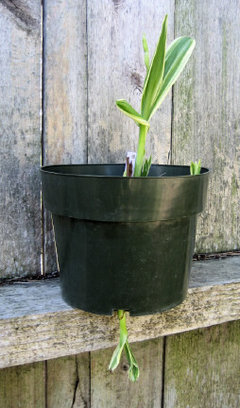
    I plant my mint in the ground in those leftover black plastic pots that larger plants (gallon plus, five gallons are better) come in - just cut the very bottom off and you can plant in the ground without worry about gophers or that it'll spread. Until your husband decides to compost leftover mint cuttings.

  • 10 years ago

    Some plants choose to be geotropism confused. Bottomless containers are not a foolproof containment method.


  • 10 years ago
    last modified: 10 years ago

    Maybe not, but I've had 3 varieties of mint in bottomless pots in the ground for over 5 years now and no escapees so far. Other than the compost incident.

  • 10 years ago

    I wasn't referring to mint specifically.

  • 10 years ago

    I've learned that I don't have to have every plant I see, but it's hard!

  • 10 years ago

    Get rid of the weeds

    Prepare the soil

    Get rid of the perennial weeds

    Apply the Mulch

    Install the irrigation

    Get rid of the weeds

    Shop for plants


    Seems I did the shop for plants first before...

  • 10 years ago
    last modified: 10 years ago

    If you're thinking about doing hardscaping (rockwalls, water features, irrigation, etc...) plan ahead with a detailed to scale drawing, love your plan, and stick to your plan.

    Know that hardscaping always takes twice as long as you think it will.

    Plant native or plants that come from very similar habitats. Only do natives that you like in the wild and when planted in cultivation. If not native, know that the difficulty level of growing a plant is roughly proportional to how different the it's native habitat is to yours.

    After you have your plan and you have your plants picked out, plant your trees first thing. By the time you have the rest of your hardscaping done, the trees will be big and nice.

    Every good garden moves plants that were in the wrong place the first time. Do it properly.

    Carly S. San Diego, CA - 24 / 10b thanked User
  • 10 years ago

    That drought-resistant shrubs and trees in SoCal need undisturbed native soil to establish symbiotic relationships with soil fungi to truly go unwatered for 6 months of the year. Mycorrhizae don't typically need to be bought at a nursery, but all our yards sure need it to be in the soil for plants to do their best through summer/fall. Xeric plants need to get established, then they seem to do best when largely left alone, with not much more than some mulch, compost teas in the rainy season and light pruning to thrive.

    Masanobu Fukuoka foresaw this in One Straw Revolution (a book as radical in some ways as anything else the 70s had to offer) when he advocated abandoning modern ag methodologies, especially tilling, focusing instead on preserving soil food web ecologies in the topsoil. I doubted it for years, but modern soil science and my experiences sure have made me a believer in it

  • 10 years ago

    Do you have a study backing up the claim that SoCal natives need undisturbed native soil? Sure, tillage can reduce your microorganism populations but they rebound especially with a nice thick layer of mulch. Any mycorrhizae that are needed are going to be present and colonize surface soils pretty quickly after grading.

    And compost tea? There's no need for that if you have compost. Just topdress the compost and water it in. poof instant tea.

  • 10 years ago

    Pay attention to the grown size of plants. Just because it's tiny now doesn't mean it will stay that way. I bought a tiny lemongrass plant which grew to be huge, too big actually.

  • 10 years ago
    last modified: 10 years ago

    In addendum to what Socks said, I think you need patience. I may have put in too many plants because the bare yard was so...bare. I think I'll be OK. I was going for a drought resistant version of the Mendocino cottage gardens.

    Another area where patience would have helped- I think I would try to do a native garden. I've seen how nice they can be. The native nurseries were a bit too far and in my agitation to get things in the ground I went mostly to the local big box stores and Armstrong and got what was available.

  • 10 years ago

    I just finished photographing my garden while it is in full bloom. Next fall, when it's a good time to start rearranging things, expanding, and patching failures, I'll have some data to go on. I don't know why I never thought of that before.

    Carly S. San Diego, CA - 24 / 10b thanked JXBrown (Sunset 24, N San Diego County)
  • 10 years ago

    It took me a long time to figure out that most gardening advice is rules of thumb. They work well for the climate and soil they originated from, when transplanted to somewhere else, who knows? Books on gardening that cover the whole country are okay if your gardening conditions are typical.

    The other thing I wish I'd known is that if other gardeners happily offer you free divisions of a plant, the chances that it's a thug are pretty good.