Software
Houzz Logo Print
dieseler

Black Madeira Figs

10 years ago
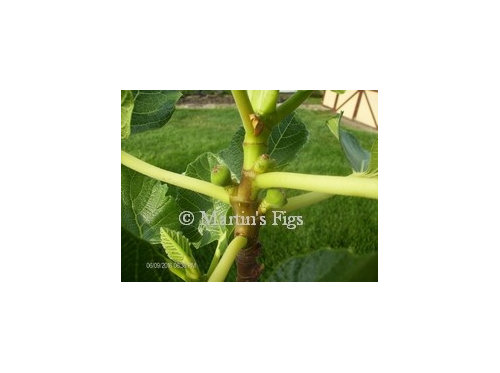
Pictures are usually taken when figs come out to save on disk and look at later , gives me estimated idea when they will get ripe.This is UcDavis cultivar Black Madeira.

Martin


Comments (11)

  • 10 years ago

    This photo shows how figs actually grow. There is a leaf stem, and a figlet near it. This is how it happens. A good lesson!

  • 9 years ago

    Hi Martin, very curious about Black Madiera, In Thailand here we have Black Madiera (KK's strain), Jon (Encanto Farms' strain), and Harvey C Strain. Would love to know how many cultivar of Black Madiera right now? Thanks

  • 9 years ago

    Popp,

    i do not know as years back UcDavis Black Madeira was the standard

    and the only Black Madeira i grow.

    Where these others come from i do not know unless folks are just putting the name

    of the person they obtained it from after the word Black Madeira ?


    Martin

  • 9 years ago

    Yes they are all from UCD, just sold by different people.

    Some new sellers name the person they originally, or allegedly, bought something from rather than show pictures of the plant and fruit in order to make a sale.

  • 8 years ago

    Jon lists Pacific Tree Farms as his other source, they sold Black Madeira at regular nursery prices but went out of business a long time ago. No reason to think their source was not UCD, they look the same and have the same name... must be a duck ;)

  • 8 years ago

    Except UCD has a bad case of FMV. Even Herman dumped his UCD BM on eBay cause it was a loser (in Herman's eyes). I'm thinking Jon would have asked the source and would have relayed it to me.

  • 8 years ago

    So I just read the info at GRIN and saw Todd Kennedy gave it to UCD, for some reason I thought it was one of the old varieties... So Pacific Tree Nursery could have gotten it directly from him.

    I got Black Madeira from UCD, all of the varieties showed FMV symptoms at first from what I remember, planted in ground and didn't grow much... the roots rotted from snow melt running off a roof the first winter out but before it did I started another plant from it and kept that one in a container. It grew without any noticeable symptoms, and no stunting or anything, shorter internodes than normal but that is probably a variety trait. It's gone now too, I gave it to my brother who planted it out right before the polar vortex.

    Anyway, the same thing has happened with a bunch of varieties for me where cuttings from symptomless growths attached an "infected" tree usually make new symptomless plants. There are some elements of chance: how many plants to select from and what percent will show symptoms. Otherwise it can just be a matter of time and effort, stimulate it to grow fast remove any symptomatic growths and start a new generation to select from.

    FMV is not systemic, research shows is not present in the sap and not known to be transmitted mechanically by pruners or any bugs other than the fig bud mite. The virus particles are able to travel to adjacent cells only. So as long as the fig bud mite is not constantly infecting the buds then fast growth can reduce the amount of virus. There is a technique used in TC labs called thermotherapy where the plants are grown at high temperatures so the virus denatures and can't replicate so the new growth won't have any virus at all.

    Whether a tree has FMV but is below the threshold of causing symptoms or the tree does not have any FMV should not really matter much, the virus is only a problem when there are so many particles in the cells that they gum up the works and get in the way of things. Trees that don't show symptoms and those that are stunted and deformed are obviously not equal though.

    From what I understand the trees at Wolfskill are never treated for fig bud mites and are only pruned occasionally so they have a slower "mature" growth habit than a new plant or invigorated older tree. There was a survey done which showed nearly all of the trees tested there were positive for FMV.

    There are also a bunch of other viruses that complicate things and can be vectored by other specific bugs and maybe pruners in some cases, FMV was correlated with the symptoms long before they were discovered but some of them they might cause some symptoms alone or together sometimes. One virus even passes to seeds so it might have integrated into the genome and can be latent like that or become active and start replicating and possibly cause some symptoms, and it has been found in nearly every tree tested and the sanitation methods like thermotherapy that work for the other viruses have no effect.

    So without lab equipment it is really not possible to actually understand what exactly is going on with any given tree. The advice for nurseries coming from Universities though, prior to and aside from all of that other drama, is to not propagate from symptomatic fig trees. Commercial nurseries don't want to deal with customers calling for their money back because the leaves are deformed and people won't buy them. The situation among people selling to collectors is different though, the disclaimer says you take your chances and place your bets and maybe nurse a tree along for a decade ;)

    Sorry for the long rant Keith, hope it clears things up a little though.

  • 8 years ago

    Thanks for all that info. I emailed Jon to see if Todd Kennedy was his source.

  • 8 years ago
    last modified: 8 years ago

    Just heard from Jon "Mine came from local California Rare Fruit Growers collection in the early 80s, and have never been able to ascertain where they got it from".
    I guess it will remain a mystery.

    Now the question is when did Todd donate to UCD?

  • 8 years ago
    last modified: 8 years ago

    https://npgsweb.ars-grin.gov/gringlobal/accessiondetail.aspx?1003499

    Todd Kennedy probably would have been the original source for CRFG also. Here is a recent article about him http://para-rigger.posthaven.com/a-quiet-hero

Sponsored