Software
Houzz Logo Print
ocean_clarke

How do you take good photographs?

10 years ago
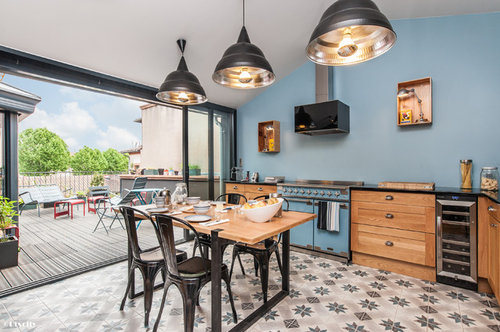
The most popular images on Houzz tend to have clear similarities - light, bright photos taken at good angles.

In the world of home renovation and design, it seems that good photo quality is key!

But how do you get that perfect shot - the one which makes draws drop.

We're asking everyone, from professionals to amateur photographers and homeowners - what makes a good photo? Feel free to share your best photography tips too - or any photos of your own!


Appartement personnel - La Cuisine · More Info

Comments (21)

  • 10 years ago
    I'd use a wide angle lens for smaller rooms. switch all room lights on. I'd place the camera on a tripod and set it to a long exposure to keep the ISO down to as low a possible. Also make sure the white balance is correct. Finally make sure the EV is up a couple of notches if needed.
  • 10 years ago

    I would use the HDR technique. This enables you to cover a wide dynamic range from sunlit windows to dark corners that would be impossible to capture in a final single image in any other way.

    It requires a tripod and wide angle lens. You should set exposure, white balance and focus manually (to ensure the setting don't change) and take perhaps five (or more) images from exactly the same point. Each image should have a different EV value to ensure you cover the full dynamic range of the room you are photographing. The images are then combined into a single image using a specialist HDR editing application such as Photomatix. Care is needed at this stage to produce a natural look. It can be done!

    Complicated? Not when you get used to it. Time consuming? Yes. Results? Excellent. There is plenty of information online about taking HDR photos. Good luck.

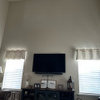
    This is an example.


  • 10 years ago

    Really interesting tips, thanks guys! The HDR technique is completely new to me and does sound pretty complicated but if you can produce results like that photo then I'd definitely say it's worth it! Beautiful shot!

  • PRO
    10 years ago

    Wide angle lends is a must (for interior shots), and again as others have said use some photo software such as Photo-shop, with HDR add-ons. Be sure to tripod.

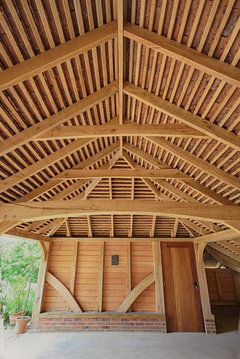
    2 Bay Oak Barns, Garages and Garden Buildings. · More Info

  • 10 years ago

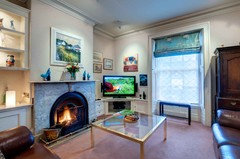
    Yes, a little knowledge of Photoshop is very helpful. I shot the TV image separately and added it to the finished HDR image. Combining multiple shots of an ever changing TV image would not be a good look!

  • 10 years ago
    Some cameras will have HDR built in. Not as good though as the techniques shown by others here.
  • PRO
    10 years ago

    Definitely tripod,good lens (wide angle for capturing the whole room and longer lens for lifestyle/detail).I use flash to add extra light in some situations,take few shots and combine it together in Photoshop.I am not fan of HDR.

  • PRO
    10 years ago
    last modified: 10 years ago

    For me it's about lighting and feeling.

    I occasionally combine exposure if necessary but try to edit images as little as possible and get everything right in camera. I often turn lights off to avoid yellow colour casts merging with blue outdoor light, use a sturdy tripod (& mirror lockup mode) and use the histogram function to make sure exposure is spot on, and I use tilt-shift lenses to keep verticals straight, choosing rational & balanced compositions.

    When budget allows, I use Elinchrom lights carefully positioned to recreate natural light, more evenly balanced, (like a HDR in real life).

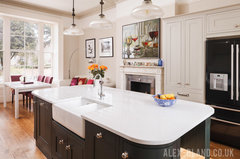
    The example image was produced with one light in the top-left at high level and one to the right - not overpowering the ambient light, 24mm lens. Shot on commission for a cotswold kitchen company.

    www.alex-bland.co.uk


    Interiors Portfolio · More Info

  • PRO
    9 years ago

    Nobody has mentioned shooting in RAW, yet. It's a much more flexible file format than JPEG. The files are bigger, but the detail - and particularly the ability to recover detail - is so much better. Everything that we shoot starts with the camera on a tripod and for the most part, verticals and horizontals corrected in Live View on the camera back. Then we take multiple exposures. We never use HDR, but after basic processing of the RAW images, we use layers and masks in Photoshop to blend the correctly exposed parts of each shot. (The dynamic range of the sensor on the camera is not great enough to cover the view through the window as well as the darker corners of a room in one shot. That's why we have two or three exposures to use the correctly exposed parts). Finally we tweak the image to adjust and remove any imperfections before cropping and saving it. (Whatever else, lens distortion corrected with edges of walls and floors straight, colour casts removed etc.,) Chris Snook is right about lights. Magazines prefer lights off, many of my clients like the added sparkle with all the house lights on. We always carry multiple head flash lighting and continuous lights with us, but only ever use them in extremis. Controlling lights to avoid pools of light is an additional time-consuming distraction and we usually have only a limited amount of time in our client's customer's house! Whilst I have an i-Phone, I NEVER take pro photos with it - and only use it to fire my camera remotely by wifi - for example when I have to stand outside a room to get the shot with no reflections.

    Family Room in South Manchester · More Info

  • PRO
    9 years ago

    1. clear the clutter
    2. get a 50mm lens
    3. turn the iso up and the aperture and shutter speed low to make the light flood in!
    www.toplogylondon.co.uk

  • PRO
    9 years ago

    I always find that lighting is key, get all lights on, open the curtains and shoot away!

  • PRO
    9 years ago

    Unfortunately, turning on all the house lighting isn't always the answer although we frequently do it. Problem is that some quality magazines don't like it, and it depends who you are working for. And. Sometimes we have to close curtains or blinds to manage the sunlight. As for Topology's comment (above), we take the opposite view! Full frame camera, 15-30 mm lens, ISO turned down to 100 and lengthy exposures (multiple exposure bracketing) for blending manually later in Photoshop (not HDR).

  • PRO
    9 years ago

    I am a beginner in photography but Topology's answer seems completely the opposite of everything I learned & read so far. Also, with a 50 mm you will not be able to capture whole rooms, it's great for close ups thought.

    John - May I ask where could I learn about interior photography? I looked up so many sites but nobody seems to teach interiors photography. I would be interested how to use lights if there is not enough natural light. I could learn PS layers & masks through Lynda.com I guess.

    Currently I use light reflections from windows, 18mm lens and a Canon D100 DSLR. Then I edit the RAW files in Lightroom, which gives be brilliant results, but it's far away from magazine style shots. (I don't think I could ever afford a full frame cam, but I could get a 12mm lens for mine).


  • PRO
    9 years ago

    Hi eRika, I don't know anyone that offers a specific course on interior photography. There are one or two interesting videos on You Tube. Lynda.com are great for the technical bits. I'm a lifetime photographer and I spent a great deal of time in advertising, art directing interiors photographers, before I took it up myself! Biggest problem is correcting as much wide angle lens distortion to get the edges straight and vertical walls looking vertical!

  • PRO
    9 years ago

    PS to eRika - send me an email from my website if you want a private conversation about any aspect of this.

  • 8 years ago
    last modified: 8 years ago

    A good wide angle lens to avoid distortions, a tripod, knowledge of white balance (essential if there are lights on, or varying light sources), and ability to use the camera manually rather than auto. A flash is useful too.. Point upwards to the ceiling. Also, lights on shouldn't be a rule...it really should depend on the room and light type, for example side table lamps can add atmosphere and warmth to the shot. Often lights render the image too yellow though (this is where knowledge of adjusting white balance manually comes in), and can appear as a big glaring blob on the photo. I would avoid ceiling lights unles they are small spotlights/down lighters. And get the composition right....usually a photo taken from the corners of a room works best. Detail shots (different lens needed) are sometimes required, but I don't really get why estate agencys sometimes include a photo of a vase of flowers...


  • PRO
    8 years ago
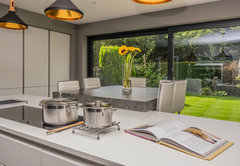
    Hy Ocean tk selecting my kitchen design. I'm a french interior designer. For information, this picture did by french interior photographer agency : Pixcity.
  • PRO
    8 years ago

    A lot of the advice that follows is personal preference, based on what I've found works well for showing off design:

    1. Use natural light - so turn of the interior lights. This will give an accurate colours and a natural feel to the images.
    2. Use a tripod and take the time to level the camera.
    3. Position yourself in the middle of the room and the corners.
    4. Do not go ultra wide - if you can't fit everything in the frame, tell the story with multiple images.
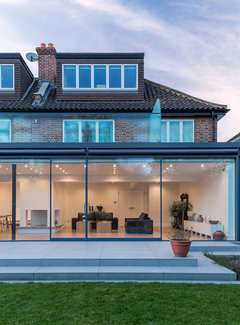
    5. For great exterior images, turn on the interior lights and photograph at twilight - see example below:
  • PRO
    8 years ago

    What this thread demonstrates is that it is impossible to build a photography course and years of pro experience into a series of answers here. There is just too much to say about photography and photoshop techniques. I think what it shows is that with pro photography costing so little in relation to the massive impact that a good image can have, there is much to be said for tapping into the experience of a professional photographer here on Houzz. Find one whose work you like and trust him or her to do the job! After all, I wouldn't attempt plumbing or electrical work - I'd pay a pro!!!

  • PRO
    8 years ago
    I agree with johns comment! The ability to create a good image takes years of experience and this is why it’s better to hire a pro! However if you want to become a photographer that’s another story! :)
    But my tips are to create attractive interior photos

    1. Clear the clutter and make sure surfaces are clean

    2. Camera on tripod with wide angle lens and shoot raw

    3. Whether you leave the lights on or off it’s your choice, if there’s a nice ambient side lamp it can be switched on to create a warm
    Inviting image, use natural light as much as possible though

    4. Shoot from different angles and make sure lines are straight

    4. Edit in light room or photoshop (I use a mix of the two)
Sponsored
Bella Casa LLC
Average rating: 5 out of 5 stars17 Reviews
The Leading Interior Design Studio in Franklin County