Software
Houzz Logo Print
amokk50

What's wrong with my Grape vine?

10 years ago
last modified: 10 years ago
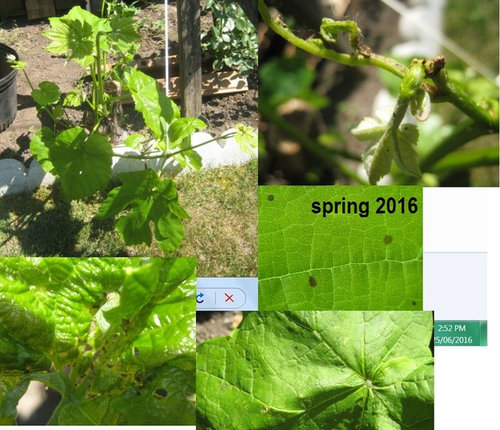
Last year and the year before, my grape vine was infected by something. I assumed that it was Phomopsis cane and leaf spot disease. So this past spring, I decided to remove everything except the trunk about 12" high.

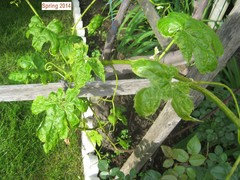
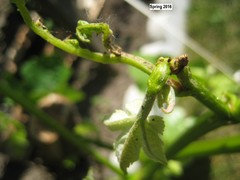
I thought that this would get rid of the disease or whatever it is. New canes started to show up about a month ago, but it still shows some sign of disease. The growth is slow (not sure if that's normal). The infection is not as bad as before, but it's still there. See the pictures.

I've been applying Captan. I apply it all over the trunk, its bark and the new canes.

It's as though the disease shelters inside the vine, but I thought maybe it might have been hidden within the old bark on the trunk? Captan might have not killed it?

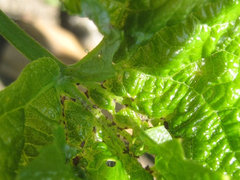
I noticed that I can remove those dark spots on the leaves and stem just by rubbing it, but some leaves look a bit deformed. Those lesions on the stems were much more severe in the past, but this year, it's only removable dark spots.

If you look at the "spring 2014" picture, it would start off like that in 2014 and 2015. Some new canes would die and fall, but starting in mid July, the disease would go away and the canes would grow long and everything would be fine, but in spring, very few berries would grow due to the disease.

I will try to remove those dark spots and unhealthy leaves, but what should be done? Should I try to remove some of the old bark on the trunk?


Comments (19)

  • 10 years ago

    Stop the Captan and an other treatment until the problem is diagnosed.

    I appreciate your effort to post as many images as possible, but could you please post a few full size versions of typical damage?

  • 10 years ago

    Thanks for the reply, Jean! I would really appreciate if you can let
    me know what the problem is and what to do. I'm assuming it's Phomopsis
    Cane and Leafspot, or Blackspot.


  • 10 years ago
    last modified: 10 years ago

    I'm bumping this thread since I haven't heard back from anyone. I was thinking about removing the grape vine and replanting another one in its place, but I know that it can be hard to remove and kill a grape vine.

    I would appreciate if anyone can give me some advice. How can I fix this problem?

  • 10 years ago

    The bottom pic is a bug. You see the black spot on the lower part of the leaf? Looks like caterpillar waste.

  • 10 years ago
    last modified: 10 years ago

    Throughout the season so far, I've only seen one green caterpillar like bug on the stem of the grape vine. If it's not a disease issue, is the growth rate of the vine normal so far? But I'm not convinced because some of the leaves don't look healthy.

  • 10 years ago
    last modified: 10 years ago

    FarmerBIll,

    Herbicide damage is what I'm suspecting at this point, because I can't find any other reason.

    Fiesta herbicide is applied to my lawn in Spring. As you can see, half of the roots are exposed to this herbicide application. This year's leaves also look a bit similar to the ones in 2016, but somewhat less damaged. No round-up or weed and feed was used.

    The active ingredient is Iron HEDTA (FeHEDTA).

    How many inches should the radius around the trunk be herbicide free? What can I do to speed up the recovery process?

  • 10 years ago

    I'm not familiar with Fiesta, but reading the label is causes plant death by iron poisoning. I would be wary of try to add anything else to 'fix' the nutrient imbalance.

    Sunflowers are very good are removing metals, like iron chelate, from the soil, they absorb the metal and store it in the roots and stem, then you can physically remove the plant (and those metals) and dispose of it. So, you could plant some sunflower seed right now and then pull them up this winter.

    As for inches from the plant, most plant growth is mirrored at the soil line, so if your vine has caned out four feet, the root has sent runners out about four feet. Most herbicides are absorbed through the leaves not the roots. Not sure with Fiesta's different mode of action.

    I do know that glyphosate (round-up) can be applied directly to the plant up until bloom, and can be used on woody tissue after that. 2,4-d (weed & feed, and many other broad leaf herbicides) can be used only until bud break. After that, even nearby applications (like at the neighbors) can drift.

  • 10 years ago

    Another thing to consider. What is it planted beside? Could be a soil issue.

    or roots.

  • 10 years ago
    last modified: 10 years ago

    This a 10 year old grape vine. It used to produce a decent amount of
    grapes until a few years ago. A new company has been applying the
    herbicide on our lawn since 2014, though I don't remember the exact year.

    They
    only come and apply it once in spring, and our grass manages to
    stay relatively weed free until fall, believe it or not.

    Another
    thing. Every season, right in the middle of summer, between mid-July and
    late July, the grape vine suddenly "wakes up" and produces more healthy
    leaves and longer canes, as it is the case now. New leaves don't look distorted at this point in the season. So I'm assuming that by
    mid-summer, the herbicide ingredient is no longer present in large
    quantities. That's the reason why?

    Also, I cut the vine all the way to bottom
    trunk last spring. New canes showed up on the trunk in late May or June.
    The herbicide was applied on May 10 when there was nothing but a woody
    trunk. So no leaves or canes were exposed to the herbicide.

    I will send Fiesta an email and see if they can find out what exactly is being applied on my lawn by the company.

    Thank you for the replies. I will update and hope to hear back.

  • 10 years ago
    last modified: 10 years ago

    I learned that the company also applies a 15-0-30 granular fertilizer on my lawn during the the 3rd week of August. According to the brand: It's a "Fall fertilizer formulated to harden turf for winter or used to correct soil deficiencies in potassium"

    Since half of the grape vine's roots are covered by grass, can this application delay the dormancy of the grape vine or cause any other problems? Our first frost date is around October 7.

  • 10 years ago

    I wouldn't be overly concerned about the fertilizer, the turf grass will capture most of it before it gets to the grapevine roots.

    Are the shoots hardening off? i.e. turning brown?

  • 10 years ago
    last modified: 10 years ago

    Yes, they are. The vine is also going great and growing. This is typically how it is. Towards mid-summer, it all of a sudden becomes healthy and grows decently without any deformed leaves.

    It also put out a cluster of grapes and they don't seem to be rotting, but they won't be ready by the end of the season, so maybe I should remove it. Usually, during the first half of summer, if a cluster of grapes shows up, it rots and dies out quickly.

    I called the company and asked them about Fiesta. They said it doesn't go further than an inch into the soil.

    If it's not the herbicide (which I think is the culprit), what kind of disease would go dormant during mid summer?

  • 10 years ago


    Herbicide injury can happen before bud break on grapes. Oregon State University studies show that applying it before bud break only reduces the chance of injury but does not eliminate it. So it can happen, or not, it is a roll of the dice. Also fall applications can show up the following spring looking like disease. This includes glyphosate and 2-4, D which along with others, can cause root injury, although the extent of this is not clear.

    It may not be anything you have applied. According to the Oregon studies, drift from some types of herbicides applied up to 1/2 mile or more, away can affect grapes. So it looks like they are pretty sensitive.

    Since Fiesta is an iron rich product I looked up Iron toxicity. It is possible but all I could find was that it was usually linked with low PH. That is without taking into consideration a product such as Fiesta being applied. Not sure if your plant has symptoms of this, I could not find any photos. Others may know more.

    I vote for herbicide damage, but I am not a grape expert, maybe there is one here.


  • 10 years ago

    herbicides can be taken up through the roots too. Can you ask the company to leave a 1 foot distance from the roots of your grapes when they spray? Or put out mulch 1-2 ft so they don't spray it. Also, in the first 2016 pic, do you see the tiny spidery webs? You may also have some spider mite damage.


  • 10 years ago

    fruitlovernc7b8a, I can't really know how far the roots have spread, so I'm going to put a tape around the grape vine 6 foot from the trunk and let them know not to spray in that area. I'm not sure if this would be good enough.

    Yes, I've seen those spidery webs. It's no longer an issue. Half way through summer, the grape vine grows viciously as if there is nothing wrong with it. These problems only occur during the first half of summer...

  • 10 years ago

    I too suffered from herbicide injury on my grapes a few years ago. The applicator did the lawn near the grapes. At the same time, the farm field behind them was sprayed too. Not sure who the culprit was but the trellis ran perpendicular to the farm field and the vines closest to the field were damaged the worst (I suspect the farmer).

    Mine struggled for a year then all recovered but the one closest to the field. It lived for 2 more years but never pushed much growth and the leaves were not normal. Then it died after producing the finest grapes I ever tasted for that variety. Its parting gift that final season.

    I have replanted with a different variety and all is well. Assuming the farmer avoids spraying on windy days.

  • 9 years ago

    Hi RD - I know I'm too late but just saw this thread. I know exactly what is (was) wrong with your grapevine. You have an infestation of spider mites. I have exactly the same problem. Leaves curling and browning, holes in leaves, little spidery webs everywhere, black spots etc. Only when I bought a little digital microscope (for £50) I was able to see the little critters. I tried liberal doses of 'neem oil' solution but that didn't help a lot - had to resort to insecticide.

    Good luck!

  • 9 years ago

    Thanks, ajjohnston59. In early spring this year, I applied dormant oil. No more problems this year. Except some leaves are discolored, likely due to herbicide use.