Software
Houzz Logo Print
sneed_gw

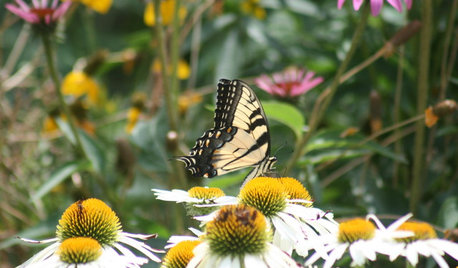
Vine Borer?

10 years ago

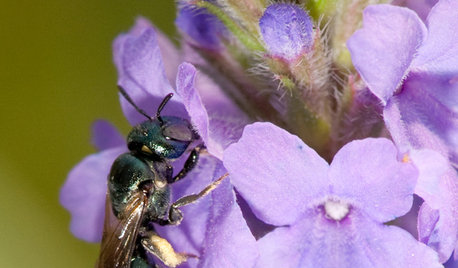
Every year Squash Vine Borers kill my pumpkin plants. This year I'm determined to destroy them first. Is this possibly a young SVB?

Comments (33)

  • 10 years ago
    last modified: 10 years ago

    The large eyes and having only one wing per side tells us this is a fly. A long legged fly, most likely, which are predators and good to have around.

    Also, there is really no "intermediate" state between pupa and adult. They will emerge from their cocoon (SVB's are moths) more or less "full grown." that is, there will be no significant difference between a newly pupated adult and one that pupated earlier. A "young" SVB is the white grub-like larva/caterpillar that ruins your plants.

  • 10 years ago

    I look for the row of black dots lined up dorsally down the body. Don't see those here. At least the adults are pretty unmistakable in that regard.

  • 10 years ago

    Pumpkins can root wherever the vine touches soil. To combat SVBs I throw dirt down along the vine through the growing season to encourage secondary roots. By the end of the season, between the SVBs and powdery mildew, the vines look awful, but the fruit make it.

  • 10 years ago
    last modified: 10 years ago

    I had pretty much given up on non-moschata squash, because I don't have the time to inspect MILES of vines for SVB eggs or frass, and then inject BT, or surgically excise the worms, or to maintain MILES of row cover. I have one squash vine (actually in multiples) that is 20 feet long. One plant. In fact, the SVBs do a job on moschata as well. Just not quite as destructive.

    But I have heard that simple weekly spraying of foliage (and especially stems) with BT does the trick. That is VASTLY easier than inspecting, injecting, hand pollination, and surgery. I've started doing that on my moschata. Can anyone verify that that strategy works in the long term? So far so good.

  • 10 years ago

    So far so good for me with the BT spray too. Someone named Peter on here said he sprays every three days with BT and now he doesn't consider SVB a significant problem.

  • 10 years ago

    Yes that's me, it was effective for me last year and this year so far so good. There was a thread from last season where a couple other posters also reported success, also using spinosad as well as BT. Good luck!

  • 10 years ago

    That's a Long-legged Fly, pretty little predators in our gardens. LLFs come in assorted iridescent hues, like jewels. You don't want to harm them, they feed on aphids, etc.

    A "young SVB" is the borer, itself. The moth emerges from the pupa, fully grown.

  • 10 years ago

    Peter, thank you. I think I recall you saying you did that as well, but I was never sure if it actually succeeded. Regular BT spraying is now going to be a standard strategy for me. Goodness knows. One of these days I may be able to grow zucchini again, like I did in abundance on the West Coast. Ah, the good old zuke days ...

    Just curious about your spraying frequency. Was once-a-week not enough? How did you decide on once every three days? Actually I spray irrigate every four or five days, so I probably need to BT-spray that often as well.

  • 10 years ago
    last modified: 10 years ago

    I doubt I will do it every 3 days the rest of this season. I will try once every 5-7 days, except after heavy rain. Alas, AFAIK it degrades pretty rapidly in the sun. It was another poster who wrote abot spinosad.

  • 10 years ago
    last modified: 10 years ago

    I suspect the early warm weather the SVB emerged early this year.

    Another pretty effective strategy is to either just plant more squash (if you like to have squash early) then plant more after the SVB has completed it's life cycle.

    In CT that is supposed to be the 4th of July. Meaning it should be safe after the 4th of July and not need spraying of anything.

    So you can wait if the life cycle is complete or just make two plantings - one early and one later.

  • 10 years ago
    last modified: 10 years ago

    I think they are active for much longer after that... into late August. I researched this but don't remember the exact info.

    I do think SVB damage tends to be overstated. The plant dies and you find SVB it is easy to assume that was the cause when it is not always the case, it may be unrelated. On commercial fields they rarely worry about SVB, and plants can definitely sometimes live a good long time even with the borer.

  • 10 years ago
    last modified: 10 years ago

    This from CAES <In CT that is supposed to be the 4th of July.>

    Check with your local Ag Station, it could be sooner in your area.

  • 10 years ago

    Here in more Southern States, the SVB can have 2 generations in a year... not cool, not cool at all.

  • 10 years ago
    last modified: 10 years ago

    Care to share which states? Let me guess they have a long growing season and don't get a hard freeze or snow?

    I expect because of the mild past winter there will be some slight variations in many insect cycles this year.

  • 10 years ago

    Yep, I am in Georgia and we definitely have at least two generations. I found this out last year. I planted an early crop and got some good squash before they showed up. Then waited a while and planted a second crop. The SVB got those before they even produced any squash. This year I am growing the Moschata (sp) species on trellis and also two whiskey barrels of the summer squash covered with tulle.

  • 10 years ago
    last modified: 10 years ago

    I'm in E. Tn., and we have 2 generations where I am - depending on the year. As the climate warms, it's only getting worse. In the mountains not too far from me, I'm sure they have only 1 generation. I'm pretty much at the cusp. I'm sure that parts of Va.and Ky. also have 2 gens., but here in the Mid-Atlantic, it's regional. Further South, like Yolos in Ga. mentions, they routinely have 2 gens. per year.


    ETA: I keep mine covered in insect barrier or forget it... no non-moschata squash.

  • 10 years ago
    last modified: 10 years ago

    Gumby, here are some links indicating that SVB first emerges in mid to late July in NY and Pennsylvania. It shouldn't be any different in Connecticut.

    http://ento.psu.edu/extension/factsheets/squash-vine-borer

    https://www.google.com/url?sa=t&source=web&rct=j&url=http://idl.entomology.cornell.edu/files/2013/11/Squash-Vine-Borer-1o1wrzj.pdf&ved=0ahUKEwiS_Oy0ksjNAhXFVD4KHUpxBKEQFggfMAE&usg=AFQjCNETDltXocqwLmhOJPWM_qMCxEjIog&sig2=lQs8feNTINPd_LlwiHdrhw

    It then takes 2 weeks for the eggs to hatch.

    There is no way you are safe on July 4th....

    I stopped spraying last year at the end of July and still managed to get 1 plant (out of a dozen) with SVB near the end of August. I think we had a second generation last year... it was an early Spring.

  • 10 years ago
    last modified: 10 years ago

    <Gumby, here are some links indicating that SVB first emerges in mid to
    late July in NY and Pennsylvania. It shouldn't be any different in
    Connecticut.>

    Peter, I guess it is then.

    I am telling you exactly what I was told by the entomologist at the CAES in New Haven, CT. Perhaps you want to call and discuss it with them.

    The entomologist suggested two plantings, one early and one after the 4th of July rather than frustrating over the SVB. His exact words were "plant more squash".

    Pointing me to info that does not cover my growing area will not convince me he was wrong.

  • 10 years ago
    last modified: 10 years ago

    Here you go Gumby, here is a link that DOES cover your growing area.

    http://www.ct.gov/caes/lib/caes/documents/publications/bulletins/b328.pdf

    If your entomologist is suggesting PLANTING on the 4th of July or later, that is an entirely different thing than stopping protecting your plants on the 4th July. Plants take a time to mature to the point that they are palatable to the SVB.

    Of course, no one is saying that planting more squash isn't a decent option, however this does not really help with long maturing winter squash that need a full season.

    Feel free to do whatever you want in your garden, but if you are going to tell people that they are 100% safe from SVB after July 4th, and that people should stop protecting their plants, I am going to tell you I think you are very wrong, based not only on my own experience but no less than 3 links from reputable official sources I have provided.

  • 10 years ago
    last modified: 10 years ago

    His advise was to plant late or plant twice to avoid the beast. I sure this is not a new technique, planting outside the life cycle of a known pest.

    My original mention of the 4th was indeed directed at CT, so if you are not in CT it prob won't be relevant.

    You should point out the link you provided was published in 1931. I am willing to bet the weather pattern in 1931 was just a bit different. Certainly research and knowledge has improved slightly since 1931.

    I am hopeful I have clarified my info enuff for you to understand it does not apply to people outside of CT and maybe some in CT. There is not much in gardening that is all inclusive, IME.

  • 10 years ago
    last modified: 10 years ago

    Last year, here in Long Island, NY I removed all the SVB larvae from my withered pumpkin plants on 7/26/15.

  • 10 years ago

    Gumby_ct, in the interest of not propagating misinformation, please delete your comment about July 4th.

  • 10 years ago
    last modified: 10 years ago

    So I am gonna guess you have never heard the saying "Knee High by the 4th of July" for corn crops either?

    I think the inclusion of dates is not to be anally specific but to make things easier to remember.

    So you could say either 1000 degree days from Jan 01 or early July also as a marker. In the US 4th of July is normally easily remembered. As is planting after Mother's Day or Memorial Day in some CT areas.

  • 10 years ago

    <sneed(7)

    Gumby_ct, in the interest of not propagating misinformation, please delete your comment about July 4th.>

    You have not proven that info is inaccurate or incorrect for my area of CT.

    I might consider modifying to say that SVB activity is temperature and weather dependent but you should be safe to plant 1000 degree days after Jan 01. But that is much more to remember.

  • 10 years ago

    As I stated, here in NY the borers were heartily dining on pumpkin plants July 26.

  • 10 years ago

    I thought I explained the logic behind saying "4th of July" for my area of CT, Long Island will be different no doubt as the coast of CT may also be, I don't garden there so I don't know.

    Here's Link you may find useful - Cancel ALL of My Meetings

  • 10 years ago

    SVB emerges before July here in PA, I lost 2 plants the second week of June, But I had extra plants that I used and so far everything looks good, Just need some bees now.

  • 10 years ago

    What is BT? Thanks

  • 10 years ago

    BT (thuricide) is an organic pest control for caterpillars and larvae. It is effective only when consumed and is not toxic to pollinators, so it is a responsible pest control when properly used. It is available cheaply under a few brand names. I buy Safer brand.

  • 10 years ago
    last modified: 10 years ago

    Came across this article today which is linked below - here are some snips which may be of interest...

    Hopefully this will explain what I was trying to say better than I did...

    <Cultural Control

    Plant early with transplants, if possible; plantings made in early spring may bear a

    crop before squash vine borer can kill the vines.

    If feasible, consider a late planting of curcubits after the main flight period of squash vine borer, when adult females have finished laying eggs>

    About: <Chemical Control

    In general, cultural control methods are more effective in managing squash vine borer than relying on chemical controls (Adam 2006)>

    Note: this link also has an excellent pic of the SVB and the larva.

    Squash Vine Borer Lepidoptera: Sesiidae, Melittia curcurbitae (Harris)

    <Chemical Control

    In general, cultural control methods are more effective in managing squash vine borer than relying on chemical controls (Adam 2006)>

    <Life Cycle and Characteristics: Squash Vine Borer

    Squash vine borers overwinter as larvae or pupae in the soil.
    Adult moths emerge in the spring and deposit eggs on a host plant.
    Disk-shaped, dark-reddish-brown eggs are laid singly on the plant near
    the base.(7)
    After hatching, the larvae penetrate the plant stem and burrow toward
    the base. An individual adult can lay from 150 to 250 eggs, and
    (theoretically at least) as few as 10 moths can cause 100 percent
    infestation on a single acre of squash-family plants.(8)
    Occasionally, small borers may also enter leaf stems. The burrowing
    larvae destroy the internal vascular tissue and cause the whole plant or
    the invaded runner to wilt and die. Feeding may continue for four to
    six weeks. A sticky gob of excrement (frass)—which resembles wet sawdust—typically marks the entrance site.(9, 10)
    If a vine dies before the borer has completed its larval cycle, the
    larva can migrate to a neighboring plant and resume feeding there.(8)

    The squash vine borer larvae are whitish, wrinkled, brown-headed
    worms that can grow to about 1 inch in length. The adult moth, a member
    of the clear-winged moth family, has translucent wings (wing expanse of
    about 1.5 inches) with metallic green-black and orange colors on the
    body and wing fringes. The moth is a day flier, often mistaken for a
    wasp.

    Generally, only one generation per year is produced in northern states, two generations in many southern states.>

    Linked here... https://attra.ncat.org/attra-pub/viewhtml.php?id=138#squashvineborer

    This may not be practical for the home gardener but may spawn other ideas <Perimeter Trap Cropping (PTC) involves planting trap crop plants so that they completely encircle the main cash crop like fortress walls, and the use of other perimeter defenses, if necessary. PTC functions by concentrating and/or killing the pest in the border area, while reducing pest numbers and disease spread on the unsprayed cash crop in the center and by preserving natural enemies. >

  • 10 years ago
    last modified: 10 years ago

    SVB dont read our forums, and research.

    I used Spinosad succefully in the past, sprayed weekly, all over the plants, had both zucchini and pumpkin. All made it.

    now use tulle cover and grow parthenocarpic. No pumpkins.

    i have seen SVB flying around in August, happens almost every year

  • 10 years ago
    last modified: 10 years ago

    <SVB dont read our forums, > Maybe they should?

    Just like there are people who don't eat meat there are also people who do not and will not use chemicals on the vegetables they eat.

    Hard to believe I know but it happens.

    Just plant more squash <smile>

Sponsored
Peabody Landscape Group
Average rating: 3.5 out of 5 stars8 Reviews
Columbus' Reliable Landscape Design & Contracting