

Summer squash
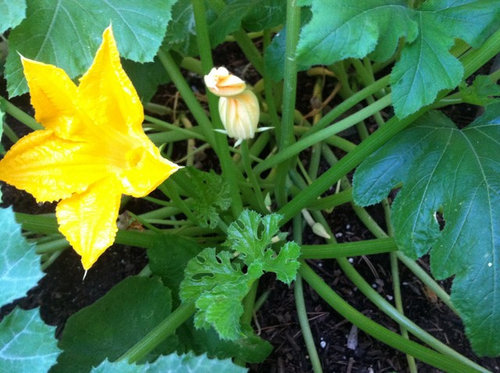
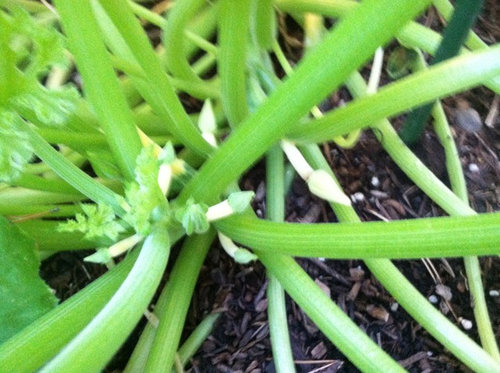
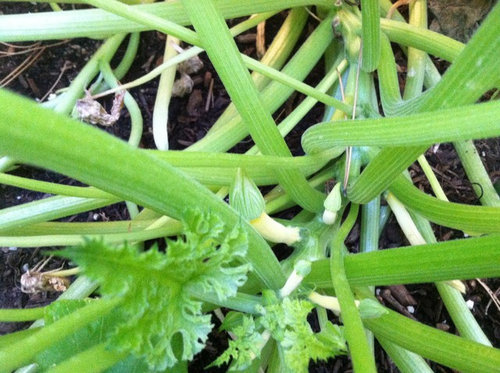
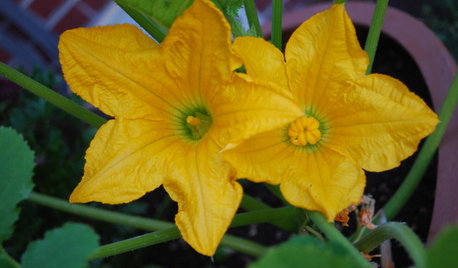
Can anyone help me understand why the female blossoms on my summer squash are not opening? The male ones are blossoming and dying off, the female ones appear but do not open up for pollination. Below are photos.
Please help. There's lots of large, green foliage but no squash.
Comments (38)
 10 years ago
The first pic are both males. The very young females in pics 2 and 3 are still far too young to even think about blooming yet. They are just starting to develop a stem. It is normal to have many full size male blooms well before you get any females ready to pollinate.
Dave
 PRO
None
Original Author10 years agoThanks for responding. The problem is is that there were older female blossoms that never opened. They just remained closed then shriveled up and died. I read that it could be due to too much nitrogen. I've been using Miraclegro's water soluble tomatoe plant food fertilizer every 7 days as directed on the box. The nitrogen, phosphate, potash for this product is: 18, 18, 21. Any other thoughts or suggestions. Thanks Dave.
Related Professionals
Fort Myers Landscape Architects & Landscape Designers · Charlotte Landscape Architects & Landscape Designers · Spring Landscape Architects & Landscape Designers · Wichita Landscape Contractors · Middlesboro Landscape Contractors · Cambridge Landscape Contractors · Vicksburg Landscape Contractors · Dayton Landscape Contractors · Marietta Landscape Contractors · Oklahoma City Landscape Contractors · Keene Landscape Contractors · Victoria Landscape Contractors · Sanford Landscape Contractors · Albert Lea Accessory Dwelling Units · Oshkosh Accessory Dwelling Units- 10 years ago
It is very true that excess nitrogen contributes to blossom drop as well as to fruit abortion. And MG that often and at that level is a great deal of N. I'd suggest cutting way back on its use frequency, especially if the plants are not showing any need for it.
I won't use it personally but those that do often recommend diluting it to 1/2 strength since it is so strong. It is rare to find a soil that is low in phosphorous so most of it wasted and runs off to contaminate ground water and few plants require either N or K levels that high despite the claims made by the manufacturer.
Dave
- 10 years agolast modified: 10 years ago
In the effort to quantify fertilizer strength through standardization, good intentions often lead to confusion. Further, as is often discussed on these forums, the financial impetus to sell products also causes misunderstandings.
Fertilizer 'strength' is not easily measured. Sure, a product can be analyzed and compared, but translating those measurements to an unprofessional consumer base is at best difficult, and at worst a company's commercialized efforts to embellish border on fraudulent misrepresentation.
First, the NPK formula, while useful, is often inadequate for determining if a certain product is appropriate for meeting the complete needs of plants.
Second, 'strength' is a term wanting in connotation when employed to describe the practical application of fertilizers. The chemical form of the fertilizer is often a better descriptor of 'strength' (or potency) than is its NPK ratio.
Fertilizers in the form of crystallized salts can have a low NPK, and yet, because of the nature of salt, and the readily available forms these fertilizers take, their 'strength' can be extremely potent. Miracle Gro is an example of this type of fertilizer. To say that they are 'strong' assumes straight, undiluted preparations, and says nothing about the amount used, the size of the plant, the amount of medium being fertilized, or the moisture content of the container/growing space.
So, if you are applying something like 18-18-21, first it's helpful to understand what those numbers mean without having to rely on the sale's pitch of the product in question. Second, it's good to understand that simply by diluting in half, you lower the ratio proportionally. Third, by using more or less of the product, you take further control of the product's usefulness and potency. Fourth, if the product is either a liquid, or a crystallized salt, it is very important to know that 100% of the constituent nutrients are immediately available.
Lastly, as alluded, another consideration is the importance of understanding terms like; 'slow release', 'granular', 'complete', 'water soluble', etc... Knowing if a product is immediately available, or requires bio-ingestion for transformation into an available form for plant life is not easily described in the 5 mins a novice gardener has when shopping in a box-store environment.
So, just as a comparison, if a gardener were presented with a choice to apply a 'slow release', organic, 'complete' granular product that is calculated at 20-20-20, or a soluble product that has a 'guaranteed analysis' of 10-10-10 -to be applied as directed - one might assume that the 20-20-20 is 'stronger'. The assumption would be both correct, and incorrect. The potential fertilization strength is greater, but the immediate potency is not even comparable in active, practical application. Plants can receive far more N than they require with the latter product.
This discussion hasn't even yet touched on how a plant's needs change with its maturity and growth stages, the needs of diverse types of crops, nor the fertility and 'exchange' capacity of the growing medium - often a measure of the bio-activity of particular soil's web-of-life. (soil web).
So, if we are to use the term 'strength', perhaps we should describe what we mean, as well as be prepared to discuss potency and availability. I'm not saying we don't, but many of the people who ask these questions have no background from which to understand these terms nor to separate out the hype used to sell common fertilizer products. Unfortunately the problem is compounded by the tendency to not know what plants need until they show signs of stress - at which point options have become quite limited.
- PRO
None
Original Author10 years agoUmm, well thanks for the info rgreen48. I'm just trying to grow summer squash in my raised garden bed.
 10 years ago
My squash has shown blossom drop with inadequate water. If it is very hot in your area, consider water needs.
- 10 years ago
While all things mentioned can certainly be the problem it is not clear to me when the OP is checking to see if these females are open and receptive.
So I would like to point out they are only open for a few hours in the AM. So if you are checking after you come home from work that could also be why you haven't noticed.
- PRO
None
Original Author10 years agoOnce again rgreen48 I appreciate the info, however I don't have a whole lot of time to determine the proper fertilizer strength for my veggies, therefore I'm sort of forced to buy the product from the manufacturer. As of right now, it is a hobby for me as well as a source healthy produce. After 8 or more hours a day of working, I don't have much time for anything more than "backyard gardening."
- 10 years agolast modified: 10 years ago
Ok good enuff. Just wanted to be sure.
Maybe it's time for a complete soil test to determine what, IF anything, is needed. Has that been done? So often we tend to add things that aren't needed by what we are growing and serve only empty our pockets.
I'm not talking about a pH test as done at many garden centers because they are the ones who will sell you things you don't need. Too often the solution to your problem is only something they are selling. Meaning if they don't sell it - that is not your problem.
- 10 years agolast modified: 10 years ago
geo, fair enough. here's what you do... for now, no more fertilizing. Your plants look fairly healthy. If you haven't already, start a compost pile. If you have compost, for the rest of the year, unless you see color changes in healthy leaves, the only 'fertilizing' you should do is with 'compost tea'. You may not even have to do that.
For in-ground growing, the Fall is the best time to fertilize for fruiting plants like squash. You aren't fertilizing this season's plants, your fertilizing for next summer. Get a soil test through your local County Agricultural Agent. Find out what your soil needs and supply it as early as possible. You're feeding the soil, not the plants. A healthy soil nurtures healthy plants. What you choose will depend on the results of the soil test (it's like $10 - well worth it.)
Squash needs a bit more N than some plants, but not as much as others. N promotes leafy growth, not flowers nor fruit. You want to encourage leafy (vegetative) growth early, but you want summer squash and zucchini to switch to the fruit bearing stage quite quickly. So, fertilizers with a good amount of phosphorous (such as bone meal) help plants with what they need for flowers and fruit. You can use synthetics, but organic fertilizer resources are usually more 'complete'. That means they have a fuller 'spectrum' of nutrients and minerals. These types of fertilizers need time to become active in the soil and available to plants. That's why Fall is the best time. More fertilizer is not always better. A soil that is within the range of 'balance' is better than a heavily fertilized soil that is out of balance.
And for most places in the U.S., think compost. Compost is decomposed organic matter. It has some fertilizer qualities, but it hosts a huge multitude of life forms which live in soil and feed your plants. So, while I was talking to others above about fertilizer strength, to you I say: unless your plants show symptoms of under-fertilization, forget the fertilizer for this year. Plan instead for next year. Feed your soil, supply it with what it needs to support life and next year your plants will have the best chance of performing well. Of course next year brings its own issues... lol.
- 10 years ago
I propose a simple solution -- put the MG away for now. Don't feed them anything this week or for the next 2-3 weeks either. Water the plants as needed and watch and wait for squash to develop. I'm betting the plants will adjust and produce. Nothing to lose and a real potential gain.
Dave
- PRO
None
Original Author10 years agoThank you rgreen 48 and Dave. Now my question is, this coming August I planned on direct sowing for cold weather vegetables. Should I let the squash, cucumbers and tomato plants continue growing until then or should I pull them up? If so, when should I get rid of them and start prepping the bed for the next crop?
Is there a certain length of time I should let the soil "rest" and or be fed before the next planting? I live in Southern California and right now the temps are in the 90s. I have a 4'x8' and 2'x5' raised garden. In the larger bed I have summer squash, lemon cucumber (both of which are nice and leafy, but no fruit), 5 tomato plants (these are bearing fruit. One is a cherry tomato plant which is bearing much fruit, the others not so much). There are also 2 bell pepper plants which I believe are done producing anymore fruit but there are signs of more to come.
Does that sound like too much growing in one bed? If so, any suggestions? The smaller bed has 2 tomato plants, 5 bush bean plants that are about 7-8" tall (obviously no beans yet) and a small blueberry bush that's approximately 10 - 12" tall. Can't wait for a larger backyard.
Anyways, as I mentioned previously, this is a hobby as well as a way for my family and I to eat more fresher veggies but quite honestly, I'm becoming more and more frustrated due to lots of green growth but low fruit production. I think I'm doing all the right things but apparently not. I'll send pictures of the beds if that would help.
Thanks everyone for whatever help you can provide.
- 10 years ago
I would recommend the original Square Foot Gardening book for guidance on dense planting. I have 4 hills of summer squash in a 6 x 6 area and it looks very crowded now that the plants have taken off (I'm in NH -zone 5).
I agree with suggestions on feeding the soil with compost and organic fertilizers. The organic fertilizer I use (Pro-Gro) recommends adding fertilizer. I like to start of the growing season with at least an inch of composted manure. I have started getting ready for the next crop in a bed where I grew spinach. I'm getting low on manure so I am using some Coast of Maine compost. Each of my beds was started using the lasagna method of layering different materials to compost in place. Depending on how much rain you've been getting, liquid fertilizer may be washing out of your beds. By using a granular fertilizer, compost and manure, I think nutrients stay in the bed better. I agree with Dave's suggestion to stop using liquid fertilizer for a few weeks. I'm a hobbyist so my reason would be I think I have pretty good soil and I get pretty good results without using that kind of fertilizer. I do like to plant things close together. I'm trying to feed the soil and not just the plants. The liquid fertilizer I use when I transplant seedlings is fish or seaweed emulsion. I will also use it for weekly fertilizing for a couple of weeks until plants get established. It sounds like the fertilizing you are doing it promoting leaf growth. If you have great leaf growth but no fruit, sounds like too much nitrogen.
I don't think pepper plants should be done unless it is too hot in your area. Mine will produce until cold weather shuts them down.
I'm not familiar with your growing zone but pulling up tomato plants in August doesn't sound right to me. Perhaps it depends on what variety you are growing. Some produce heavily for a couple of weeks and then peter out. Others continue slow and steady. Here in NH, I keep my tomato plants going until cold weather and frost are imminent. I have noticed that once nights get below 50, the flavor decreases and get bland. Your beans will probably be done after one good harvest so can be pulled up. Sometimes I get a second crop with a variety like Provider as long as I give the plants some more fertilizer. If you don't keep summer squash picked, I think the plant stops producing. I use the rule of thumb that a plant's job is to produce fruit/seed so when it does, it stops growing. Big overgrown zucchini sends a message to the plant that it's time to quit.
Given that you don't have a lot of growing space, I would not direct sow cold weather crops. Start them in plastic pots and perhaps transplant once to a large pot (large red Solo cups with holes drilled for drainage are great) before transplanting to your beds. This will give the crops growing now a few more weeks to produce. I keep reminding myself I need to start my fall crops right now. I use a seed starting mix but then switch to potting soil when I transplant to larger containers. I was much surprised at a seed starting workshop this spring that the presenter sows quite a few seeds in a small 2x2 container, then transplants to individual containers when first true leaves are just showing. This gives you a couple of weeks of not requiring very much space at all for a lot of future plants. Even sunny steps will work.
- 10 years ago
"I'm becoming more and more frustrated due to lots of green growth but low fruit production. I think I'm doing all the right things but apparently not. "
That can all be attributed to over use of the Miracle Grow fertilizer. As someone already mentioned, their goal is to get you to use lots so you have to buy more. So while an experienced gardener would look at those lush plants with little fruit production and know they had to cut way back on the fertilizer, a novice gardener would not recognize the cause. Put the MG away for the rest of the season for these plants. They have more than enough to last them for now.
No "rest" is required so while any diseased or dying plants can be pulled and replaced, let the plants that are healthy keep going. They will kick back into production as the weather cools some. The fruiting plants can only set fruit within a certain temp range but it doesn't mean they are "done".
Dave
- 10 years ago
If you are in SoCal you should try to get advice about seasonal planting from some of the members who live in your climate. It is distinct enough of an issue that I'd post a separate question that would attract those with experience gardening in your area. In some parts of SoCal. plants that act as annuals here, are perennials there. As an example of climate differences, some areas of the country have 2 tomato crops per year.
Pulling out and replacing plants is usually only worthwhile when the plants are finished for the year.
As has been explored, I think it's safe to say that a good portion of your lack of fruiting issues is fertilizer-based. However, one thing to keep in mind is that certain varieties perform differently from others. Lemon Cucumber is an example. Yes, it too may have received more N than optimal, but it is known to be a late producer. I have it growing also, and this morning I picked my first one. It may easily out-grow the abundant N you applied, and start producing at any time. In the case of this variety, patience is definitely required.
Photos are always welcome, and try not to get frustrated. Gardening really is the exact opposite of instant gratification. Look on the bright side, had you grown leafy-green veggies you would have been the most successful gardener in your zip code lol. Like any endeavor, it just takes a little time and some learning about the specific needs of the crops you are growing. That's one reason it is recommended to start small and expand as you learn.
Speaking of specific needs, from your description it sounds like that blueberry is growing in the beds with the veggies. You'll want to transplant it out to its own space away from your veggie garden soil. It has particular pH requirements, and what makes blueberries thrive will literally kill the majority of garden veggie crops. And the pH requirements of the regular veggies will seriously hinder the blueberry. Do a web search for blueberry growing. It requires quite an acidic soil. Blueberries have fertilizer products specially formulated for their specific needs. - PRO
None
Original Author10 years agoThanks to all. I'm getting a lot of good info here. Rgreen, I'll repost another question concerning my location here in SoCal, zone 9. Anyways, here are some pics as promised.
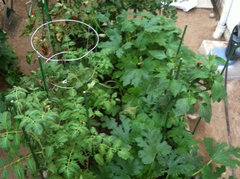
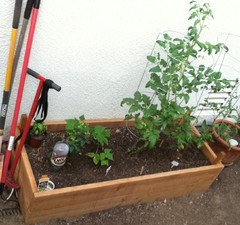
The larger, 4'x8' has 5 tomato plants, three summer squash and some green bean bush plants.
The 2'x5' has 2 tomato, a blueberry bush and 3 bean plant in between the blueberry and tomato plants each. In front of the middle tomato are some perilla plants. Too much in either box? Let me know your thoughts/suggestions. Thanks.
- 10 years ago
"Too much in either box?"
Oh yeah, waayyy too much in both boxes.
The 2x5' box - As already mentioned the blueberry must come out of the box and into its own container or the ground. Totally different growing requirements in terms of soil pH, nutrients, and water. The 2 tomato plants and 3 bean plants can maybe do ok depending on the variety of the tomato plants. But then 3 bean plants is pretty much a waste of space for little production and they can't tolerate all the nitrogen the tomato plants need. Nitrogen + beans = big lush bushes with very few beans.
When you inter-mix different crops you first have to have an understanding of their very different needs and you have to know in advance the spacing they require to be productive. What looks like plenty of room when the small plants are first planted quickly disappears as they grow and you realize they needed 2-3x as much space as you gave them.
But the 4x8 box is way over-crowded. You could fit 4 tomato plants in that amount of space and still have a disease-ridden jungle OR you can fit 3 squash plants in that amount of space and still have them take over the entire bed and drape out over the sides and into the yard.
But to have all of that plus additional plants is fraught with problems. Not only are they over-crowded, shading each other, blocking good air circulation, competing for water and nutrients with each other, but they have different water and nutrient needs, especially the beans.
I suggest some serious thinning of box contents.
Dave
- 10 years ago
Which way is north in the above pics?
Also I'd be interested in knowing how many hours of direct sunlight these locations are getting.
That is direct unfiltered, unshaded, shadowless, sunlight. If you can document the start and end times even if you have to wait for the weekend.
- PRO
None
Original Author10 years agoSo should I remove the squash and pepper plants from the 4x8 box or the tomato plants? I planted them like this based off of other supposed gardening experts online.
As concerning the blueberry, I should have went with my first inclination to put it in a pot. Any ideas as to how large a pot? Furthermore, should I pull the bean plants?Sheesh, wish I had someone here to help or at least more time in the day to spend on my garden. I'm not giving up though.
I did get some good size bell peppers and some nice cherry tomatoes.
I did well during the last growing season of cold crops. I had an abundance of kale and lettuce in the large box.
- PRO
None
Original Author10 years agoOh, the first pic is actually facing north and due to the construction of the condos, the garden gets approximately 3 - 4 hours of direct sunlight. Not my choice. I built and situated the boxes to where they'd get the most sunlight possible.
- 10 years ago
Don't feel bad. Gardening is a learning experience and none of us will ever know everything. You might be able to find the Square Foot Gardening book at your local library but I also usually see it at used bookstores. It was published back in the 80s. Keep in mind that tomato plant size varies with variety. The tomato grower who presented a workshop I attended said he uses 10 gallon pots for tomatoes. Due to the rocky nature of his property he went for pots and raised beds. Which to pull out? I would keep the tomato plants since I think squash might be available from neighbors or purchased inexpensively while tomatoes cost more and are better for all kinds of uses and preservation methods so I think you will get more out of a tomato crop than a summer squash crop. I think you can transplant the peppers to individual pots. I think people use 5 gallon pots or possibly smaller. Again, varieties vary in size. I have bell pepper plants that get pretty big while jalapeno stays pretty small.
- 10 years ago
"I planted them like this based off of other supposed gardening experts online."
I don't know where or what you were reading so can't fairly comment on whether it was accurate or just out of context or just mis-understood. Can you link to the site you used and perhaps we can explain somethings?
If you are talking about Sq. Foot Gardening as a source of info then it has very specific varieties to be used, lots of pruning, and very different soil and nutrient approach. Although I hazard the guess that even they would find it over-crowded. It is a totally different method of gardening with its own forum here so if that is what you went by then you'll want to check with them.
Plus we are working from a photo rather than seeing and being there and it isn't as if there is only one right way to do things. But there are fairly standard spacing requirements and sizes for most plants. For example the average indeterminate tomato plant is approx. 6-7' tall and 3 feet wide and the average bush variety squash plant is 3-4 sq. feet wide. Those are averages and can be affected by several variables.
So as to what to do I can only tell you what I would do based on your photos. I'd remove all the bean plants. Given all the Miracle Grow you have used they likely will not produce much anyway and even if they do it will only be enough for maybe one meal. Give that space to the rest of the plants.
Buy an 8-10 gallon container for the blueberry plant and fill it with a high quality peat-based potting mix (no soil) and the acidic fertilizer made specifically for acid loving plants. They make a specific acid-lover plant potting mix at many nurseries made from raw peat, coir, and perlite if you can find it but if not keep in mind that blueberries need very acidic soil to grow and fruit.
For the big bed with the tomatoes and squash - you don't list what varieties the tomato plants are and that is vital info. If they are cherry plants they will easily get very big (cherry plants are the biggest plants there are) so I would remove the center squash plant, leave the other two for now, and remove at least 1 of the tomato plants (depending on the variety they are. You will likely have to do some extensive pruning on the rest of them to keep them from taking over the bed but that is a whole other discussion.
Cole (not cold) crops have totally different spacing and nutrient needs so you really can't compare them.
And like gumby asked, exactly what is your sun exposure situation? The photos are shady and there is obviously a wall on at least two sides and the beds appear to be in some sort of enclosed or recessed space on a patio rather than on dirt??? so from the photos it doesn't look like nearly enough sun for most plants.
Dave
- PRO
None
Original Author10 years agoCan't find the websites anymore. The cherry tomato plant and the other are both indeterminate. All the other sites I visited used the term cold crops so that's what I've been calling them.
Direct sun exposure is approximately 3 - 4 hours. We live in a condo and have a 30' x 10' private patio. I did my best to to position the beds for maximum exposure.
Now, I just purchased a 22" in diameter, 15.24" tall pot and some shade mix specially desined for "acid loving" plants, especially blueberries. Is that pot large enough. I visited some websites specifically on the topic of growing blueberries and all suggested between a 20" and 24" pot to grow them in. I could only find the 22." Not to mention, one within my budget. I also purchased a vitamin B-1 solution to reduce stress when I transplant the blueberry plant. Was that a wise choice? I'm planning on transplanting it this Sunday.
Finally, for now that is, I live in Murrieta, Ca in the Inland Empire area. Right now it has been getting in the triple digits. I've been using a light landscaping, cloth material to provide some shade so that the plants leaves won't get scorched. It happened a few weeks ago when it reached 117 degrees one day. Again, I got the idea from a garden expert on the web. Is that ok for the plants? As I mentioned it's a light, landscaping cloth material which still lets a lot of light through. Your thoughts.
- 10 years ago
I use Neptune's Harvest fish or seaweed liquid fertilizer when I transplant and for several feedings afterward. http://www.neptunesharvest.com/faq.html see the link for transplant advice.
I think you were correct in using the term "cold weather" crops if you mean planting for fall and early winter harvest. Check with your county cooperative extension service for advice for your area. Here in New England it's time to start sowing some of those. I use Johnny's Seeds and subscribe to their emails. The most recent reminder is about planting carrots but their seeds and information tend to be for northern gardens. Information on their website that might be helpful to you is about which varieties are best suited for each season. For example, some varieties of lettuce stand up to summer heat better but others survive colder temperatures better.
I have a plastic covered high tunnel which has been getting up to 103 degrees F despite having sides rolled up and double doors on one end opened up. But it also cools down at night to currently high 50s. This is in full sunlight situation. Since you don't have full sun exposure, I wonder if shade cloth is necessary. I realize an additional 10 degrees can make a big difference. My high tunnel heats up by 10 am and doesn't start to cool down until 3pm and then just a few degrees until the sun goes down. Peppers and tomatoes seem to love it. I also have potatoes, chard, lettuce, kale and arugula doing well in there. The potatoes really shouldn't have been planted in there for the summer but I needed the room. A summer mix of lettuce planted in April has bolted. I'm watching some heads of romaine. Of 12 original plants, only one has bolted. The seeds were started indoors in an early April workshop. Have you checked the temperature where your plants are growing? It might not be 117 in less than full sunlight.
- 10 years ago
I am going to guess that you have more than one problem. At least one of which is the reduce amount of direct sunlight, the other over fertilization. You would do better to grow plants that would be happier in that amount of sun and perhaps matched to the soil you now have.
Get a notebook write in it plans for next year while they are still fresh in your mind. If you are like me when next year comes you will forget all that you learned this year.
Besides things to do, things to buy, things to grow, you can write things that went well this year, things that need improvement, and things not to do.
Also planning dates for next year such as when to start seeds, etc. Grow plants you like to eat but will grow in the environment you have. As mentioned, start small as you can see how much work is involved.
Don't be ashamed to buy the things that you can't grow at the farmers market.
- PRO
None
Original Author10 years agoThanks gumby. Actually, I've already implemented many of your suggestions. The vegetables I currently have were chosen based upon what we eat and the zone we're in. I guess I just overcrowded the boxes. I'm going to transplant the blueberry plant into a 22" diameter, 15" deep/ tall pot with a soil specifically made for acid loving plants, especially blueberry plants.
Next, I'll be transplanting out of the larger bed, the two bell pepper plants to make room for the tomato plants and squash.
I've already laid off the fertilizer due to possibly too much nitrogen. Is the 22" pot large enough for the blueberry plant. Most websites dedicated to growing blueberry plants propose using between a 20" - 24" pot. Thanks
- 10 years ago
I don't know about blueberries but will say that you should be forewarned that removing any plants at this point can impact other plants in the bed. I would guess their roots are pretty well intertwined by now and think it would be impossible to remove one without impacting another. You may be just as well off to ride out this season.
Spacing isn't your only problem and I doubt more room will make the remaining plants any happier this year.
- 10 years agolast modified: 10 years ago
I'm not sure it was mentioned here but squash plants normally will produce many male blossoms (early in the season) before a female comes along. Yours is likely complicated by extra fertilizer.
Also in case it wasn't clear the plants you are growing definitely need more direct sunlight than they are getting. 5-6 hrs for tomatoes and squash is generally preferred.
I remember when I first started gardening, my tomato plants were beautiful with lots of blossoms but no fruit. Every garden center I went to tried to sell me things like blossom set, etc. Then someone asked me about sunlight? Of course they get plenty they are out in the wide open. But when it came down to timing it the "direct sunlight" was only one and half hours. The sun was up but behind the trees surrounding the neighbors property. What they were getting was "daylight".
Problem solved
- 10 years ago
good point about roots. When I suggested transplanting the pepper plants, I was thinking about the small size in one of the photos but on looking again, I don't see any pepper plants in the photos but several small bean plants. At this point in southern CA growing season, the pepper plants should probably just be cut down and discarded.
- PRO
None
Original Author10 years agoThanks gumby and defrost. I was considering cutting down the bell pepper plants myself but they produced some nice peppers which I harvested. Looks like more are growing. Anyways, I'm thinking on starting over with them but in pots so that I can move them around to get the maximum amount of direct sunlight. Again, I'm thinking a large 24" in diameter pot around 15" tall or taller would do. What do you think? Some say grow them in 8 - 10 gallon containers. Where would I get such containers?
- 10 years ago
You might check the hot peppers forum for container sizes. My jalapeno plants stay pretty small so I would think a 5 gallon pail or less would be fine. A friend put two tomato (cherry) plants in a grow box on wheels so she could wheel them in and out of her garage in early May which here in NH is still possible frosts at night. I put containers of plants in my garden car to wheel around, again, mostly in and out of the garage in early spring until after danger of late spring frosts have passed. I did find some very large plastic pots at a big box chain. The plastic is thin so I don't know how long they will last. These are probably 10 gallon size. It's probably safe to put drainage holes in plastic trash cans. I have annual plants in old tin wash tubs with holes punched in the bottom for drainage. Keep watch for yard sales and Craigslist for ideas.
- 10 years ago
The only thing I have in pots right now is mint. Which is parched now in this summer heat.
- PRO
None
Original Author10 years agoThere's a forum for hot peppers? Whew! My jalapeños are in separate containers. Is there a separate bell pepper forum?
- 10 years ago
At the top left of this forums home page is a link to all the Garden Web forums.
Here is the link http://forums.gardenweb.com/forums
Also look for Container Gardening for container advise.





rgreen48