Software
Houzz Logo Print
desertdance

How are Ripened on the Counter different from Store Bought?

This confuses me. I'm new, but you all seem to like to ripen yours on the counter. What is the point? Why not buy them from the store?

Me? I'm new. I'm ripening on the vine and they are delicious.

You told me to pick the ones with sun scald and ripen on the counter, so I did that, but I thought the whole point of growing them was to have them ripen on the vine. Am I wrong? If so, I'll go back to store bought.

No difference I can see. Ripen on the counter? Come on!

Comments (22)

  • 10 years ago
    last modified: 10 years ago

    I added some more info on my original post.

    "Harvest time for tomatoes then should ideally occur when the fruit is a mature green and then allowed to ripen off the vine."


    Blog of an Ancient Gardener

    "1. Tomatoes at full red-ripe stage have optimum nutrition, color, and flavor, but they don’t have to be on the vine to reach that point. (Let’s assume this applies to tomatoes of all colors.)
    2. Tomatoes start producing ethylene gas internally when they reach full size and turn pale green from their earlier dark green. The ethylene regulates the ripening process. (Tomato growers in Florida, for example, gas their dark-green fruit with ethylene to turn them red in winter, so we can have beautiful red tomatoes that taste like green ones.)

    3. When the tomatoes reach the “breaker stage”—about half green and half pink—“a layer of cells forms across their stem, sealing them off from the main vine. At this state, tomatoes can ripen on or off the vine with no loss of quality or flavor,” Marr explained. (If the variety produces a color of fruit other than red, determining “breaker stage” may be more challenging."

  • 10 years ago

    Tomatoes grown commercially need to be able to stand up to travel and to store well. Consequently, they tend to have thick skins and little to no flavour.

    Tomatoes ripened on the vine are the best (IMHO) and some varieties require that. I happen to think that Sungold is one that absolutely needs it. However, it is good to know that if there are critters out there just waiting to pounce on our tomatoes as they turn colour, or that rain is imminent, it usually won't affect the flavour if we pick them and ripen them safely inside.

    I usually wait until my tomatoes are almost ready before I pick them - unless I know that it is going to pour with rain, in which case I will pick anything that is blushing to save them from getting waterlogged and split skins.

    Linda

  • 10 years ago

    I have picked green tomatoes at the end of the season when frost was imminent but, although they eventually turned red, I found that the flavour was sadly lacking.

    Linda

  • 10 years ago

    There have been numerous studies showing that people can absolutely detect a difference in taste when tomatoes are picked early. So IMHO, I don't think a tomato picked early is going to be, as many claim, exactly the same as a tomato ripened completely "in the field". There are lots of explanations for why there's supposedly no difference in flavor, but I don't find that they hold up scientifically.

    THAT SAID, most of your normal largish to large tomatoes are not going to taste that different if you pick them a little early, such as when they're colored up half way or so. And since a lot of us pick early to avoid damage from pests and weather, it's pretty clear that a tomato that is 95% awesome is better than getting no tomato at all just because we want that last 5% of awesome.

    No matter what, a home-grown tomato is going to taste better than a supermarket tomato because we get to grow tomatoes at home that are bred for flavor and texture first, not bred prioritizing qualities like durability for mechanical harvest and shipping, uniform ripening, uniform size, and timing of harvest over the qualities of flavor and texture. Home growers and specialty small farms serving a local gourmet clientele just have the option to grow better-tasting varieties.

    Like Linda, I find that cherry tomatoes taste noticeably better when left to ripen completely on the vine. I think it's because they have so much less mass to accumulate the sugars and flavor-bearing compounds that make tomatoes taste good, so that little bit they get from the plant during the final days of ripening make much more of a relative difference in cherries than in larger tomatoes. That's OK, because cherries tend to be prolific, so losing a few to the critters isn't as heartbreaking as losing a big, beautiful beefsteak or oxheart.

  • 10 years ago
    last modified: 10 years ago

    It is the difference between artificial ripening green tomatoes with ethylene gas (store bought) and naturally ripened on the counter. And that is a BIG difference.

    Once a tomato hits color break a membrane form at the joint of the stem and the fruit sealing off the fruit from the plant. Mom cuts the apron strings. She is done with him.

    Sure you can leave the kid outside in the rain and the bugs and the squirrels and the heat if you want, cross your fingers and hope for the best. I prefer to bring mine indoors where it is safe and when it is ripe it tastes just as good as one left on the vine and 200% better than anything bought in the store. Plus I actually get to eat it rather than the worms or squirrels getting it.

    Dave

  • 10 years ago
    last modified: 10 years ago

    Re: the claim that tomatoes get "sealed off from the main vine"--that can't be the case, otherwise they wouldn't split after a heavy rain. Almost everything that flows past/into tomato fruit does so via xylem (normally transports water), not phloem (normally transports "food"). That means that the vast majority of what the tomato fruit gets from the plant during its growth and maturation comes from the xylem, and that xylem obviously doesn't ever get sealed off until the fruit is off the plant because liquids are still capable of being transported into the fruit even at dead ripeness, as proved by ripe fruit splitting after rain.

    While it's probably fair to say that maybe the tomato doesn't get all that much from the plant at the end, at least not enough to make a big difference in taste when you're talking a larger tomato, I can't understand where this idea came from that the tomato gets "sealed off" or "forms a membrane" that seals it off after it reaches mature green size. It seems to me that this is a misunderstanding or mis-description of the changes that occur in the abscission zone that then ended up getting repeated, even among many people who are experts.

  • 10 years ago

    Well, as you know, my volunteer tomatoes are amazing. They are the seeds of grocery store tomatoes that germinated in our compost and came up in the petunias. VERY sweet and delicious with no thick skins. An amazing array of sizes and shapes. Some are plums like I bought, others look like San Marzanos, one like a beefsteak, and others like those salad tomatoes.

    I haven't tried them all but they are ripening at a quick pace on the vine. Jury is out.

    BUT the one plant we actually bought from HD turned out to be a horrible mislabeled cherry with skin so tough you could choke on it. We have decided to kick it to the curb.

    Weather? It's hot here. No rain. I move the umbrella to shade them from extreme heat. Critters? they go for my figs, and they have all gone to the happy hunting grounds.


  • 10 years ago
    last modified: 10 years ago

    Suzi: Well, as you know, my volunteer tomatoes are amazing. They are the seeds of grocery store tomatoes that germinated in our compost and came up in the petunias.

    Seeds from grocery store tomatoes usually do not have the same genetics as the plant that produced them, as many varieties used on a large scale commercially are hybrids, and the F2 generation will have quite a bit of variation. So you can't really compare them the way you'd compare a home-grown plant of variety [x] with a tomato from a store of variety [x] (if you could even find out what variety your store-bought tomato is).

    Suzi: BUT the one plant we actually bought from HD turned out to be a horrible mislabeled cherry with skin so tough you could choke on it.

    My aunt "gifted" me a big box store tomato plant once. It was some kind of large cherry. Flawless looking tomatoes, very productive, big vigorous plant... Tasted only marginally better than a very mediocre supermarket tomato. The plants I grew from seed tasted amazing. The HD plant was probably some kind of commercial hybrid bred for producing lots of pretty tomatoes.

  • 10 years ago

    @dirt, that is a little too much for my simple brain. Is it ripe? Is it not? That is how my thinking goes. Overthink, you will die an old sorry man. Underthink, you will enjoy the fruit of your labor.

  • 10 years ago

    Dave: It is a functional seal gorbelly, a two-way safety valve, in that the resistance in the xylem is dynamic, not static. It increases exponentially as the fruit ripens and it is increasingly difficult for even water to move in either direction.

    Yes, but a functional "seal" that is really a function of pressure and resistance is not a membrane or actual seal. As I said, I have no problem with the statement that very little gets transferred from plant to fruit in the last stages of ripening under normal conditions. That's probably true overall, except maybe for cherry tomatoes and other small tomatoes. But it's not a membrane, and it's not an actual seal. It is controlled by the peduncle--science does not yet know exactly how--and not in the fruit or the pedicel.

  • 10 years ago

    suzi - that was all for gorbelly. We are having a semantics discussion. ;-) When I try to put it in simple terms and use words like "seal" and "membrane" to avoid being overly technical somebody who does understand it all always takes issue with the simplistic terms.

    Bottom line - for all practical purposes the fruit is sealed off from the stem by a membrane. How they function in detail and how they are formed isn't really relevant to your original question. The momma plant has moved on to new business.

    But " Is it ripe? Is it not?" is a bit of an over-simplification as there are multiple degrees of ripeness.

    Dave

    PS: "Overthink, you will die an old sorry man. Underthink, you will enjoy the fruit of your labor."

    Sorry but I wouldn't touch that one with a 10 foot pole.

  • 10 years ago

    Here's a different study that contradicts much in the one you link to.

    http://www.ncbi.nlm.nih.gov/pmc/articles/PMC2754649/

    Methodology/focus is slightly different, but it clearly shows that influx into a tomato truss continues even as fruits turn red.

    It's a difficult subject to study, and we know surprisingly little about this, actually.

    But given this and the fact that people can detect definite differences in flavor, including sugar and acid content and aromatic compounds, between tomatoes picked early after mature green and ripened off the plant vs. picked when table ripe, I just don't feel comfortable telling people that the fruit is actually sealed off from the plant. And the "membrane" thing honestly drives me crazy--it's not a membrane, and people are fully capable of understanding that flow to the fruit is greatly reduced without needing a made-up membrane.

    Also, some people have more acute senses of taste and smell, so to promise that there is zero difference between a ripe tomato picked any time after mature green and one picked table-ripe is very likely to be a false promise for some people. Different varieties will also differ in this, no doubt.

    I personally prefer to say that we don't yet understand exactly what the relationship is between fruit and plant in the end stages of fruit maturation, but that IF there is loss of flavor due to earlier picking, it's in most cases, with most people, probably not significant enough to affect eating enjoyment and that it's almost certainly a good trade-off if the gardener is having issues with pests and/or weather ruining fruits right before they ripen completely.

    In other words, for most people, picking at the half-way-colored-up stage is likely to have very little detectable effect on potential flavor of tomatoes, but the less color is on the tomato when picked, the more likely one is to detect a difference in final flavor. However, it may not be enough of a difference to be disappointing, especially since home growers rarely do side by side comparisons of the same variety of fruit picked table ripe and fruit picked earlier and ripened off the vine in large enough quantities and in controlled enough situations to do a nitpicky comparison.

  • 10 years ago
    last modified: 10 years ago

    Here is what I added to the tomatoville post.

    "As for getting nothing from the plant after color break, I'd like to see the scientific data on that."

    Me too! I think this was the stuff I majored in, back in the day. And I am an exit or two from UC Davis. They study a lot of grapes and tomatoes. Maybe it is the abscission layer.

    "Once the tomato has reached maturity an abscission layer forms between the calyx and the fruit, ultimately resulting in the fruit falling off of the pedicel."

    http://www-
    plb.ucdavis.edu/labs/rost/tomato/Reproductive/dev.html

    "Development and regulation of pedicel abscission in tomato"

    "Tomato has been studied as a model system for abscission, as tomato plants develop a distinct AZ at the midpoint of the pedicel and several tomato mutants, such as jointless, have pedicels that lack an AZ. This mini-review focuses on recent advances in research on the mechanisms regulating tomato pedicel abscission...

    Abstract
    To shed unfertilized flowers or ripe fruits, many plant species develop a pedicel abscission zone (AZ), a specialized tissue that develops between the organ and the main body of the plan"

    http://www.ncbi.nlm.nih.gov/pmc/articles/PMC4462994/

    "Before abscission, pedicel AZs attach the flowers firmly to the plant body, but when the AZ cells perceive an abscission-stimulating signal, the adhesion immediately starts to loosen. "

    Maturity and Maturity Indices - Fruit & Nut Research and Information Center

    "To most people mature and ripe mean the same thing when describing fruit. For example, mature is defined in Webster's dictionary as: "mature(fr.Lmaturus ripe):l: Based on slow, careful consideration;2a (I):having completed natural growth and development: RIPE (2): havingundergone maturation, b: having attained a final or desired state; 3a: ofor relating to a condition of full development." In postharvest physiol-ogy we consider mqture and ripe to be distinct terms for differentstages of fruit development (fig. 6.1). Mature is best defined by 2a (l) above as "having completed natural growth and development"; forfruits, it is defined in the U.S. Grade standards as "that stage which will ensure proper completion of the ripening process." This latter definition lacks precision in that it fails to define "proper completion ofthe ripening process." Most postharvest technologists consider that the definition should be "that stage at which a commodity has reached asufficient stage of development that after harvesting and post harvest handling (including ripening, where required), its quality will be at least the minimum acceptable to the ultimate consumer."Horticultural maturity is the stage of development at which a plant or plant part possesses.."

  • 10 years ago
    last modified: 10 years ago

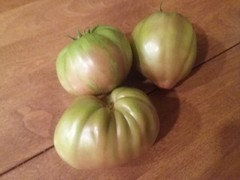
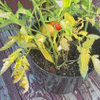
    And a picture of the tomatoes before


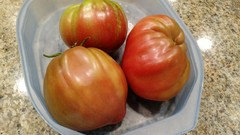
    24 hours later.

  • 10 years ago

    I think the amount of completely green and gassed store tomatoes is really small nowadays, at least in Europe. The biggest difference is the quality of fruit itself (variety, nutrition), but to some extent I think some hybrids need to stay more on the vine than OPs. This is just a personal observation that may not be true. I think it maybe has to do with the slower ripening of most hybrids. To be able to last longer, they also ripen more slowly, so from breaker to fully ripe it can be a week or more (while most OPs ripen in 3-4 days in good conditions).

  • 10 years ago

    Comparing ripening on the counter vs store bough is not a good comparison, IMO. Taste is mostly determined by the genetics and climate.

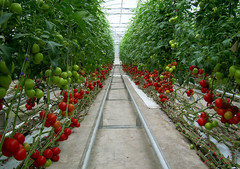
    Store bough commercial tomatoes are not general grown for taste but it is for shelf life, look and uniformity in size. If they don't taste good is not because they have been picked too early. I have been to a big commercial green house. Most of what they picked were almost ripe or partially red .

    here is a picture.


    So the next time somebody says that all grocery store tomatoes are picked green, don't believe that.


    Sey

  • 10 years ago

    That might be true that some greenhouse tomatoes are picked red Sey, but if they have to travel a long way, it would make sense for them to be picked green so that they can ripen as they travel in the spring and winter months. By the time they get all the way up here they tend to taste like cardboard.

    I was thinking that the OP probably gets nice tasting tomatoes from the store year round because they can be grown in CA during the winter. That would explain why she is so confused.

    Linda

  • 10 years ago

    "So the next time somebody says that all grocery store tomatoes are picked green, don't believe that."

    This statement is based on a visit to one commercial greenhouse operation? And you know for a fact that they are shipping these red just picked tomatoes how far? The local supermarket or local farmer's market down the road or next town over, maybe but not much further. More likely to the local canning factory.

    Would love to see those tomatoes in the photo survive shipping and be even close to edible even if shipped out of state much less to Kansas and beyond.

    Plus no one said ALL grocery store tomatoes are picked green and as more local growers pop up many chains make an effort to buy locally when they can, But a large percentage of them are artificially ripened simply because they have to be shipped so far away.

    Dave

  • 10 years ago

    I said :

    " So the next time somebody says that all grocery store tomatoes are picked green, don't believe that."" Keyword "ALL"

    I don't know how far the tomatoes were going to be shipped, not across the globe,, I think. I was there almost 5 hours they kept picking, packing continuously. They would sort out the ones with more green (not fully red) into different boxes. From what I heard they are suppliers to some of the major grocery chains in US and Canada.

    Maybe other greenhouse growers do differently. But this one that I visited is a huge operation with over 7 acres of greenhouse just growing tomatoes.


  • 10 years ago
    last modified: 10 years ago

    I live near a few of commercial tomato places (...these might be primarily for cooking and processing... Safeway once told me they got a batch of the "pretty ones" from Florida!), and nearby UC Davis studies commercial tomato farming quite a bit. There is a lot of more "scholarly stuff" available, but this was easily found on their website;

    Tomato: Recommendations for Maintaining Postharvest Quality

Sponsored
Peabody Landscape Group
Average rating: 3.5 out of 5 stars8 Reviews
Columbus' Reliable Landscape Design & Contracting