Software
Houzz Logo Print
ranger481vs

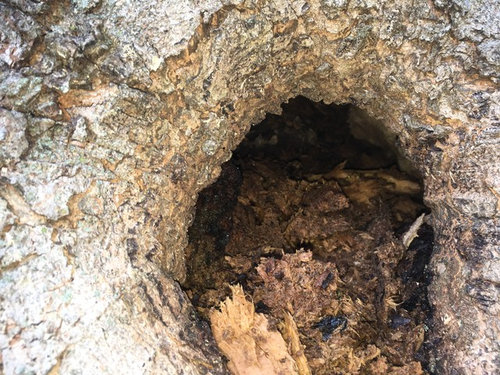
Large rotting hole in silver maple tree

10 years ago

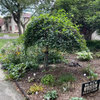
I have a fairly old silver maple tree in the backyard, and there is a rotting hole in it. It appears to be at least a foot deep and once you get past the opening about a foot high. I'm guessing this tree is 35+ years old, possibly or more. So, my question is, how worried do I have to be about this tree. I know it will have to be taken down eventually, just wondering if I need to do it really soon or not? Thanks for any help.

Comments (23)

  • 10 years ago

    Hollow doesn't necessarily = dangerous.


    A Certified Arborist qualified to evaluate potentially hazardous trees can provide an educated opinion.


  • 10 years ago

    I personally would clean out the loose material inside by a gloved hand. This will at least expose the inner surfaces to more air & allow some drying out. Won't hurt.

  • 10 years ago

    Ranger, you are both right to worry and perhaps worrying too much. There is definitely a decay pocket-wall one in Shigo's hierarchy of defense mechanisms by trees is the most easily breached, and this is the one that leads to vertical movement of decay, hence hollow areas. Silver maples are poor compartmentalizers too, so this decay is essentially free to continue to expand, however gradually.

    Nobody can guarantee the integrity of this or any tree really. We can only make generalizations. I would say you needn't panic into an emergency removal. But one question; What, if any targets are in the area? Kid's sandbox directly under the tree? Cars parked? House? From the photo, it looks fairly wide-open where this tree stands, and if that is so, I'd just enjoy the tree. It could remain standing long after you, me and the rest of Houzz are gone. Or it could get worked over by a big wind tomorrow. I suspect the former is closer to what actually ends up happening, but again, that's no guarantee.

  • 10 years ago

    Very common situation with silver and less so with red maples. Really can't tell if it needs to be removed now or if it can wait another decade or three. I'd guess the latter.

  • 10 years ago

    Thanks for the comments. I will probably find an aborist to look at it, but good to know it has potential to be fine for years.

  • 10 years ago

    That's where birds used to live before there was any man made nest boxes

  • 10 years ago

    Agreed^. Cavity-nesting birds-and other critters-really need for there to be "imperfect" trees around!

  • PRO
    10 years ago

    I have one with a hole in it right next to my house, it has even been topped once. It also survived carpenter ants coming back bigger and stronger. It hardly ever drops a branch. Yours looks better than mine so I wouldn't worry about it.

  • 10 years ago

    Appreciate the comments. Pretty I've had ants in there. Can I treat the hole with the black-colored paint to slow down decay and ants?

  • 10 years ago

    paint will only trap more moisture.. leading to more decay ... the only suggestion to do anything inside.. was to clean it out.. so it will dry more ..


    can we have a pic of two on its situation in the yard.. relating to the buildings around ...and a pic of the whole in regard to such.. so see can scale of it all???


    any chance that was the limb that was heading directly toward the house ...


    that hole looks 6 to 8 feet above the ground.. how tall is the tree beyond that??? .. wonder how many tons are hanging in air.. above the rotting hole in its structure ....


    you need a certified tree surgeon.. not just any dude with a chainsaw .. see link for such .... peace of mind.. will be worth the cost of the visit ...


    ken

    https://www.google.com/search?q=isa+tree&ie=utf-8&oe=utf-8


  • 10 years ago

    I disagree, if it was your deck would you seal it?

    In hindsight when that pruning cut was made it should have been sealed with something. I have seen silver maples encapsulate metal fences and put up with my neighbor UNDERCOATING their wounds.

    These rot and quickly in tree terms, the rot is the greater danger than a sealant traveling about the tree and killing it.

    You DO need to wait for that cavity to be relatively dry, then any attempt to seal that irregular cave in there, man what to use is the question.

  • 10 years ago

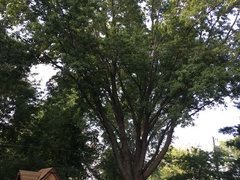
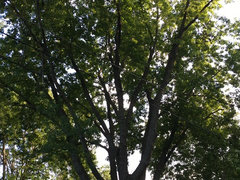
    Here are a few more pics. I guess the tree would be in the vicinity of 100 feet tall. It's next to powerlines, but otherwise, If it were to fall, it probably would not hit anybody's house, just the play structure and landscaping


  • 10 years ago

    Nice tree.

    What is the general rule guys, when mushrooms or rot start showing out the other side?

  • 10 years ago

    I'm not sure there is a general rule, but the presence of fruiting bodies (mushrooms or bracket fungi) protruding from tree trunks is indicative of internal decay. These fungi are not killing the tree per se, but are simply opportunists setting up shop for an easy meal.

    Ranger, with one exception-that being wounds on oak trees in regions experiencing oak wilt disease, and which for whatever reason have had pruning cuts or other wounds happen to them during the growing season, the use of so-called tree paint, tree wound "sealant" etc. has been long discredited. Simply put, trees have had to manage various wounding processes since long before us hairless monkeys showed up on the scene, and they do this by the C.O.D.I.T. process, which stands for compartmentalization of decay in trees. That is, they do their own walling off of wounds when they can, and when they can't, there is nothing we can add to make things better. Nothing.

    Now if Spruceman still hung out on this forum, he might disagree with me in that he developed his own formulation of "liquid copper fungicide" that he used even on some very large wounds -at the time of making these wounds (pruning cuts), but that's a specialized case and all that notwithstanding, there is simply no evidence that applying tars, paints, orange shellac (lol!) or any other material does one bit of good.

    Incidentally, the reason trees get so much larger than other living organisms is this very C.O.D.I.T. process. It enables them to go on living after significant injury, to wall off these injuries, and not have them end up leading to whole-plant failure. Grass, herbs, flowers, etc. can't do this. They have essentially no means to cope with injury, at leas tin terms of retaining permanent structures. And this process is not "healing". In healing...let's say I cut my finger....new cells will replace the old, damaged ones. Trees don't replace cells like that, they wall off-both chemically and physically-the damage, so that it doesn't go on to spread throughout the plant. If one were to somehow wound the trunk of a young tree, but not so badly that the tree was destroyed, that wound will remain with the tree for its entire life (and beyond-you can see this stuff in lumber), and as the tree puts on girth, the old wound ends up buried deep inside. But it's still there.

  • 10 years ago

    I wanna debate.

    CODIT did not seal that wound in a rot prone maple.

    Applying undercoating of all ridiculous things to the side of a tree not kill it or have any negative effects over a decade long period per my observations. (Silver maple, redbuds, tulip poplar that I have seen)

    In my point of view if during a dry week about a month after that pruning cut was made undercoating (!) was applied it would not have that rotting hole.

  • 10 years ago

    I agree to disagree. So, you're saying that not only would using some undercoat spray-I've used that stuff too, but on cars-not have harmed the tree, it would have actively protected the site of the pruning wound from the decay that befell it? I got to ask because first you say the one thing, then at the end, you go further and claim an advantage to using this stuff in the manner you describe. I say poppycock! This is a classic case of wall one in the C.O.D.I.T. model failing, and what's more, on a species known to be a poor compartmentalizer. There's no controversy here.

  • 10 years ago

    My neighbor uses the undercoating so his trees have been what I have observed. I've had my house since 02. It wouldn't be my first choice, but his trees and I can no longer argue.

    To be clear, I say (with hindsight) sealing that wound with undercoating would have been helpful when it was fresh.

    My theory is, the rest of the tree isn't rotting so if that spot were protected from the elements it wouldn't be either.

    Also undercoating obviously doesn't kill trees, somehow. There HAS TO BE a better choice, but hey, its what I've witnessed.

    Not sure what I would do now if it were mine. That irregular cavity doesn't take well to sealants or drying out. I think eventually it will be the death of the tree though as I agree silver maples rot. I used to have two.

  • 10 years ago

    The point of debate in my mind is when to seal a cut on what species. My red maple closed a 4 inch wound without issue as did a good sized black walnut. Both were really fine unsealed. I can't see a sealant hurting if applied once the wound dries up, but I left both alone.

    A big cut on a rot prone tree is another thing, but how big? 5 year estimated encapsulation? 2 year? I dunno. My hindsight on that tree is 20/20.

  • 10 years ago

    Tornado, disagree, because any "sealant" seals in moisture, which is exactly what you DON'T want. Only direct air exposure will dry things out. The wound is vertical, so little/no rain can get in.


    BTW ranger, your maple has been working long & hard to close that wound. My opinion -- give it a chance. Again, I'd hand-clean it out myself.

  • 10 years ago

    Plus, the tree itself has numerous tactics-chemical, physical, new growth-oriented-to deal with wounds. Why muck up the process with something that really has no bearing on the process......or worse yet, somehow interferes with it?

    To date, the only two cases where wound dressings of any kind are warranted IMO are: When oaks must be pruned for some reason during the time of oak wilt transmission (or have been wounded somehow).....and perhaps the use of "liquid copper fungicide" a la Spruceman and his big white pines, etc. all those years ago, wherein this non-BSer seems to have arrested any hint of decay on what should have been much too large of pruning cuts-basically where a white pine split into two main trunks, that sort of thing. These two settings continue to be the only cases where any such technique is warranted IMO.

  • 10 years ago
    last modified: 10 years ago

    And the copper fungicide solution isn't a sealant -- it soaks into the wood. Technically, that solution COULD be sprayed into the cavity, tho you'd have to get down to sounder wood -- otherwise you'd just be soaking loose debris (useless).

  • 10 years ago

    I would like to say it is nice to debate, argue or disagree without the political name calling. Man, elected officials just can't have different opinions on a subject without hurling insults and name calling. That seems to be trickling down to the public also.