Software
Houzz Logo Print
dailyvideo

HELP! Problem Floor - Claims Process / Lawsuit?

10 years ago
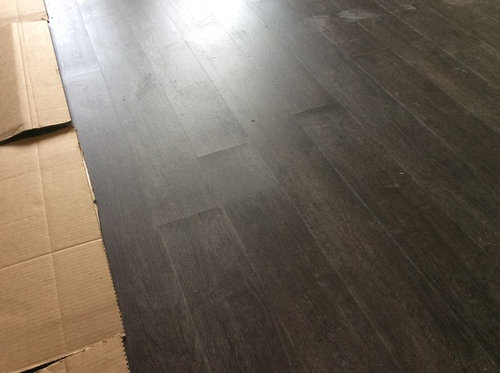
Moving into our new home 9/1 and our Armstrong LVT problem floor issue won't be resolved. Basically it peaks at almost every end joint and it has been verified it is NOT an install issue. We can't even decide if we have the builder hold off on putting up baseboards because we don't know if/when Armstrong, the distributor or retailer will make good on this. Even if they did we don't know if they would cover all the damage and cost to pull baseboards off and put back on.

We are about to give the retailer the flooring replacement estimate so their claim can be official filed to the distributor. Distributor rep came out and was extremely rude and belligerent. Builder had to step in and tell him not to speak to us like he did. We have been told by another local flooring company that this is common behavior for the distributor rep. The rep didn't acknowledge the issue, said he though all the peaking was "within tolerance" and that things like the direction we ran the floor and our wall color made it look like that! But even the distributor said the install was just fine.

Distributor sent us another carton of the product and it has same peaking issue.

Read elsewhere on Houzz about telling the retailer after we jump through the hoops of getting their claims process started that they have 10 days to issue a replacement credit or we will take them to small claims court. Is this the route to go?

We are totally stressed out and frustrated about our flooring situation.

Thanks for your advice. We need it.


Comments (13)

  • PRO
    10 years ago
    last modified: 10 years ago

    No matter who pays, you do NOT want to move in and replace the floor afterwards. Base skirting is far less an issue, as it should be possible to trim, and set these high enough to allow flooring under the base with a shoe molding in the worst case. How you resolve this financially is almost secondary. Rip it up, document all peaking, and replace the flooring, delay the 9/1 move in. File the claim and pray. These are not quality floors. A good pre-finished floor installed correctly does not do this, and while I understand the love of these new "grayed" deep colors colors, nothing will beat a sand on site hardwood floor for quality of install, and longevity, or at least a QUALITY pre- finished material. Pay now, or pay later is fact. If the areas that are peaking will be under rugs, maybe live with it. The problem doesn't have a "good" resolution with a 9/1 move in. ALL flooring needs to acclimate on site for at least a week, no matter the type of wood flooring. Allowing order / delivery /acclimation time/ install within the house? I'd expect a huge problem with 9/1 move in. In any case, the floor is junk.......or it will be soon after you begin walking on it, and maintaining it. I won't even ask if the builder allowed time for the flooring to acclimate...................

  • 10 years ago
    last modified: 10 years ago

    JAN MOYER, Thanks Jan. We are essentially homeless 9/1 so we have to move in. I'm concerned tearing them out before resolution may be an issue if further inspection is needed on the claim, plus we wouldn't want to live on a plywood subfloor indefinitely. I don't think we can leave this to the Armstrong claims process from all I've read and experienced so far. Armstrong is firewalled by the distributor.

    PS: Yes, floor acclimated several days in climate control. I was even careful to ensure the replacement test carton sent by the distributor acclimated. It's not that or the install that is the issue. Cartons had lots of defects and even pieces with large red cut indication marks in them.

  • 10 years ago
    Jan, you are talking about wood floors but the poster said these are LVT. At any rate, I do think getting the floors dealt with prior to moving in will be the thing to really aim for. Just be the squeaky wheel with all parties involved and get them to make it a priority.
  • 10 years ago
    last modified: 10 years ago

    Any damaged pieces straight from the carton should have been discarded, not installed. That is on your installer. If the installer noticed defects after installing a couple of cartons, the manufacturer requires that the installation immediately cease, and contact the retailer for assistance with a claim.

    Industry standard Is that installation constitutes acceptance. Your installer is the one at fault here if he noticed issues and continued to install defective planks.

    If the peaking occurred after installation, most likely it is at he installers feet again. What is the entire length of an uninterrupted run? End to end, how long is the span? Vinyl expands and contracts much more than wood. It cannot handle temperature extremes, or you WILL get gaps at the wall in cooler weather, and peaking during warmer weather. That is the nature of vinyl.

  • PRO
    10 years ago

    I agree in my mind this is an install problem.

  • 10 years ago

    Need a lot more info to give you thorough advice. Here are your options:

    1) Live with it. Yes, it is a defective situation. OTOH it is a purely aesthetic issue, affecting appearance and perhaps wear (I would expect those peaks to be highlighted over the long term by the excessive wear they will be exposed to). You have to have light grazing the floor just right to even photograph it, correct? Right now, your eyes are magnetically drawn to that feature. Once your furniture and lighting and artwork are in place, the peaks will be de-emphasized.

    2) Do your best to hold the manufacturer and/or installer accountable. Without knowing details, just hearing the abusiveness of the manufacturer's rep make me 98% certain it is their problem....it's the bluster of someone who's in the wrong. There is a cost to doing so, whether it's delayed move-in, delayed baseboard installation, ongoing strife, prolonged uncertainty, etc. You would need to balance the risks and rewards. Yes, I agree that to do so, you most likely need to leave the floor intact and unremediated, and logically you can't move in any furniture (or maybe just a cot and a folding table).

    What is your total exposure? How many square feet, and do you have any rooms without this issue where you could live during the struggle? (BTW, baseboards alone wouldn't need to be a big deal.) If more than 1 room is affected, the small claims (usually $2K - 10K depending on state) may not nearly cover it. Was your installer certified by Anderson? How do you know the correct installation procedure was used? Have you combed over every step of the installation guide and attempted to prove your case? Anderson will be doing the exact opposite. Make sure you know the facts about installation like the back of your hand before deciding this route.

    3) Fix it yourself. Make sure you know a price and a method for this - that's info you need to make a decision. Take your lumps and move on - we've all done it and sometimes it is the right decision overall.

    4) Fix it yourself while still trying to hold the manufacturer accountable. Combine 3 and 4.

  • PRO
    10 years ago

    Its the product, plain and simple. Luxury vynil tile expands and contracts in temperature and humidity changes. I have seen this product from this manufacturer installed in 2 different apartment buildings and in both buildings the installation was done correctly and within weeks there was either peaking or gaps depending on whether the floor was either sun exposed or in a unit with no sun exposure. Some colors were worse than others. Natural wood colors were the worst. How did we solve the problem aside from ripping out 100 000 sq feet of it?. After completing the buildings so the mechanicals like hrv's and airconditioning were running fine and everything was balanced we allowed time for the floor to adjust to the conditions, then where there was peaking we pulled up the flooring and cut back the rows. We did the opposite where there were gaps. There havent been any problems since, but it took a while and we back charged the manufacturer. It seems this product regardless of manufacturer needs to be laid in perfect conditions. You can let the flooring sit and acclimate to your house all you want. We even opened every box and spread it out for a week to allow it to acclimate to the building. In my opinion, unless your home has a CONTINUOUS, STABLE temperature and humidity conditions there will always be a possibilty of peaking. So finish the house get the hrv running and keep the place constant than have the install compant do the repairs unless you have the chance to rip it out. Go to small claims and like sophie wheeler says, THEY WILL ALWAYS BLAME IT ON INSTALLATION. The can prove it you cant unless you videoed the whole install.

  • 10 years ago

    Thanks all for chiming in! Distributor rep himself at least 3 times said it is NOT an install issue. We have several witnesses who were there at the inspection who heard him say it was "fine," "perfect," "not an issue." All the things like acclimation, expansion space, etc. were followed.

    We already hired another installer to verify issues, but yes, we have an inspector lined up for $350 if needed.

    Sprucewood developements how does one "cut back the rows" with an intergrilock system that has to snap together?

    Thanks.

  • 10 years ago
    last modified: 10 years ago

    qam999, funny Armstrong wasn't even sure about the installation rules. We had to talk to several people between @ Armstrong to see if the product could go over OSB or not. Package says no. Website says any subfloor one place and most subfloors other places. Armstrong told us to go against what their own box said, BUT we went the extra mile and paid $$$ for a flat, level plywood subfloor just in case there was a warranty claim. Ironic!

    It's 1,500 sq. ft.

    "Take our lumps..." yea, no more money is the issue because of so many other unexpected overruns.

    The peaks can actually snag your sock and you can feel them so it will likely be an issue over time. The time to fix is now.

    Might have forgot to mention all the chipped pieces in the boxes and pieces with long red swirly marks that Armstrong says are indicator marks telling the factory where to cut pieces. Not sure why I would have paid for those!

    GreenDesigns, Peaking also happens on a brand new acclimated carton on empty plywood subfloor. It's not the original install. Hired another pro installer for second opinion, same results. Plenty of expansion room left at wall and again even distributor said, "Install was perfect, not an issue." Distributor would have everything to gain saying it is an installation issue. Distributor just said what we are experiencing is "within tolerance." We've had two people from Armstrong technical online tell us it should be completely flat and that that issue is not considered "within tolerance." A lot of disconnect between the distributor rep and Armstrong reps.

    Sophie Wheeler, Try to answer as best I can without being redundant. Thresholds not required every certain amount of feet with this product like other vinyl products require. Expansion gap fine. Went to extra expense of level, clean, flat plywood subfloor that even Armstrong candidly told us wasn't required. And no, (giggle) without the gift of prophecy I didn't think of videotaping the temp and humidity for several days before hand. Guessing even if I did that they could dispute that saying I couldn't prove it was constant or my humidity gauge was off. I do know the date of the install of the HVAC and it was running in the mid 70s for days before the LVT arrived. I do know the new carton had the exact same issue. Best I can do.

    Thanks all.

  • PRO
    10 years ago

    I chimed in on another thread...but the issues I see are three-fold (in no particular order of relevance):

    1) Defective product shipped with "Regular" product - Product Red Flag #1

    2) Relative Humidity of home too high (62%) - Interior Conditions Red Flat #2

    3) "H" joints visible throughout the floor (gardenweb photos show this the best) - Installation Red #3

    The fact that the floor rep MISSED the "H" joints and declared this "fine" is Red Flag #4...but I won't get into that.

    There are 3 places for Mea Culpa. As the homeowner, you will need to CORRECT the HUMIDITY ($$$$ for whole home dehumidifier/humidistat) before you can get yourself OFF that hook.

    Please work with an NWFA Certified Flooring Inspector. They are some of the few inspectors who's work "holds up in court". Everyone else's reports are suspect and require other experts to testify that THE INSPECTOR is an expert. So you need more experts to testify that your expert is an expert. Yah. It gets weird.

    The going rate for NWFA Inspection = $500 - $750 (depends on travel time and how many are in your area).

  • PRO
    10 years ago
    last modified: 10 years ago

    The only answer is to move in, replace room by room as you can with a really good pre finished hardwood. Frankly, I see only problems with every mimic of the real thing. If you want wood, get real wood, unless the climate means you can not, in which case even tile is far less trouble. You don't see a lot of Pergo these days.....do you?!

  • 3 years ago

    We are going through the same thing! We had it replaced once already and we're only been this new ho e we had built. The builder will not replace it again! Our kitchen panels

    Are popping up now! We are at lost now 😢