

A reason for good/bad/sad?
I wonder if part of the reason why their has been a shift away from taking parents' old furniture, particularly when you are young, is this:
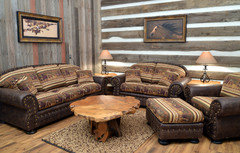
When I was growing up, if you bought a really cheap sofa it tended to look something like this: Robo posted this picture, but I had a college roommate who had this set, not because he liked it but because it was cheap:
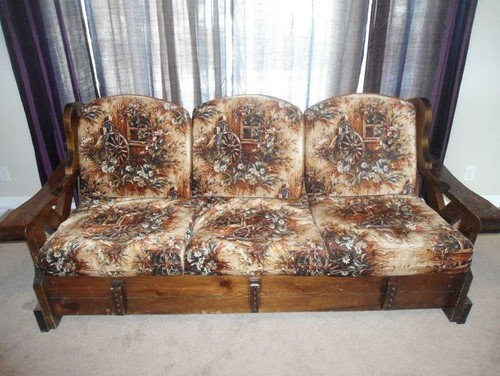
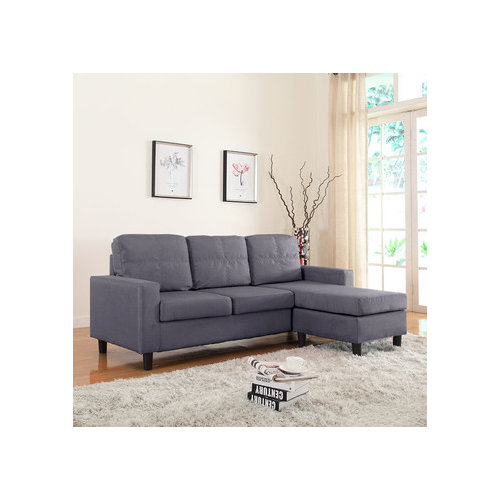
And now if you want a cheap sofa, you can get something like this: If you analyze it, it still looks cheap, and the sofa above is probably better made (structurally anyway), but the overall "look" of the sofa below imparts something that the one above does not. People aren't punished esthetically for buying cheap things nearly as much as they used to be.
Comments (38)
 10 years agolast modified: 10 years ago
I think most cheap items are massed produced to take advantage of current styles and trends. So if it is a particularly bad style period, the cheap stuff is going to reflect it. I think if you posted a Greek key pattern sofa from Walmart, it would be more in line with your oak monstrosity.
Related Professionals
Harrisonburg Interior Designers & Decorators · Petersburg Interior Designers & Decorators · Champaign Interior Designers & Decorators · Coldwater Interior Designers & Decorators · Trenton Interior Designers & Decorators · Yuma Interior Designers & Decorators · Palm Desert Interior Designers & Decorators · Carson City Interior Designers & Decorators · Athens Kitchen & Bathroom Designers · Rocky Mount Kitchen & Bathroom Designers · Cherry Hill Kitchen & Bathroom Designers · California Furniture & Accessories · York Furniture & Accessories · Peoria Furniture & Accessories · Rochester Furniture & Accessories 10 years agolast modified: 10 years ago
In addition, today you could probably buy the second sofa on credit with 0% financing.
I'm surprised the credit factor wasn't raised in the other discussion. A quick google search indicates I can buy a entire room of furniture from 3 different furniture chain stores near me for no money down, no interest for 5 or 6 years (one was only 2 years--I bet this increases at Labor Day).
palimpsest
Original Author10 years agolast modified: 10 years agoThey are apples and oranges. That's pretty much my point.
But both occupy the same price point to their relative periods. The grey sectional is about $350. You could buy a better quality but similar looking sofa for $3500. You could probably buy an exceptional but similar looking sofa for $35000. (of course it would be more refined, but it could be a grey sectional with chaise)
So there are relatively stylish looking sofas at very low price points. I don't think this choice existed in 1980.
If this sofa cost $99 in 1980 people were not paying $990 for a high quality sofa with kitsch wagon wheel upholstery, and they certainly weren't paying $9900 for a highly refined sofa with kitsch wagon wheel upholstery and chunky wood arms.
You can buy an ugly cheap sofa in 2016, but I don't think you have to. But in 1980 I think your options for cheap but stylish were much more limited.
 10 years ago
Having been poor in the 1980's, I can attest to the limited selection of cheap and stylish options, which is about when I discovered IKEA . . . it's quite different now, there are lots of options for the cheap stuff now, for the nicer, higher end . . . not so much. And there seems to be very little in between, which is my favorite price point.
 10 years ago
Sorry, if I had to choose, I would take the first. The second is awful IMO. You could recover the cushions on the first, but you could never make the second comfortable.
 10 years agolast modified: 10 years ago
If that's the set we had when we first married (we're not together any more), then you'd HAVE to recover the cushions because the fabric was really cheap "velour" that felt prickly. And cushions were highly uncomfortable. So by the time you replace the cushions and recover the sofa, it's no longer cheap. It looks exactly like that and it was the late 80s/early 90s, so I'm sure that's it.
 10 years ago
I agree.... lots has changed in the home decorating world in the last 30-40 years(time I can speak with experience about).
When I got married and bought our first house in 1983, there was no HGTV, no internet(so no wayfair, overstock, etc), no homegoods stores. Our house was in the NYC far northern suburbs, no we didn't exactly live out in the sticks. The choices for furniture and decorative accessories were very limited. You had expensive furniture stores or really cheap furniture stores. The cheap stores had couches like the first one above. Oh... there were department stores like Macys and Bloomingdales near me. They were also above the normal newlywed, newly out of college price range. There was always the sears and montgomery ward catalogues.
We were lucky... my husband had a coworker who was recently divorced and paying rent on an apartment full of furniture. We picked up LR, BR and DR furniture for a song.
palimpsest
Original Author10 years agoI can't attest to the comfort of the second. It seems like the cushions would start to deteriorate under use pretty quickly and there is probably a lot of cardboard under there.
But it has a certain trendy "look" at a glance, anyway, that emulates more expensive sofas. The wagon wheel doesn't emulate expensive sofas of the day.
I don't remember sitting on the one in the apartment very much, first off when I sat on it I think my feet went straight out. I remember sitting on the floor a lot in that apartment, with my back against the seat cushion.
Before the Martha Stewart era of K mart, there was little that emulated more expensive goods. The most common sheets sold at Kmart before that were apparently emerald green, dark maroon, and brown. Why?
Apparently it was a way of emulating the rich. During the same period the most popular colors for Jaguar, Mercedes and other luxury cars were emerald green, dark maroon and brown. I read this somewhere, it may not be true.
 10 years ago
"People aren't punished esthetically for buying cheap things nearly as much as they used to be."
You made me laugh. You're right!
palimpsest
Original Author10 years agoNot to overly belabor a point, but there is the above sofa at about $350,
This West Elm (and similar at Room and Board) for $2300

This Restoration Hardware one that comes in grey for $4700

And this Vallone sofa at $18,000. This is obviously different, but if I looked hard enough, and at places like B&B Italia, the prices could go up and up for things that on the surface have the same sort of stylistic roots: Okay this one isn't really the best example.
But call Robo's wagon wheel sofa 1980.
To be fair, I did find this Ethan Allen Jacobean Oak sofa, and I think that was still in the lineup in 1980. But even going from Wagon Wheel to this relatively modestly priced sofa of the period, there is a fairly big stylistic leap especially if you put better fabric on it.

This is more of what was going on around 1980 in the high end traditional-leaning sofa market
And this in the more transitional market (Milo Baughman) : And this in the casual wood framed market (Tobia Scarpa)
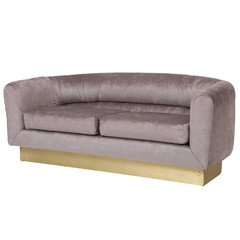

I am really trying to find anything at the upper end of the market that closely resembles that wagon wheel sofa: where that may have originated in a higher end design, and you just can't That is in contrast to the currently available cheap $350 sofa that is essentially a knock off of something more than ten times the price.
 10 years ago
I agree with you, Pal. And this brings up something I wondered, even as a child . . . why are so many cheap things UGLY? For example, fabric-- I understand that the feel and durability wouldn't be there, but why does the pattern have to be ugly? The cost to design a pretty vs ugly pattern would be the same, no? Surely there are enough talented designers out there who work at all salary ranges. I think this is improving now but it's only recent.
palimpsest
Original Author10 years agoI think to some extent that overwrought or sort of ugly things appeal to people at the bottom of the price structure.
Now that sheet vinyl no longer appeals to large percentage of people it's harder to find a pattern that is just sort of plain and attractive. There are some really kinda ugly sheet vinyls out there. In the late 50s and through the 60s when even high end designers like Billy Baldwin and Dorothy Draper were putting vinyl in Manhattan apartments and high end hotels, there were some really nice patterns.
If you look at real estate at the low end of the market you will see houses that are decorated in a purposeful manner that would be considered really ugly by people higher up on the price structure. It's not just that it's cheap and they can afford it, it's marketed to them because that's what they like.
Ironically at the very top of the price structure you see a lot of ugly overwrought design as well.
 10 years ago
I just watched an interesting local TV show "Chronicle" which featured a new antique section recently added to the Boston Design Center. One of the dealers interviewed said that there is a high demand for high quality antique pieces. Maybe it's a regional demand, given the historic nature of homes here. I plan on going in person, but doubt I will be able to afford anything. Anyway, take a tour.:
palimpsest
Original Author10 years agoI am not sure what the parameters are for high quality. I know that first period Federal furniture commands astronomical prices ($8M for a piecrust table, hundreds of thousands for pristine highboy chests), but there are a lot of fairly unremarkable first period antiques in the Philadelphia area, nice enough but wobbly, damaged, drawers that stick etc., and it's just not practical if you actually need to use it. This does not command very high prices.
- 10 years ago
"high quality antique pieces"
In the other thread, high-quality antique pieces needed custom glass tops to ward against use, regular waxing/wood treatments, and polishing. If they are so high-quality, why can't they handle day-to-day use?
The frame of the wagon-wheel sofa doesn't need such white-glove treatment. Sure, it's ugly as sin, but it could handle a family of 5 and 2 dogs. Most of the "high quality antique pieces" aforementioned would be off-limits to children and pets.
- 10 years ago
Good thesis but I don't know...
Here's something current as cringe worthy as the wagon wheel couch. Rich people buy this stuff for their Dakota "ranches." Maybe not this exactly.
I think the Ikea of yesteryear were all the Danish furniture places. I tried to reupholster a piece one time and it literally fell apart. Cardboard...check. But the stuff had the look oforward the higher end pieces that go for tens of thousands today.
Then there's the ubiquitous brown bonded leather puffy sofa/recliner/cup holder. I don't see its doppelganger in Mitt Romney's LA Jolla beach house.
But yes, it's an interesting problem to ponder.
- 10 years ago
And why aren't craftsmen making federal furniture if there's a demand? There's only a demand for the actual antiques? I would be very happy with a copy as long as it was good wood and the same skilled craftsmanship. No wobbles,no sticking drawers. It's like when the old pieces were new for the first owners.
- 10 years agolast modified: 10 years ago
Kittymoonbeam, some craftsmen can meet local demand with the right workmanship and word-of-mouth. But by the time a large-scale trend demand has been identified, the big manufacturers have laid claim and met it with large-scale production.
There's a certain romance with antique pieces that have withstood the test of time because they were treated as fine furniture. But a young family that buys ikea-type furniture and uses it on a daily basis bemoans the quality of ikea. We judge furniture by its perceived craftsmanship, not by how we use it.
In my house, I have both inherited furniture and furniture that we have purchased for ourselves. It's easy to get caught up in praising granny's chest of drawers because I'd never let my kids touch granny's chest of drawers.
 10 years ago
I think we have more mass production and cheap labor overseas to thank for the plethora of cheap items available today.
Twenty years ago, there was a store called "Furniture Mart." We were young and broke and a lot of our friends and family went there to get cheap furniture with 0% financing. My BIL bought a sofa there, and it started popping seams and cushions lost their shape within four months. 10 years ago
While we debate how well some of this older stuff is built, I think we should consider if some of it is still in "good" shape because it was so uncomfortable to start with (we helped a tenants toss that first couch a few months back I think) and my 1990's cheap couch had plenty of cardboard, rough upholstery and probably formaldehyde too
 10 years ago
The furniture that JN3344 posted above regarding Dakota ranches makes me think of the 80s country blue with geese and girls in poke bonnets. If one is really in the country, you shouldn't need fake motifs to create the setting. Same goes for ranch houses, beach houses, wagon etc.
palimpsest
Original Author10 years agokittymoonbeam
You can buy Federal period reproduction furniture being made in the 21st century. It's beautiful stuff and sometimes almost as expensive as the original.
Someone brought up the cup holder sofa. I agree that's probably the wagon wheel sofa of today. But I think today you are more free to Not buy something like this because that's all that's available at your price point.
 10 years ago
I agree that today's cheap decor is much more attractive than cheap decor used to be.
I think there are a few reasons. One, with the popularity of design shows and magazines, people's taste have been elevated and they have also come to value design more highly I believe. I recall when I was doing my kitchen and trying to decide on marble, I saw a show in HGTV where a mail carrier was looking at a home that they declined, because they insisted they really wanted marble kitchen counters. With all due respect to mail carriers, this person's price point was at the opposite end of the spectrum from mine, but we still wanted/expected the same thing.
I also think that women's greater economic power is part of the shift. I think men used to exercise more dominance over large purchase decisions, and that is what brought us cupholders in sofas, built in barcaloungers, heavy crude wood and awful dark prints. Not all men, mind you. : )
 10 years ago
Not only have design shows, blogs, magazines, and certain retailers elevated taste, but they've homogenized them a great deal as well, to the point where everyone and his brother wants/expects stainless appliances and granite (now marble I guess) countertops, or that West Elm/Kinfolk aesthetic. More than 15 years ago, it was the Pottery Barn apothecary table, as made famous on the Friends episode (which was in fact sponsored by PB, if I recall correctly).
I'm considering formica for our new house countertops and everyone from my sons on up thinks I'm out of my mind, because granite is considered the new "minimum" for a new house. Whereas I like the price point, practicality (I've never broken a glass setting it down on formica), and 20+ years of experience I've already had with the stuff.
I have a good deal of Kittinger (which is still going strong), Henkel Harris, and Kindel, inherited from my parents who bought it new in the sixties and seventies, mixed in with some antiques and Ikea. We have great-great granny's Hoosier, refinished by granny, and it gets regular use and was never off limits to the kids.
That said, we use everything, including the "good" china (Spode), which is our only china, but we also have a decent minimum standard of care, which I don't consider babying. It's the way my siblings and I were raised and how I raised my kids. Coasters, no feet on the coffee table, etc. I like my things, I don't want to keep replacing them, and I'd rather spend that money and time on other things (like travel and a new house). I also like the fact that my eclectic mix means my house doesn't look much like anyone else's, which won't hold if I have to start replacing my stuff with mass market purchases.
- 10 years agolast modified: 10 years ago
I have complained before about formica. I dearly wanted aqua linen formica in my beachhouse kitchen, after I saw it featured in a magazine shoot of an old house in Nantucket. Formica does not make anything like that anymore; they mostly make Formica that imitates other materials!
- 10 years ago
They've brought back the boomerang, at least in grey : ) . I haven't bought formica in 20 years or so, so not sure what to expect, other than I'm happy to hear about the new IdealEdge, which gets rid of the detestable brown seam.
Considering I'm also thrilled by my wood-look vinyl plank flooring, I'm probably in no position to complain about formica that looks like linen!
- 10 years ago
tell me about your flooring? A few years ago when i was looking for b/w checkerboard tile I came across armstrong vinyl wood look that I really liked, but had no use for. Im not considering it for my carriage house studio now. Its that or painted wood floors in a celadon.
- 10 years ago
Five or so years ago when we did our dining room addition to the kitchen (yes, we are peculiar dining room people) we replaced the horrid, cheap vinyl sheet flooring (chosen by my husband before we met, and which always looked dirty and dinged very easily, especially when three little kids were in their can stacking stage) with Home Depot's Trafficmaster Allure vinyl planks, in hickory. I love it. I think consciously every morning and evening as I sweep it, "Oh how I love you" : ) . It just needs light mopping for easy cleaning, and still looks good. It has scratched in a few places, but it's not obvious. We had an elderly English friend, who lives with Georgian antiques, get down on his hands and knees to touch the floor when I told him it's vinyl. I wasn't looking for vinyl to masquerade as something else, just for something nice to look at daily. And I'll admit that having grown up in a prewar apartment with hardwood flooring, I'm accustomed to the look of wood.
We were going to go with hardwood for the new house but have been so impressed with the cost and maintenance of LVP. The scratching is why we're going with Karndean for the new house. The flooring place showed us Armstrong, which is supposed to be good as well, but we've seen the Karndean in a commercial installation nearby, and we live in the country on a farm, with a construction business as well, so tougher is better for us.
PS I chose b/w checkerboard tile for my laundry room 20 years ago and would never do it again lol. The white tiles showed ALL the dirt, and the black tiles showed all the lint and fluff.
- 10 years ago
Do not get Formica
Once you use granite (or similar, i.e. quartz) you'll never want to go back.
- 10 years ago
MtnRdRedux, if you're still looking for a Formica type counter, check Wilsonart. We used it when building out our office buildings. They used to have a linen look I used for kitchenettes. I also had it in a vacation home and it held up nicely.
- 10 years agolast modified: 10 years ago
I have wilsonart in the laundry. They have thousands of selections. I didn't see the linen finish. I know exactly what that used to look like, too.
 The second one is called Aqua Brush but looks more turquoise to me. The color is too saturated without the "linen" effect.

Anyway, back to the op, maybe we can blame the Internet.
palimpsest
Original Author10 years agolast modified: 10 years agoOverall, a big factor has been media saturation.
At one point, most people probably only knew what their neighbors' houses looked like. People who bought decorating magazines had some idea of what was going on in the country at large, but I don't think circulation of the higher end magazines was particularly high, and there was not anything on television like there is now.
I have a collection of Architectural Digests from the early 60s related to the era of my house and it came out 4-6 times a year, and the prescription was very expensive. I figured it out one time in 2016 dollars and I want to say it worked out to the equivalent of $20 an issue or something like that.
On top of it, although the houses featured were of well-to-do people and featured well-known decorators and designers, the houses were much more modest than those featured now and there was no real celebrity presence to speak of. (But still Rolls-Royce was a regular advertiser to readers).
So the target market for arguably the highest end design magazine of the day was the same as the people who got their houses published, essentially.
The median household income of the reader of AD at this time is $108,000.
The median household income of the owners of featured properties is what, probably ten times higher?
So sure, the average person is seeing a higher level of design, and is actually surrounded by it.
I grew up in a small town three hours from a major (actually a minor) city. But a city with things like department stores. I had been born in that city and we traveled there regularly. When I was in high school I had several pairs of pants and some shirts from Izod. This is before Izod and Lacoste split. So they had the alligator emblem embroidered on the chest or pocket and on a belt loop of the pants.
People thought I was wearing Garanimals. There was no brand recognition at all for anything "designer" at all. Most of my clothes, and everyone else's were from Sears. Now everyone has brand recognition of everything.
- 10 years agolast modified: 10 years ago
In 1965 CEO to worker pay ratio was 20:1. In 2013 the ratio was over 500:1. In what would become the Rust Belt, the CEO drove a Cadillac and a worker might drive an Impala. Virtually the same car back then. Different trim and accessories.
AD moved from the actual architecture to more interior design and celebrity showcase in the 80s.
I don't know where kitsch comes into this. The prints of the "big eyed children" or the dogs playing poker tapestry seem to be gone. The various fake wrought iron accessories don't seem to be on the same level. Maybe the mall paintings like Thomas Kincaid. The 90s ducks. But again, somewhat elevated all things considered?
If you look at Archie Bunkers house in Queens versus George and Louise Jefferson's place in the sky in Manhattan ...not that much different inside. Now if you want to show someone on TV that has made it...wow...a 25 million dollar duplex or something. And the janitor would live in a roach infested SRO.
 10 years ago
Haven't read all the comments, but I think the trend of low-cost but decent design merchandise took off with Target's business model. Target started the "low price doesn't have to mean ugly" trend, to where even Walmart changed its merchandise and its store layout to make them look cleaner, less cluttered and more design-conscious. You see something similar in the Old Navy/Gap/Banana Republic type of same parent corporation with trendy merchandise at different price points. Anthropologie/Urban Outfitters too. A generation or two ago, businesses would not own a low cost affiliate for fear of losing prestige. Anyway, I am no business guru, but I think the business model and the lack of stigma with low cost options started with merchants like Target that started with the mission of making fashion and design accessible. I could be completely wrong.
- 10 years ago
I'm guilty of writing "formica" recalling the countertops of my youth, but meaning laminate in general, living as I do in the land of Arborite. Speaking of which, Arborite (Canadian) has Sky Tulle, if that's an option. Also, Retro Renovation did a post the other month on currently available laminates, which might have some other possibilities.
pal, my Sunday morning coffee barely survived your Garanimals story.
palimpsest
Original Author10 years agolast modified: 10 years agoRe: the Garanimals:
Since there was no brand recognition, I wasn't wearing them to impress anybody, either. I think what happened is that my dad went to a meeting there by himself, instead of the three of us going, and my mother said "he needs some good pants and shirts for school", and my dad walked into the boys'department of the department store we normally went to and got steered to the Izod-Lacoste. And normally for school I would have gotten Sears or JC Penney, but at that time I seem to remember it took weeks to get things sometimes.
I think the whole thing is a double edged sword. On the one hand consumers at all levels have exposure to better designs, but on the other hand 50 years ago the worker did not want or have the expectations of having the identical consumer goods of the CEO who made 20 times the salary. (Even though the goods between the two groups were probably more similar)
Now the worker has expectations and covets the same goods that the CEO who has 500x the purchasing power has. (Or the illusion of the same goods.)
- 10 years ago
Pal, those were some mighty fine duds for the day. When I was in junior high, the Ralph Lauren polos were just gaining popularity in my area. We were only about 20 minutes from the nearest mall but my family was large and our clothing budget was lean. (My mom sewed most of my clothes until I was in middle school.) At the time, the style was to wear two polos, one over the other, in contrasting colors with the collars flipped up. I remember bargaining with my mother to buy me a few RL Polos if I agreed to wear a generic brand underneath.







User