Software
Houzz Logo Print
patrick_clark40

Central Florida St. Augustine Lawn Help

10 years ago

I'm a recent first-time homeowner, so at this point I'm not really sure what I'm doing and don't want to destroy our lawn.

I purchased Milorganite, a Weed b Gon hose sprayer (that I'll be waiting to use until it's not 90+ here every day) and Bayer Complete Insect Killer. I've noticed some gray leaf and there are some minor brown patches. Is there a recommended fungicide?

My main question is what order should I use everything in? Can I use the Milorganite at the same time as the insect killer? And when would the fungicide be best used if I'm using the other two?

Thank you!

Comments (9)

  • 10 years ago

    I have the sprinklers set up to do 1 inch once a week.

    I'm sure some of the problem can be attributed to the vacant lots that are currently on either side of the house, but there are some leaf spots throughout the lawn.

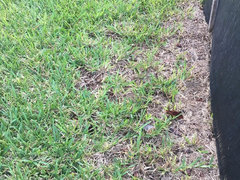
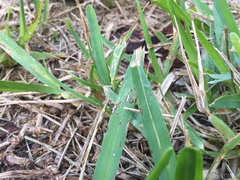
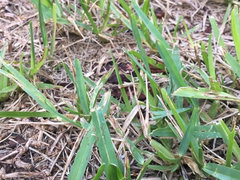
    Here are a few pics of one of the areas in question:

  • 10 years ago

    What's on the other side of the construction barrier? Just dirt? is it possible that grass right there gets hardly any sun (maybe between the shade of a tree and the barrier)? Is that dead patch in the picture spreading? Are your other problem areas next to a barrier? There is some leaf spot looking marks, but honestly I've seen worse in my own yard without any issue, but each yard is different and maybe there is also a different fungus at work. Maybe someone with more knowledge will chime in. Did you check for chinch bugs? See a lot of moths in the lawn? Any caterpillars?

  • 10 years ago

    See the tan colored spots with the dark brown edges? Those are fungal disease spots. That's what's taking out your grass.

    This should respond to ordinary corn meal if you have not already applied a fungicide. Call your local feed stores to find it in 50-pound bags. If they don't have it you'll find corn flour at any grocery store in FL and especially those that cater to the Hispanic population. If you get it at a grocery store there are different products packaged in very similar bags. You don't want the stuff that already has baking soda/power in it. Apply at the rate of 20 pounds per 1,000 square feet. Apply to the entire lawn or else you'll have green spots. Corn is a fertilizer.

    The reason corn meal works against fungal disease is through the decomposition process a predatory fungus takes over the final stages. Once the predator finishes with the corn meal it takes over killing the disease fungus in your yard. This is a biological process that takes about 3 weeks. You can apply in the heat of summer or whenever you feel the need. During the 3 weeks you should see new grass coming in but it might still get the spots. After 3 weeks the new grass should not get the spots.

    Most people in FL are watering wrong - at least the ones writing in here report that everyone waters every day. That's wrong. Here's more.

    Watering: Deep and infrequent is the mantra for watering. This is for all turf grass all over the place. Deep means 1 inch all at one time. Put some cat food or tuna cans around the yard, and time how long it takes your sprinkler(s) to fill all the cans. Memorize that time. That will be the time you water from now on. My hose, sprinkler and water pressure takes 8 full hours to fill the cans. Your time will likely be less. I like gentle watering. As for watering frequency, that depends on the daytime air temperature. With temps in the 90s, deep water once per week. With temps in the 80s, deep water once every 2 weeks. With temps in the 70s, deep water once every 3 weeks. With temps below 70, deep water once a month. Note that you have to keep up with quickly changing temps in the spring and fall. This deep and infrequent schedule works in Phoenix and in Vermont, so it should work for you. The reason for deep and infrequent is to grow deeper, more drought resistant roots and to allow the soil to dry completely at the surface for several days before watering again. If it rains, reset your calendar to account for the rainfall.

    Patrick Clark thanked dchall_san_antonio
  • 10 years ago

    Thank you! So if I'm putting down the corn meal and it's a fertilizer, should I nix the Milorganite for now?

  • 10 years ago

    You can do both. With organic fertilizer the amount you put down is much less important than if you were to use chemical fertilizer. It's hard to over do it. Milorganite has a bit of an aroma, but so does corn meal if you're not on an organic regimen. At least it's not maneury.

  • 10 years ago
    last modified: 10 years ago

    I was reading some of your other comments and I'm surprised you can get it so cheap. I called around and I'm being quoted at $40-60 for a 50lb bag!

  • 10 years ago

    I ran into the same problem when I first started looking for certain organic material. I could only get food grade corn meal from Winco and it was costly.

    I started over again looking at local feed stores but changed my terminology. I asked for "corn chicken feed" or "finely cracked corn." The simple request change got better results from the exact same places. I was able to source it for less than $12 / 50 lb.

  • 10 years ago

    The watering advice above should be treated as a goal. While working towards it you still need to water soon after 1/3rd or so of the lawn shows signs of draught stress.