Software
Houzz Logo Print
deegw

Advice for my shrinking table

9 years ago
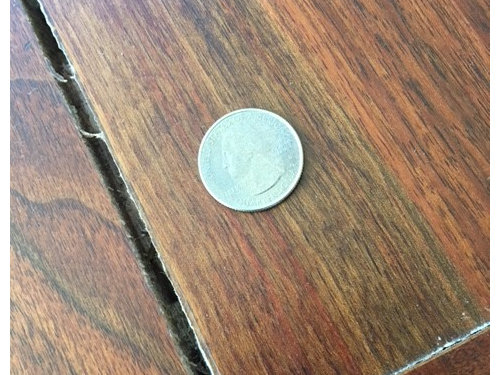
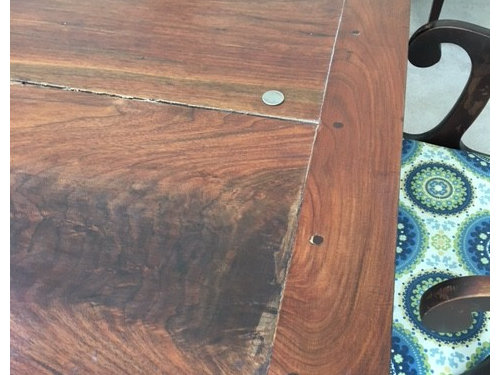
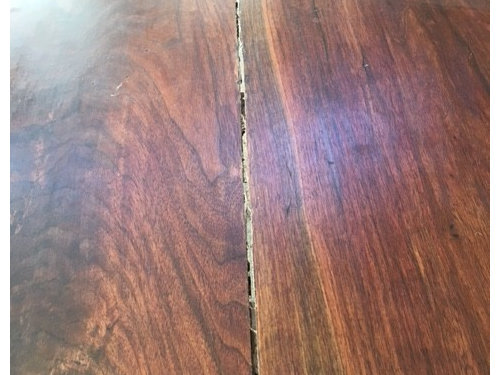
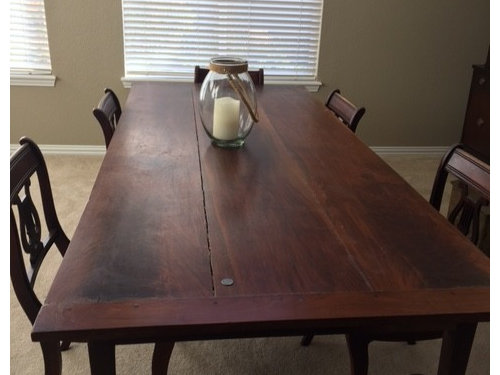
We recently moved from a humid island in SC to very dry Denver and have been here about three months. One of the boards on our dining room table is really shrinking. Any advice about what we can do to make it look better and fend off any potential damage, The boards are old walnut but the table is only about five years old. Thanks.

Comments (17)

  • 9 years ago

    Could it be glued and clamped?

    deegw thanked grapefruit1_ar
  • 9 years ago

    Disclaimer: I am far from a woodworker! Amateur opinion: I don't believe you can do anything about the wood shrinking in low humidity unless you install a humidifier. I believe your culprit that is separating the glue joint there is the pretty crossboards at each end of the table that are holding the boards in place at their pre-shrinkage width and therefore encouraging them to come apart. If you feel it is worth it, you may be able to redo the ends to allow for shrinkage.

    http://www.thewoodwhisperer.com/articles/do-they-know-about-shrinkage/


    deegw thanked robo (z6a)
  • 9 years ago

    It was not built properly. The breadboard ends should have allowed shrinkage. Of course, it was fine as long as you lived in a humid environment.....

    A woodworker needs to build with humidity changes in mind.

  • 9 years ago

    So gregbradley, do you have any advice or suggestions?

  • 9 years ago

    I would post the question on sawmillcreek.org and you will get far better suggestions than I could give. If for some reason you don't want to join, even though it is free, I will post your picture and ask the questions for you.

    Most of this country has to deal with seasonal humidity fluctuations. I live in SoCal, where the humidity is naturally low, so I don't have to deal with fluctuations. Most have high humidity in the Summer and low humidity in Winter, where heating makes the inside humidity ultra low. I do know local furniture manufacturers that have to worry about this since they build for designers all over the country.

    I assume it will have to be rebuilt. If the drawbore pegs are part of the desired design, that should be able to be accomplished as well.

    deegw thanked gregbradley
  • 9 years ago

    I'd like to start by saying it is a wonderful table and deserves to be saved. To fix it right it will have to be partly dismantled. That being the case it might make sense to farther disassemble,depending on wherther there's other problems that just haven't shown themselves yet. To get started,how long has it been in Denver? I would give it a minium of 12 months to dry before doing any permanate repair. Meanwhile scraping that caulk out and filling gap with dark wood filler will make it look much better. The end board (breadboard) must be removed. Possibly all that's holding it is screws concealed beneath those plugs. If it is glued,the ends will have to be sawn off and new t&g cut. Boards on both sides of gap must be jointed and reglued. Some will say boards should be dowled,t&g or biscuited but I would only edge glue. Here's the part where you prevent reoccurance of split. If screws were holding it origionally,just clean up the t&g then re-use because the joint does not need to be tight. Slots in 3 boards alow screws/bolts to slide as boards swell and shrink. That's the method,if you are a woodworker and want to tackle it,we can walk you through details of procedure. If you plan hireing it done,let's don't waste time telling you what to tell the repair person,they will use their own technique.

    deegw thanked klem1
  • PRO
    9 years ago

    If you fix it now, by late january it could be just as bad again. Wait several more months until you know the limits of shrinkage have been reached.

    deegw thanked Sombreuil
  • 9 years ago
    last modified: 9 years ago

    Thank you to everyone that gave constructive advice. It certainly makes sense to wait until the driest part of the winter before we try to repair the table. Would it be okay to use filler to cover the gaping seam until we figure out how bad it will get?

    BTW, the price of the table was MUCH less than the comparable size at Ethan Allen or Pottery Barn. It may not be a perfect table but we supported a local craftsman and recycled old boards so we are pleased with our purchase and get many compliments about it. You can see a photo of the man who built the table on the company's home page.

    Links - Island Sea Design and Two old guys

  • 9 years ago

    Beautiful table. IMO, If it was mine, I would carefully remove the glue and leave alone until it stops shrinking. Then, have a woodworker in your new area redo the top. You could use placemats or a runner if the crack bothered you for dinners. Another option would be to get a glass topper for the table and leave the crack. That would look like the cracks were intentional.

    deegw thanked Sherry8aNorthAL
  • 9 years ago

    Same problem here (maybe not as severe). We moved from TN to NM. Someone suggested Howard's Feed and Way. I do gob it on and leave it for about an hour, but it has really worked well for me.

    deegw thanked cooper8828
  • 9 years ago

    You've gotten some good advice here, the long boards need to be free to move inside the breadboard ends and with respect to the table base. The table top could change width by upwards of a half inch on a seasonal basis. The breadboard ends should only be firmly attached in the center of the table; the ends of the breadboard could use dowels in slots, with no glue. The table top should be secured with screws in slotted holes or another system that allows expansion and contraction. It's a very nice table and well worth fixing.

    Please don't make the repair person's life even harder by putting anything into the gaps.

    deegw thanked rwiegand
  • 9 years ago

    I am sorry this happened to your beautiful table. The only thing that would really bother me is the lighter glue. I would try to scrape that and not worry about the gap.

  • 9 years ago

    Use a dark brown caulking (one that is a little darker than the wood) and then sand it down.

  • 9 years ago

    Oldiesmom,did you ever try to sand caulk?

  • 9 years ago
    last modified: 9 years ago

    I would not put anything in it , let it continue it's natural climate adjustment . When you think it's ready contact a woodworking specialist and determine what type of fix is acceptable to both of you . Price will vary depending on the choice . If you are bothered by the crack get a runner that is wide enough to cover it . I would definitely contact the guy that made it and talk to him about it . He would probably be able to tell you how it's made and might appreciate knowing his tables might be designed a bit differently .

  • 9 years ago
    last modified: 9 years ago

    I'd suspect the breadboard edges aren't attached properly and that caused the problem. My very first woodworking project was a small table with a breadboard top. I made a prototype first and for silly reasons I don't remember glued the breadboards. A few years later the top cracked, it sounded like a gunshot!

    As others have suggested, I'd give it a full year to acclimate to your new environment and then make repairs. Unfortunately, the only proper repair will be to cut the table apart. You'll loose a little in width and a 1½" or so in length but that would be a lot better than gobs of wood filler. Until then, use a nice table cloth as anything you put in the joint will just have to be cleaned out later.