Software
Houzz Logo Print
hzdeleted_35406546

Succulent propagation help!

10 years ago
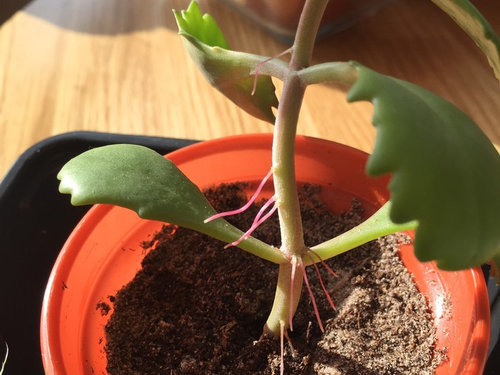
Hello,

I took a cutting from the top of what I believe to be a Kalanchoe of some sort a few weeks back. After letting the end callous over, I reported it and wrapped it in cling film for just over 2 weeks. I've just unwrapped it and noticed that although there are roots in the soil coming from the base of the cutting, there are also roots coming out of the stem.

Does anyone know what has happened and what I should do? I was wondering about removing the lower 4 leaves and putting it in a deeper pot.

Thanks very much,

Merri

Comments (5)

  • 10 years ago

    Merri

    Yes, it is Kalanchoe. Did you wrap the whole pot with the cutting in it in cling wrap? It is not necessary with succulents - they do not need extra humidity. It was likely too humid for it, that is why it grew aerial roots. These plants (and some others) will grow them, sometimes it indicates things plant could be without - like too much humidity. Good you didn't keep plant too humid for too long. You can just leave the roots as they are, they may eventually dry and wither.

    You should add more potting mix into the pot, the plant sits too deep inside of it. I can't tell what you used for potting soil - is there sand in it?

    Succulents should be potted in well draining mix. Sand usually compacts and interferes with drainage. You should be adding lots of perlite to improve it, but first pls. tell us what the soil is.

    Succulents may develop all kind of fungal diseases if kept in very humid environment.

    The plant also seems to need more light - plant seems to be bending toward source of it. Kalanchoes will grow taller than many other succulents, but stems should become sturdy enough so they don't 'droop'.

    User thanked rina_Ontario,Canada 5a
  • 10 years ago

    Hi rina - thanks for the response!

    There is indeed some silver sand mixed in with the compost (about 30%). I was advised to add this by the guys in my local gardening centre over adding anything else.

    As for the light, I'm aware of the problem but this succulent and my others are in the sunniest part of my flat - unfortunately, this is the best they can get here

  • 10 years ago

    Many kalanchoes grow aerial roots naturally and it is not dependent on humidity or light. You shouldnt remove the 4 bottom leaves and plant it deeper, because when it does grow taller, it will simply grow aerial roots again. If it really bugs you, you can cut off the roots with no horrible health effects.

  • 10 years ago
    last modified: 10 years ago

    Merri

    I do not know what is 'silver sand' - so many different names are used...I was referring to a fine sand - if it would be sifted out using a insect screen, it is most likely too fine. If it has larger grains, it could work. There are ppl that use sand to grow cacti - but IMO, they really understand the plants needs, have experience and have perhaps more suitable environment to grow them in than most of us (like glass hosuses and similar)

    I agree with Garrett's advice of not cutting the leaves off, and he is correct that aerial roots are quite common on kalanchoes. Some succulents grow so many, they look like a beard - see Adromischus cristatus (photo from net):


    I posted that ...These plants (and some others) will grow them, sometimes it indicates things plant could be without... There are many other reasons these roots grow - I didn't want to go to extensive explanation why as many of these plants are not succulents.

    From Encyclopedia of Life Sciences:

    The root system of a plant is composed of the primary, lateral and adventitious roots (ARs). Lateral roots always develop from roots, whereas ARs form from stem or leaf‐derived cells. AR formation is part of the normal development of the plant and occurs naturally, like in most monocotyledonous for which they constitute the main root system or in many dicotyledonous species that propagate vegetatively. Adventitious rooting is an essential step for vegetative propagation of economically important horticultural and woody species as it allows clonal propagation and rapid fixation of superior genotypes prior to their introduction into production or breeding programmes. Development of ARs is a complex process that is affected by multiple endogenous and environmental factors, including phytohormones; light; nutritional status; associated stress responses, such as wounding; and genetic characteristics.

    Key Concepts:

    • ARs are the main root system for monocots.
    • ARs are an adaptative response to environmental changes.
    • ARs are required for vegetative propagation of plants.
    • ARs arise from any organ of the plant but the root.
    • ARs originate from different cell types depending on the organ or the species.
    • ARs can be induced by ECMs or Agrobacterium rhizogenes.
    • AR development is controlled by environmental factors.
    • Adventitious rooting is an age‐dependant process.
    • Auxin cross talks with other hormones to control adventitious rooting.
    • Adventitious rooting is a complex quantitative genetic trait.
  • 10 years ago

    Wow, super detailed answer! Thank you again. I'll see if I can get my hands on some perlite to be on the safe side.

    A succulent with a beard seems like a very novel idea...!

Sponsored
AIS Renovations
Average rating: 4.5 out of 5 stars15 Reviews
Custom Craftsmanship & Construction Solutions in Franklin County, Ohio