Software
Houzz Logo Print
rwcw34

Outdoor lamps

10 years ago

I am making outdoor sconces. I want to take them inside in harsh weather. I'm in need of a small connection of the wires that will fit in a 2 inch box that is also shallow; again, it must have an easy disconnect. Any ideas

Comments (22)

  • PRO
    10 years ago

    Without know exactly what type of outdoor sconces you are talking about it is impossible to recommend a box that may work for you? Any box that is exposed to the weather needs to be weatherproof rated. As for your small connection of wires just how many wires are you referring to? And how many lights are these wires feeding? As for easy disconnect of these wires and boxes once again will they be exposed to the weather?

  • PRO
    10 years ago

    Fixtures and wiring that are weather proof can be temporary quick connected by twist lock and cover plated with off the shelf designed products. The wattage and voltage requirements tell the story of the required materials needed.

  • 10 years ago

    I'd recommend making your outdoor sconces able to handle harsh weather. Otherwise, I wouldn't call them "outdoor" sconces. They'd be indoor ones.

  • 10 years ago
    last modified: 10 years ago

    DB, can you explain how are you going to weatherproof a quick connect and also allow a light fixture to physically connect to it. How is this quick connect going to stay waterproof with said light fixture connected.

  • PRO
    10 years ago

    Vlth follow this link https://youtu.be/8V9FYi87ENs SOOW Flexible Cords are designed for extra hard usage on industrial equipment, heavy tools, battery chargers, portable lights, welding leads, marine dockside power, power extensions, and mining applications. SOOW Flexible Cords are rated for temperatures -40°F (-40°C) to 194°F (90°C) and is also UL® and c(UL)® listed for water resistance.

    • 14-4

    • 15A, 600V

    • Indoor/outdoor

    • Sunlight, Oil, Water, Flame, Ozone and Abrasion Resistant

    • Flexible copper stranded conductors are insulated and cabled with fillers.

    • Insulation is heat, moisture, and oil resistant EPDM rubber.

    • Jacket is black heat, moisture and oil resistant flexible CPE extruded over the entire assembly

    • Wet or dry locations

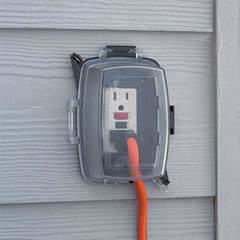
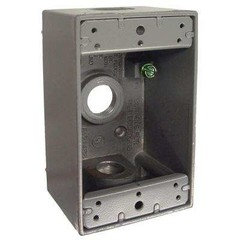
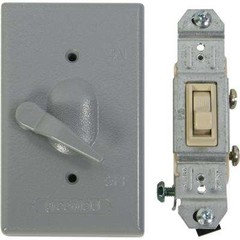
    • There are varieties of connectors for SOOW cable that are also rated for weatherproof use. Without having more information from the original poster rwcw34 and the type of lights (outdoor sconces) a proper weatherproof box would need adjusted to those needs. If going thru all this trouble I would suggest to just bury PVC conduit and use weatherproof boxes like the ones above. Weatherproof lights (outdoor sconces) are rated for outdoor use so why take them inside in harsh weather is beyond me? www.dbelectric.us

  • 10 years ago

    rwcw-

    Since you probably are not going to send these homemade sconces to Underwriters Laboratory for testing, this will be an intentional installation of a fixture that does not comply with code. If there are any problems in the future, such as a fire caused by the design of these fixtures, you could find yourself in difficulty with your insurance company.

  • 10 years ago

    I know in-use boxes exist (I have a few). We are talking about a wall mounted sconce are we not? I don't think outlets and extension cords are involved here.

  • 10 years ago

    The NEC requires installation UL-listed luminaires?

  • 10 years ago

    It is not commonly understood that insurance policies do insure against stupidity. There may be some language in them that excludes payout after some specific stupid practice causes a catastrophe. Note that if some stupid practice leads to injury or death of another party, you may go to jail if proven negligent.

  • 10 years ago

    2 hours ago

    "The NEC requires installation UL-listed luminaires?"

    In my experience, yes. It's like any other electrical component. But I'd be interested I'd anybody can show an exception for some reason.

  • 10 years ago

    Then all those antique chandeliers, and for that matter, any fixture that has been repaired at all (since the repair hasn't been checked and passed by the UL) is a violation and nullifies your insurance.

    As ionized said, insurance will not cover you if you tried to burn down your house (ie. arson) or maybe gross negligence. Installing a homemade fixture is neither.

    The UL listing is required for companies who manufacture and distribute fixtures, not homeowners.

  • 10 years ago

    The question still remains. Will a luminaire without UL inspection stickers trigger a failure in an electrical inspection in the construction permit, construction, inspection process?

  • 10 years ago

    Probably only if the inspector notices a fixture that is obviously not commercially produced. Who knows? Just pointed it out as a potential issue...

  • 10 years ago
    last modified: 10 years ago

    greg-

    Yes, but the tags are there to assure the homeowner is able to select code compliant fixtures. People can do whatever they want and it may not be a problem,,,until it becomes a problem.

  • 10 years ago

    kudzu,

    Yep... the sticker is just to provide information to the homeowner. Just like the ingredients list on food in grocery stores. The homeowner doesn't have to pay attention to it if they don't want to, but it might provide peace of mind. However, the manufacturers are required to put it there.

    If the homeowner baked their own cookies at home, they don't have to add an ingredient list to tupperware that they store them in. :)

    There are different rules for companies than individuals.

    ionized,

    My guess would be that if it was a new house that was being built to be sold after it's done, then it would have to have all fixtures with UL listing.

    But if it's a renovation (or maybe even a custom home) where the homeowner specifically is paying you to install a non-UL fixture, then it'd probably be okay. I have a hard time believing that an antique fixture can't be legally installed by an electrician. Granted there may be some culpability for the electrician to ensure that it looks like a safe fixture and he could obviously refuse to install something that he's not comfortable doing.

  • 10 years ago
    last modified: 10 years ago

    greg-

    People choose to do things all the time that don't comply with building codes, including not even getting a permit. I'm not telling people what they can and can't do. I'm fully aware that many people would not worry about whether a fixture is UL-rated, and that inspectors don't check every fixture for a UL sticker. All I'm saying is that, if you are installing a light fixture, it doesn't matter if it's new construction, a remodel, or a weekend project: if you want to do it legally, you comply with the code. There are all kind of electrical code requirements, and using a UL-listed fixture is just one of them. It's no different from all the other technical requirements for electrical work. I presume that you wouldn't argue that, if you were doing a rewiring project, it didn't have to meet code because it wasn't new construction.

    If you take a look at the link below, it may help explain to you that a UL listing has ramifications for electricians and homeowners...not just manufacturers:

    UL fixtures

    And this article explains the practical issues with vintage fixtures:

    Vintage fixtures


    I'm also not saying that, if a person doesn't comply with the code, something bad will happen. I'm just saying that, if there is a problem, like a fire, there could be ramifications if you had installed unlisted fixtures.

  • 10 years ago

    The first link is talking about ramifications for sellers and that it's necessary for manufacturers and distributors to get the UL listing. That's what I said.

    The second link also stated the same thing I did. Antique fixtures, repaired fixtures, etc aren't UL listed and they can be installed legally. I'd include home-made fixtures in that category.

    It's legal.

    I think the problem with our conversation is that we are equating laws with codes. They aren't the same. You break the law you can have issues with insurance (eg arson). You break a code you may just have issues with permits and I admitted that I don't know exactly what the rules are with UL listing and permits. In fact, your second link didn't give definite answers there either. Just anecdotal evidence that one electrician refused to install an antique fixture because of possible permit issues. But it also had other anecdotal evidence that lots of places do rewiring etc and don't bother with the UL listing.

    Homeowner insurance companies can't deny coverage after the fact because you broke a code or didn't get a permit. If they somehow find out that you did unpermitted work before there's an issue then they can cancel your coverage but not after the incident. If you had the fixture professional installed by an electrician, then it's possible that the insurance company may pursue the electrician's insurance for reimbursement if they can prove that he should have known better. They'll try to shift the blame where ever they can but the bottom line is that they can't deny your claim. They can't shift the blame to you unless you broke a law.

  • 10 years ago
    last modified: 10 years ago

    If that is how you want to interpret the info I provided, then please do. Others may have a different view. In any case, I'm done here.

  • 10 years ago

    I'm not really sure how the info you provided could be interpreted any other way. I think we're basically saying the same thing and I'm not disagreeing that UL listings make things smoother and easier and may give somebody peace of mind. I'm just saying that they aren't always required (by the homeowner).

    The only big difference in our opinion is that I disagree that homeowner insurance can deny coverage based on code or permit violations. And that is something that I know for a fact, so it isn't just my opinion.

    But you're right that we're probably kicking a dead horse and there's really no point in both re-iterating our stance over and over.

    Have a good day!

  • 10 years ago
    last modified: 10 years ago

    Getting back to the original question.

    I would look at low voltage (12 volt?) lighting and cables that are designed for yard lighting, which usually have a lot of options for connections and routing. You just plug your lighting transformer into an approved outlet (usually means it needs GFCI), and then run low voltage lighting cable to your sconces.

    You may be able to use parts from something like these lights and modify them to work with your sconces. http://www.homedepot.com/p/Hampton-Bay-Low-Voltage-Integrated-LED-Bronze-Outdoor-Light-Kit-6-Pack-IWW6626L/206265499

    Building your own light fixtures using low voltage lighting is much safer than trying to make a custom fixture that runs on 120 volts.

    Bruce

  • 10 years ago

    Good idea from bcarlson78248.