Software
Houzz Logo Print
ontario_canada5a_usda4b

Conifer root flare and correct planting depth

This thread on conifer root flare http://forums.gardenweb.com/discussions/1839605/conifer-root-flare seems to arrive at the conclusion that garden size conifers don't have a root flare.

If so, how does one determine the correct planting depth?

Comments (15)

  • 9 years ago

    I'm not sure I'd agree with that conclusion. If you do research on 'root flare' (sometimes referred to as trunk flare or root collar) you will quickly see that they do not differentiate between deciduous or shade trees and conifers - they just refer to "trees". All trees have a root flare........even single stemmed shrubs will have one. It is usually defined as the transition zone or area where the roots join the main stem or trunk. It may not have an obvious "flare" or the curving out of the trunk base as you see with many deciduous trees but this transition zone still exists and its location still needs to be considered when planting.

    Removing any surface soil from the root ball (either with containered plants or B&B) until you can visibly see the origin of the roots as they start spreading outward from the trunk should provide an obvious indication of the depth at which the tree should be planted. As well as an opportunity to make any needed root corrections.

  • 9 years ago

    garden size??

    ===>>> you mean large potted stock ...


    the problem with such.. in growing large specimens .. they are often potted up many times ... and in that process .... the soil seems to creep up the trunk ..... [quality control] .... and then near the end.. they are so expensive.. they sit in that last large pot for many years ...

    the former requires taking the media down to the root flare ...


    the latter may require root surgery ...


    perhaps high draining potting media .. which is kept rather dry for trees and conifers.. is much more forgiving that mother earth.. so its not that big a deal ...


    but when homeowner plants it in non premium soils.. and then tries to love it to death thru drowning .... maybe that the difference ... though of course.. there are lots of losses in the growing out program .. that we never know about ...


    the cliche is.. roots in the ground.. trunk in the air .... roots can take some level of being wet or damp all the time.. but trunks.. for the most part .... can not ... so i suggest you find the line of demarcation .... and act accordingly ... [lets not argue about the exceptions]


    ken


  • 9 years ago

    Maybe I'm wrong but I interpret "garden size" to mean garden conifers, what used to be called dwarf cultivars. And along with gal, the root flare may not be very well developed on such slow-growing stuff, but it would be a mistake to therefore think that one can be careless with planting depth on such items. They're probably more sensitive, not less, to such differences, although my experience is limited.

  • 9 years ago

    Most of my conifers (even some of the largest) have a less-pronounced flare than most of my deciduous trees. Note the use of the word 'most'. The easiest way to determine that zone where the trunk becomes roots is to find the place where your first large roots come off. In most deciduous trees that is more or less a continuation of the flaring out of the trunk. If you were to unpot and completely bare-root a plant with little or no flare, you would still be able to see the spot where large, woody roots form. Per Ken's point above about trees often being planted too deep (or ending up that way due to tilling/maintenance in the nursery), ignore the small, fibrous roots that often form above the flare and can be removed with no harm to the plant. Google around to get photos as this is one case where photos really do a much better job than words.

  • 9 years ago
    last modified: 9 years ago

    In terms of visible flare above soil level and referring to the pic below that I got from Google Images, all of my 5 small conifers look like the non-shiny, upper part of the trunk. My concern is that they may have been planted too deeply, although they all look quite healthy, 3 of them have been in the ground for 30+ years. (I inherited them.) The point being that I would not disturb the plants if not really necessary.

    Does it matter if the roots start 1" below soil level? 2"? 3"?

  • 9 years ago
    last modified: 9 years ago

    Ontario Canada, good question. I read an article which stated that some trees that are planted too deeply grow fine but some trees will quickly die. Personally I think it depends on the tree. Just like some trees are choked by girdling roots and some trees are unaffected by it.

    To play it safe I plant my conifers so the top of the root ball is even with the outside ground (sometimes slightly higher). Sometimes I have to remove excess soil on top before I get to the top roots. I doubt that most people follow these set of guidelines and the trees grow fine. Not all of them die from being planted too deeply.

    If your tree's 30+ years old and its doing fine then I would leave it alone.

  • 9 years ago

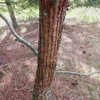
    I saw this tree while walking in our town. I suspect it is a victim of being planted too deeply. Not 100% sure of this but why else would a tree (Norway Spruce?) planted in good soil, in a climate it agrees with, for this long, look so sparse and spindly?

  • 9 years ago
    last modified: 9 years ago

    Bill, just a guess but maybe it's due to drought or has a disease.

  • 9 years ago

    no, no droughts here, for quite some time. If it had disease, would it have so many cones? dunno, just thought it was a good time to throw this picture out there.

  • 9 years ago
    last modified: 9 years ago

    What made me think planting too deep was the reason, is it looks so straight where the trunk meets the ground. I would think that at the size that it is, there would be a definite flare at the bottom.

  • 9 years ago
    last modified: 9 years ago

    Missouri Botanical Garden: "A tree trunk that emerges straight from the ground without any flare roots, like this ash (Fraxinus, referring to the photo below), usually indicates a tree that has been planted too deep and may develop girdling roots."

    Conifers
    do develop a very significant root flare with substantial tree size. I had a 3-storey tall Thuja
    removed and kept a 5" thick slice of the root flare, which now serves as a
    very nice base for a flower pot.

    Not all of my 5 conifers are 30+ years old, 2 have been newly planted this past growing season. The later planted conifer showed signs of growth before the earlier planted conifer did. The earlier planted conifer is a Pinus sylvestris cultivar on a 16" standard or so I thought. The 16" is measured from soil level, but from my later readings I gather that 16" is unusually short for a standard. Chances are that the standard is longer than 16" but how long is longer? Dig in the rootball, you say, but the rootball is clay, which is difficult to work with. However, after a very wet week this past autumn, I was able to depress the clay around the trunk by about 1" without damaging the beautiful bark. Still no root flare. I have no idea if a 2.5" caliper rootstock (possibly of the Pinus sylvestris species?) is supposed to already have developed a significant root flare or not. I will try to depress the clay by another 1" or more in the very wet days of late winter, and hope to at least get to the shallowest root. It is possible that I am overly concerned about all this :-)

    --------------------------------------------------------------------

    Fraxinus planted too deep, may develop girdling roots - Missouri Botanical Garden

  • 9 years ago

    I once removed 2-3" of excess top soil out to about 6" from trunk of a Cedar Elm that had been planted the year before. Tree growth took off like a rocket! Exposing the flare can be very beneficial to the tree.

  • 9 years ago

    Yes, conifers develop a root flare. Here's a big European larch:


  • 9 years ago
    last modified: 9 years ago

    Bill , that tree is too deep,,just like Ontario shows for the ash

    a radio guy on sunday mornings talks about this all the time (dirt doctor .com)

    he's a big proponent of exposing root flares on all trees

    ron

  • 9 years ago
    last modified: 9 years ago

    Whereas large conifer trees have clearly visible root flares, I think the question that I have comes down to this:

    => Does a 2.5" caliper
    Pinus sylvestris have a clearly visible root flare?

    The picture from Google Images that I posted further above looks like a smaller caliper of an unidentified species which shows a slight root flare maybe up to 1" above the shallowest root.

    If anyone can make the answer to the => question more precise with a photo, that would be great :-)