Software
Houzz Logo Print
wantonamara

Frost Cover question

9 years ago
last modified: 9 years ago

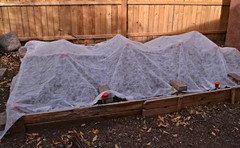
I have some frost covers built with arching PVC over 4-5' wide beds. How high off the ground is optimum for holding heat in. I am beginning to think that mine are too tall. They are around 36" tall off the ground which is a raised bed so the actual profile is even higher. I am torn between thinking that the higher level has more air that is held in in a warm mass and that it should be slower in cooling down. Then I think , that if it is smaller, not as high in relation to its width, the warm ground warmth would not be as diluted into the mass of air., and the cover would be more effective art holding the radiation of the heat in. I am in Texas and our ground was warm before the last cold front. The air will move back up to 60F soon, so the ground warmth factor helps us through the cold fronts. How high do you guys think that the PVC arches should be?? I am growing mostly winter greens, lettuce and beets. We just had 2 nights of low 20's. Tonight's low is back up to 32F and then into the mid 40's. I have the heavier frost cover that gives you 7-10degrees protection (they say).

I am an occasional lurker here, so thanks in advance.

Comments (29)

  • 9 years ago

    They should be fine. I'm in zone 7A and have the lightest Agribon covers on low stakes (maybe 6-18 inches) over kale, chard, bok choi, spinach and lettuce. Yesterday morning it was 22F and the lettuce seedlings were frost coveres. That afternoon they were fine. This AM they were frosty, this afternoon they were fine. The ground froze and thawed.

    One thing the covers do, more important than freeze prevention, is prevent drying. Let the plants thaw out and perk up before removing the covers, and make sure the beds are well-watered going into a freeze.

    This blog covers the tips and tricks of using frost covers and winter-hardy veggies.

    http://www.motherofahubbard.com/10-vegetables-more-cold-hardy-than-kale/

  • 9 years ago

    Just personal op but for such low growing crops I would lower the tunnel by about 1/2 just for the reasons you outlined. Widen it out if possible to include more ground surface heat. The drawback is it reduces ease of access and could trap more heat IF you get some really warm days. Just something to think about.

    Dave

  • 9 years ago

    My beds are in a small deer enclosure so I can not widen them. They are what they are. The beds are regular intersecting rectangles so one will have runs on the border intersecting with another border. I tried to make the most square footage out of the enclosure. I have no dirt where I live. It is calcarious marl and caliche. The beds were brought in . I have been thinking of changing the shapes of the beds since I designed them not thinking about frost covers and irrigation. BUT that won't be now.

    I take the covers off between cold fronts. I like to quip that we have three 3 day winters. We have at least a week till the next front, as far as the weather reports stand today. We just survived a stint down to 21. Unfortunately my job had me too busy to get in my winter garden on time so they are mostly very small and tender . WE , unlike many people have the sunshine to have growth. I do find that if I protect them from most even gentle freezes, they continue to grow with speed. Otherwise their growth slows. I am not looking to "store things" through the winter still alive , but to get growth. I will be planting sugar snaps in early January.

  • 9 years ago
    last modified: 9 years ago

    If the heat is all coming from the ground (perhaps illuminated by the sun, perhaps warmed from previous weather), the enclosed air is what is being heated. So I'd have to assume that the more enclosed air above, the less it will be heated. Also, the rate of heat loss is simply a function of the interior temperature, the exterior temperature, and the area of the interface. High walls are just going to add to that interface area, making more area for the heat to be lost from.

    That being said, a thick layer of air will add to the insulation, but air is a pretty poor insulator.

    So I'd agree with you that a lower tunnel is better.

  • 9 years ago

    YEA, that is what I was thinking too. I guess I could try cutting down the PVC on one of my runs and seeing how it does. Maybe I should stop in and ask about this issue at the Natural Gardener in Austin and see what they suggest . They are pretty good with their thinking. I am about to take the covers off again. The wind is more of a factor when they are taller also.

  • 9 years ago

    Don't overthink it ... I have seedling lettuce (planted in early December) that is doing fine a zone colder than you with this slap-dash covering. Temps in the low 20s with 20MPH wind and 40MPH gusting for several nights in a row, then some freezing rain, than temps in the high 50s for a few days and back down again.


    I think protection against dessication is as important as
    against temps, or more. I get frost inside the cover but the plants are doing
    well. Frost on the edges of the leaves, mulch/compost frozen solid and they are putting out new leaves. Like you, I have plenty of sunshine.

    This is some sort of butterhead lettuce, planted Dec 7 or 8, and it's doing fine.

  • 9 years ago
    last modified: 9 years ago

    My question was a theoretical question that is oriented to my conditions. I did go in to the Natural Gardens place in Austin and they said 6"- 8" over what your plants will reach. Lower is better for what we deal with in Central Texas. They teach lessons in organic gardening and have several garden gurus on site.

  • 9 years ago

    I have some "data" on height of cover versus plant growth.

    The plants in the center of my tent have grown more than those closer to the edge.

    Whether it's the height of the cover, the colder soil along the sides of the raised bed, or the cold wind sneaking under the edges, I don't know.

    They are all growing, nothing has died, but the plants near the middle have more leaves.

  • 9 years ago

    Well, that's pretty easily understood. The air is colder near the walls of any enclosure, however tall the enclosure is. Your plants in the center have been warmer, and grown more. That could certainly be used to argue that a wider tent is warmer, because it contains more warm soil within it, but not that a taller tent is warmer.

    For a given width of tent, I think a lower tent will be warmer. It would be interesting to do that test with a couple of thermometers and tents.

  • 9 years ago

    I think of penguins huddling when given this data. The guys in the middle also get the benefit of the insulation value of the mass of plants . The guys in the middle are in the sweet spot. There are more than one factor in the play. Whatever heat is captured will move to the center following the roof line theoretically.

  • 9 years ago

    I really don't want to think of the thermodynamics of frost covers, although that could be a good science fair kind of project - tall versus wide with recording thermometers, and which one gets better growth over time.

    What I REALLY care about is that I'm harvesting lettuce in JANUARY!


  • 9 years ago

    I have no trouble thinking about the thermodynamics of frost covers. That's what the original question was about, and it was a good question. If you have a choice about how to build a frost cover, some thought about design is appropriate for any gardener.

  • 9 years ago

    What I find interesting is that the question changes from place to place. What I look for is different from the issues further north where they do not experience the shortness of the cold fronts or the long ground warming warm ups in between. The blogs were for people further north. I look for a different result than people up there. Therefore design issues might be different. We in Texas have it easy comparatively.

    I imagine that in NM , you experience a lot of warm up from the sun but many more colder nights than what I have. I bet the ease of putting a cover on and off would be very important there. I also realize that where in NM that you are makes a big difference too. Tall state, many zones. One person I knew in NM gave their garden a black painted northern wall and a taller roof. It was more like a green house. It protected heat loss from the north wind and emphasized the heat gain from the sun. They did a lot of covering and uncovering through the fall and early winter.

  • 9 years ago
    last modified: 9 years ago

    In central Texas, frost protection is almost always about mild freezes (the very unusual hard freezes this winter notwithstanding). The temperature gets quite warm in between these freezes, and that's exactly right that the ground is therefore an important source of warmth during these freezes. The ground doesn't really cool off very much. I've successfully protected even eggplant and tomatoes through 25F overnight freezes, just by throwing a tarp over everything and sealing it to the ground around the periphery, keeping the ground-warmed air in. I get a few burned leaves where the leaves touch the tarp, but otherwise, the plant comes through unscathed. But several days of much below-freezing temps would require a lot more effort. We almost never get those.

    Such covers also shield the wind. All the water inside the tent will effectively freeze out on the cold tarp. So the air is going to be REALLY dry both inside and outside the tent. But the wind will super-chill the foliage as it dries it out. Wind blowing across something moist will get it a lot colder than without wind. Foliage temperature can then drop to near the dew point, which can be well below the air temperature. You know that super-chilling effect when you come out of a swimming pool.

    Hey, there's another good science fair project!

  • 9 years ago

    wantonamera -

    Wind here is a big consideration - every front that comes through has high winds. Something turtle-shaped is less likely blow away.

    I haven't been removing and replacing the cover because I want to save moisture. I only take it off to harvest and water the bed.

  • 9 years ago
    last modified: 9 years ago

    It is dryer there in NM. I take it off to let in warmth and get the ground warmer which equals more growth. The cover only goes on every once and awhile. They clocked a 105 knot gust at the Austin airport a couple of days ago. Thank GOD we only had gusts of 50 MPH at my place. 105 is enough to make a fat tortoise air bound.. This winter, temperature wise, we we will most likely only use them twice since the 10 day forecast has no freezes in it, so it might be a bunch of brouhaha for not much at all..I still get much better growth if I don't even have them flirting with dormancy.

  • 9 years ago

    I would tend to agree that a lower row cover is preferred. However I find just the opposite in my high tunnels where larger is always better. So one has to look at all of the factors involved. I would expect certain advantages for both low and high coverings. For my larger high tunnels (30 ft. Wide) the "buffering effect" is far superior to smaller structures. I would expect that when considering low tunnel dimensions the dynamics are different but then one has to wonder at what dimensions a change occurs?

  • 9 years ago
    last modified: 9 years ago

    That's interesting. What do you mean by "buffering effect"? You mean the degree to which the wind outside moves the air around inside? Certainly you're best off if the air isn't moving around a lot inside. You want to keep the cold layer of air near the wall close to that wall.

  • 9 years ago

    30' is bigger than my whole garden. LOL .. Are you using frost row cover and plastic or just the row cover? Again I see a North/south divide in how the shelters are used. Yours is more of a seasonal greenhouse and mine is a minor stop gap. Do you use yours to keep already grown plants alive till consumption or is there actual growth . Do you use a heater in your enclosure?

  • 9 years ago

    I use the term "Buffering effect" to denote resistance to change in temperatures. I can go into my larger structures in mid winter or during midsummer hot day and just feel more comfortable. Even though heat rises the outer few feet along any edge are only areas where my tunnel soil ever freezes. In a 20' wide structure that is 1/5th of the soil surface; in a 30' wide structure that is closer to 1/8th of the surface area.

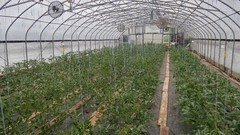
    Wanto, I use row covers for field crops but my high tunnels are covered with plastic, all but one with 2 or more film layers. I used to use row covers inside but my ultimate temperature control was limited so now I just heat with wood stoves.

    Too many tomatoes to consume myself but I grow and harvest from inside this tunnel.

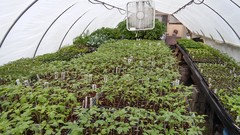
    From this 15x40' greenhouse I only grow starter plants.

  • 9 years ago

    I also see that there is the difference of commercial expectations and the flea like concerns of the small scale private gardener. That is some operation that you have!

  • 9 years ago

    I still think of myself as a past hobby gardener who got a little carried away. Regardless of operation size you need to pay attention to things you can control if you want recurring success.

    Dan, to continue on your comment- I DO want to move the air around inside. If you notice in the picture the high tunnel has 4 circulation fans which I consider to be very important. When I fire the wood stove (located in the far corner) there has to be a way to move that heat throughout the structure. With those internal fans moving there are no "dead air spots" where cold air can seep in from any edge and damage some plants. But even without heat or fans the plants are kept in a more moderate environment in this structure (30x96') than an adjacent 20x96' structure a few feet away and parallel to it.

  • 9 years ago

    OK, you have heaters in your tunnels. So yours are a lot more than just "frost covers". Yes, certainly if you have heaters, you want circulation. If you don't have heaters, and are just trying to protect, I suspect you don't want circulation. I think the "buffering effect" you're talking about is just that your tunnels are large enough, that it's easy to get away from the cold walls.

  • 9 years ago

    On the contrary there are many Fall nights (and into mid-mornings) that my circulation fans are on. It is my experience with crops in high tunnels that plants fare better on frosty nights when air is moving around them.

    I only wish I could do the same with row covers. I had 1600 pepper plants covered this past November with Agribon 30 and had to just lift the fabric to witness the results of a few degrees below a tolerable level. Row cover is so very risky when temperatures fluctuate to freeze levels. One night you might get spared, another might end your season. With a heated high tunnel I determine when to end.

  • 9 years ago

    I don't have the experience that you do, but I'm surprised. If you move the air around under a tent, you'll just chill more of it near the walls. Of course, natural convection will drive some circulation, in the that warm air near the ground will rise, and the cold air from the walls will fall. But that's going to be pretty slow.

    It would be interesting to measure the temperature at mid-tunnel with the fans on, and compare with the temperature with the fans off. Of course, moving air is a lot easier than heating, so one wonders if sticking a fan under row covers is a smart thing to do.

  • 9 years ago

    Thanks, lazy_gardens, for the link to the blog on growing cold-tolerant veggies.

  • 9 years ago

    With regard to fans in tents, I should say that I have my starts going in a cool (50-60F) garage, with T8 bulbs over them. I put a tarp over the top, seal the edges, and a blanket partly over the tarp. The bulbs warm everything up to 80F or so, which is ideal. I was surprised to see, when I put a small fan under the tarp, to strengthen the stems, that the temperature under the tarp dropped dramatically. Down to 65F or so. Ouch!

    This says to me that blowing air under a tent that is shielding plants from the cold is going to make it colder under that tent. Presumably because the air is being blown past the cool wall. The bulbs are like heaters for me. So it may depend on exactly where the heaters are in the tent. Mine were along the top.

    Not sure how this small scale example can be extrapolated to a large tunnel, but it's an interesting observation.

  • 9 years ago

    Around 15 years ago I did use remote thermometers to measure temperatures at various areas throughout a few weeks of Spring. I don't know where that data is but the bottom line is that cold spots occurred and I lost a few plants. I had then constructed a 11x 90' canopy frame within my largest high tunnel and covered it with fabric. Then I further put wire hoops over my tomato plants under the canopy and covered them with another layer of row cover.

    My false premise was that I could protect the tomato plants even when the outside temperature dropped to 25*F. I lost a few plants when temperatures even dropped slightly below 30*F. If the night is clear and the temperature drops quickly so that it remains below freezing for an extended time the covers alone are unreliable.

    Many specialists like Adam Montri, Mich. State, still recommend a double cover method. I'm far happier with my supplemental heat. In fact the only plants that I've lost since then when planting 2 months before last frostfree date occurred was when my woodpile caught on fire 6 years ago.