Software
Houzz Logo Print
rockybird

Do water softeners really work?

9 years ago

I live in a city with extremely hard water. My kohler stages kitchen sink always has chalky deposits front the water. I am considering installing a water softener but I am not even sure where to begin. I will have contractors at the house over the next couple months working on an addition and remodel so I was thinking this might be a good time.

I really dont want to spend the money on one, but it seems like it probably is a necessity.

Any recommendations for a brand? My house will be 4700s q. Feet when finished. Thanks!

Comments (6)

  • 9 years ago

    Thank you!

    I am reading about kinetico system which seems to have a fairly good reputation. But I am reading that people do NOT soften the water at the kitchen sink? That is one of the main problem points! Is this true?

  • 9 years ago

    Reliable brands: Kinetico, Fleck, Clack. Of those, Kinetico is likely to be the most costly, but the company also tends to have well-trained service personnel, unlike most residential softener providers. If you call around, you may find a local, independent dealer that can provide great service. Get several to come out and provide a quote. If you would like a double-check on their recommendations, provide some information here and I'll take a look. To properly size a softener, you need water analysis: hardness, pH, TDS at bare minimum. Better: also analyze sulfates, iron, manganese, nitrates, alkalinity. With city water, the water treatment plant's quarterly water report can be a good place to start.

    Some people don't soften water to the kitchen sink because they object to the taste of soft water. However, that leaves hardness buildup at the sink, as you noted. If you find the taste objectionable, you can handle this in one or two ways: 1) Run a hard water line to a separate drinking water faucet, 2) Install an RO for drinking water.

    Some things to watch for when considering softener quotes:

    The following requirements are for an industry standard softener. If
    you are looking for a non-electronic softener, Kinetico offers the
    more reliable options at a premium price (and you would need to deal
    with a local Kinetico rep). Any decent softener vendor should be
    able to provide the following:

    1. High quality American or German made resin. This will provide a
      tight size distribution for optimal flow within the resin, longer
      resin life, and more reliable, predicable water softening.

    2. Since you have CITY WATER: 10% crosslinked resin. The oxidizers
      that city water treatment plants use, such as chlorine or chloramine,
      are harmful to softener resins. Higher crosslinking will resist
      chemical attack longer.

    3. Top basket. This serves two purposes. It sets up a proper water
      distribution during normal operation and prevents resin loss during
      backwash.

    4. Gravel underbed. The gravel underbed is there to set up proper flow
      patterns, improve backwash, keep the bottom basket in place, prevent
      basket failure, and prevent channeling. Many softener sales
      companies like to leave this out or sell softeners with a vortex
      system instead. Vortex systems weigh less than gravel so they cost
      less to ship. In addition, they are a more expensive item that adds
      profit for the softener salesperson, but provides no additional
      benefit to the homeowner . It simply adds another piece of equipment
      that can break.

    5. Fleck or Clack valves. These set the industry standard. Be aware
      that you will not be able to purchase Clack valves online. This is
      not a problem if you purchase locally.

    6. The valve should regen based on water usage, not time.

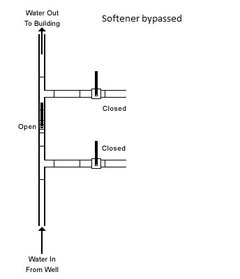
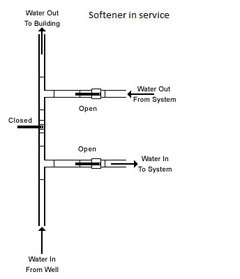
    7. Install the softener with a three-valve bypass. This will make it
      much easier if you ever need to remove the softener for repairs or
      wish to take it with you when you move. Use full-port, quarter-turn
      valves.

    8. Noryl bypass. Most softeners are available with either Noryl or
      stainless bypass valves. Both are good valves, but the noryl tends
      to be more reliable when not used for long periods of time. This is
      a redundancy if you install with a proper three-valve bypass. I
      prefer a bit of redundancy but it is your call.

    9. Brine tank: Although either round or square will work, round brine
      tanks are more structurally sound and will not deform like a square
      tank will. Additionally, if you need a softener 1.5 cuft or larger,
      a square tank will most likely be too small.

    10. If you live in a cold climate, ensure equipment is stored in a
      climate-controlled environment. Frozen softener resin is damaged
      softener resin.

    11. Purchase a Hach 5-B test kit. You will want to periodically check
      to ensure your softener is working correctly and this kit is your
      best option.

    rockybird thanked User
  • 9 years ago
    last modified: 9 years ago

    Alice in wonderland, thank you so much!!! That is very valuable information. Is the valve hard to place? Can the water softener co. Do this?

  • 9 years ago

    The valve/controller is the heart of the softener. Fleck, Clack, Kinetico are valve/controller brands. I'm sorry I wasn't as clear as I should have been. If you are talking about the bypass valves, each softener company can provide an intrinsic bypass valve. If you choose to use a three-valve bypass, your installer can do that for you. It should look like this:

    rockybird thanked User
  • 9 years ago

    We are looking into a water conditioners instead of a softener.