Software
Houzz Logo Print
metrovavin

Conversion to full water culture procedure question:

9 years ago
last modified: 9 years ago

Newbie to orchids, attracted to experimenting with full water culture I got three small plants in 2-3" pots (bark, sphagnum &/or florist sponge), two onc. and 1 phal. I aim for 1/3 of the phal roots in water, 1/2 of the onc., with an occasional dry day for the onc.

My question is during the adaptation period where the bark roots are replaced with air and water roots, is it better to keep the full amount of water even though there are no water roots yet, or to use a smaller amount of water and periodically soak all the bark roots, gradually adding more water as more water roots grow?

I've watched dozens of excellent Youtube tutorials but I did not find the answer.

Most of the roots are very white, looking like aerial roots, as the medium was very open and did not cover all the roots. They are in 60-80% humidity, 70 F, about 1000 fc for 16 hours.

Comments (10)

  • 9 years ago

    Why re-invent the wheel? Why not use the tried and true methods? What is to gain? I like to keep things simple. The more complicated the more likely I will fail. It is hard enough to get results. Why make it harder? At least before you go off on a tangent, why not first learn tried and true first?

    metrovavin thanked shavedmonkey (Harvey in South Fl.)Z10b
  • 9 years ago
    last modified: 9 years ago

    Thanks dannie for your suggestion on how to proceed, and both of you for expressing your sane doubts.

    Whether to try water culture is off-topic to the question, but I will digress to address the doubts.

    If you look on youtube "orchids full water culture" you will find a number of people blooming orchids in full water and part water culture (with great success). I agree it is surprising but it is a fact. OME, Orchid Whisperer, Samantha's Orchids, Diloram Brown, Trac McNguyen, so neaty, Sharon Short, and other Youtube publishers show lots of blooming orchids in water and give instructions. OME, Orchid Whisperer, Samantha and others list the reasons they prefer water culture.

    On the other hand, MissOrchidGirl tried it and didn't like it for her conditions (I think Romania, on a balcony with extremes of hot and cold), although she reported it did work for her phals. She has strong objections to it as un-natural. She says it works with phals because they are "weeds" that will grow in any conditions and that it's a "gimmick."

    Facts beat speculation. :) The great majority of people who tried it found it worked well for them, I only found two that didn't like it.

    To go into more detail, I observed that MissOrchidGirl seemed to me to have left some media on the roots, which is a no-no. It looks like she also used full water culture on plants that need part water culture (some need one day a week dry, some five days a week dry). Her problems with it may be part due to her technique and part to her growing environment which is way different from mine, which is much more like OME's and Samatha's.

    Aside from the fact that it is proven to work well if done properly in the right environment with the right species, you can ask why it works. Don't orchids grow in trees, not swamps and lakes, as MissOrchidGirl strongly objects on Youtube?

    First of all, water culture is not simulating a swamp or a lake. It is more like a little stream or a water reservoir in a depression in a branch or a hole in a trunk. The places where orchids grow have lots of streams and the rain forest canopy has lots of tiny "pools" or water caches in the branches, kept full since it rains every day. I have read that there are many species of animal, for example, that are adapted to live only in these small pools of water high in the forest canopy, or that depend on them for procreation. (The very common tank bromeliads hold up to 2 gallons of water high in the canopy, but I don't see how orchids can send roots into them. Maybe it happens. The canopy is not well studied.)

    Orchids growing right by these pools, either in the forest canopy or on logs, rocks and boulders by small streams or pools, can send out water roots into them for a steady reliable source of water and nutrients (like your clever Twinkie). If we are going to speculate on the evolution of orchids, I speculate that this is why many species of orchids and other plants too, like African Violets, are able to grow specialized water roots that can live in water. This situation happens often enough and it is so beneficial it promoted this adaptation and kept it in the genes. If it didn't happen enough in the wild, then according to evolution the plants should not have the genetic ability to grow specialized water roots.

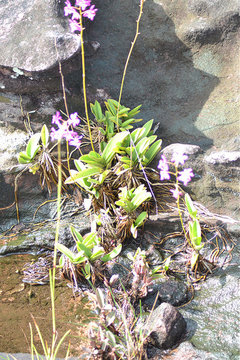
    I have seen one photo of a large phal in the wild growing over rocks by a small pond, with its roots trailing into the water, which proves this does in fact happen in nature. It looks to me like this orchid, supposedly in the wild, has bare roots sprawled over the rocks with some roots dipping into the pool, very much like full water culture:

    As far as the advantages of doing this in cultivation, here is a list I made based on reports of successes:

    1) no media to make a home for critters
    2) no need to re-pot on a regular basis, because there is no organic media to break down and acidify. Never repot. When the orchid gets too big, just pick it up and put it in a larger glass vase (or coffee cup or any container). Not only saves a lot of work and time but also saves damage to roots. Keeps roots out of acid media.
    3) most of roots are in air, so they get plenty of air, better circulation than in media
    4) roots are completely visible for beauty (with a glass vase)
    5) roots are completely visible for health monitoring
    6) no guess about when to water, you keep the water at a specific level and top it off or replace it when low or cloudy
    7) fertilizing is easy, several ways but you can add a very small amount of the right stuff to the water (e.g. 1/4 tsp / gal MSU) all the time. Very simple.
    8) increases local humidity around plant
    9) plants gets constant supply of water on demand, as much as it can use and no more, instead of depending on the grower's schedule
    10) roots are prettier, silver above the water, green in the water. Never brown or dark.
    11) roots get light and contribute (a small amount) to photosynthesis
    12) with a large enough reservoir, you can go away for weeks and the plant will be fine.
    13) you don't have to experiment with or buy the various media and mixes- bark, perlite, moss, leca, etc. No media at all. Very simple, very cheap, very clean.
    14) no need to buy special orchid pots. Any cup or glass works fine.
    15) as far as natural goes, no orchids grow in pots in nature. :) Yet pots work better than mounting on wood for many people due to their growing environment and time schedule, even for MissOrchidGirl. (I also doubt orchids in the wild have their roots immersed in small bark chips mixed with perlite, or wrapped in sphagnum.)

    There are also advantages to growing in bark based media, I am not saying water culture is superior for all plants and for everyone, just that it is not a totally untried, crazy idea. It is both well proven in culture and has a theoretical biological justification.

  • 9 years ago
    last modified: 9 years ago

    The reason I have a question is the 'gradual method" advocated by dannie might on the one hand, help the plant to adapt slowly, or on the other hand, fail to promote growth of water roots as fast as the "sudden method" which as far as I can gather is what people usually do.

    I just figured out I can ask OME on Youtube. I will report here if she answers.

    Also I just looked and there are a few Facebook groups, 2 very large ones Orchid Water Culture (2,500) and Water Culture Orchids (18,000) that have instructions. Water Culture Orchids has more people answering questions, Orchid Water Culture has some good documents.

    Water Culture Orchids response:
    "Start
    w about 1/3 of your roots submerged and WATCH. In time you will see
    some things: leaves yellowing (particularly oncidiums) which mean raise
    the water level. If you see the phal bottom leaves wrinkling then raise the water level. If you see a totally healthy plant, keep it at 1/3"

    An Orchid Water Culture document says aerial roots can be submerged and survive and adapt, and there were lots of aerial roots on one of my plants.

  • 9 years ago
    last modified: 9 years ago

    That's beautiful Ben, love the fish and the moss. Good information on specific phals. Great water culture success story.

  • 9 years ago

    OME responded to my Youtube question, the OP:

    "Thanks for watching and commenting. That is a good question. I don't
    necessarily handle every orchid the same way. sometimes I put them in
    water and they just take to it with no problem.
    Sometimes some of the old bark roots don't touch water and get pretty
    dry while some of the roots in water start looking a bit water-logged.
    In that case I would let it dry out over night or for a day. Then I
    would soak all the roots. Then I would drain most of the water so that
    only about 1/3 of the roots are in water.
    If I am getting some roots that die and rot after going to water culture
    I would trim them up, spray with peroxide, put some cinnamon on the cut
    (if it is a thick root) and let them dry for a while before putting
    them back in water.
    I just watch them for the first month or so (esp the first couple weeks)
    and see what it seems like they need. Sometimes they don't need any
    help at all. Sometimes they do."

  • 9 years ago

    The full water culture method means that only the tips of the roots are in the water. The rest of the roots and of course the plant, are dry. My phals have been on FWC for over a year and they are doing beautifully. I think it is called full water culture because the tips are always in water, but actually the plant remains dry. I don't know if this would work for other types of orchids though. But in my conditions it works beautifully for phals. I have some photos on my profile page.

  • 9 years ago

    The link Ben posted shows John's phal indeed growing & blooming with roots totally submerged. Please check out that link to Theorchidsource forum. I was in fact going to copy and try to create this for display. Hubby too, said, why??? So I haven't followed thru with my plan...yet. But I will try it! To answer the 'why' query, for me it's just to do something different. To make a unique display. I'd enjoy showing it on Show N Tell evening at my OS and perhaps, if I'm successful, make it part of a display at a club show.

  • 9 years ago

    There are two methods. For semi-water culture, the roots are totally immersed for 2 days, then water is poured off and roots remain dry for 5 days. I tried that method too, but liked the full water culture method of having only the tips of roots in water (all the time). It was too hard to remember the 2 day - 5 day thing of semi-water culture. I also just decided to go ahead and try it because my phals weren't doing all that well anyway, but it turned out they did so well I decided to stay with it. I hope this isn't confusing. My collection is small, only 7 plants, so it was no big loss if it failed, but it has been very successful for me. The names of the methods are confusing too. "Full" meaning it is always in water (but just the tips), and "Semi" meaning all the roots are in water only two days a week.

Sponsored