Software
Houzz Logo Print
ontario_canada5a_usda4b

Fastest dome-on-a-stick

I am fascinated by
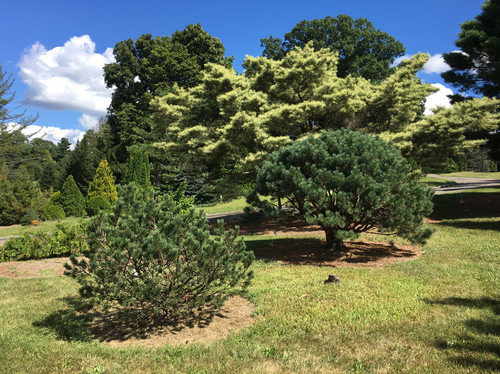
the standard tree in the foreground on the right, especially by the large crown
and the thick trunk. What common lollipop tree can I use to emulate it in the
fastest way? The dome does not have to be perfectly round, can be less dense, etc.

Pinus sylvestris 'Cutty Sark' at the Dawes arboretum, standard tree in the foreground on the right. Thanks to Plant Map for the photo and to Garen Rees for IDing the tree!

Comments (17)

  • 9 years ago

    The tree you are asking about is a kind like Pinus sylvestris 'Nana'. Another, taller cultivar that looks like a head of broccoli when far enough along is P. densiflora 'Umbraculifera'. I had one of these get fairly big but it took decades. Annual growth once a full head of steam was reached was maybe something like 5 in.

    "Had" because its geometry did not fit with the style of planting I do here.

    Ontario_Canada5a_USDA4b thanked Embothrium
  • 9 years ago

    Talked to a local
    nurseryman about this and that. In the context of this thread, low shrubs benefit from
    reliable snow cover around here. But if the shrubs are high grafted on a standard, snow cover is less reliable and hardiness suffers.

    The conversation
    then went in a different direction, but now I wonder if the loss of hardiness
    can be expressed in terms of zones. Less hardy by 0.5 zone? 1 zone?

    Loss of hardiness would depend on how tall the standard is, e.g. a 4' standard would be less hardy than a 2' standard. Other height dependent exposures may be winter wind and winter sun, either directly or indirectly via less snow cover. Thoughts?

  • 9 years ago
    last modified: 9 years ago

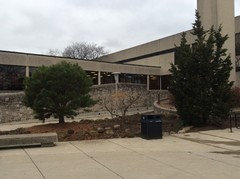
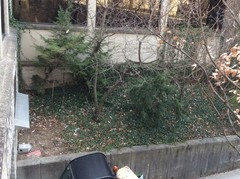
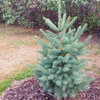
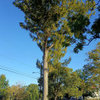
    The same thought crossed my mind when I saw this at the local community college. It obviously could have been pruned better, but same general idea/shape.

    Ontario_Canada5a_USDA4b thanked User
  • 9 years ago

    Oh, I love that
    specimen on the community college grounds! It has that very natural appearance
    too, with minimal trimming. It looks like a grafted Scots pine too (?) so
    chances are I get to enjoy a sizeable tree (?) before moving house again.

    The two specimens,
    at the Dawes arboretum and at the community college, have both wonderfully
    well-balanced crown-to-trunk proportions. This is quite unlike the standard
    trees that I see on sale at retail nurseries, which look like little round
    green sofa pillows on spindly 4' trunks. Makes me wonder if the next breeze
    will float away with the pillow. But there is not much choice if I want to try
    one out.

  • 9 years ago

    I looked at it up close and do not think it is a Scots pine. Im not so good (quite bad actually) with IDing conifers, but I was thinking some type of mugo pine? Ill try to snap some up close pics this week. And I do have a Scots pine that was trimmed as a topiary that I was gonna just let grow wild but I may now try to do something like this.

  • 9 years ago

    Sure Wayne, it is
    not the length of the trunk as such, but the fact that it sticks the
    shrub/crown above the snowline that brings winter evil.

    However, the
    straight Pinus sylvestris species is on paper 2 zones hardier than where I am.
    Chances are that there are quite a few cultivars that give me at least a 1 zone
    margin, which I like. Same for the Picea pungens in this regard. I think that at this point, getting my hands on a good specimen to bring home becomes more important.

    One issue with fast
    growing standard trees is that the crown can grow faster than the trunk can
    support, necessitating ugly staking of the ornamental tree for life. Someone in my town has such a staked dwarf
    Korean lilac standard tree. Any thoughts?

  • 9 years ago

    Thoughts? when in doubt, go for hardy. as for getting a good stem caliper, search. they are out there, although not always cheap.


    Anything that can be done can be done in a manner attractive to one but not another. if you feel you have to stake, think about what you are doing and what the materials needed are. you may be staking a tree, but that metal rod could be a rustic cedar log. you may need wire, but it could be black, or a little spray paint, it's a rainbow. you have to protect the trunk, functional, but there's no reason you can't then decorate that somehow, be it paint, outdoor fabrics, or fake flowers.


    The stake is temporary. personally, i'd shop around until I felt I knew what all the available options were, and the related price points, and make your decision then.

    Ontario_Canada5a_USDA4b thanked waynedanielson
  • 9 years ago

    I have not thought about fake flowers yet :-)

  • 9 years ago

    Grafted lilac trees are used here a lot and I don't see them being staked.

    I have heard that claim about grafted trees being less hardy, but have not heard an explanation of why. For the grafted trees, you are dealing with hardiness of two different plants. I'd want to know what the roots ands trunk are.

    I have also heard that some of these patio trees, whether grafted or own root and trained, can suffer sun scald in colder climates damaging the trunks. I recently learned that is a problem on Hydrangea paniculata north of here.

  • 9 years ago

    I think Wayne posted not long ago that the rootstock of grafted lilac trees are of the Syringa reticulata which is hardy to USDA zone 3. I have also heard that grafted lilac trees have 2 grafts and 3 parts: roots, trunk, and crown, but I don't know anything more.

  • 9 years ago

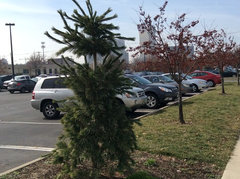
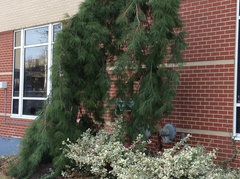
    More pics.


    and non stick on a ball as well

    Ontario_Canada5a_USDA4b thanked User
  • 9 years ago
    last modified: 9 years ago

    The experts here may be able to ID the trees, especially the one pictured in the first 3 photos in the above.

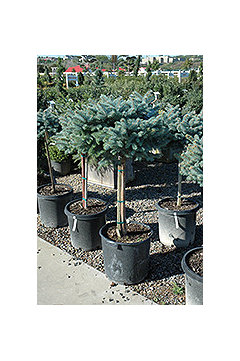
    I found the photo below of a standard tree in a nursery pot. The crown is bigger than what is usually offered for sale around here. Note the stake, I would not dare to plant it in a windy spot.

    Picea pungens 'Glauca Globosa' Globe Blue Spruce grafted on a standard

  • 9 years ago
    last modified: 9 years ago

    Most for sale around here look about like that but smaller. However one place (darby creek nursery in hilliard, oh) gets (the most expensive/largest size only) them on shorter and notably thicker standards. They arent cheap.

  • 9 years ago

    I'm not an expert but the one in Pete's first three photos is Pinus densiflora 'Umbraculifera'. =)

    Ontario_Canada5a_USDA4b thanked Garen Rees
  • 9 years ago

    Did some more
    reading on this fastest-dome-on-stick topic and have become a bit concerned
    that the 'dome' grows too big too fast. This conifer pruning overview http://www.richsfoxwillowpines.com/advice_and_how-tos/pruning_evergreens.php
    provides this ordered list from easiest to most difficult:

    Easiest to prune:
    Yews, Hemlocks

    Firs, Cedars,
    Spruce, Douglas fir

    Pines

    Most difficult to
    prune: Junipers, Arborvitae, Chamaecyparis

    Looks like from the point of view of controlling the size of the 'dome' then Yews or Hemlocks on a stick are the
    easiest to work with? Thoughts?

  • 9 years ago
    last modified: 9 years ago

    The gallery of Wiel
    Linssen (link below) shows beautiful landscaping utilizing an unusually large
    number of standard trees. Most but not all of the standard trees are conifers.
    Some of the individual standard tree specimens rival the beauty of the one in the OP.

    Enjoy!

    https://get.google.com/albumarchive/109726537264644092409/album/AF1QipPwbrYYx5Fnjej7hSeQsMa2aGgQEBOBwYQxfNxw?source=pwa#