Software
Houzz Logo Print
weslsew

Logan Labs soil test results

9 years ago
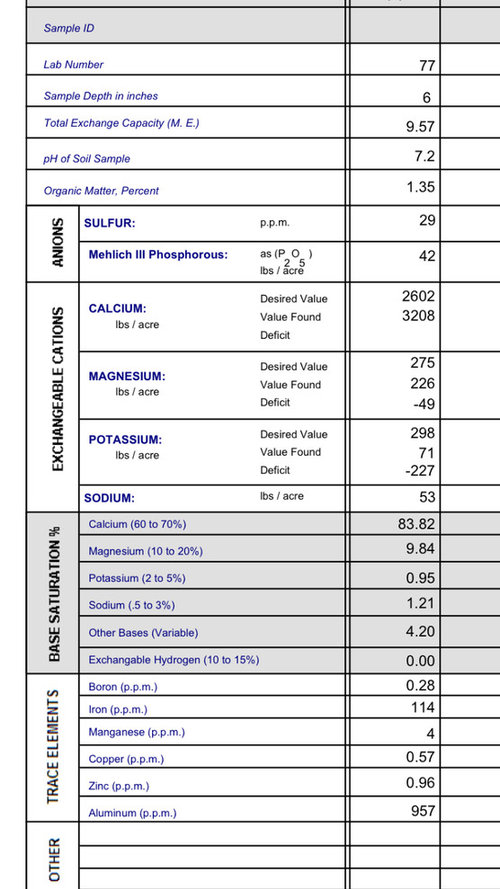
Just got my soil test results! I'm in north Florida with sand to about 6" and dense grey clay deeper than that. My grass is st. Augustine. I would greatly appreciate any input!


Comments (9)

  • 9 years ago

    I'm not the guy you want to take advice from on soil tests, so I'll try not to give any, but I can comment on a few things. Your sand seems to be adulterated with something that is bringing the Total Exchange Capacity up from the depths that pure sand usually sits at. More is better with TEC. You probably don't have pure silicon sand - I'm thinking calcium sand. With a pH that high, probably calcium sand.

    Bringing the magnesium levels up will help with water retention in the sand itself. Again, I can't tell you the best way to do that.

    Of course organic levels are in the basement. If any of your neighbors throw away leaves in the fall or spring (live oak leaves), collect those, shred them, and spread them on the lawn. And you can use organic fertilizer any day, or every day, of the year as you can afford it.


  • 9 years ago
    last modified: 9 years ago

    In the absence of any others ?:

    Sample Depth: 6 inches is a bit deep for turf sampling. 4 inches would be preferred. One issue here is whether or not you caught some of the "dense grey clay" which is not indicative of the top 6 inches which would skew the soil profile slightly. The recommendations below are for a depth of 6inches. If you wish to adjust to a 4 inch depth (I would encourage you to do so), multiply the recommended amounts by 0.67 (2/3) to determine the amount for application. Also, as you are in Florida, adjustment in your case can be done in one year although I'd rather stretch the potassium over two years.

    Total Exchange Capacity: 9.57 falls into a silty sand/loam range (if it wasn't dramatically skewed by any addition of clay soil from the lower level). A good number. It is high enough to hold decent amounts of nutrients and low enough that adjustment to depth will occur fairly rapidly.

    pH: 7.2, slightly higher than the ideal 6.8 (give or take a few tenths) but definitely will not be a detriment to an attractive lawn. Options will be discussed later when Trace Elements are addressed.

    Organic Matter Percentage; Low. For a sandy soil 3% would be desirable, however in Florida this is going to be tough to achieve. See discussion under Trace Elements below.

    Sulfur: 29 is safely above minimum levels.

    Phosphorous: 42lbs/acre reported as P2O5. Below minimum levels. Deficient. Optimum levels would be between 138 and 230. With the addition of a small buffer, I would recommend 250. Your soil is deficient by 208lbs/acre of P205 or 4.75 lbs per thousand square feet. P2O5 is the common form of P contained in starter fertilizers or, as you are also short on potassium, triple NPK fertilizers. Apply either type as your regular nitrogen source at the rate of one pound of N per thousand square feet. Follow your regular N schedule and cease applying P2O5 (phosphorous) containing fertilizers once you have calculated that you have applied 4.75lbs of P2O5 per thousand square feet over 3-5 applications. In Florida and St. A., one application may be used as your "winterizer"

    Calcium: More than sufficient, but not detrimental.

    Magnesium: Safely sufficient.

    Edit: Potassium correction below.

    Sodium: Well within the acceptable range.

    Trace Elements: Aluminum is not at issue at pH levels above 5.5.

    Iron is above minimum levels, but due to your higher pH it may not be readily available and your St. color may suffer some.Additions of iron can improve this (Milorganite)

    All other trace elements are to varying degree below recommend levels. However none are so deficient they would be expected to be detrimental. With the exception of Boron, most require internet purchase and require foliar application on a regular basis as the grass blades are cut. Trace elements/micro nutrients become more available as pH drops below 7. The application of the chemical nitrogen (ammonium/urea) fertilizers (necessary for P and K adjustment) should temporarily lower soil pH and on a sandy pH 7.2 soil may more permanently lower soil pH below 7 if used for a number of years.

    Organic sources can be used to supplement and maintain trace element levels. For instance, alfalfa is a good source of Boron and soy meal is a good source for manganese. All plants retain some amount of all trace elements in their stems, leaves and fruits and will return them to the soil as they decay. Plus they can slightly improve OM levels.

  • 9 years ago
    last modified: 9 years ago

    Potassium: 71. Above bare minimum, but below the optimum range. Optimum range is from 220 up to 440. Your
    soil is short between 149 to 369 lbs per acre or 3.4 to 8.14 lbs per thousand square feet. I prefer to target mid optimum range. Fertilizer potassium content varies by form of the potassium product
    contained in them. To clarify: It takes approximately two pounds of a potassium fertilizer to apply one pound of potassium. For a mid range potassium application, 12 lbs per one thousand square feet of potassium fertilizer product needs to be applied for amending to a 6" depth or 8 lbs per one thousand square feet for amending to 4" (recomended). The recommended potassium fertilizer product is potassium sulfate (sulfate of
    potash) SOP.

    In addition, Once you have purchased your starter (preferred) or triple NPK, we can adjust phosphorus applications for depth and timing also.

    Let me know what is available to you and its nutrient (NPK, 18-24-9, 24-25-11, etc) content.

  • 9 years ago

    Thank you for the information. I now realize that I should have sampled at 4", but I did not get any of the clay and for what it's worth my soil looked the same at 6" as it did at 4" and I just eyeballed the depth anyway.


    If I understand correctly, if I buy 18/24/6, I would apply 5.5 pounds of it per 1k to get an application of 1 pound N and 1.32 pounds of P2O5, and I would need to do 3-3.5 applications of this fertilizer to get my phosphorous level where it should be.


    If I also buy potassium sulfate, I would apply about 7 pounds per 1k.


    Im not surprised with the organic matter, unfortunately (or fortunately) there are no trees on my block except palms, so no leaves. I do mulch mow and I've done about 5 applications of milo and 20lb/1k of alfalfa pellets in the 9 months since moving in.


    Would it hirt anything to mix 4 tablespoons of borax per sack of milo for my next application? I don't mind buying things online, so let me know what I can do to improve my other trace elements.


    I'll do some shopping around, I just quickly found 18/24/6 at tractor supply for $35/50lb. I just wanted to make sure I'm doing the calculations right.


    Also, when do I do my first application of starter fertilizer? I put down milorganite two weeks ago after taking the soil sample and the grass is green and appears to be growing. If it matters, I would like to do an application of atrazine in April before it gets too hot. How many applications do I need to break the potassium sulfate into?


  • 9 years ago
    last modified: 9 years ago

    Refreshing. You're no math or lawn novice. I see you selected to amend potassium to the 4" depth AND accounted for the potassium in the starter.

    Allow me to throw a curve ball at you. Nearly all fertilizer mixes use potassium chloride as the potassium source. Rather than the 0.5lbs of actual potassium in each lb of SOP, potassium chloride contains 0.6 lbs of potassium per lb of product. A slight adjustment.

    When making my recommendations, I was leaning more towards a sugar sand with the TEC inflated by clay contamination during sampling. Although application of phosphorous at a rate of 1.25 to 1.3 or so is not detrimental to the grass, the preferred method when applying any amendment is smaller applications over extended time particularly as TEC increases. Your description of the top 4-6" of soil gives me confidence of the accuracy of the 9+ TEC and let's take that into account. Although there is likely some inflation due to the presence of free calcium.

    Phosphorous: First, I would adjust the the amount for a depth of 4" for consistency as you did for the potassium. 2/3 of 4.75, 3.2, and 4 would be no problem. Second, Let's spread the applications out a bit. Phosphorous is an incredibly slow mover into the soil. Let's give it some increased time, and employ slightly reduced application rates. What is your current nitrogen fertilization regiment? Thirdly, Rather than 18-24-6, a 24-25-X will be more convenient for application purposes. That way you can apply close to 1 lb of N while reducing the P application to 1 lb. per thousand square feet.

    Potassium: Potassium, although no speed demon, moves down much faster than phosphorous. Generally, I recommend no more than 3lbs of product per application in 3 applications spread out over a season with emphasis on early spring and mid to late fall if well before ground freeze (not a problem for you). I like to separate by 6-8 weeks. Because potassium sulfate and chloride are salts, a reduced rate (1 or 2lbs) should be made during the heat months. Also as chemical N fertilizers are also a salt, try to separate N and K applications by a couple of weeks. This wont create a toxic situation, but the salt presence will increase plant stress and require more attention to watering.

    Keep in mind that amendments don't got feet and can only move down into the soil on the water train. Amendments should be watered in, followed by weekly water apps.

    Your atrazine treatment should be no problem.

    Trace elements: I'm not a fan of playing with these. Unless the turf is actually showing signs of deficiency- malformed plants, leaf streaks etc., there are enough trace elements to satisfy the needs of the grass. It is extremely rare, almost unheard of, that the soil is detrimentally short for the needs of grass. Many of the trace elements cannot successfully be surfaced applied as they almost immediately get tied up upon hitting the soil. Most require foliar application every couple of weeks. Over application can be detrimental, even toxic and very very seldom can anyone see any change for the better.

    Ending my "vent", (no offense intended to you) most of the trace element amendments can be found on the internet in soluble sulfate form. There used to be/is a site that caters to lawns. Before purchasing, verify that there are instructions for turf application rates.

    As to your Boron question. To raise Boron by 1 ppm in a 4" depth, 0.43 oz of boron would be applied over 1000 sq feet.. That would require about 3.8 oz of Twenty Mule Team Borax. As you may have guessed, I'm very conservative with these applications. I wouldn't try to make more than a 0.5ppm change in any one season, and I'd divide it into two applications and retest before attempting the next year adjustment. So I wouldn't apply more than one ounce of TMT Borax at a time. Sorry, I have no idea how many tablespoons that is, nor how much Boron would be in 4 tbls. I like to use weight, not volume.

    We can firm up the P and K rates and timing once you post your current/desired seasonal N regiment.

  • 9 years ago

    Again, thank you for the help! I'm definitely a novice but I'm trying to do my homework. I don't have a fertilizing regiment yet as this is my first year here. I understand though that I can't apply chemical fertilizers once the temperatures get too high, which will be soon. We're already consistently in the upper 70s with 80s not far off.

    It looks like Scott's turf builder starter is the only thing I can find with high and nearly even N and P, it's 24-25-4 and looks like $22 for 15lbs.

    Understood about the trace elements. It sounds like it's time for me to invest in a scale.

  • 9 years ago
    last modified: 9 years ago

    Unfortunately, I'm not familiar with St. A. grass and its care. For instance, Bermuda needs monthly N throughout the summer and if you had Bermuda, I'd suggest using a starter every other month which would allow the P to work in before the next P app. Cool season grasses need a number of feedings May 30, Sept 1, October 1 and and a winterizer after the grass stops growing but 6-8 weeks before the ground freezes. So I would suggest substituting the starter for all but the October feeding and a little heavier app May 30 which gives us the desired "work in" spacing. Maybe someone here who is familiar with St. A. can help with the recommended feeding schedule for St. A., or you may need to research it?

    Use whichever starter is cheaper and more convenient to apply for you. If you use the 18-24-6, adjust so you are applying 1 lb (bag rate) or slightly more of P per app. You can supplement the N with Milorganite or an Organic if you like.

  • 9 years ago
    last modified: 9 years ago

    Weslsew,

    No one came to advise you on St. A.

    I happened upon a university site the other day and they recommend 1# N in late Spring and three 1# feedings on N in the Fall (Starting after Sept 1). Do just those four feedings with the starter. Besides, on reconsideration, I think it would be best to reduce the amount of total P anyway. Shoot for 4# P/k total or 4 apps of 1# P/k each. That will still give you a total soil P in the upper (near top) range of optimal.

    EDIT: and don't forget to adjust that for the depth of the soil you want to balance. e.g.: 4#/k total for 6" depth, 4# x 2/3 for 4" depth (2.7#/k and you could round that up to 3 if it's more convenient for application)

    Sorry about the delay.

  • 9 years ago

    From reading both the UF and TAMU websites the recommendation seems to be 1 lbs of N per 1,000 sq ft every 2 months while the grass is actively growing. UF estimates that to be 4 apps in northern Florida.

Sponsored
Mary Shipley Interiors
Average rating: 4.8 out of 5 stars34 Reviews
Columbus OH Premier Interior Designer 10x Best of Houzz