Software
Houzz Logo Print
chelsea_913

Tree roots in raised garden beds

9 years ago

I was out clearing leaves out of my raised garden beds and adding in some compost and to my dismay, kept pulling out handful after handful of brown roots with healthy white centers. This is terrible! The beds are just outside the drip line of two huge elm trees.


I created the beds last spring, so I didn't anticipate any root issues this soon. I have 4 4'X4' beds for veggies, a 4'x6' bed for flowers, a 4'x8' bed with blueberries and a large area of regular in ground planting that's just for tomatoes.


What should I do? I've been searching past threads here and people either seem to recommend building beds that are up off of the ground, or double lining the beds with landscape fabric, or digging out the roots several times a year (which I'm not a fan of).

Comments (20)

  • 9 years ago

    I had the same problem until Dutch Elm disease solved it for me by killing the trees..... That bed also get more sun now that the trees have gone.


    I don't know what to suggest as it was a constant battle with those roots which I had to hack away every spring, although my veggies grew pretty well anyway. I added aged cow manure on top of the bed every year (and still do).


    Linda


    Sunflowers thanked Labradors
  • 9 years ago

    The trench thing works.

    Sunflowers thanked User
  • 9 years ago

    Hand dig? Or is there a machine I can rent?

  • 9 years ago

    If the ground is fairly workable then hand digging the trench is more effective. If you can't hand dig it or can't get it deep enough then you can rent a trencher (aka cable trencher). But it needs to be several inches wide 6" minimum. The drip line of a tree is where the most rooting activity takes place so if there is any way the beds can be moved further away go for it. Sometimes on level ground it is possible to just shove the whole bed over and with such small beds yours may move easily.

    Dave

  • 9 years ago

    Unfortunately the beds are at the far end of the yard next to the fence, so unless I could move into the neighbor's yard (I wish) they're as far away as they can go. I'll see if I can get some help with digging the trench because that would be a big job for one person. In the meantime, we'll keep pulling roots out.


    I wasn't planning to till up the tomato bed, which is not in a raised bed. But would it help to run a tiller through there before planting?


    Thanks for the help!

  • 9 years ago

    Here are some other options I've come up with. Any thoughts?


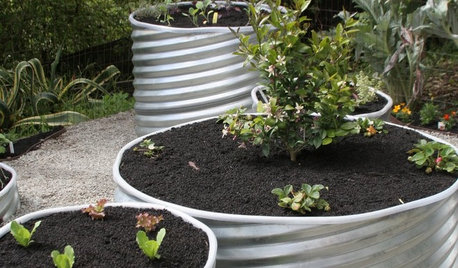
    1. Change all raised beds to galvanized tanks like these and put them on bricks or pavers so there's air beneath them.


    2. Change raised beds to smart pot type raised fabric beds like this. Not sure if tree roots would be able to go through the fabric.


    3. Abandon the thought of raised beds and reconfigure the garden to all in-ground planting so I can till it each spring and/or fall. Save the nice fancy raised bed soil for pots.

  • 9 years ago

    Don't use galvanized, use fiberglass or whatever those are made of. Galvanized rusts and gets really ugly over time.

    We haven't had a lot of luck with fabric, various roots can penetrate it and you have to be careful digging or you tear it. Lots of folks love it though.

    Raised beds and traditional inground planting are two totally different animals and schools of thought. We've done both and my wife has flowers, etc. in various pots, eleongated trays, etc. Veggie garden I just plant traditionally.

    You "might" get by with a "single bitted ax" and chop around the perimeter, should be able to get down to 8-10" and will sever roots. Problem with that is, unlike a trench where you can see and pull out the root, it would just be cut and immediately start "infiltrating" again. However, it is easier than trenching, grass would heal fast and be fast to accomplish.

  • 9 years ago

    Agree with exmar. Galvanized tanks are not only expensive to buy and fill but have limited growing room so you end up with very expensive vegetables. The fabirc pots and beds are not root-proof, just somewhat resistant, and have a limited life span and difficult to maintain from year to year. I have several of them in 10-15 gallon size and I'll be lucky if they last through this their 3rd season.

    And any container is a totally different type of gardening with its own rules and problems from either in ground or even a normal raised bed. But since you have been using only small 4x4' raised beds you may be able to make the transition to containers more easily.

    So, if you are going to go to large containers of some kind then go to heavy duty plastic with drain holes in the bottom and elevated on some bricks so no ground contact. No root problems, cheaper, easy care between seasons, longer durability, and no heavy equipment required. There are many heavy duty plastic containers that will give you as much growing room as a 4x4 bed does.

    Dave

  • 9 years ago
    last modified: 9 years ago

    I had to abandon six boxes 4x8 12" tall redwood boxes, invaded with redwood roots. Guys they got me back for using redwood! Pretty sure I posted here somewhere. I grow in containers now.

    Good luck.

  • 9 years ago
    last modified: 9 years ago

    I just got done cutting down one tree that was about 20' from the closest raised beds last weekend. The roots are drawn to the garden beds because of the fertility of the soil and the moisture from watering I'd guess.

    I don't dig a wide trench but I do severe the roots in the top 10-12" of soil at least every other year by using a sharpened flat spade. When the soil is soft a couple days after a decent rain in the spring, I go around the perimeter of the raised bed area about 10' out and drive the spade as deep as I can. It takes awhile for the roots go grow back into the beds.

    Sunflowers thanked LoneJack Zn 6a, KC
  • 9 years ago

    With the right tool, hand trenching can be fairly easy.

    A mattock, with a trench-digging blade on one side and a root-hacking axe blade on the other, would be my weapon of choice. Use a shovel only to remove the dirt, not to break it up.

    Dig in multiple passes, one blade-depth at a time, remove the dirt, and make the next pass. Let the weight of the mattock's head do the work. You don't slam it down like a WWF fighter slamming an opponent.. Give it a bit of a downward flick with your arms and let it fall.

    https://www.youtube.com/watch?v=HfJAT5AOecI

  • 9 years ago

    If you are going to drill holes in plastic containers, drill them on the sides about a one up from the bottom. This will keep tree roots from coming up from the bottom, and let a little water stay in the bottom in the summer to soak back up, especially if you use peat moss. I have had trees roots grow up from the bottom and invade the entire pot. Also, if the pot sinks in the ground a little the inch above the bottom will allow for better drainage. May not work in the north where drainage is a premier, but in the south it has worked well for me.

    I have found that cutting the roots on the outside with a spade once a year works pretty well. If the garden is growing well that is all that matters. The annuals compete pretty well with the tree roots if you provide enough water.

  • 9 years ago

    Thank you all! I'm going to try to sever the roots on the side of the beds closest to the trees. I still may grow a few things in containers to be safe. That's a great tip on not drilling the hold right on the bottom, garybeaumont.


    I have a 4'x 8' raised bed with blueberries in it. Do you think the roots will be attracted to or repelled by the acidic soil in the bed? Because I'd hate to have to disturb the berry plants' thin surface roots.


    Also, I hadn't planned on tilling the tomato bed this year because we tilled it last year and I'd like to try a year of no till with that bed. Do you think tilling would help break up any roots?

  • 9 years ago

    I have fruit trees in the ground with pine trees close by. Yes, they do invade the raised beds but the do not seem to hurt the growth too much. But I do get ample amounts of rain. I would think the blueberries would be ok as long as you keep them moist. I would prune the roots outside of the bed and not disturb the roots of the blueberries. The acidic soil wouldn't attract or repel the roots. I have elm trees where I am with a pH of 5.5 in the native soil.

  • 9 years ago

    has anyone lined their trench with plastic corrugated roofing?
    I'm reluctant to use galv steel.

  • 7 years ago

    I have cedar trees near my vegetable garden, and we wanted a solution that did not include frequent trenching (plus cedar roots go deep and find their way under even a deep trench). We created a galvanized bottom for our beds and put them up on cinder blocks. Works great! I posted photos and some instructions on how we did it on another post: https://www.houzz.com/discussions/constructing-raised-bed-with-bottom-to-avoid-root-invasion-dsvw-vd~1476833

  • 7 years ago

    KGBM isn't there a cheaper way? Can't a bottom be placed on current garden beds and then placed onto something like cinder blocks or how about placing on weed block material with a few inches of gravel?


  • 4 years ago

    Weed block material doesn't work at all. I experimented with some copper fabric and no roots of any kind went through it. Roots hate copper. Copper fabric is expensive and you have to go up the sides a bit or the roots will come in from the sides, but the fabric is totally unscathed after being in the ground for a year or two. Just saying so maybe it will give someone else an idea.

  • 4 years ago

    I eneded up building raised beds with bottoms and put them on cinder-blocks and after two years no roots from eucalyptus. Hope this helps others. There was no other way around it for us, the eucalyptus roots were relentless otherwise.

Sponsored
Buckeye Basements, Inc.
Average rating: 5 out of 5 stars40 Reviews
Central Ohio's Basement Finishing ExpertsBest Of Houzz '13-'21