Software
Houzz Logo Print
upperbaygardener

Are there wild Pinus strobus in New Jersey?

9 years ago
last modified: 9 years ago

Farjon says of the species: "[south] of the Chesapeake Bay, it retreats inland". I think it retreats inland south of the Long Island sound! In all my time driving around central or southern New Jersey, I've never seen what I thought was a wild one. And certainly nowhere in the Delmarva. I've seen them in the mountains of NE PA, meaning they might be found in the mountains of NW NJ, but I've only done a brief whirl through that part of the state to visit the excellent Well-Sweep Herb farm nursery.

Can anyone shed some light on this? Maybe it's possible he (or a volume contributor) was confusing cultivated specimens with wild ones?

Comments (17)

  • 9 years ago

    Well, you can check a distribution map HERE.

    tj

  • 9 years ago
    last modified: 9 years ago

    Thanks, I had seen that at some point. Was more curious to hear from anyone in the state or more familiar with the flora there. Am I just missing them? Admittedly, the Delaware valley is a pretty developed area, and along I-95 near Trenton, for example, it's possible I saw some and just dismissed them as being planted. Again...it's not that you don't see white pine in NJ, obviously - just doubtful I've seen truly wild ones. Certainly none of the wild pines forming that canopy at Rarefind, for example, are white pines.

  • 9 years ago
    last modified: 9 years ago

    Seems conifers have survived wild in "islands" out & away from their main base, like hemlocks & table mountain pines. Wouldn't be surprised if white pine has done this in hilly northwest NJ.

    UpperBayGardener (zone 7) thanked bengz6westmd
  • 9 years ago
    last modified: 9 years ago

    Good point beng. There is an "island" of hemlock in Harford county I do believe is natural - because the trees are estimated in some cases to be almost 300 years old. OTOH the way that map shows a little blob of white pine in the middle of the eastern shore? Or over Aberdeen, MD? I find that suspect. Maybe back in the 1820s someone tried to create plantations of them that failed. By 80-120 years later, some old looking trees remained and someone assumed they were native? The little blob over the eastern shore is especially suspect. There's nothing geographically different about that patch. There's no 2000' tall "Delmarva Mountain" LOL. (it would be cool if there were) Unless an expert who studied the Midatlantic distribution of Pinus strobus can address this (from beyond the grave if an academic paper can be found) I'm going to be suspicious of that part of that map.

    At any rate the overall map confirms my general concern with Farjon's statement - they've already "retreated inland" north of the Ches. Bay, not south of it.

  • 9 years ago

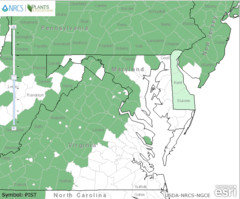
    Here is a zoomed-in map from the USDA, you can zoom in further if you like, the slider is on the left, and move around on the map by clicking and dragging the cursor https://plants.usda.gov/core/profile?symbol=PIST

    UpperBayGardener (zone 7) thanked Ontario_Canada5a_USDA4b
  • 9 years ago
    last modified: 9 years ago

    ok well it might make sense I hadn't seen them as my driving/visit experiences in NNJ is very limited compared to the central and southern NJ, as I said. Haven't driven much north of I-195 and the area around Trenton/Princeton, NJ. I used to work for a company with an office outside Princeton in that area before 2005, and visit Rarefind each year after 2005!

    As for the zoomed in map, the notion of them being in the Potomac River valley south of DC is very surprising to me. But the next time I'm down there I'll check it out. It's possible they blend in so well with the other pines I have just never noticed them. The newer detailed map doesn't show a blob on the eastern shore, at least. Why Harford County but not Baltimore County - it has just as much high, hilly terrain if not more.

    What are really surprising to me are the Alabama outliers, which are not even in the mountainous part of the state!

  • 9 years ago
    last modified: 9 years ago

    They are gorgeous trees! Used to have one planted in front of another house. But they don't seem that prominent in NJ/Zone7, in the most eastern lying, low land areas. I remember that when I first saw one, I naively thought it looked like what I assumed a "western conifer" would look like.

    UpperBayGardener (zone 7) thanked User
  • 9 years ago
    last modified: 9 years ago

    The USDA map above is absurd -- P strobus is widespread & native in my west MD county (Allegany) and also the white counties in eastern & central W VA.

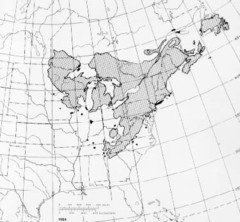
    Edit: OK, here's a more accurate if not as detailed a map from the US Forest Service. Note the islands & the differences between the two maps in, say, OH, WV and MD:

    UpperBayGardener (zone 7) thanked bengz6westmd
  • 9 years ago
    last modified: 9 years ago

    That map is a little more reasonable (none in south Jersey, and even better none in Alabama!) but I still don't believe they naturally occur in the immediate western suburbs of DC, Baltimore & Philly as is depicted. At minimum, I think you'd have to be the mountains like the Catoctins. I've been to Sugarloaf mountain a lot of times and feel like spotting a wild Pinus strobus there would have blown my mind. All of the pines at the top are clearly other species.

  • 9 years ago

    Well, don't question me, question the USDA :-)

  • 9 years ago

    Ok, full disclosure, I gotta admit I think in _some_ cases I am just tuning them out.


    Today I drove up to an Amish farm supply store to buy some potting soil and other supplies. (chain hardware stores these days exclusively sell the cr-p that is preloaded with fertilizer) As I have several times before I drove past the Octoraro Reservoir. Had never noticed a big portion of the shore line is lined by white pines! It suddenly makes you feel like you are in Maine or something! BUT, that is still a bit suspect to me. It's not a natural lake and that land was quite likely Amish farmland before the state bought it. The white pines could well be a plantation type planting...for one thing, looked too much like a monoculture. Anyhow I'll keep my eyes open, I might make another trip to NE PA or upstate NY this summer and I'll try to see where the dividing line between natural and cultivated ones is.


  • 9 years ago
    last modified: 9 years ago

    David, pretty much every square foot of forest in MD, PA, VA, etc has been logged at some time. Perhaps P strobus was originally found scattered around the megalopolis areas (the range limit seems to be the fall-line in MD), but unable to subsequently regenerate there? The oak/hickory/etc forest resprouts from cut stumps, but conifers that were in them couldn't do that.

    There's several apparently planted P. strobus groves not far from me in Green Ridge State forest that are old & the trees well over 100' tall.

    UpperBayGardener (zone 7) thanked bengz6westmd
  • 9 years ago
    last modified: 9 years ago

    Well you raise an important point. I was thinking along somewhat similar lines: for example, the oldest primary source I can find about Maryland at least, was in google books and was one of those turn of the century "gazetteer" type publications. It simply states something like "not found in the eastern part of the state". So it makes me wonder if back then, 1900 or so, they knew that it was only from being planted in, say, the Delmarva, if it was seen there. Fast forward to 1971 when the USGS map found at wikipedia was created. Some naive field correspondent sees some old white pines in the middle of the Delmarva, assumes they were wild, and puts a blob of them on the map? Not realizing as they would have in 1900, had the same pines been seen, that they had merely been a plantation planting of some kind?

    My extended family owns some southern pine plantations down south, they have been harvested for over 100 years, and I know from having been in those forests the trees at least used to be scatter-shot planted, not in rows. So you could think you were seeing a natural forest.

  • 9 years ago
    last modified: 9 years ago

    David, you bring up something unusual I just recently noticed driving along Rt 70 around 10 miles east of Hancock, MD -- a small & very hard to see planting of healthy-looking Loblolly pines in a very wide section of the medium. I'd assume the State planted this decades ago.


    And yes, the aforementioned P strobus groves planted in Green Ridge State forest are dense, but not in discernible rows.

    UpperBayGardener (zone 7) thanked bengz6westmd
  • 9 years ago
    last modified: 9 years ago

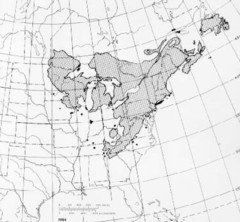
    Of course one could do it themselves, but I blew up the Forest Service jpg. Click on it to get the largest view:

    UpperBayGardener (zone 7) thanked bengz6westmd
  • 9 years ago
    last modified: 9 years ago

    One wonders from the above map how P strobus got to Newfoundland after the ice-age. Cones carried by ocean currents (unlikely to survive the salt water), or more likely migrated when climate had warmed (like 8k yrs ago) but ocean levels were still low enough for a land bridge to exist.