Software
Houzz Logo Print
griswoldam1

Oh no...Should I paint OVER this wallpaper?

9 years ago
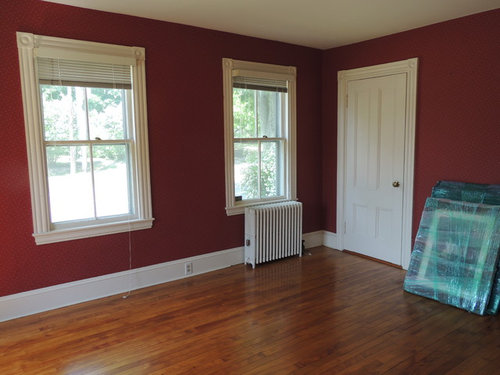
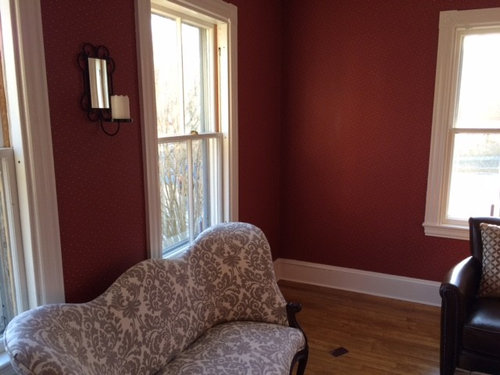
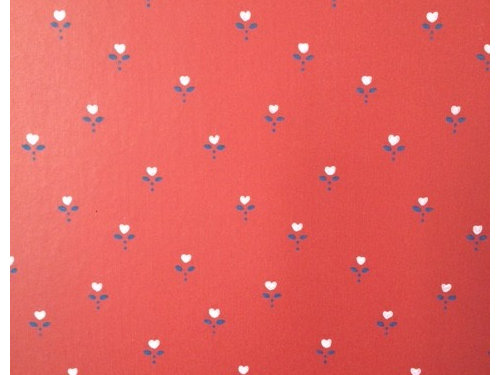
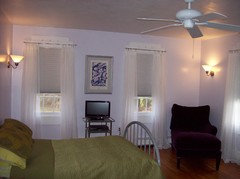
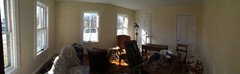
Our old colonial home has some "inherited" wallpaper that we'd rather have down. The room is the parlor in the front of the house and I actually didn't hate the wallpaper...until someone pointed out that up-close it's little hearts. Nope. It's gotta go.

We've been putting off the struggle because we're intimidated by ripping it down - we've heard that can be hellish. It's the only wallpapered room in the house, which is almost 200 years old. The wallpaper is in very good shape, but we have no idea how old it is. Running a hand along the wall (and based on other walls in the house) makes me worry that the wall behind the paper is uneven and not in fantastic shape. One wall used to have a woodstove and there's odd bulges there which is masked by the paper but I worry would be difficult to cover with paint. That may be why this room was papered in the first place, but we don't know.

What's the verdict on painting over wallpaper? Is it really a mortal sin? Any experience or advice would be appreciated!


Comments (39)

  • 9 years ago
    If you paint over it it will make it that much harder to take down. Also, painting can loosen the paper. I would just take it down.
  • 9 years ago

    Painting over wallpaper just creates more mess! It's best to take down the wallpaper, then paint.

  • 9 years ago

    Oh boy, that's what I was afraid of hearing. What if after we take down the paper we find the wallpaper was "hiding' terrible walls? What are my options then? Should I consider wallpapering OVER the existing wallpaper instead? Or is that the same thing - requires taking down the existing paper?

  • 9 years ago

    Putting up wallpaper over existing wallpaper to cover up wall imperfections is like putting a bandage on a dam. You just end up with several layers of wallpaper which can become a problem down the road. Fixing wall imperfections is not that hard--you just need to find someone who knows how to use caulk or wall putty, which is what my husband does when we need holes patched up. Once the hole is caulked you do have to let it cure for at least 24 hours before you can paint or do anything else.

  • 9 years ago

    what Bev said. score the paper, spray it with solution (look it up, I forget what it is) and peel it off the walls. scrub the residue before applying paint. hopefully the wall is in decent shape. if not, its easy enough to float and redo. plenty of how-to videos out there.

  • 9 years ago
    The correct answer is you should take it off before painting. Having said that I've actually painted over wall paper. The biggest issue doing so is the seams show. If you want to try, tsp first and use flat paint.
  • 9 years ago

    Thanks so much, I feel like I dodged a bullet. Down comes the wallpaper after all. A friend said I should use a steamer of some kind to take it down, which sounds different than the spray solution Beth mentioned. I'll have to look up both options.

  • 9 years ago

    Anyone have any inspirations for paint colors for this room? It's a formal room and the rest of the house uses historic or historic-inspired colors. The room gets a lot of light but I was thinking this red was a bit dark.

  • PRO
    9 years ago

    I have done both and if you don't plan to be there for 5 years, paint it. If you are staying, then go to Ace Hardware and buy some wide blade, long handled scrapers. The kind that have replacement blades. You will need a lot of them! Then score the wallpaper (but not the plaster) and spray it with warm water. There are pre-made solutions, but I have found warm water does just as good. Then let it set for about 10 minutes. Have large heavy duty plastic contractor garbage bags ready and scrape it off. Get as much off as possible and then repeat where needed. Once it is mostly off, go over all the surfaces with more hot water and scrape again. Yes, it is tedious and time consuming. If you can convince our friends, (and they would be careful with your walls!) get 4-5 scrapers and some beer and pizza. It goes much faster then and you can have fun too! We removed 52 rolls of wallpaper on a home that was built in 1900 and some of those walls had 5 layers of wallpaper! If you paint it, it will bubble up in some areas, but just let it sit. Most of the bubbles will disappear, and if not, take a thin needle and poke gently on an angle and you can help remove the air pockets. Good luck!

  • 9 years ago

    Flo - you are leaving the problem for the next person who owns the home by advising painting if only there 5 years:(

    That is not good stewardship and can get you cursed to a hot place by the next home owner trying to remove the painted over wallpaper.

    I've heard from people that while renting the steamer is a pain, it works wonderfully.

  • 9 years ago

    Get the wallpaper off. Sort out the walls and when they're ready, paint them. You'll be happier and the next owners will thank you.

  • 9 years ago
    If the walls were primed well before papering the job of removal is much easier and you won't need the steamer, but if you find that its retry hard to remove a steamer will help. I happened to have a Joy Mangano My Little Steamer and that worked for the rooms where I needed one. Good luck!
  • PRO
    9 years ago
    Jhmarie - actually the wallpaper that had been painted was easier to remove. The coating once scored helped and cut down on mess too because you could remove larger chunks.
  • 9 years ago

    Removing the paper isn't as bad as u may think. But it is time consuming yet still it's worth the effort. Painting over it is like putting a bandaid over it n makes it harder to remove later. The best advice I can give is go slow n try not to gouge the walls. Even so u still have to skim coat the walls for an even look before u paint. I have used hot hot water n let sit for a few, if it's vinyl coated it will come off pretty much in big pcs, but there is still a thin paper coating to remove under the vinyl. One other advice, if u do like Flo says n invite friends to help - no beer until it's finished! Lol.

  • 9 years ago
    last modified: 9 years ago

    Remove it. If you don't want to do it yourself there are companies ( in my area) that will do it for you. That's what I did, they did it quickly, was well worth it .

  • 9 years ago
    We just removed wallpaper form the 4 th room in the house. We tried scoring followed by a warm water spray, a vinegar solution spray, and by the last room we broke down and bought a steamer at lowes for less than $50. Should have done it with the first room!
    So score the wallpaper, use a steamer, scrape the paper, wash wash wash the walls, fill the cracks, sand the walls, then paint.
    Like any paint job,the key is in the prep.
    Good luck.
  • 9 years ago

    Rent a wallpaper steamer for a day from Home Depot. Be careful to avoid gouging the wall when using a flat blade scraper. Put some music on and go to it. When you are ready to paint, use a good quality washable flat or matte paint. Using a paint that has no or very little sheen will help hide any flaws on the wall.


  • 9 years ago

    Guys, this has been so incredible helpful. Thank you! Armed with this advice I'm going to tackle this soon. I'm going to ask friends if anyone has a wallpaper steamer and see if I can get lucky that way! Anyone have a rough estimate of how long it will take a room this size to strip? We'll likely have to get childcare (we have two babies) and so try to get it done in two long afternoons. Now if only we could come up with a color to paint the walls! :)

  • 9 years ago

    Test for lead paint under a small corner of the wallpaper before you get started.

    griswoldam1 thanked apple_pie_order
  • 9 years ago
    200 yr old house and only one layer of wall paper? Doubtful!
  • PRO
    9 years ago

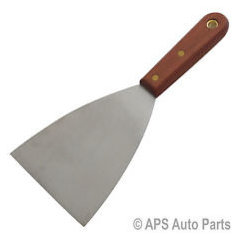
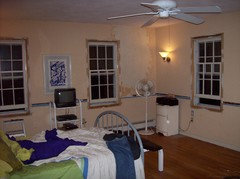
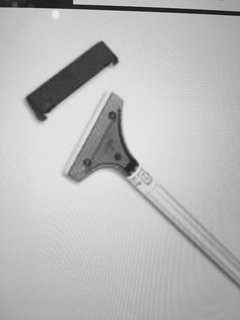
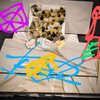
    The tool we found worked the absolute best is this one. I think Sears Hardware also carries them, but we got them at our local Ace Hardware.

  • PRO
    9 years ago

    Having trouble loading the photo. I'll try again.

  • 9 years ago
    Never paint over wallpaper. Hire someone to remove it...it'll take a short time if the person taking it down knows what they are doing. The final job is removing any residue of glue. Most professional painters can provide wallpaper removal service. And then they paint for you, too. Worth every cent, and it isn't expensive.
  • PRO
    9 years ago

    I've actually painted over wallpaper and it came out great...but here's the catch: painting over wallpaper should be the very LAST resort. Seriously, if you can get it off, get it off. But if all else fails...

    In my case, the previous owners wallpapered right on to the sheetrock without priming first. We tried everything - scoring, chemicals, heat and it was an absolute mess. The wallpaper and sheetrock were one so that it was only possible to get tiny half inch pieces off at a time. And it usually ripped a top layer of sheetrock off in the process.

    Here's what I did: First, I scraped off any loose pieces. Then, I used an X-acto to puncture any bubbles in the paper. Then, I applied a skim coat of joint compound to the entire walls. It took three coats to get it smooth and the sanding of the entire room was an unholy mess. BUT, I was finally left with a smooth paintable surface and it looks great. You'd never know it was paper painted over.


  • PRO
    9 years ago


    misc · More Info
    There are a couple of reasons this works so well. First it actually has a sharp blade, and you need to buy replacement blades because they dull fairly fast. But with this sharp blade you can slide under the wallpaper much better. The flat edged one shown above, just doesn't get under the wallpaper so you wind up sort of shoving the wall paper rather than lifting it. This one also has a long handle which helps in reaching further and getting more off at one time. My guess, just from looking at the photos of the room, you have about a 4-6 hour job, not counting the clean up, washing walls, etc. that will get the paper off. Then another several hours for really getting all the glue and remaining remnants of the wallpaper backing that didn't come off in the initial scraping. We did it on a "assembly line" approach. A couple people doing the scraping, a couple picking up the crud (oh wet wallpaper sticks to everything, so make sure you have a heavy tarp down on your floors! Get that stuff (which is now wet and heavy) into big extra strength garbage bags. Then someone took them out to the trash area. We actually had about 12 people doing this and we had it all done, including ceilings!! in one day! but it was WORK!!! No children allowed! Messy, dusty, sticky job. I put 52 rolls of wallpaper up to keep with the style of the house after this was all done! But I prepped the walls to death so next time, the "strippable" wallpaper would come off, relatively easily. Good luck.

    griswoldam1 thanked Flo Mangan
  • 9 years ago
    Oh, and pause periodically to do some reverse shoulder circles, and shoulder blade pinches. Your rotator cuff will thank you.
  • 9 years ago

    Our house was FULL of wallpaper when we bought it. We hired pros to remove it. Definitely money well spent, and they do it so quickly.

  • 9 years ago
    You have gotten excellent advice here on how to strip wallpaper. It will be cheaper to buy a small steamer than to rent one, even for one room. And I have loaned mine to my friends many times since buying it. Let the steamer do the work, soaking through perforations on the paper that you gently make with your scraper or a razor blade. After removing the paper you may have to wash the walls several times to get off all the glue. Use vinegar and hot water. It will help dissolve the glue on the walls. I suspect your walls are plaster, no? There are people who know how to patch plaster. They will test for cracks and secure loose plaster before removing that which cannot be repaired. This isn't something the average homeowner can do. Having a solid, smooth base of plaster to work with is important if you plan on painting your walls. Call me a bit strange, but I love stripping wallpaper off the walls. Those long curly pieces dropping down on the tarp. Plus....it is a great way to get a facial when you work with a steamer! Good luck!
  • PRO
    9 years ago
    After the wallpaper is gone and you have washed the walls down, make sure to prune with SHELLAC based primer. Regular primer or paint will craze over the remaining wallpaper paste (and there is always remaining wallpaper paste!)
  • 9 years ago
    last modified: 9 years ago

    This will save you cleanup and heartache.

    Purchase 2 canvas drop cloths 10x12 so you can cover the floor where you are removing paper. Canvas stays flat, (trip hazards get wet and messy as well as dangerous) don't slip like plastic or thin paper throwaways, and you can launder it if you wish. Use later when painting. Fold over about 2' along edge of wall to keep it nice and flat and to catch water from steaming and washing. You may want an over layer of old towels if it gets really drippy - saves LOTS of cleanup I guarantee.

    Smaller tarps are easier to move about or drape over furnishings when necessary to protect from other future small jobs where you don't empty the room before working - drilling to run wires, install drapes, etc. They will last a lifetime so are a good investment. I am still using my dad's from the 1940's, and they aren't that soiled although used for papering, painting, DE-construction, etc. Paint does NOT pass through the canvas.

    To fold tarp for storage, bring edges of short sides toward each other so they meet along the center of the canvas. Bring the resulting parallel folds on each edge to the center where they too will meet, then fold one layer over the other and you have a long, narrow, neatly flat stack of folded canvas. Repeat the process the other direction, folding both ends so they meet at the center and so on, till you have a neat folded square about 2' square. When you want to use the canvas again, lay it in the center of the room and unfold. This works especially well with big tarps (40' wide) because you know where the edges will land before unfolding (as in covering a roof under construction). My dad learned this procedure in the Army Air Corps during WW2.

    Write your name and drop cloth dimensions near one corner using permanent marker. Patch tears on canvas and on heavy outdoor tarps before storing so they are quickly ready when needed in future WET emergencies. Paint or rain will ALWAYS land in the one spot where there is a hole.

    Good luck. It could be worse. We once helped friends strip paper from an entire house in the 70's - most of it FOIL which steam and chemicals did not penetrate very well. It was similar to stripping the foil off gum wrappers! We became deliriously happy when we peeled off a strip 4x12"! Invite friends and get REALLY acquainted. You've got lots of good advice from others about stripping, plastering etc, so follow it.

    Oh, buy top quality brushes. They too will last a lifetime if you care
    for them properly. I have my dad's brushes from before the 70's and
    they look like new. They will save you more time than you can imagine.
    Go on line and read how to use fabric softener to remove paint from
    brushes - the best tip ever. I've used it for years.

    2 quotes I have learned are ALWAYS accurate:

    Those who don't do the job correctly the first time always find time to do it over. (ouch!)

    Buy the best. You only cry once.


  • 9 years ago

    Thanks everyone! Happy to report we're halfway through getting the paper down. With your tips it's been a cinch and we're lucky enough to only have one layer of paper. The walls beneath look pretty good - I'll post photo once we're done!

  • PRO
    9 years ago

    Love a happy ending.

  • PRO
    9 years ago

    Fantastic. Can't wait to see the finished project.

  • 9 years ago

    Wallpaper gone! The walls appear to be in pretty good condition too. We didn't even need to score the paper and actually ended up using a garment steamer to get the job done. Someone must have very kindly done good prep work beforehand. We're immensely grateful we didn't go the foolhardy route of painting over it when the previous owners had obviously done things right. Thanks for all the advice.

    One more question! The walls do still have a faint sticky residue. When it dries, its not obvious at all because it's smooth and flat, but I can kind of scratch the wall with my fingernails if I've just steamed over that area and a sticky film comes off. It dries hard, with faint stickiness. Is this leftover glue? Do I have to wash the walls and get all of this off? It's proving pretty resistant because it just kind of smears all over when you try to wipe it off with steam and vinegar. It would be a real pain to eliminate completely but I will if I have to - want to finish this job the right way!

  • 9 years ago

    It is either glue residue, or the sizing that helped the paper come off relatively easily. You have to get it all off or the paint won't stick. ( been there, done that )

    we used a solution of dish soap and warm water, with some baking soda in it.

    TSP was recommended but I couldn't find any at the time.

    scrub the wall, if you get chunks, use your scraper, then rinse. We did it 3 times, then when the wall was dry we lightly sanded the wall, then vacuumed the dust.

    good luck, and continue to protect the floor, your eyes and rotator cuff!

  • PRO
    9 years ago

    Yes, do what ladma said. It is either glue, or sizing or backing from the wallpaper. You aren't quite done yet. But forge on!

  • 9 years ago
    last modified: 9 years ago

    So glad steaming worked out well for you! Wash wall using a bit of soap as stated by ladma and flo. I have done this and it WILL take off all the glue.

    I once helped a professional artist friend paint walls of apartment in Chicago (with landlord's permission) in imitation of walls at Pompeii. Walls in all rooms except one were thoroughly washed and rinsed, except for the large bath, where we did NOT wash off all the wallpaper paste/sizing, hoping it would create a peeling effect and boy, did it! The deep red bath (a LARGE room) was stunning, looking as it it had just been unearthed by archeologists. The walls had a crackled, or crazed, appearance in many areas - some areas with large pieces, others with multitudes of tiny pieces - all curling up a bit, just as mud dries and cracks in patterns during drought. Guests ALWAYS were awed by it. It really was wonderful, but NOT for the timid and certainly is NOT what most people would want on their very smooth ordinary walls. So WASH those walls thoroughly!

  • 9 years ago
    Ive heard a mixture of fabric softener and water works. Products I would use is Gardz and BIN shellac.
Sponsored
Haus Studio
Average rating: 4.8 out of 5 stars28 Reviews
Franklin County's Preferred Custom Cabinetry & Design Studio