Software
Houzz Logo Print
biondanonima

Help with lilac placement

Lilacs are one of my favorite flowers, and I've been dreaming of having them for years! Now that I am gardening in my own yard for the first time, I'm afraid I went a bit overboard and ordered four varieties (a pink/purple Josee reblooming, deep purple, French red and Sensation) before I figured out where to put them! Furthermore, I ended up with three separate plants of the Josee variety. So now I've got six and I'm clueless as to placement. Help!

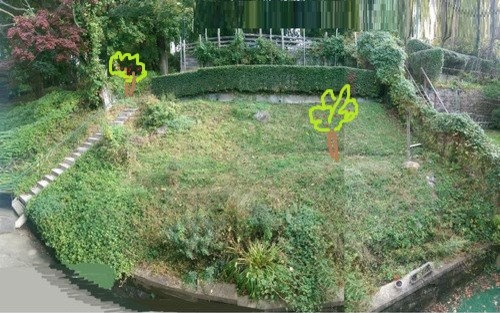
Here's a photo of the area I have to work with (backyard). I have room for one in the front yard, I think, so I was planning to put the French red there and keep the pink/purple ones in the back. The drawn-in trees are planned locations for two dwarf cherry trees. The red maple on the far left was dying and had to be removed last fall. This is a composite photo so the angles and perspective are somewhat off, but the area to the left of the staircase is about 10' wide and currently has nothing growing on it but weeds. It's very steep and rocky, but gets more sun than anywhere else (the house faces west, so that area faces south and has nothing blocking the sun).


In addition to what you see in this photo, there is a flat, grassy area about 7' wide AND a set of raised beds (ranging from 3-4' high) behind the hedgerow at the top. I am planning to pull out the hedgerow and create a low raised bed that runs the entire width of the yard in its place, leaving a 3' walkway between the new bed and the existing ones. Right now some of the existing beds are planted with garlic and tulips; the others need to be weeded but can then be used for anything. Thanks in advance for your thoughts!

Comments (15)

  • 9 years ago

    What is your soil pH? Do you see lilacs in your area? You will probably need at least a little lime to grow lilacs, but test to check. Where ever you put them, you won't be able to grow azaleas, blueberries or any real acid lover near them.

    biondanonima (Zone 7a Hudson Valley) thanked mad_gallica (z5 Eastern NY)
  • 9 years ago

    The pH may be less of an issue than you think. Like most plants, lilacs are adaptable to a range of pH but prefer it not too acidic (<6.0) and not too alkaline (>7.5). Mine grew quite happily in proximity to rhododendrons and azaleas in my 6.3 soil, however your soil may be excessively acidic so do test. But they do need full sun to bloom well! And 'Josee' is a dwarf reblooming lilac - I would plant them in a mass so to maximize the impact when flowering.

    biondanonima (Zone 7a Hudson Valley) thanked gardengal48 (PNW Z8/9)
  • 9 years ago

    nice job on splicing together multiple pix.. but the curvature of the pic.. really throws off my interpretation ... can you step back.. perhaps acorss the street and give us a regular pic ...


    i think you over bought.. lol .. we all start that way ....


    plant all of one kind together ... you really dont have 6 spots ...


    you dont mention size of what you got ... if nothing else.. just get them in the ground and move them in fall .... you can barely kill Ls ... planted in mother earth ... dont hold them in a pail of water until you make some decision .. they are not aquatics .... just heel them in ...


    is there any chance.. you were provided full latin names ....??? ... one way i do this type of thing... is to use google images on the latin ... see link below.. to get an idea of size potential ....


    iot will be imperative.. that you learn REJUVENATION PRUNING OF LILACS .... to keep any L from taking over the universe ... even if it claims to be a dwarf ... because.. a dwarf of a plant that can be as big as a house.. is still a plant that can be half as big as a house.. lol ...


    better pic.. will get you better ideas ...

    ken

    https://www.google.com/search?q=lilac+Josee+reblooming&source=lnms&tbm=isch&sa=X&ved=0ahUKEwjDoKKdsuDSAhWC8oMKHeFHBaIQ_AUIBygC&biw=890&bih=743#tbm=isch&q=syringa+Josee+reblooming&*&imgrc=_


  • 9 years ago

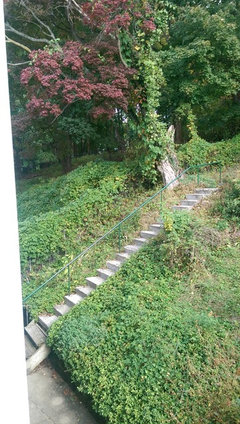
    I do see some lilacs around my area, although rhododendrons seem to be more popular (I have a couple of them in my front yard). The house at the end of my block has a gorgeous lilac though, so hopefully the soil around here isn't too inhospitable. I haven't tested the pH but I just got a meter so hopefully I can get a decent read soon, once all the darn snow melts! I can't take a better picture right now due to snow either, unfortunately. The curvature in the composite photo isn't present in real life - there is a 3' stone retaining wall that runs straight across the entire width of the property, broken only by the staircase. Here's the photo of that side of the yard separate from the composite. BTW, the chain link fence belongs to us so I can get rid of the mounds of vines on it (or try; I have a feeling some of them are pretty aggressive weeds!).

    As for the Latin names, here's what I found on the website from which I ordered:

    Syringa 'Josee'

    Syringa vulgaris 'Albert F Holden' (deep purple French)

    Syringa vulgaris 'Sensation'

    Syringa vulgaris 'Congo' (red French)

  • 9 years ago

    I grow both rhododendrons and lilacs on my property, in places side-by-side, and haven't seen any issues with either as far as health, so I wouldn't worry. My soil is acidic enough to grow wild low-bush blueberries and wild Rhododendron canadense (rhodora) so I wouldn't expect pH to be an issue. I do need to lime my veggie garden, but I've found lilacs far more forgiving.

    Consider putting them in spots that are visible, but will fade into the background when not in bloom since they don't hold much attraction when they are just green. You might want to stack at least 3 of them between the fence and stairs, though you will want to plant them in slightly flat areas you create so that moisture has a chance to soak in; this would involve using something to retain soil a bit, boulders or miniwalls. You would need to remove the weedy groundcover and immediately replace it with a combination of an ornamental groundcover and mulch. I'd also remove the vines from the fence as they would be equally happy growing over the lilacs. You can get the vines IDed on the Name that Plant forum. Or along the back fence would work as well. Regardless, I would consider the wind direction in deciding where to plant the S. vulgaris since one of their attractions is the scent, so where you will be should be downwind of the plants.

    I'd also encourage you to stop ordering plants for spring delivery. I know that's really tough to do, but it's a whole lot easier to prep the bed (weed removal, soil improvement if needed, any reworking of shape and grade, etc.) when there aren't already plants needing to be put in the ground or already in the ground that need to be worked around. Plan on spending the spring and summer prepping beds and then covering them with cardboard or multiple sheets of newspaper topped with mulch to keep the weeds from sprouting. In your area, fall planting in late September through late October is probably just about ideal, though check with folks in your area to confirm. I've planted as late as November (would you believe Thanksgiving weekend in a good year.) It's good for the plants since the soil is warm, but days are shorter and the air cooling, so less stress on the plants. They put out a lot of roots in fall, so can get well settled in before winter. Then mulch well and keep the soil damp but not wet until things freeze or leaves drop.

    biondanonima (Zone 7a Hudson Valley) thanked NHBabs z4b-5a NH
  • 9 years ago

    im not sure you have space between the fence and the stairs ... for a L of any kind ... ken

  • 9 years ago

    Ken, s/he said 10' width, and that would work for my lilacs, which were old when we moved in 20 years ago.

  • 9 years ago

    I grow clematis into one of my lilacs and it does extend the "bloom season" for the shrub, even though the blooms are borrowed. I like using type 3 (hard prune) clematis for this use since after hard freeze I cut them down to a couple of buds and then I don't have to look at dead vines in the shrub all winter.

    biondanonima (Zone 7a Hudson Valley) thanked NHBabs z4b-5a NH
  • 9 years ago

    Yes.

  • 9 years ago

    Unfortunately there is nothing evergreen against which to place them currently, but I would like to replace the vines on the chain link with something evergreen, so perhaps that could eventually provide a nice backdrop. I love the idea of training clematis vines onto them, too - the more blooms the better, IMO! Since the lilacs need plenty of sun, I don't know if I have any choice but to put them on the slope between the fence and stairs. The other side of the yard probably doesn't get enough sun, and I have the two boxes against the back fence that do get good sun earmarked for possible raspberry and blackberry plantings.

  • 9 years ago

    Consider putting the smaller ones in that large front bed of yours that you have posted about elsewhere.

  • 9 years ago

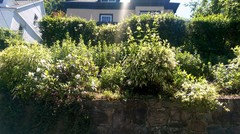
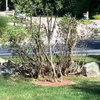
    NHBabs, do you mean this sloped area? I had considered it, but I wasn't sure I had space (although if I get rid of the uneven privet hedge and pull out some of the other junk, I might). I am planning to put the French red lilac out front, but in an area just to the left of this photo (where I happen to have a flat spot, one of the few!).

  • 9 years ago

    Yes. While some of it is nice plants, my memory is that there is a giant evergreen on one end and a sprouting maple, etc., so definitely some of it should be removed. Regardless, plant for scent as well as sight, so if this spot has wind blowing away from the hose, I wouldn't plant here. Is there a spot along the front of the house? Do you want to remove this privet hedge? IME lilacs can be twiggy enough to provide some privacy, even in winter. I was thinking more of the three Josees grouped out here. Keeping each kind together, 3 Josees and three S. vulgaris, will provide better size-matched groupings and IMO better bloom impact.

  • 9 years ago

    The house faces west along the Hudson river and we tend to get wind off the river, blowing from the front of the house to the back. I actually don't have a sense of smell so I hadn't thought of that aspect but it might be nice for DH to be downwind!

    You are correct that there is a big false cypress on one end (the left side of that photo), and a sprouting maple that is going to be eradicated smack in the middle. I would like to get rid of the privet and replace with an evergreen vine on the chain link fence or a trellis parallel to the fence. That might make a nice backdrop for the Josees? There is plenty of room closer to the house but I don't think there will be enough sun once the fence is covered in vines.