

About architects
I've seen so many folks here say, "hire an architect!" And the responses sometimes include, "Yes, I'm working with an architect." That is often followed by: "A real architect?"
Unless you work in the industry (I do, and have for almost two decades) you probably don't know this about architects:
Not all architects are DESIGNERS. Some are good with design, some--quite frankly--suck at design. The good non-designers know this and gravitate more toward project management or practice management or marketing.
I know literally hundreds of architects, yet there are only a handful I'd even *think* of hiring to *design* a house for me. Just because you're working with a "real architect" doesn't mean you're working with one who understands design.
Just wanted to throw this out there because I see these statements frequently, and I've seen plans/elevations created by non-designer architects.
I'm hopeful the architects on this forum will chime in, here.
Comments (85)
 9 years agolast modified: 9 years agoI hope he didn't give up his day job.
User
Original Author9 years agoI (for one) do understand about the legalities of practicing in a state where one is unlicensed. I was just throwing that out there - if your architect has a license, he/she passed the AREs and is, in fact, an ARCHITECT.
In the case where drawings have to be sealed, an out-of-state-licensed architect would team with a local to stamp the documents. :)Related Professionals
Mobile Architects & Building Designers · San Antonio Architects & Building Designers · Roanoke Architects & Building Designers · Augusta Architects & Building Designers · Edison Architects & Building Designers · Lima Architects & Building Designers · La Grande Architects & Building Designers · Florence Design-Build Firms · Santa Maria Design-Build Firms · Middlesboro Home Builders · Houma Home Builders · Wilmington Home Builders · Chambersburg Home Builders · Bloomington Home Builders · Beatrice Home Builders PRO9 years ago
Pardon me, architects...but I think we may be dropping into "deep architectural speak" which may be far beyond and of little interest to a consumer thinking of having a custom single family residence designed.
The challenge for consumers is to find experienced and creative architects who have a successful record of designing custom single family homes. And who are a good fit for each individual consumer, their personalities, needs-wants and budget.
To find a good fit, as with family doctors, attorneys, accountants and everyone else who works with consumers, it takes a certain amount of time, effort and due diligence on the part of the consumer.
Simply going to the builder's "designer" (or the lumber yard's "designer") may seem easy and a painless thing to do, (and golly, we'll save tons of money!), but this forum is full of threads about how this is not always a desirable solution, given the "designer's" limitations in experience and creativity.
Architects offer very real value in terms of quality and in terms of cost savings, initially and long-term, and that's the message that needs to be explained. Over and over.
 9 years ago
Simply going to the builder's "designer" (or the lumber yard's "designer") may seem easy and a painless thing to do, (and golly, we'll save tons of money!), but this forum is full of threads about how this is not always a desirable solution, given the "designer's" limitations in experience and creativity.
Yep if you want to see a great example of this, just go read my threads. And now that we're building, we continue to find issues that are directly caused by the draftsman missing things or not knowing any better.
- 9 years agolast modified: 9 years ago
"In the case where drawings have to be sealed, an out-of-state-licensed architect would team with a local to stamp the documents. "
That is certainly possible but it is important to know that in such cases registration laws require the plans, specifications and other instruments of architectural service to be prepared under the responsible control of the local architect. That usually means the work must be done in the local architect's office or the local architect must travel to the other architect's office. Reviewing and stamping work performed by an out-of-state architect ("hot stamping") is usually specifically forbidden. However, some states will allow it with reservations if both architects are registered in that state.
NCARB supports these restrictions as explained HERE.
The thread is "About architects" so I think it is worthwhile to clarify the rules that govern their practice even if it may not affect many homeowners.
- 9 years ago
This has been a great thread to read. We hired an architect for our build and couldn't be happier. Most of our friends live in the 'burbs and live in tract homes. Nothing at all wrong with that, but that was a direction we didn't want to go.
We live in an older neighborhood where new builds are a result of tearing down the old house first. Most of the homes are custom built. We literally drove around and stopped at those houses we liked, looked for any sign that said "Designed by XXX" or the name of the builder, so we could call and inquire who the architect was. We had a neighbor who built a gorgeous custom home several years ago and we called their architect for a quote too. Unfortunately, we soon found out that our high-end/desirable neighborhood and our gorgeous neighbor's house came at a price. All the architects we called via that method were very expensive. Out of our budget expensive. I'm not arguing their worth, but not something we could swing.
Then I put out a request of some generic website for architects to contact me to bid our project. What a holy mess! I got so many responses and I'd guess 99% of them did commercial work. The other 1% looked like they were just out of college and wanted/needed work. I just couldn't take the chance.
Then I remembered that I went to a college with a guy who is an architect out of Fort Worth. He works for himself and only does residential homes. He specializes in "vintage" style homes....like craftsman, Victorian, etc. and has a special love for Swedish architecture. So I called him out of the blue and asked him if he would design our house. We met, talked, drove around to show him the styles of houses we liked and he created something great for us. Full disclosure, after spending hours and hours looking at online house plan sites, when we got his design I hated it. I had become so accustomed to the standard house layouts and elevations I found online that this 'different' layout and elevation looked awful to me. It took several weeks of me just staring at it and doing research online (including this forum!) to realize that he knew what he was doing.
 9 years ago
Virgil, I personally find "deep architectural speak" to be extremely interesting..whether I understand everything or not:) I'm sure many people do. Great thread. I enjoy it tremendously and learn a lot through it.
(Reading books about doctors, for example, is also most interesting when a writer was a doctor himself (and many of them were actually). Gives you an inner perspective..invaluable, really. )
 PRO9 years ago
I learned a lot of "deep architectural speak" in my architectural classes, most of which can not be repeated here because there are ladies present. Maybe I misunderstood the term.
- 9 years ago
Full disclosure, after spending hours and hours looking at online house
plan sites, when we got his design I hated it. I had become so
accustomed to the standard house layouts and elevations I found online
that this 'different' layout and elevation looked awful to me. It took
several weeks of me just staring at it and doing research online
(including this forum!) to realize that he knew what he was doing.The above is so true. A lot of consumers spend so much time staring at standard mass market plans that we think all homes look like them.
- PRO9 years ago
And if you spend much time looking at the plans from the plan factories (and builders), you begin to see many similarities among them. For example, a square room located off each side of the entry space, called "Dining" and "Office" or a range of other names, none of which make sense. Why would any entry have two twin, symmetrical rooms on either side of the entry? And why would plan after plan do so? Is someone copying someone else...?
Every time I see such a plan, it telegraphs that here's another plan which will make little sense...
Look closely at the next few plans which are posted to see if it appears...
- 9 years ago
Virgil- This is exactly the phenomenon that made us quit looking at plans and start down the true custom path. (though we first talked with a designer, we quickly moved on to an architect).
- PRO9 years agolast modified: 9 years ago
I saw an interview with a well known artist years ago. The interviewer asked what advice he had for other artists, he said "Don't look at bad art". I see a parallel here.
 9 years ago
I have a question. Is it possible that a custom home design is so different or unique that it would be impossible or very difficult to sell.?
- 9 years agolast modified: 9 years ago
Yes. Though anything sells if the price is right.
I usually reference the 3,000 square foot 1 br house built for 7' tall guy. You got to the family room through the master bedroom. It had a 1 car garage. The kitchen was an 8 x 10 galley and the cabs were up 42 inches off the floor.
It sold. For about half price.
 9 years agolast modified: 9 years ago
I totally think so, PG. Totally think so.
Like what I want to build, if I didn't have to worry about resale *at all* (and if I didn't have interference from my husband, lol!)....
I mean, who in their right mind would want a 1-room deep, cube-shaped Storybook house, with an enclosed, outdoor central courtyard that's four times the volume of the house itself?
A kitchen for 2-4+ cooks (okay, 1 cook, 1 damage control cleaning lady, and 2+ "helpers"), with no upper cabs, 2 dishwashers, and a pantry that lives a double life as a tornado safe room? A laundry room big enough to hang dry/lay flat clothing for 7+ people, plus 2 wash machines and a dryer? A dining room for 10-12?
Only 4-6 bedrooms? Secondary bath(s) with 1 tub/shower but 2 toilets (in water closets) and 2 sinks? Window seats everywhere (except the bathrooms... aww, heck, let's throw a window seat in one of the powder rooms and call it a baby changing station! ;-) )?
No garage (gasp!), wishing wells, and a million rose bushes/vines all over the place? All hidden on a heavily treed piece of Heaven that you have to drive along a windy, cobblestone path through tree tunnels to get to? And if anyone is mean to me or wants to sell me something, the dogs are released and, "It's A Small World," pipes throughout the property until buckets of Newfoundland drool and insanity drive them away.
I'm sure I'd have to pay someone to take it, if I ever had to leave it. :-D
- 9 years agolast modified: 9 years ago
"Why would any entry have two twin, symmetrical rooms on either side of the entry?"
I would consider that the least offensive common aspect of internet plans. If a house has a center entrance, something has to be on either side of the foyer. When a house has more than two ground floor bedrooms its difficult to enter at a corner. Changing lifestyles contribute more to the repetitive ideas seen online than anything else.
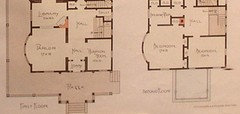
Rooms on either side of an entry foyer is a very old idea, Traditionally one of the rooms was a "reception" room for guests. My house (built 1891) has that arrangement with two sets of 6 ft wide pocket doors.
The difference today is these rooms can only have front facing windows because there is a garage and/or bedroom next to them. Internet designers are just following the space program people are looking for and unfortunately that doesn't fit well on a narrow lot.
I guess I've been lucky; no client has wanted more than one ground floor bedroom and older houses only have upstairs bedrooms so I've had few restrictions on the design of living spaces and many great stair design opportunities. The stair in my house is the best part of the house. When I have a party half a dozen people end up siting on it and I have many photos to prove it.
- 9 years ago
Our new house follows the "entry flanking rooms" design, but I thought it was based on more traditional designs. I like the idea of having a front house/back house design where the front half of the house is used for guests and formal entertaining and the back of the house is used for family and cooking. That's why I can't stand open concept design houses where you can see clearly into the family room from the front door/foyer, or when the front door is in the family room itself. Even with our central rotunda, our great room is partitioned off from the LOS of the front door by a fireplace column. We do have a study in the front of the house since we couldn't see wasting space on a formal living room and more visibility will force me to keep the office clear of clutter.
I wish our architect experience was a better one. We used our (fired) builders recommended architect since he uses him all the time and is experienced with ICF building requirements. What he turned out to be was a budget, but licensed architect that provided bare bones blueprints sans mechanical layout, which caused more work later. We came in with a strong idea of what we wanted and he just formalized the plans and put his stamp on it. There were a few site visits but nothing as site-specific-custom as most of you recommend. Being our first (and last) build, we had no idea what to expect, so I guess the fault is on us but there really isn't a lot of education out there. Through the sweat of our brow and years off our life, it's finally working out for us but we were saved by our interior designer and her recommended builder. User
Original Author9 years agoThis thing is still going? I wish there was a way to "turn off commenting" on this forum. lol
 9 years agolast modified: 9 years agoThe stepped Pyramid of Djoser, arch. Imhotep, built 48 centuries ago was the first large scale cut stone structure in the world attributed to a known individual making him the first known architect in the world. It was originally covered in polished white limestone.
Yes, as Vizier to the King, architecture was just a sideline for Imhotep, so to speak.
Personally, I've always preferred the later Mortuary Temple of Hatshepsut
Temple of Hatshepsut, Luxor, Egypt c. 1470-58 BC. arch. Senenmut
Then, as now, state-funded projects with unlimited budgets are where the money is for architects.
- PRO9 years ago
A custom home, which I believe is still on the market and available for perceptive buyers...you're welcome!

- PRO9 years agolast modified: 9 years ago
I will have to add a general note to my drawings, "∆This Side Up ∆"
- 9 years ago
There is always the side hall entry concept. It works well in narrow lot settings. If you make the hall wide enough, you don't feel cramped. It also allows light in from both directions.
On more generous lots, you can add step wings to the central structure or asymmetrical wings to the structure for master suites and garages. In my case, my southern colonial cape cod with Palladian pediment allows for two masters on the main floor. It is only two floors deep, so there is plenty of light.
- 9 years ago
My son has a degree in architecture. Friends have asked me why I didn't have him design my house. Because he has a degree in architecture but he is not an architect, that's why. I've had fun discussing options with him, and he is totally impressed by ARG.
Working with ARG is the first time I've worked with an architect. It was a lot of fun--and his design flows together. And he does residential work because he wants to.
 9 years agolast modified: 9 years ago
A while ago I mentioned this in the forum, I will do it again:
I am an architect in my country. A licensed one.
That does not make me any less or better than an American architect.
One of these days I will explain the smaller differences of my education (a mix of my former country's system, and American and European educational systems) in another thread by Virgil that I have seen in the past.
I just have to wonder which are those not architects that claim to be one in this forum that are soliciting jobs? I think the members should know this info. This makes a difference because a non licensed person with a bachelor's degree in architecture can claim to be an architect as long as he is not soliciting a commercial job.
Degree: I went to college for 5 years, full time. All my coworkers have a 4 year degree. I do not think any less of them. As a matter of fact, I always praise them, even in this forum and have called my boss the best architect I know. My degree was validated by Ncarb/Naab in order to join AIA. I have been a local president of the American Institute of Architects (I know, some of you dismissed it as a club but hey, my boss pays for it).
I completed the 3 years IDP. When I got my current job, all I had to show to my boss was 3 architectural magazines that I brought with me from my country, they featured some of my past jobs (and gave me the credit). He said, ok, I do not know how I will use your skills yet, or if you are a good fit, so lets start with a temporary part time job. I was offered a full time job before the "trial" time was over and I have been here ever since (13 years). When I came here I did to know any drafting program as I had a person that did this for me in my country of origin. By now, I know most programs (I though them myself) and last semester I went to college to learn Revit. There are many other things that I had to learn. Not many architects can claim that they are skilled in both, English and Metric system. I guess I was lucky that my father's business was lumber and that is the only thing that is measured using the English system in my country so I was very familiar with it.
Do I want or need an American license? No, but maybe I will get one in the future, to me is not a priority. I am more interested in become a better human being.
Now, guys you need to contact The Pritzker Architecture Prize. They are committing blasphemy calling all those international winners of the prize, architects. The Pritzker is an American Award. I particularly love last year's laureate whom is also from south America as I am. More that half Pritzker winners are from another countries.
Hmm. They are not architects? Think about it. Someone here once told me that Le Corbusier was not "a real architect". Yeah, everybody is entitled to live in their own little bubble.
Having said that:
The "real" architects in this forum are some of the best I know.
I highly respect them and knowing that JDS was a Walter Gropius student, makes me jealous :) I would not hesitate to hire any of them.
...
bethohio,
My father wanted me to be a doctor, but supported me when I decided to study architecture. He gave me the chance of designing my family's home when I was just an student.
...
A bit about me:
I am Martha, an architect from/in Colombia but you can call me whatever you want.
I love residential architecture and I am here to help.
- 9 years agolast modified: 9 years ago
Interesting Pritzker link.
The Taelons from Earth Final Conflict would feel right at home in the New Museum of Contemporary Art in N.Y., N.Y. (below)
Architects: Kazuyo Sejima, Ryue Nishizawa. Pritzker laureates, 2010.
Of course, I remember when The Guggenheim opened in NYC to near universal criticism. It's an "inverted oatmeal dish", snorted the imperial road master Robert Moses.
- 9 years agolast modified: 9 years ago
JDS,
Maybe you are going to be shocked when you see what will happen with the use of the word architectural. Some other time when in the office I will post a link that I received a few weeks back from the AIA.
editing to add that MSDG posted the link below.
What you said about Le Corbusier is true, but to say that he is not a real architect only shows ignorance (not saying that you did or that you are ignorant). LC was an architect in his country just like I am an architect in my (former) country. A person that knows his/her value shouldn't care about titles and I feel the same way.
- 9 years agolast modified: 9 years ago
I do not call myself anything in general, not even in my web page, on my business cards, at work or in social events (if someone is wondering). I do not need to. It changes nothing. I am happy for you or anyone else if you/they feel special by calling themselves whatever you/they want to be called. I can use the term Intern Architect but I do not.
In the office, there are 5 licensed architects, and only the principal signs the plans, no one else have ever used their license. I will retire soon to do some other things (I am still young) and that is one of the reasons getting a license is not a priority. I am earning the same as my licensed coworkers and I learned this by accident.
Currently, those Pritzker winners are being called architects, because they are, in their countries.
editing to add:
Complex? In my former county we enforce an earthquake resistant code. What happens here when we have tornadoes? Do you know what the general consensus is when architects from another countries visit and see the construction methods here? I have seen them laugh. I have to admit, I thought of the 3 little pigs story when I first came here but I hate to judge.
 PRO9 years ago
Intern no more: AIA supports two new titles for professionals pursuing licensure
https://www.aia.org/articles/70411-intern-no-more-aia-supports-two-new-titles-f
Check out the article and stay informed
- 9 years agolast modified: 9 years ago
And JDS, I am ok with your per saecula saeculorum diatrive. I am a patient person.
You could contact the P. Prize organization and file a complain as they are breaking the law according to you.
- PRO9 years ago
Folks, this is the sort of conversation which makes consumers laugh at and about architects--architects arguing about who is an architect and what is architecture(al), and whether or not it will all fit on the head of a pin.
I'm wondering if a more valuable conversation for consumers might have to do with the value(s) of using an architect to design a custom home...or not?
I'll take a wild guess and speculate that many consumers don't know the difference between their state of residence having a title act for architecture or a practice act for architecture. Going further out on the limb, I'm guessing not one consumer of a hundred even cares about the difference in these two types of acts which govern and regulate the practice of architecture in their state.
 9 years ago
I once used a residential firm who had a legitimate Architect, a certified designer, a certified CAD person, a certified artist and a client relations person to go between all of that with the clients - all under one roof. Worked out well.
- 9 years agolast modified: 9 years ago
The very successful Canadian ultra luxe "architect" Ferris Rafauli is not licensed and is careful to call himself a "designer." Licensed architects work for him.
***
Different countries, different ethos for sure!
The lighter the colour the less the corruption.
Canadian engineers are often confronted with problems designing in Latin America. Their mistake? They presume that what they specify is what is supplied whereas native engineers know that you have to at least double up everything as endemic corruption means that builders skim by half.
- 9 years agolast modified: 9 years ago
Awe JDS,
Do not do that. I like you. If you could see what is in my heart, you'll see that I have a lot of respect for you. I have learned a lot from you and I get upset when someone is not nice to you or when someone do not appreciate your expertise.
I see now that I went too far and for that reason, I apologize
I deleted my last comment.
- PRO9 years ago
Hey, I don't have a dog in this party! Leave me out of it...I tried to redirect the conversation to a more positive direction and was told to mind my own business.
Doncha just love how architects talk among themselves... :-)
- 9 years agolast modified: 9 years ago
So, I just went and looked at home that I was considering purchasing. It was constructed by James "Jimmy" Means, who was never licensed. He studied under both Neil Reid and Phillip Schutze and independently practiced for many years. Neither of those gentlemen were ever licensed, either. BTW, the house was spectacular. Too bad they wanted a renovated price for something that wasn't renovated.
I salute anyone who pursues and attains an architectural license. It's a very difficult accomplishment. Apparently, it's even harder to retain due to the continuing education requirements.
I think we all understand that licensing is a recent development of modern society. The title of architect is an accomplishment. It's not a designation of talent.
For the purposes of those who seek help with a project, it is important to understand the differences and everyone who has contributed has enlightened us.
- PRO9 years ago
"Doncha just love how architects talk among themselves..."
I find the more the speech is slurred the better the conversation goes.
- PRO9 years ago
Generally an Architect will design structures that will be occupied by people determining what it looks like, how the spaces are sized and located, how it sets within the environment it is located, materials and colors, and how the site is designed to help make the structure function properly.
Generally a Civil Engineer designs roads, bridges, dams, and similar structures.
There is overlap in in the two professional services and a lot of times in larger projects they will work together in designing the project.
There's better answers out there, but that is my shot at it.
- PRO9 years ago
Paraveina wrote, "...what's the difference between a civil engineer and an architect...?"
As Mark responded, the general difference is that architects design buildings intended primarily for human habitation, while engineers design structures for some utilitarian purpose. The specific difference depends on each state's licensing laws for architects and for engineers. It's these individual state laws which define what an architect may or must do and what an engineer may or must do. In many cases there is a certain amount of common overlap.
To further cloud the issue, engineering is a very broad field, and challenging to define simply or succinctly. The ranges of sub-specialties in civil engineering is staggering. Google "civil engineering" to be dazzled!
- 9 years ago
Google "civil engineering" to be dazzled!
I work as a mechanical engineer (in power generation) and my father was an electrical contractor (mostly for retail and industry), so I have an idea. However, I always assumed that when building a structure, an architect was the artist half of the equation, and the civil engineer was the code half of the equation, since most buildings around here have an engineering firm involved, but few have an architect involved.
Then I read about stamping in this thread, and got confused. Would it be correct to say an architect gets the portion of education to do with structures and their related codes, but not the rest of the civil engineering curriculum? And on the flip side, if a civil engineer had an eye for design, they could be the "person of talent" that people on this forum recommend, since their education allows for the design of structures?
- 9 years ago
Santiago Calatrava (from Spain) is both, an Architect and an Engineer. He was originally and artist and decided to study architecture after reading Le Corbusier.
It is my understanding that Santiago decided to study civil engineering after many engineers told him that what he wanted to do was not possible.
The 9-11 Memorial, admission building in NY:

- PRO9 years ago
In the U.S., in many accredited architectural degree granting programs, there is much more in the curriculum having to do with architectural design, and design studios, than with materials, engineering and science. Architectural degree programs do require introductory materials, engineering and science courses (these vary program by program, university by university), but are no where near the depth and breath required in accredited engineering degree programs.
Conversely, many accredited engineering degree granting programs, there is a strong emphasis on materials, engineering and science. "Design" plays a minor role and has a completely different emphasis than in architecture. "Design" in engineering is often focused on efficiency and identifying the minimal means necessary to successfully accomplish a given task.
To compare design, 5-year undergraduate professional degree programs in architecture may have up to 9-10 semesters of architectural design studios focusing on architectural and urban design issues of increasingly complex scope. A 6-year graduate professional degree program in architecture may have up to 11-12 semesters of design studios!
A 4-year undergraduate professional degree program in engineering may have one, terminal fourth-year class in engineering "design".
Now, to muddy the waters, there are around 26 university programs in the U.S. focusing on architectural engineering, but only a dozen or less are accredited. Architectural engineers typically start their university education with their architectural colleagues, but declare their major in the last 2-3 years of study, and typically focus their engineering studies on structures, environmental or building systems, acoustics or lighting specialties. Architectural engineers are typically classified as engineers, not architects, unless they have successfully become licensed in both fields, which is certainly possible if they have dual professional degrees and successfully meet the requirements for practice in both fields.
- 9 years agolast modified: 9 years ago
Thanks Virgil. I had expected all the focus on design for the architecture programs, but I hadn't realized there would be a small overlap with the engineering curriculum (hence why I thought a design would have to be handed off to an engineer for review).
How structured is a typical architecture degree? When I got my BScE, they were starting to compress the five year program into a four year program. I was able to choose three technical electives from a list of about a dozen options, and three actual electives from anything the university offered and the rest of my courses were compulsory (46 of the 52). Are you allowed more variety with architecture, or is it similarly packed with compulsories?









Virgil Carter Fine Art