Software
Houzz Logo Print
kevin_marsch

Black, sticky trunk on Pine

9 years ago

Hi,

Love my garden but I am no expert. We have a pine tree (I think it's a pine) that we've had since it was about 3 foot tall. It has grown and been

healthy for just under 20 years. This year however, it has developed a very sticky, blackish substance on the trunk and branches, which is dripping off it and staining the ground below. It has never done this before and I'm worried it may be unwell. Please see photos. Is this normal? If so how long will it be like this for. If it's not normal, what can be done. Thanks in advance, Kevin

Comments (59)

  • 9 years ago

    Hi Edlincoln, thanks for taking the time to try and address the actual issue here. I've looked at photos of the three trees that have been suggested so far (Abies, Blue Spruce, Balsam Fir) and have to say it doesn't look like any of them. My tree doesn't look as dense as these, the branches seem far more spaced on mine and the colour is a lot lighter, an almost yellowish-green.

    As for the other things you mention, I can't see any little blisters, flesh coloured masses of goo, holes, blisters or any other indication of damage. The sap on the trunk looks like it go's almost to the very top of the tree. I have never seen the cones close up as they only started to appear once the top of the tree was well out of reach, and they only grow at the very top of the tree.

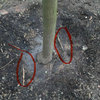
    I have included a photo of a close up of the needles as well as the very bottom of the trunk, which shows what the color of the trunk is usually like.

    Thanks for your time

    (Let me know if you need a closer shot of the needles)

    (The very base of the tree is closer to the usual color of the trunk, a very light grey/brown almost white color)


    (A shot to show the spacing of the branches. There's those gaudy fence posts again!)


    (The top of the tree - not sure that this shows anything useful)


  • 9 years ago

    If it helps, I am based in the North of England in a city called Hull (or Kingston-Upon-Hull to give it its full name) (UK City of Culture for 2017). It has a moderate climate, never really gets sustained periods of very hot or very cold weather, I think being on the estuary helps moderate it. Typical temperature in Summer is usually between 18 and 23 (although on really nice days it gets higher) and in Winter it will be between 2 and 5 degrees during the day with nighttime temperatures never really going lower than 2 or 3 degrees below (all temperatures in Celsius). Kingston-Upon-Hull Climate, Wikipedia

  • 9 years ago
    last modified: 9 years ago

    Edlincoln, I am really quite upset by your comments about me. You presume to know my preferred gardening style but you are wrong. My preferred gardening style is any style suited to the space and locality. It is simply not true that I often recommend cutting things down. That is complete rubbish. In fact I very, very rarely suggest that course of action and frequently argue against it, as any long term poster here can attest. Perhaps you are mixing me up with someone else?

    The fact is that I live in the U.K. and am familiar with conditions and styles of gardening here. Many US posters have very little idea of how small our plots are or of the massive variety of plants which we have at our disposal given our benign climate. There is no need for us to choose dull specimens and forest size trees. In this case I am just giving an opinion, which is what the forum allows. Obviously Kevin doesn't have to take any notice.

    Kevin, do you have grey squirrels? That kind of bleeding sometimes occurs after pruning but since you probably haven't done any at height it could from some other type of damage. That's where the squirrels might come in.

    I know Hull very well. My in laws live there. In fact I will be there next week starting to walk the Wolds Way from Hessle to Filey. Let's hope the weather is kind.

    I'm liking your Kingcups. Mine are still in bud because they're not in a great position.

    There are no sapsuckers in the British Isles. The standard Christmas tree 20 years ago was Picea abies.

  • 9 years ago

    I like the color of the fence and don't consider it gaudy at all. Fences here, if they are painted at all, are usually white. I prefer they blend in rather than standout. Same for house color also. Opinion only. :-)

    Sometimes sentimental value overrides common sense. A potential customer called me over to look at her yard and see what I could do to help it out. It had been professionally designed and installed with mainly a conifer theme. A good job on both counts, but it had been 20 years ago. Right in the middle of the back garden was a Acer macrophyllum (Oregon Bigleaf Maple) sapling about 7 meters tall. It didn't fit at all and I knew it wasn't part of the original design. I told her that obviously it had to go. She said she wanted to keep it at all costs. Her late husband had planted it. The tree stayed.

    Mike

  • 9 years ago

    its telephone poled ...


    when was the grade above the root flare changed??


    ken

    https://www.bing.com/search?q=root+flare&pc=MOZI&form=MOZTSB

  • 9 years ago

    My immediate feeling is that the tree is infested with adelgids, an aphid-like insect typically found nestled, almost hidden, along the small stems and needles of infested conifers.

    As they feed (24/7), they excrete large volumes of sticky, sweet waste upon which a simple black mold can develop.....called black sooty mold. The sticky stuff drips down, covering everything underneath the affected branches.

    The yellowing and thinning of the tree is another sign of an adelgid infestation.

    If we could see some closeups of a few branches, perhaps this mystery could be solved. Adelgids can be difficult ID, unless you know what to look for....they don't wiggle around and are quite small.

  • 9 years ago

    That's really quite weird. Hemlocks here get plastered by adelgids top to bottom but the trunks don't get wet like that. Aphids? Seems too early in the season for them. All I can suggest is that the "issue" seems to originate somewhere on the trunk above your pics....

  • 9 years ago

    The main sap sucking pest of Abies picea in the British Isles is green spruce aphid which is active in Winter. Symptoms are discoloured needles and sooty mould at joints not honey dew/sap all down the trunk.

    Keith, can you tell us what the liquid smells and feels like? Is it resiny? Is it a thin or thick liquid?

  • 9 years ago

    Is any of the sap dripping on the fence or is it restricted to the trunk? Did you check behind the tree to see if in windy condition it rubs on the fence and opening it up for pests?

    It is a fir. Abies balsamea is my guess.

    tj

  • 9 years ago

    Abies balsamea is fairly unlikely as a Christmas tree in the U.K. I couldn't find any sources for it other than dwarf selections.

  • 9 years ago

    Abies balsamea was my first thought as well...the reason I asked about the "blisters" is there is a conifer...I *THINK* it is Abies balsamea...that has lots of little blisters on the trunk full of resin. While I see things that sort of look like that on this trunk, the OP said it didn't have blisters.

    What *IS* frequently sold as a Christmas tree in the UK?

  • 9 years ago

    Abies nordmanniana?

  • 9 years ago

    Traditionally for many years Picea Abies (sorry, got it back to front above.). More recently A nordmanniana, A fraseri, Picea pungens and some others.


  • 9 years ago

    My reading shows Abies grandis as a naturalized tree to Britain and Ireland.

  • 9 years ago
    last modified: 9 years ago

    A grandis is found planted in forestry plantations and parks. It is only very slightly naturalised and wasn't found self sown in the wild until 1980s. It's not used in the Christmas tree trade afaik.

  • 9 years ago

    The needles of Abies grandis are flat and arranged like a comb. I have several including a few self sown seedlings.

  • 9 years ago

    I see lots of abies grandis seedlings around every mature tree of that species, in sweden

  • 9 years ago

    I can't explain that. According to the Atlas of British and Irish Flora 'It occasionally regenerates from self-sown seed.'


  • 9 years ago

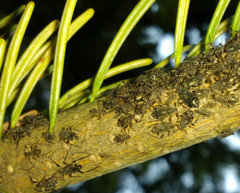
    Thanks all for your comments and suggestions. We have a possible/likely culprit. The underside of the branches are infested with these.


    Really gives me the creeps as I have been working under the tree a lot over the last couple of days and I know that my head has brushed the underside of the branches several times.


    So, I have a couple of questions. What are they? Can they be got rid of (bear in mind that they could be all the way up to the top)? Will they affect anything else in the garden (particularly interested in this one as I have just spent a fortune planting up the garden for the summer).


    (Really gaudy shed!)


    Thanks all for your suggestions and input so far.

  • 9 years ago
    last modified: 9 years ago

    Looks like aphids. Start farming ladybugs, they eat aphids

  • 9 years ago
    last modified: 9 years ago

    Aphids. Perhaps Cinara confinis on Abies nordmanniana (maybe). My first action would be to spray the tree with a strong blast of water every week or so. The blast just needs to be strong enough to shake the branches. They are soft-bodied and a sharp spray of water will kill and dislodge them. See how the infestation looks after 3-4 treatments.

    tj

    Kevin Marsch thanked tsugajunkie z5 SE WI ♱
  • 9 years ago

    Compare them with these fellows.

  • 9 years ago

    Really nice looking garden!

  • 9 years ago
    last modified: 9 years ago

    Actually not the worse thing it could be (for the tree). The hose and the ladybugs are both good suggestions.

    And while it isn't the cause of this problem, ken is right that you should dig out the base of the trunk to expose the tops of the roots.

  • 9 years ago

    We very rarely see ladybirds in the garden, so I'm thinking of buying some. Anybody in the UK have experience of these guys:

  • 9 years ago

    I've never bought Ladybirds, Keith. I find they usually show up if there's a good crop of aphids. I see them regularly on the allotment but not so much in the garden. Other insects also prey on aphids eg Lacewings and wasps and bluetits eat aphid eggs. Aphids tend to come in waves- worse some years than others. You might find they just peter out of their own accord, especially if you get some good heavy rain and wind. But not next week, please.

  • 9 years ago

    Aphids are also very temperature sensitive. Once it gets hot they disappear. That may not ever happen where you are, though! ;-)

  • 9 years ago

    Sadly, its never too hot for aphids here ;-(

  • 9 years ago

    Those are big aphids! We get large ones on Cedrus atlantica and Broad beans. (Fava beans) Water with a jet nozzle knocks them off. My neighbor uses Cayenne powder mixed with water for the Broad beans.


  • 9 years ago
    last modified: 9 years ago

    In my neck of the woods, the presence of aphids like that is usually accompanied by a colony of large black ants that milk and defend the aphids from predators.

  • 9 years ago

    Same thing here, ants will herd the aphids. Must be quite some time since that symbiosis started, since it is present on both continents. But can the ants fend of ladybugs or ladybirds or whatever they are called?

  • 9 years ago

    Floral that is too bad in terms of you having to fight aphids but I hate hot weather so would gladly trade!

  • 9 years ago

    'But can the ants fend of ladybugs or ladybirds or whatever they are called?'

    I'm thinking they can and even so the ladybugs wouldn't trouble themselves even trying, because the ants are so numerous.

  • 9 years ago

    Here's an interesting u-tube vid on ants defending aphids, https://www.youtube.com/watch?v=cxkqj6RfNNE

  • 9 years ago

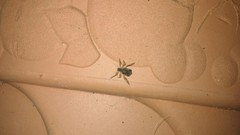
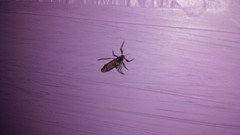
    Are they only interested in the tree? Now that I am aware of them I am spotting them all around the garden wandering around as if looking for something else to eat. If I knock them off with a hose are they going to start on the bedding plants that I have? Also, looking at the size of them they are the same size if not bigger than ladybirds/bugs. I'm not convinced that they'll be able to eat them.

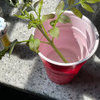
    On side of plant pot

    A winged one on the Purple Plant pot

  • 9 years ago

    They will eat a lot of different trees, shrubs and herbs. Once I felled a large birch tree and it was full of aphids, I had them all over me when I was finished.

  • 9 years ago

    Most types of aphid have a restricted range of food plants. This article describes some of the commoner UK species. If you do indeed have Green Spruce Aphid it won't go for your pansies.

  • 9 years ago

    'Also, looking at the size of them they are the same size if not bigger than ladybirds/bugs. I'm not convinced that they'll be able to eat them.'

    The idea is that the ladybugs eat the babies. no babies = no adults.

    Kevin Marsch thanked User
  • 9 years ago

    Looking at other photos I think I agree with tsugajunkie that they are Cinara aphids (I squashed a couple and they have a very distinctive purple mush, which from the limited reading I have done is indicative of Cinara).

    I found a ladybird in the local park whilst walking the dog this evening. I bought it back to the garden, put it on a branch with the aphids and it seemed to look at them before quickly flying away!!

    I will blast them with the hose tomorrow, although not sure i will be able to reach the top.

  • 9 years ago

    Gave the tree a good blast with the hose and its made an immediate difference. There are fewer aphids, but most noticeably (and surprisingly) the sticky substance on the trunk has gone.

    Further to this, and again surprisingly, the 100 ladybirds that I ordered on-line arrived this afternoon (super fast service). They have now been released into the tree. Fingers crossed its the beginning of the end for the aphids.

  • 9 years ago

    And all done with no poisons! The only spray you used was water.

  • 9 years ago

    Birds eat bugs. Even herbivorous birds feed bugs to their young. Would putting a birdhouse and birdfeeder in the tree (and a birdbath beneath it) help? Could attract birds. A good flock of starlings could make quick work of those critters.

  • 9 years ago

    edlincoln we have a small Sparrow colony at the end of the garden, a couple of blackbirds, a robin and three wood pigeons that spend a lot of time here. I have noticed that none of them are going anywhere near the tree. The sparrows and blackbirds especially used to use it as a lookout but not anymore.

  • 9 years ago

    Aphids are too small for most species of birds. The blue tit, Cyanistes caeruleus, is known to feed on them however. That is a common bird at my place and should be common in the UK as well. A birdhouse with a 25mm hole would keep larger species of birds out. The idea is quite good actually.

  • 9 years ago

    I mentioned Blue Tits in a post a while back. They feed their young on aphids and they eat a lot of the eggs in Winter. Dont quote me bu I believe other Tits also eat them. If you get Goldcrests, they like conifers and they eat insects. The pond would already provide water and bathing for birds so a birdbath isn't really needed. Blackbirds come to my pond for mud to build their nests.

  • 9 years ago
    last modified: 9 years ago

    I used to have a rhododendron called 'Blue Tit'. A customer bought it for no other reason than he liked the name. :-)

  • 9 years ago

    They are common in our gardens, along with Red Breasts.

  • 9 years ago
    last modified: 9 years ago

    Didn't notice the pics...is the pond shallow enough for birds to wade in?

    If you use bird houses for small birds, make sure the opening is reinforced with a metal washer so larger birds and squirrels don't peck or chew on it to widen it. Make sure it has a trap door for cleaning.

  • 9 years ago
    last modified: 9 years ago

    The
    pond does not appear to have shallow parts, but birds can use the stream
    leading to the waterfall. I had used the identical fiberglass product for a
    short while when I had my rock-and-water garden. It has a small shallow header
    pool/bowl with a gradual slope at the top end for small garden birds to wade
    in. Bigger garden birds just jump in to bathe. Also popular drinking spot not just for
    birds, but also for squirrels, bees, beetles, etc.

  • 9 years ago

    In the future if you want to use predatory insects like ladybirds you'll want laboratory reared ladybird larvae. More aggressive feeders, free of parasites that could get introduced to those that are native to your garden and won't fly away!