Software
Houzz Logo Print
adi_az_gw

Logan Labs Soil Report - Need Advice

9 years ago

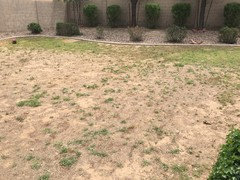
The lawn is in Arizona. Planning to plant BlackJack bermuda seed. It already has very small patches of Bermuda. Lawn gets full sun.

Comments (16)

  • 9 years ago

    Thank you Dchall.


    The lawn is in Phoenix. Attached is the picture of the area I will be seeding.

  • 9 years ago

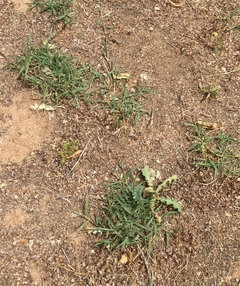
    There are small patches of grass as shown in the picture below. Everything else is weeds, and dirt. I think I am able to stick a showel 5 inches through using my leg pressure. I will give a shampoo treatment anyway

  • 9 years ago

    bump for ridge runner

  • 9 years ago

    There are a couple of questions I'd like answered.

    What if anything has been done with this yard (fertilizers, amendments, when and amount) over the last year?

    Have you done a vinegar test, if not, please do one.

    When you dig, does the soil stay together in a solid lump or does it crumble and fall apart easily like sand?

    Does water pool on the surface?

    How quickly does water soak in?

    Have you ever had a lawn in this soil?

    If so, did it ever do well?

    When do you plan to seed?

    How closely did you follow the following these guidelines:

    Proper and consistent soil sampling is a must in order to reduce inconsistencies and get the most accurate results possible.

    Proper: When digging the samples, use only high quality steel
    tools. Use only plastic buckets for holding and mixing the samples.
    Avoid brass, galvanized or other zinc coated utensils. Otherwise, the
    sample can be contaminated. If you do not have a soil sampling tool
    (auger or
    probe), insure that your soil sample is an even thickness vertical slice
    and not a wedge shaped slice. Take 8 samples, evenly
    dispersed, from each 60 x 60' area. Try not to sample any sooner than 30
    -60 days after an amendment application.

    Consistent: Take all samples to the same depth (4" for turf)
    and do so each year of testing. Use the same "range" of soil for each
    sample and from year to year. e.g. soil from the 0" depth down to the 4"
    depth (preferred, but remove the soil surface and any fertilizer
    prills it may contain). or from 1"-4", or the 2" to 4" depth, etc. Stay
    consistent. Take the samples in the same
    month each year.

    Use the same lab each year. Use an established professional or
    university lab that offers a broad menu of testing processes, reports
    results in ppm or lbs/acre and at a minimum, reports CEC/TEC, Ca, Mg, P,
    S, K, Na, OM, Mn, Zn and Cu. Verify that they offer ammonium acetate
    cation and buffer pH testing and that their fees are reasonable. Verify
    if they use Mehlich III as their default extractant and extra points if
    they offer Bray and Olsen too.

    Do the vinegar test on a small sample. If it fizzes, request that an
    ammonium acetate test be performed. If it doesn't fizz, either ask for
    or be prepared to request that (if the test comes back with a soil pH
    less than 6) a buffer pH test be done.

    I would encourage you to read this whole thread for additional information:

    http://forums2.gardenweb.com/discussions/4535255/taking-soil-samples-for-lab-analysis-get-your-moneys-worth?n=14

    adi_az_gw thanked User
  • 9 years ago
    last modified: 9 years ago

    Ridgerunner - Thank you for the response. Here are the answers

    What if anything has been done with this yard (fertilizers, amendments, when and amount) over the last year?

    [Ans] I may have tried seeding the lawn last summer. But nothing after that. No fertilizer, or amendments

    Have you done a vinegar test, if not, please do one.

    [Ans] Will do

    When you dig, does the soil stay together in a solid lump or does it crumble and fall apart easily like sand?

    [Ans] I dug the morning after I watered it the previous evening. The soil was moist, and like a lump. It did not crumble like sand.

    Does water pool on the surface?

    [Ans] Not much. Did not notice that.

    How quickly does water soak in?

    [Ans] Fairly quickly I think. How much time is quick?

    Have you ever had a lawn in this soil?

    [Ans] Yes healthy lawn until 3 years ago. We had trees in the area, and the Bermuda thinned out because of shade. Now we removed the trees, so I am hoping we will have a great lawn again. I did not seed, or water for more than 6 months.

    When do you plan to seed?

    [Ans] Plan to seed once the night temps are above 65 with blackjack Bermuda

    Soil sampling: Took about 12 samples equally spaced in a 1300sqft area. I used a metal shovel, and collected the soil in a painted metal container. Two things I probably did not do correct. Took the soil samples at 4-5 inches.

  • 9 years ago

    Bump for RidgeRunner

  • 9 years ago

    Ridgerunner I went through some of your posts on soil reports. and this is what I understood. I just need to check if you agree with my understanding.

    1. PH - 6.0 - 6.9 - My result - 7.6. High, but nothing can be done?

    2. TEC - ?? - My result - 14.32. Seems ok?

    3. Organic matter - 3% - 10%. My result - 1.70. Very low.

    4. Phosphorus: (range 124-280 lbs/ac of P205) Most common target is 200 lbs. My Result - 224. Seems ok?

    5. Calcium: (700+ lbs/ac to unknown) Ca/Mg ratio range: 5:1 - 10:1. My result: 10.6

    6. Ca Saturation %/Mg Saturation % - My result - 2.61

    7. Magnesium: (range 100-600 lbs/ac) - My result - 548. Seems ok?

    8. K Saturation: (2-7%) most common target 4-5% - My result - 4.82. Seems ok?

    9. Sodium <110ppm, and <5% base saturation - My result - 72.3ppm (217lb/acre) and 4.95%. On the high side but within range?

    10. Boron - 0.5 - 1.5 - My result - 0.79 Seems ok?

    11. Copper - 0.5 - 2.0 - My result - 3.06. Much higher.

    12. Potassium: (range 100-440 lbs/ac) Common target is 220 to 360 lbs/ac - My result - 359lb/acre Seems ok?

    13. Sulfur: (range 9 to 40ppm) Most common target is 15-40 ppm - My result - 70ppm. Seems ok?

    What I am not sure about is what soil amendments are needed before I seed. One thing is clear, is that I may have rake in some compost to increase the organic matter.


  • 9 years ago

    Vinegar test?

    adi_az_gw thanked User
  • 9 years ago

    Will do today, and post the results.

  • 9 years ago

    Ok, I did the Vinegar, and Sodium Bicarbonate test on the soil.

    I saw very few bubbles when I added the vinegar. No fizz, nothing.

    When I added Baking soda to a different sample, with some RO clean water. Same thing. No bubbles, no fizz.

    Looks like the soil is pretty close to neutral.

  • 9 years ago

    I haven't forgotten about you.

  • 9 years ago

    OK,

    First the recommended value ranges that you used in analyzing the soil are based on a 6" depth, and your test numbers are for a 4" depth. You'll need to adjust the test numbers to make any usable comparisons. Even so, some of your conclusions are inaccurate for other reasons. For one your Ca:Mg ratio is not in the 10:1 range, it is more like 4:1 (2300/548).

    Time is short, so without further adieu:

    The great news: Nutrient wise, this soil lacks for nothing. All nutrients, Major, Secondary and trace are within optimal range with some even in what might be considered excessive.

    The not so good news: pH isn't optimal as it's medium high. This can interfere with nutrient availability, but really should be no impediment to a nice lawn.

    It would be nice to get it a little closer to pH 7, but that is usually not practical.

    The other not so good news: The following affect structure/tilth issues, not plant nutrition (or very little) Your values are not at a critical stage, but be aware as values approach undesirable levels, adverse symptoms are likely to increase on a continuum:

    Magnesium: Mg can make soils "tight' and hard, think of it as glue. Thresholds for some concern are values >600ppm, >15% base, and Ca:Mg ratios less than 4:1.

    Potassium: In soils with high Mg (see above) or Na levels, K levels can increase soil particle dispersion (like Na can) that reduces space between particles reducing air and water penetration (soil compaction). Threshold value in high Mg/Na soils is >5% base.

    Sodium: Na is a major factor in soil particle dispersion. Threshold values are 10-15% base and > 110ppm. High Na values can also signal a possible soil salt issue.

    You have a nutritious soil that has some issues with some yellow flags in regard to improved soil structure/tilth issues. I think there is a good potential to create really nice soil here.

    It would be desirable to reduce pH, Mg and Na while Keeping our eye on Sulfur levels. (Although there is no known plant toxic level for S, there is some evidence that high S levels in a high EC soil has adverse affects on plants.)

    Two possibilities;

    1. Adding Elemental Sulfur (Flowers of Sulfur). The vinegar test in conjunction with a mid level 7.6 pH and your climate indicates that there is a decent possibility that S additions might effectively reduce pH over time. Due to the cation hierarchy, an increase in hydrogen would knock off some Na, and Mg and unfortunately some K. Sounds great, but it will take time, it's very aggressive and can be hard on plants and soil life and it's base cation balancing results are very unpredictable and due to soil characteristics can be disappointing in the base cation change results. In addition, it's going to raise S levels and which in conjunction with the salt levels I suspect are there, would not be good. So, although I strongly suspect your soil's pH is amenable to reduction, I'm not recommending this route. And certainly not in conjunction with a seeding. Review and reevaluate this again in a year or two.

    2. Adding gypsum, will do nothing to pH, BUT, the addition of Ca is adding the cation hierarchy bully and most assuredly should knock off some goodly amounts of Sodium and to a much lesser extent some Mg (unfortunately also some K and will reduce availability of P to some extent), However, your soil has an abundance of K and P, room to add Ca and you really need to drop Na levels (and Gypsum will help wash any salts out too). Although I try to avoid any amendments during or prior to seeding, gypsum is pretty benign and safe. This is the route I recommend.

    Recommendations:

    Apply 15lbs/k of gypsum ASAP, the longer the time between app and seeding the better-20-30days. Apply another 30lb/k app this Fall. (Septemberish)

    Avoid all sources of S. Use only uncoated urea, Milorganite or starter fertilizer.

    Apply a starter with your seeding.

    Do regular recommended apps of N (spoon feeding is always best for newer turf) once the turf is up and established, until then, Spoon feed starter.

    Next Spring, do a soil test this time of year and let's see what has happened. Adjust amendments based on test results.

    Good luck


    adi_az_gw thanked User
  • 9 years ago

    Sodium Bicarbonate test?

  • 9 years ago

    Sodium Bicarbonate/Baking soda also did not produce any bubbles.

    I really appreciate your detailed recommendations. I know it must have a lot of time to type it up. By 15lb/k you mean 15lb/1000sqft right?

  • 9 years ago

    Yes, 15 pounds of gypsum per one thousand square feet.

Sponsored
High Point Cabinets
Average rating: 5 out of 5 stars21 Reviews
Columbus' Experienced Custom Cabinet Builder | 4x Best of Houzz Winner