Software
Houzz Logo Print
katekingg

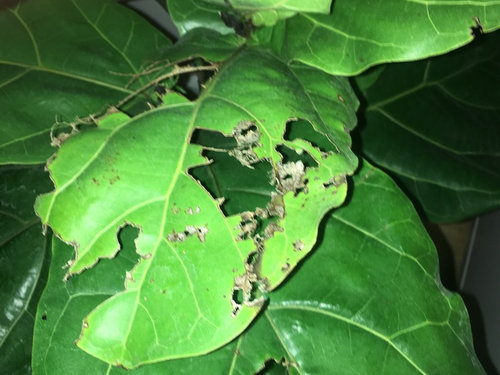
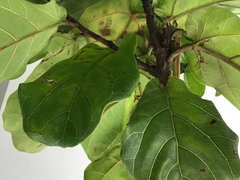
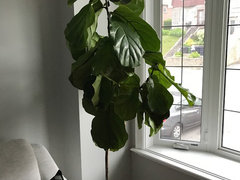
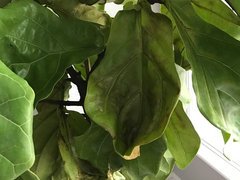
Fiddle Leaf fig damaged

9 years ago
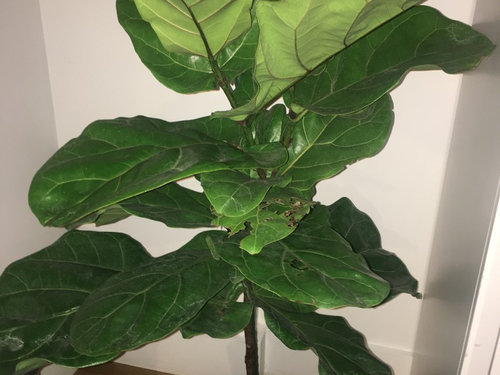
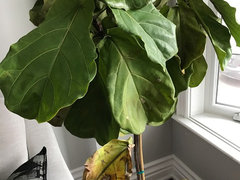
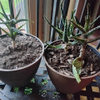
Should I prune the very damaged leaves? I just got this from an online store an unfortunately it wasn't in great shape.

Comments (18)

  • 9 years ago

    Hi Al!

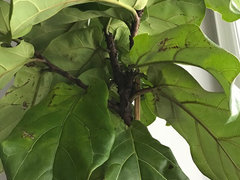
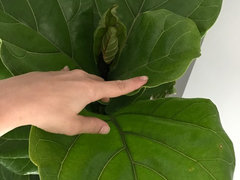
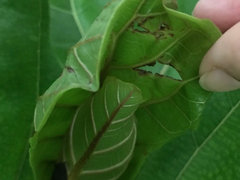
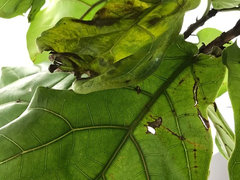
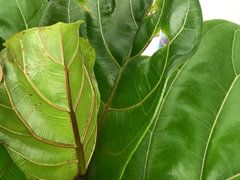
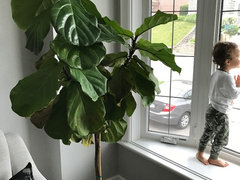
    I have been reading all your threads and haven't seen an answer to this yet so here goes... I purchased a 5-6ft tall Fiddle Leaf Fig with 3 branches 5 days ago. The bottom leaves don't look that great but the new growth looks decent. I was excited to see a new leaf coming in but upon checking it yesterday I was shocked to see t looks damaged. Ive attached a few photos and would appreciate any feedback you have. I have not watered it yet the soil is pretty dry but not completely. I am going to water it today. It's west facing bay window. The plant came from a plant store that was hot and humid and has glass ceilings and these plants sit in the middle with pure sun beaming on them. I am hoping after reading all of your comments I might be able to get "her" comfortable enough to keep us company for a while :)

    Thanks,

    Raquel

  • 9 years ago

    Most common in F lyrata, during periods of low humidity or in plants that are chronically over or under-watered, nascent leaves often stick together and tear as they unfold from the bud stage.

    Al

  • 9 years ago

    Thank you for your response! I've since watered it but I might need to flush and then fertilize with the pro 9-3-6 recommended. The water ran right through the soil and it's all dry again 3 days later. I'd like to repot it since it's not looking that great up top - the new leaves look almost rusty or if something is harming them or perhaps it's needing nutrients. Another thing I've noticed is that all the veins on the leaves are brown - they are not green or clear which makes me wonder whether I should have returned the plant (they have a 7 day return policy). I bet I could still take it back but I love this plant so much and although I searched, I could not find another one in better shape. In fact I'm shocked at how sad the main shops and nurseries selling the Fiddle Leaf have them in. Would it be too early to repot? I know you recommend doing it in the first or second week of June but I'm afraid to wait that long since the new growth doesn't look great and some of the bottom leaves are perhaps getting worse as well. Is there a way to get new growth near the bottom again? The leaves that are there before the tree branches out are in rough shape. It's been warm and sunny most days and the tree is next to the window with cellular shades so there is plenty of light. I plan on making some of the famous "gritty mix" this week and thinking about repotting.

    Thanks again,

    Raquel

  • 9 years ago

    A) Are you certain the entire soil/root mass is getting moistened when you water?

    B) In some cases, plants have been in the same pot for so long that a very high % of the soil has 'gased off'. This means that the soil particles have been broken down into elemental form, some of which has been uses, some has washed out of the pot, and a good portion has entered the atmosphere as CO2. When this occurs, soil seems to simply disappear from the pot gradually over time. When this happens, the root mass itself has to serve as the reservoir for moisture and nutrients. This is something you should check out. If you lift the root/soil mass from the pot and find it's pretty near devoid of soil, you're looking at the reason you need to water so frequently.

    C) If your soil gets too dry, it becomes hydrophobic (water repellent). When you water a soil in this state, water usually just runs over the surface and down the perimeter of the root mass between the root/soil mass and the pot walls. To fix this, you can soak the pot in a tub for an hour or so, or keep watering it with a fine mist from the hose or Foggit nozzle for an hr or so. Soaking wastes less water.

    Al

  • 9 years ago

    Thank you Al. I am not sure if it is getting entirely moistened, but I do try to disperse the water. I took your advice of letting it soak up some water and it seems that worked since the pot is still heavier than it was.

    I am having a very difficult time finding crushed granite and/or cherrystone in #2 size/forms here in Toronto to make the gritty mix. I can't travel to a farm since I've got 2 little ones under 2! I've read a few people use aquarium rocks (even the coloured ones) and I was wondering if this would be ok? Or would Clay Pellets / Hydroton (Liaflor) be a better substitute?

    I want to get the soil right the first time so as to repot only once!

    Thanks again!

  • 9 years ago
    last modified: 9 years ago

    You're welcome - my pleasure. The Liaflor would be too large to be of value as a fraction of the gritty mix. This might be helpful:

    http://forums2.gardenweb.com/discussions/1415995/canadian-gritty-mix

    I applaud your reasoned response (get it right the first time). One thing I'd point to is the fact that understanding the underlying reasons that increasing/controlling particle sizes in your soils has such a big impact on how able you are to keep your plants' root happy will allow you to make adjustments in your current practices that offer relief from excess water retention. ..... don't know if you've read this or not:

    http://forums2.gardenweb.com/discussions/2842847/container-soils-water-movement-and-retention?n=8

    Using ballast in your plantings can really make a major difference in how much perched water your planting can hold, and perched water is the major culprit when it comes to wrecking root health. If you'll take some quiet time (when you get it) to read the info at the link I posted to immediately above, when you come back I'll explain how to use ballast as a way to negate your soils ability to hold appreciabvle volumes of perched water.

    Al

  • 9 years ago

    I can testify to the effectiveness of Al's recommendations about using ballast. The smaller of my very ill scheffleras was in a too-big pot of very water-retentive potting soil that took weeks to dry. Using Al's advice I put three small jars in the bottom of the pot, making sure the soil between them reached the bottom of the pot, then planted the schefflera above the jars in the same soil. After that there was virtually no perched water in the pot after a thorough watering.

    That was late last year. It took a while before I saw any improvement, probably because the pathetic root system needed to grow before anything could happen aboveground, but now there's more than twice the leaf area as before, the bottom of the pot dries as fast as a plant that's already in 5-1-1 mix, and my brave little schefflera will be in great shape to repot into 5-1-1 or gritty mix in June.

  • 9 years ago

    Thank you both for your comments. I have read both links! Lots of great information! I have called numerous farms without any luck finding granite. I might have to order from bonsai jack as he seems to be decent in terms of quality but the shipping is 140$! I will continue to look for a local source in the meantime. It is necessary that I re-pot before I loose any more lower leaves (5 now). The top has stopped growing. I might have to prune the roots but I won't know for sure until I un-pot it. I plan on repotting it into a terracotta pot as I've read this is best for gas exchange. I would also like to try and "back bud" if this is the correct terminology? I would like to try and get the tree to grow back some of the bottom leaves as I am happy with it's height. Will need to read more about pruning / back-budding, etc.

    ballast?? please tell me more. I think I did this by accident once when I ran out of soil for my succulents and that might be why that pot was the only one that survived! Basically I stuck the four containers in the bottom of the pot to take up space and filled the rest with what soil I had! But If I use the gritty mix would I really need to do this?

    Raquel

  • 9 years ago

    If you understand what drives water retention, you'll understand this right away. If you're still a little fuzzy, don't be embarrassed to ask questions.


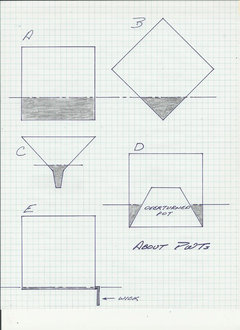
    Image D is a way to employ ballast to reduce the amount of soil that can hold perched water (PW). When using a given soil that supports PW (the shaded area represents PW) the ht of the perched water table (PWT) will be exactly the same in every conventional container set-up - no matter what it's size, shape, or depth. The images above illustrate that property. If a soil supports 4" of PW, you can eliminate almost ALL of it by using at least 4" of ballast in the bottom; but, to be effective, there must be at least a small amount of soil that forms an unbroken column between the main soil mass above the ballast and the bottom of the pot. If you don't have that unbroken column, (like when using gravel), water simply perches in the soil above the gravel. You end up with a layer of gravel and 4" of PW suspended in the soil above the gravel (see middle image below).

    Note that the bricks take up space that would otherwise be filled with soil containing PW. You can see the bricks reduce the volume of water that can be held within the PWT. To be perfectly effective, the bricks would be at least as tall as the ht of the PWT, and would completely fill the bottom of the pot ..... EXCEPT for a very small volume of soil between the bricks. Using ballast effectively can make an extreme difference in your ability to maintain a healthy root system. Envision some bricks or blocks of plastic that don't absorb water that almost, but not quite, fill the bottom of the put up to the ht of the PWT your soil supports and you have it. The saving grace will be the small amount of soil between the loosely packed bricks or ballast. That will be the ONLY soil that can hold perched water. This enables you to water correctly w/o much concern about limitations associated with poor root function/health.


    Al


  • 9 years ago

    Thank you for your comments and help.

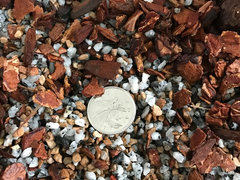
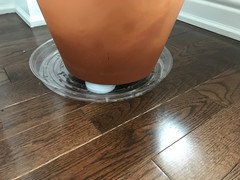
    I have transferred the fiddle leaf to a terracotta pot with gritty mix that I spend 2 days sifting through!

    When we lifted the tree out of the plastic planter it came it it was completely all in one stiff piece. It needed to be changed! There were signs of mold and the soil smelt bad. The place I bought it from had added some sort of green balls for fertilizer and I think it was burning the roots. The roots took a while to detangle and I washed them until there was basically no soil left. I only trimmed one huge long piece of the roots that was hanging and left all the rest for fear I might hurt the tree.

    Now I'm wondering when I should water again? How damp should a chopstick be before I water? It comes out clean now that it's in the gritty mix.

    Also, the leaves are all droopy - is this normal after a repot? Will they go back to normal after the tree regains its energy?

    Is there anything else I should know to help her out??

    Thank you,

    Raquel

  • 9 years ago

    Now I'm wondering when I should water again? If the soil was screened to remove all of the fines, you should be able to water at will. That's not the same as being advised to do so, but it's not unusual for plants to wilt after a repot. Important ?: Did you keep all of the root mass wet while you removed the soil? If you didn't, it's likely a lot of tiny roots that do all the work were killed. If so, it wouldn't be a bad idea to prune the top to prevent wholesale loss of the entire foliage mass or total collapse of the tree. How damp should a
    chopstick be before I water? It comes out clean now that it's in the
    gritty mix.
    For the first couple of weeks, it's important to make sure the soil surrounding the roots stays moist. I often start cuttings on a Friday, so I can keep a spritzer nearby over the weekend and spritz the top of the soil 2 or 3 times per day. It's usually just the top 2-3" of soil that dries out quickly when using the gritty mix, so you can help avoid over-watering by spritzing just a few ounces of water on the soil at a time - just enough to moisten the top few inches. An image of what the soil looks like would be helpful.

    Also, the leaves are all droopy - is this normal after a repot? It depends on the plant, how you went about the repot, how aggressive the grower was in root pruning, and how much foliage there is to root mass. Will they go back to normal after the tree regains its energy? Unfortunately, F elastica is one of the trees that has difficulty restoring the attitude of its leaves to their formal spacial positions once leaves have wilted; so 'wait and see' is probably the appropriate response.

    Is there anything else I should know to help her out?? At the moment, I can't think of anything you haven't already asked about. Keep it warm, in very bright light but not direct sun, away from wind and air conditioning vents, and start fertilizing when you see it pushing new growth.

    Al

  • 9 years ago


    How much of the top should I cut? And should I cut the other two branches as well? It looks as though I am loosing all of the foliage... I now know that I did let it dry out too much in the first 48 hours but have since followed your advice in spraying the top inch or so as it dries out. It's painful to watch the leaves from being upright and then completely dropping and rotting and falling off!

  • 9 years ago

    Patience, patience! It's always traumatizing to watch as a plant seems to decline, as they often appear to do after repotting, but you shouldn't see more dropped leaves now that you've corrected the problem. Al wasn't saying the drooping leaves will fall, just that they won't return to a more upright position, so the leaves that are shiny and green will be just fine.

    And assuming that you've screened the fines out, you don't need to worry about watering freely!


  • 9 years ago

    Just an update:

    Most of the leaves fell off- I'm sure it wasn't the repot but the fact that I didn't pre-soak the gritty mixture. As soon as I flushed it with 10 gallons of water, the remaining leaves propped straight up and have stayed that way since.

    I did cut the top 5 leaves off the main branch and have been watering every 5-6 days. There has been no growth since the repot.

    I noticed a lot of black flies / gnats flying out every time I water so I know there is a problem. Not sure what to do about these bugs and whether I should remove the plant again, clean the mixture and then re-pot it. ??

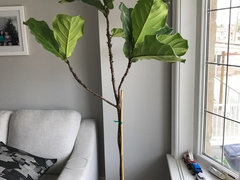
    I now have a very tall tree with 3 branches and 12 leaves on the ends - not very attractive. Can I just cut it right off at the trunk and hope new branches and leaves will grow from there?

    Any advice on how to save this tree or use it for new cuttings?? is appreciated.

    Thanks,

    Raquel

  • 9 years ago

    I'm sorry you lost leaves, but I'm sure the plant will come back strong.

    I suspect you're underwatering, though. I don't have anything in gritty mix, but 5-6 days is a really long time between watering in 1:1:1, even when it's indoors, given that people seem to water gritty mix every two of three days. It's theoretically possible to overwater it, but you really have to try hard, because it virtually eliminates a PWT. All of this assumes that you sifted the ingredients to leave little or no dust, of course.

    Note that you might need to leave a tell longer to get a good reading in gritty mix, and that it won't be stained much, if at all.

    Just to be sure, are you watering very slowly over the whole surface of the pot until 10-15% of the volume of the pot has drained out? If not you may be leaving parts of the pot dry or not getting the bottom of the pot wet at all. If watering in the living space is a problem, you can use use a large bucket with two pieces of wood laid across it to support the plants and catch drained water. If necessary, put a piece of plastic dropcloth under the bucket to protect the floor from splashes.

    Interested in hearing more...

  • 9 years ago

    Also, how big are the flying bugs? If they're little, like maybe 1/8" long, they're probably fungus gnats, although they're pretty rare in gritty mix. They usually breed in the top inch or two of the soil, though I've seen them coming from the holes in the bottom of a pot that's being overwatered.

    The common solution is to put mosquito bits or a piece of a mosquito dunk in a gallon of water overnight, then use it to waterwater thoroughly. The bits and dunks are used in ponds and pools, and you can find them in hardware stores or on Amazon.

  • 9 years ago

    Thank you for the comments.

    I did sift the mix and when I water I use a can with tiny holes to distribute the water all over the top. I place the planter on top of a large deep pot and pour a litre of water over the mix to ensure it gets thoroughly wet and let it all drain out for 14-20 minutes before putting it back on the plastic tray.

    they are definitely fungus gnats and I will try your suggestion! Thank you.