Software
Houzz Logo Print
danielinthelionsden

Graft Union Guidance


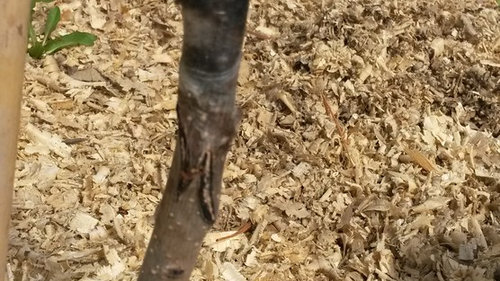
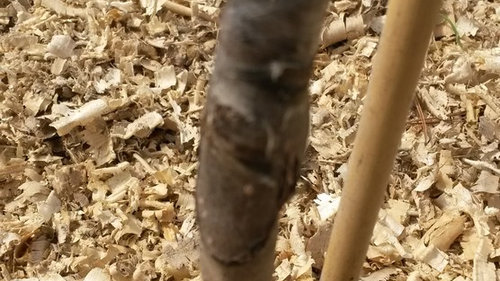
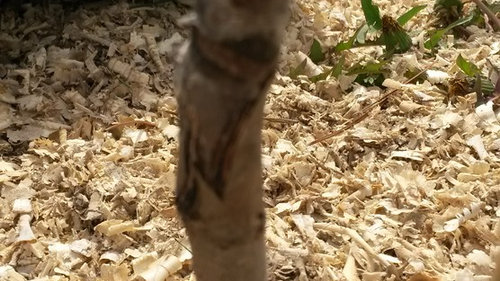
I have a young Proc American Persimmon. It was staked when it shipped last fall but I cut the ties on the stake since it seems that everyone advises against staking now. As I was removing the corrugated pipe this week that I put around it to protect from Bunnies over winter I noted that the graft union still looks pretty weak. Given the common 40 to 60 mph winds that we get during summer storms I'm wondering if this tree should still be staked to project the graft union. As you can see in the photos the stake is still there I could probably just tie it to it again. I also noted that the clear grafting tape is still on which I assume should now be removed.

You can see the very obvious union and the tape in the photos below.


Comments (18)

  • 9 years ago

    In focus pictures would be helpful.

  • 9 years ago

    lol flora .. ken

  • 9 years ago

    There are reasons to stake, and reasons not to stake. Most people here have objections that have nothing to do with this particular tree.

    You just have an odd angle at the graft. It'll likely be fine with little cause for intervention on your part. About the best you can do is put something in place to limit movement around the trunk...a tomato cage, for example, rocks of modest size surrounding the base. The stake in this case was put on to help the grafted scion grow straighter in relation to the trunk...because people like that kind of thing.

    Which has nothing to do with why folks here don't like staking.

  • 9 years ago

    I don't understand why you would graft an american persimmon in the first place. I get seedlings all of the time.

    ==>>>https://plumtreetrading.blogspot.com/2016/10/to-stake-or-not-to-stake.html

  • 9 years ago

    Well I apologize for the picture quality. They looked better on the camera. I don't think I'll be able to get new pictures right away. Maybe I can get some more soon.

    Anyway I like the idea of tomato cage. Seems like that would allow for a little movement but catch it before it could be bent to the point of breaking off the weak point at the graft.

    Regarding why you would graft American persimmon. I was really skeptical at first too. I'm pretty sure it's strictly to ensure fruitfulness. The grafted tree is guaranteed to be female, a seeding could be fruitless male.

  • 9 years ago

    Ok, that makes sense. I have never been concerned about the fruit, I just like them because they are nice, low maintenance trees.

  • 9 years ago

    Yeah I have one that's just a whatever it is and this one. Figured if we landscape with persimmon we should have at least one that has some fruit.

  • 9 years ago

    That's a whip & tongue graft with parafilm tape and does brake down over time but you can also take it off. I would still stake it.

  • 9 years ago

    Ok, I think I may go with the tomato cage approach. Seems like a reasonable transition from stake to unstaked.

  • 9 years ago
    last modified: 9 years ago

    There's staking and there's staking...

    I always like to put more than one stake, a foot out on opposite sides of tree, then use something stretchy, women's nylons work great and don't hurt the bark. Tie one end to one stake, then to the tree(well above the graft), then to the other stake. Put enough tension to the nylon so the tree can't move more than a couple inches. this allows strengthening of the trunk and still supports things during stronger winds.

  • 9 years ago

    I use the same method as bill, but with rubber bands. Being no more than usually 6 months, it doesn't hurt anything.

  • 9 years ago

    Depending on how windy your conditions can get, you can leave soft nylon on for as long as it takes. It will never hurt the tree. With a graft like yours, a year or two at least would be recommended

  • 9 years ago

    Oh, Logan... the reasons to graft a persimmon are the same for why anyone would graft any other fruiting tree cultivar... apple, pear, peach, etc.... or any ornamental selection of any other species, for that matter.

    With a graft, you are assured of what you're getting with regard to floral display, leaf color, fruit/nut size and quality, disease resistance, etc. - and, those grafted specimens will typically flower/fruit in half the time (or less) that you'd have to wait for that seedling specimen to grow through its juvenile period and achieve maturity to do what you selected it for.

    Any given batch of persimmon seedlings will be a (theoretical) 50/50 mix of fruiting females and non-fruiting males... but you'll have to wait 10 years or so to find out what you've got, and fruitfulness and quality of fruit from the females will be a genetic crapshoot. Hence, the need to graft superior fruiting selections, for those of us who like persimmons...

  • 9 years ago

    lpittman8 summed it up quite well. A catalogue came in today's mail. 'Prok' American persimmon, young grafted plants @ $29.99. "2 3/4 " diameter fruit, starts to ripen in mid-September, self-pollinating. Sounds like a good deal.

  • 9 years ago

    "lpittman8 summed it up quite well."

    Yes, he/she did. I already knew most of that, I was just confused because I didn't know that it was planted for fruit production. I have planted and sold them as shade trees. Once they gain some size harvesting of fruit without equipment (like a bucket truck) is not practical.

  • 9 years ago

    Value to wild-life might be a factor for some. I've got a young Yates American Persimmon in the backyard (leafing out now; planted last Spring as a bare root, and seems to be doing well), and had that in mind. Fruit that late into the year might be helpful for some animals.

    My main concern is if it doesn't fruit for lack of a pollinator in the future, I might need to cram a known male cultivar somewhere into the yard scape.

    Richard.

  • 9 years ago

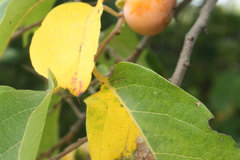
    Here is my 'Meader' from last September. This one is apparently self-fruiting also very few seed. The fruit is simply delicious.