Software
Houzz Logo Print
coriannh0uzzviolatedmyprivacy

Time to check your drip irrigation CA!

The rains have drenched us... but now it's time to check our irrigation lines... fix any drip irrigation issues... and get ready for our usual warm weather!

Who else will be fixing and adding to drip irrigation lines this weekend?

Comments (8)

  • 9 years ago

    I could see how it could depend on how long the drip lines are run, gph emitters, how often you check for problems/maintain, etc. A lot of my native plants are not on drip either. No supplemental water at all actually.... it many of them did not like all the rain we had this last year. My non-native plants love their drip irrigation! I do check it often and maintain it often though to make sure they're all getting the right amount of water.

  • 9 years ago

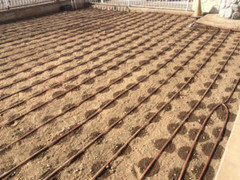
    The Theodore Payne Society, one of the premier sources of native plants and information about them in Southern CA, recently did major renovations of its buildings and grounds in Sun Valley CA. They completely redid the landscaping with, of course, CA natives. And they installed drip irrigation. But they avoided the big mistake that I made the first time I used drip, no 1/4" spaghetti tubing in sight, no single emitters targeted at individual plants. They used 17mm tubing with inline emitters laid out in a grid like this photo from the Rainbird website:

    This kind of tubing is much more robust than creating a maze of spaghetti tubes for each plant. It is less prone to clogging and can take light foot traffic if you need to step on it. If you use only inline emitters and water the ground instead of individual plants you will spend far less time trouble shooting, replacing clogged emitters and babysitting your system.

    Cori Ann - H0uzz violated my privacy thanked kentc
  • 9 years ago

    Yes, this is definitely the time of year for drip inspection. Having completely re-done the irrigation on two separate houses, I can tell you that even some professional landscapers do a terrible job of it: no pressure regulators, no filters, no shut off valves, etc. Also, I absolutely hate the concept of a single emitter per plant. I believe each plant should get at least 3 emitters so that they can develop a broader and more extensive root system. Of course, native plants that need no water are the best. I am a big fan of Netafim's drip lines with in-line emitters that are self-flushing and have pressure compensating flow rates. The one issue I have with in-line emitters is that when you are watering a bunch of plants off a single line your water usage rates will likely be higher with in-line emitters compared to running 3 emitters per plant via 1/4 inch tubing. That being said I use the in-line emitter tubing in circles around all of my trees that have a greater water requirement than individual drought tolerant flowering plants. I could talk about drip all day, even though it is one of my least favorite tasks in the garden. Well, I guess it is better than hand watering everything twice a week in the summer.

    -Brett

    Cori Ann - H0uzz violated my privacy thanked brettay
  • 9 years ago

    I have had great success converting from sprinklers to drip for mixed plantings. My favorite now is the Netafim 12mm Techline EZ. It is narrow gauge (not 17mm or 1/2') so it is easier to bend and thus no extra fittings are needed. The 12mm is enough larger than 1/4" that it won't suffer from pressure drop up to 500 feet.

    Two years ago I did a timed run (5 minutes) of each of my circuits and logged the water usage on my meter for each. I found a few issues that way with drippers that were broken but buried so I did not know. This year I can compare those numbers to see if things are still OK. It is also a good way to balance water delivery.

    Cori Ann - H0uzz violated my privacy thanked chadinlg Zone 9b Los Gatos CA
  • 9 years ago

    I really like the concept of the grid method of drip irrigation. It seems ideal for landscape areas that are planted once and expected to last without change for many years. It also seems like it would give much better coverage to the complete root zones of plants which is the main difficulty in drip systems and native plants. It also seems ideal for monoculture, or mass plantings of similar plants. The best part is that it looks like a much lower level of maintenance would be required.

    But having said all that, I am a gardener who likes variety and moves and or adds plants all the time. When I look at it, the first thing that occurs to me is that it might be quite difficult to take my shovel into that grid and expect to make changes without damaging something. Though the same or worse happens with a non-grid drip system. I was always cutting through spaghetti hose with my shovel when doing adds or changes. So the grid system, depending on the spacing of the grid, might actually be easier to make changes within, though I'm just guessing.

    Cori Ann - H0uzz violated my privacy thanked echolane
  • 9 years ago

    Echolane I thought the exact same thing. The grid seems great for some applications, but not for others.

    I am a fan of the same technique as Brettay. But that being said, I'm just a DIY woman who knows what she knows from personal experience and no professional experience at all. I have redone drip at a few different homes too. Oh my poor aching fingers! So much better to wait until it's nice and hot to make big changes to drip systems. Maybe you guys with strong hands don't have the same concern. For me... timing is everything!

    I have an area that needs an update and the grid system would be a good trial there because I don't expect any changes. That may be my first attempt with it! Or maybe I will just stick with what I know and do the circles again.

  • 9 years ago

    Spaghetti lines are a nightmare in the landscape. 1/2" drip tube is the way to go. Water the planting area not the plant. You're perennial shrubs are going to have roots extending 2-3x past the dripline where most people don't put the drippers if using 1/4". That said, if I have a regular shape where I can use mp rotators, I do because there is a lot less that can go wrong. I never had coyotes continually chew through a pvc install of mp rotators, but I sure have with drip tube.

    Cori Ann - H0uzz violated my privacy thanked Nil13 usda:10a sunset:21 LA,CA (Mount Wash.)